
Niccolò Antonio Zingarelli
Illustration — Niccolò Antonio Zingarelli Niccolò Antonio Zingarelli (nikkoˈlɔ anˈtɔːnjo ddziŋɡaˈrɛlli; 4 April 1752 – 5 May 1837) was an Italian composer, chiefly of opera during the classical period.
Also recorded as Niccolo Antonio Zingarelli
Niccolò Antonio Zingarelli
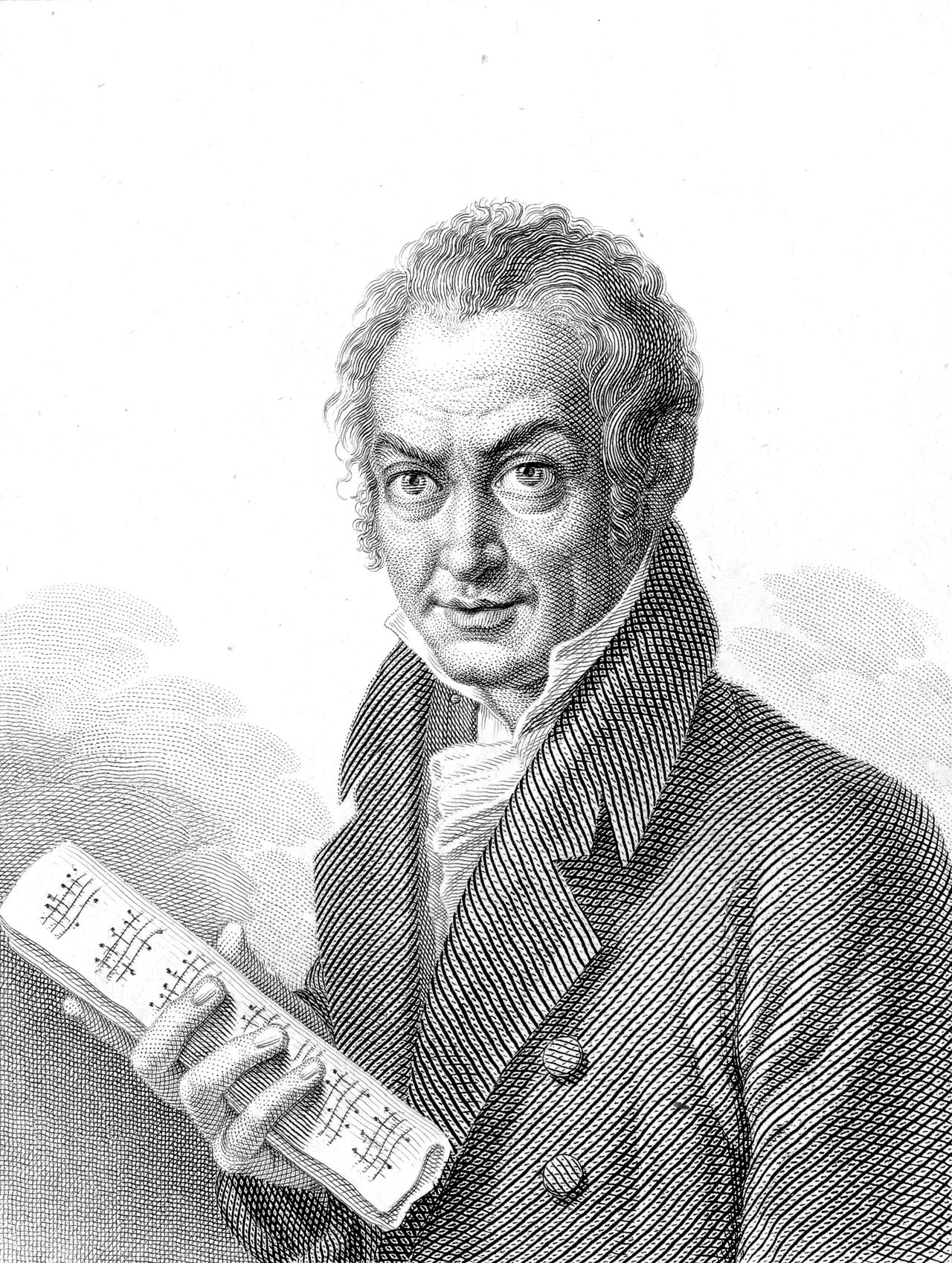
Francesco Pisante Costanzo Angelini · Bibliothèque nationale de France · Public domain
- Born
- 1752. · Naples.
- Died
- 1837. · Torre del Greco.
- Nationality
- Kingdom of Italy.
- Occupation
- composer, conductor, musicologist, organist, chapelmaster and music teacher.
- Fields
- opera.
- Teachers
- Fedele Fenaroli and Alessandro Speranza.
- Languages
- Italian.
VALÉORINE Encyclopedia
VALÉORINE documentary reading
Documentary summary
Illustration — Niccolò Antonio Zingarelli Niccolò Antonio Zingarelli (nikkoˈlɔ anˈtɔːnjo ddziŋɡaˈrɛlli; 4 April 1752 – 5 May 1837) was an Italian composer, chiefly of opera during the classical period.
Admitted source layer · organised and presented by VALÉORINE
Note VALÉORINE
Niccolò Antonio Zingarelli (1752–1837) was an Italian chapelmaster, composer and conductor, among other activities. Born in Naples, the chapelmaster died in Torre del Greco. Niccolò Antonio Zingarelli was a member of Académie des beaux-arts.
Genres include opera. Languages used include Italian.
Composed from admitted, traceable facts · 26 September 2026
VALÉORINE
Reference Check
Propose documentary evidence for Niccolò Antonio Zingarelli. A contribution is never written directly as fact: identity, source, rights and evidence gates still decide.
Sign in to contribute
World of VALÉORINE
Documentary connections
Only confirmed graph relationships appear here. Images are shown only when their identity and reuse rights both pass the documentary gate.
Documentary evidence
Evidence Panel
original value insufficient · checked 25 September 2026
- Identity
- resolved
- Independent source families
- 0
- Admitted assertions
- 0
- Open conflicts
- 0
Authority files
wikidata · Q505202 · wikipedia · Niccolò Antonio Zingarelli
In this article
Life ===== Early career =
Life ===== Early career =
Training under Fedele Fenaroli and Alessandro Speranza is recorded. Vincenzo Bellini, Saverio Mercadante and Francesco Morlacchi are recorded as having studied under Niccolò Antonio Zingarelli. The recorded working language is Italian. Subjects and genres recorded for the work are opera.
Zingarelli was born in Naples, where he studied (from the age of 7) at the Santa Maria di Loreto conservatory under Fenaroli and Speranza. In 1789–1790 Zingarelli went to Paris to compose Antigone. He left France hurriedly at the time of the revolution and eventually returned to Italy. He was appointed maestro di cappella at Milan Cathedral in 1793, and remained there until 1794, when he took up the prestigious post of maestro di cappella at the Basilica della Santa Casa, Loreto.
Rome
Rome
In 1804, Zingarelli was appointed choir master of the Sistine Chapel in Rome. Seven years later he publicly refused, as an Italian patriot, to conduct a Te Deum for Napoleon's new-born son, known as King of Rome, in St. Peter's Basilica. As a result of this refusal he was captured and taken to Paris. Nevertheless, the Emperor was a great admirer of Zingarelli's music and soon gave the composer his liberty. In addition, Zingarelli was awarded a state pension.
Naples
Naples
In 1813, Zingarelli moved to Naples, where he became director of the conservatory. Then in 1816 he replaced Giovanni Paisiello as choir master of Naples Cathedral, a position he held until his death in 1837. He died at Torre del Greco in 1837. Donizetti wrote a sinfonia funebre for his funeral.
Works ===== Opera =
Works ===== Opera =
In his early career, Zingarelli concentrated on writing opera; his debut was with the opera seria Montezuma, given at San Carlo on 13 August 1781, which aroused some interest, although the public in Naples found it too “learned”. Haydn revived it at the Eszterháza theatre in 1785. Antigone, in which Zingarelli adopted some of the reform principles of French opera, won little favour in Paris; after that he eschewed innovation and contented himself with tried and tested formulae. Zingarelli wrote 37 mainly comic operas in a prolific career. Between 1785 and 1803 he wrote mainly for La Scala of Milan, the first to be produced here being Alsinda. He achieved immediate success with Il mercato di Monfregoso and La secchia rapita. However Giulietta e Romeo is nowadays often considered his best opera. His last opera, Berenice, achieved considerable success in his lifetime after its initial production in Rome. Surviving operas include: • Montezuma (1781) • Alsinda (1785) • Ifigenia in Aulide (1787) • Artaserse (1789) • Antigone (1790) • La morte di Cesare (1790) • Pirro re di Epiro (1791) • Annibale in Torino (1792) • L'oracolo sannita (1792) • Il mercato di Monfregoso (1792) • Apelle (1793, revised as Apelle e Campaspe (1795) • Quinto Fabio (1794) • Il conte di Saldagna (1794) • Gli Orazi e i Curiazi (1795) • Giulietta e Romeo (1796) • La morte di Mitridate (1797) • Ines de Castro (1798) • Carolina e Mexicow (1798) • Meleagro (1798) • Il ritratto (1799) • Il ratto delle Sabine (1799) • Clitennestra (1800) • Edipo a Colono (1802) • Il bevitore fortunato (1803) • Berenice regina d'Armenia (1811) There are 4 doubtful works; and 17 operas were lost including: • La secchia rapita (1793) • Baldovino (1811) (libretto by Jacopo Ferretti)
Sacred music
Sacred music
Being a deeply religious Catholic, Zingarelli devoted much of his attention to masses, oratorios, cantatas, and motets. For Loreto he composed 541 works, including 28 masses. In 1829, aged 80, he wrote a Cantata Sacra, based on Isaiah chapter 12 for the Birmingham Music Festival. This was the occasion for the memorably inauspicious début of his protégé and representative Michael Costa, aged 19. The intention was that Costa should rehearse and conduct the work, but J. B Cramer and Thomas Greatorex elbowed him out and was instead engaged as a tenor soloist in another concert. Unfortunately both the work and Costa's singing met with ferocious criticism: "[This cantata] is one of the most tame, insipid things we were ever doomed to hear: a heap of common-place trash from the first to the last note. After twaddling in B-flat for half-an-hour, he ventures for a few bars into F, then returns to B, and there is an end." "As a singer [Costa] is far below mediocrity, and he does not compensate for his vocal deficiencies by his personal address, which is abundantly awkward. In the theatre while singing the air "Nel furor delle tempeste" [from Bellini's Il pirata] and accompanying himself, he had a narrow escape. The tempests proved contagious, and were beginning to manifest themselves in the galleries, and had he remained but a few moments longer on the stage, he would have witnessed a storm compared to which the roarings of his own Vesuvius would have seemed but a murmur." Less than a month before his death he produced an oratorio, The Flight into Egypt, and his requiem mass, composed for his own funeral, is said to embody his most devotional church style.
Educational works
Educational works
Zingarelli wrote two influential books of partimenti, which are the biggest corpus of partimenti after those of Fedele Fenaroli.
Life and career
Dated record
Life and career
The full dated record · 1 entries
1837
Niccolò Antonio Zingarelli died at Torre del Greco.
Places
Named by the record
Places
Only places the record itself states, plotted where the house gazetteer settles their coordinates. Nothing is inferred from a name or a nationality.
Naples.
Birth place
Torre del Greco.
Death place
Primary material
Documents and archives
reference work
- “Niccolò Antonio Zingarelli”, English Wikipedia, consulted as further reading
Reputable secondary · Wikipedia
authority record
- Wikidata, structured authority record Q505202: Niccolò Antonio Zingarelli
Unverified · Wikidata
References ==== Further reading
References ==== Further reading
* *
Notes from the source article
Cited by Wikipedia
Notes from the source article
These works are cited by the source article, in its own numbering. They are recorded as its citations, not as sources VALÉORINE has verified.
- 1.Slonimsky, Nicolas. Baker's Biographical Dictionary of Musicians. Schirmer Books. 1948–1949. 1978. 0-02-870240-9.
- 2.William Ashbrook (1983). Donizetti and His Operas. Cambridge University Press. p. 724. .
- 3.Sir Michael Costa. Born, February 4, 1810. Died, April 28, 1884. The Musical Times and Singing Class Circular. 25. 496. 321–323. 1 June 1884. 3356498.
- 4.A list may be found at :nl:Nicola Antonio Zingarelli#Missen, cantates, oratoria en gewijde muziek on the Dutch Wikipedia.
- 5.Sanguinetti, Giorgio. The Art of Partimento. Oxford University Press, USA. 86. May 2012. 978-0-19-539420-7.
Bibliography printed in the source article · 2
- Caraci, Maria. Niccolò Zingarelli tra mito e critica. Nuova rivista musicale italiana. 22. 375–422. 1988.
- Grove, George. 4.8. 508-511. 1900.
References
Citations
References
Each reference names the institution holding it, so a reader may go to the document itself.
reference work
Partially resolvedauthority record
Unverified
The Encyclopedia exists whether or not anything is for sale. Corrections are recorded rather than overwritten, and every version of this record is kept. Published 14 August 2026.
Elsewhere in Music memorabilia
42,108 published records in this field, each with its sources named.
- Nicanor AbelardoPerson
- Nicanor ZabaletaPerson
- Nicasio SafadiPerson
- Niccola SpinelliPerson
- Niccolò CastiglioniPerson
- Niccolò da PerugiaPerson
- Niccolò FabiPerson
- Niccolò JommelliPerson
Best supported in this field
For owners
Own a work by Niccolò Antonio Zingarelli?
A specialist will read what you send and tell you what the house can establish, what it cannot, and whether the object is suited to sale. There is no charge and no obligation. The object stays with you throughout; nothing is shipped to us unless it is arranged in writing beforehand.