
Newfoundland 2 dollar coin
The Newfoundland 2-dollar coin was issued in intermittent years between 1865 and 1888. It was the only circulation gold coin issued by a British colony. Although few coins were issued, it was broadly used in Newfoundland and eastern Canada.
Newfoundland 2 dollar coin
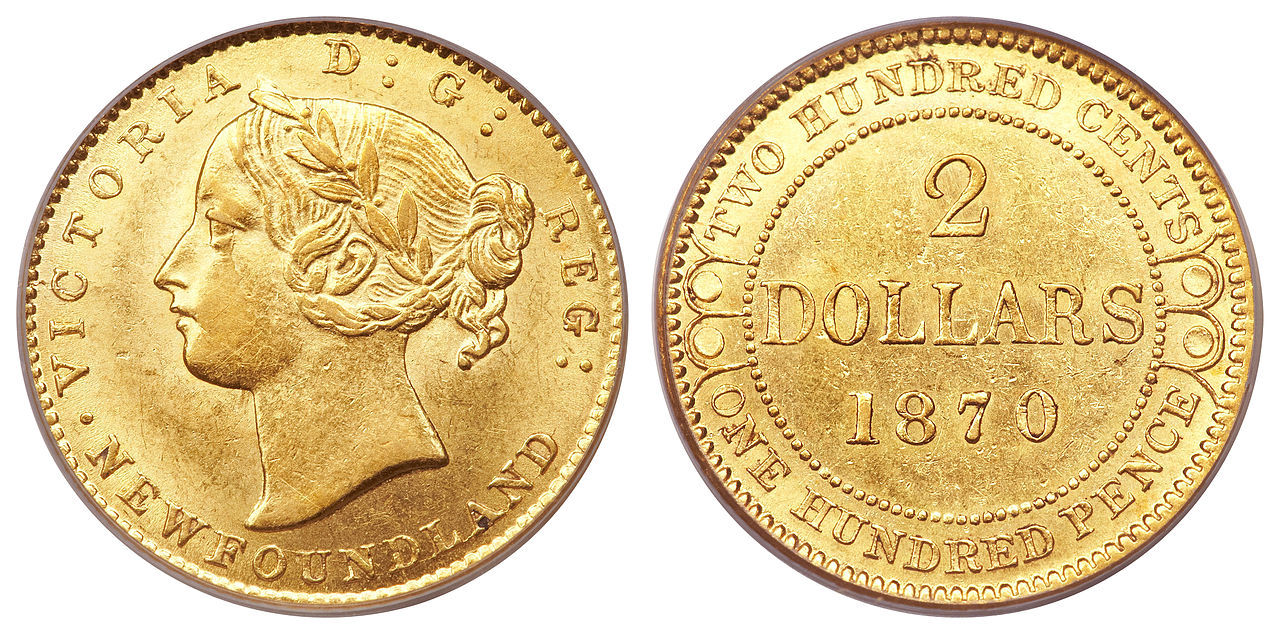
Tower Mint (UK), for Newfoundland Colony (coin) · Heritage Auctions Lot 21019, 23 April 2010 · Public domain
- Field
- coin
Reference Check
Propose documentary evidence for Newfoundland 2 dollar coin. A contribution is never written directly as fact: identity, source, rights and evidence gates still decide.
Sign in to contribute
Documentary evidence
Documentary basis
Authority files
wikidata · Q17071614 · wikipedia · Newfoundland 2-dollar coin
In this article
Overview
Overview
The coin became scarce in 1894 because of hoarding following the collapse of Newfoundland's banks and monetary system.
Key facts
Key facts
• Country — Newfoundland Colony • Denomination — Two dollars • Value — 2.00 • Unit — NFD • Mass — 3.33 • Diameter — 17.98 • Edge — Reeded • Composition — 91.7% Au, 8.3% Cu • Years Of Minting — 1865, 1870, 1872, 1880–82, 1885, 1888 • Obverse Design — Queen Victoria • Obverse Designer — Leonard Charles Wyon • Reverse Design — Geometric/inscription • Reverse Designer — Leonard Charles Wyon
Background
Background
Prior to Canadian Confederation in 1867, provinces and colonies had separate currencies. Having been a colony from its founding in 1610 until 1907, and then a dominion prior to joining Canada, Newfoundland had its own currency, the Newfoundland dollar, until 1949. Newfoundland began to issue its own decimal currency in 1865. The original plans for the new Newfoundland coinage suggested including a gold dollar. Over concerns that it would be easily lost as a result of its small size and value, the denomination of the gold coin was increased to two dollars.
History
History
Issued in various years between 1865 and 1888, few two-dollar coins were struck. The highest annual mintage was 25,000 in 1882 and 1888, while coins struck in 1880 are particularly rare because of a mintage of only 2,500. With the exception of the 1882 issue, struck at the Heaton Mint and bearing the mint mark "H", all of the coins were minted in London. Newfoundland's two-dollar coin was broadly used not only in Newfoundland, but also in Eastern Canada in general. The supply of the coins "virtually disappeared" in 1894, when Newfoundland's banks and monetary system collapsed. With paper banknotes being distrusted, the gold coins were hoarded, as well as two of the next-highest Newfoundland denominations, the silver 50-cent and 20-cent pieces.
Significance
Significance
With its two-dollar coin, Newfoundland became the only British colony to issue circulating gold coinage apart from the Sydney Mint, which issued Australian sovereigns from 1855 onwards. Gold coinage was used in Canada and other British domains. For example, in the late 18th and early 19th centuries, common gold coins included coins from Portugal, British guineas or sovereigns, French Louis d'or, American eagles, Spanish doubloons, and coins related to the eagles or doubloons. Canada issued five-dollar and ten-dollar gold coins between 1912 and 1914, which were discontinued because of World War I. At the time, Canada was a Dominion. Newfoundland's 2-dollar coin is notable in that it was issued by the colony itself, not having yet gained independence. While other contemporary British colonies (e.g. the British Raj) had gold coinage, Newfoundland was under responsible government; in the context of Canada, that resulted in Newfoundland being a self-governing colony, free to make its own decisions on internal matters, such as coinage, independently of the UK government.
Mintages
Mintages
• Date — Mintage • 1865 — 10,000 • 1870 — 10,000 • 1872 — 6,050 • 1880 — 2,500 • 1881 — 10,000 • 1882H — 25,000 • 1885 — 10,000 • 1888 — 25,000
Description
The resulting two-dollar coin had a diameter of 17.98 mm, the same as the ten-cent coin—in comparison, a modern Canadian dime has a diameter of 18.03 mm. The obverse design had Queen Victoria. There was one principal portrait of Victoria, but a different one was used in 1865 and 1870, and a third one was used in 1882 and 1888. The reverse was notable in that three equivalent denominations were indicated: 2 dollars, 200 cents, and 100 pence. The third value was the equivalent in sterling.
Text attribution
Licensing
Text attribution
Part of the biographical narrative on this page reuses licensed material. Its origin, revision and licence are recorded here.
The biographical narrative on this page is based on the Wikipedia article Newfoundland 2-dollar coin, revision 1356672950 (EN edition), by its contributors. VALÉORINE has edited that text and built its own documentary record around it. The reused material is available under CC BY-SA 4.0, and this page's reuse of it is offered under the same licence. Everything else on this page — the chronology, the holdings, the evidence, the plates and the connections — is VALÉORINE's own record. Sources and licences.
References
Citations
References
Each reference names the institution holding it, so a reader may go to the document itself.
reference work
Secondary witnessreference work
Secondary witness
The Encyclopedia exists whether or not anything is for sale. Corrections are recorded rather than overwritten, and every version of this record is kept. Published 16 August 2026.
Elsewhere in Coins
642 published records in this field, each with its sources named.
- New Zealand threepenceTerminology
- New Zealand twenty-cent coinTerminology
- New Zealand two-cent coinTerminology
- New Zealand two-dollar coinTerminology
- nickelTerminology
- Noah's Ark silver coinsTerminology
- NobleTerminology
- nomismaTerminology
Best supported in this field
For owners
Own an object connected with Newfoundland 2 dollar coin?
A specialist will read what you send and tell you what the house can establish, what it cannot, and whether the object is suited to sale. There is no charge and no obligation. The object stays with you throughout; nothing is shipped to us unless it is arranged in writing beforehand.