
Navy Cross
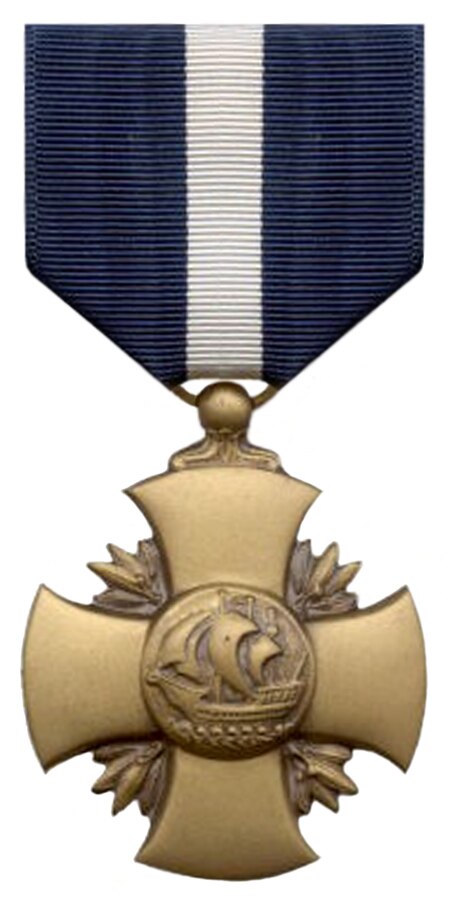
Department of Homeland Security: Homeland Security Distinguished Service Medal • Caption2 — Service ribbon The Navy Cross is the United States naval services' second-highest military decoration awarded for sailors and marines who distinguish themselves for extraordinary heroism in combat with an armed enemy force. The medal is equivalent to the Distinguished Service Cross of the United States Army, the Air Force Cross of the United States Air Force and Space Force, and the Coast Guard Cross of the United States Coast Guard; collectively, these awards are known as the "service crosses". The Navy Cross is bestowed by the secretary of the Navy and may also be awarded to members of the other armed services, and to foreign military personnel while serving with the U.S. naval services.
Navy Cross
No data / Нет данных · English Wikipedia · Public domain
- Name
- Navy Cross
- Period
- 1919
- Region
- United States
VALÉORINE Encyclopedia
VALÉORINE documentary reading
Documentary summary
Department of Homeland Security: Homeland Security Distinguished Service Medal • Caption2 — Service ribbon The Navy Cross is the United States naval services' second-highest military decoration awarded for sailors and marines who distinguish themselves for extraordinary heroism in combat with an armed enemy force. The medal is equivalent to the Distinguished Service Cross of the United States Army, the Air Force Cross of the United States Air Force and Space Force, and the Coast Guard Cross of the United States Coast Guard; collectively, these awards are known as the "service crosses". The Navy Cross is bestowed by the secretary of the Navy and may also be awarded to members of the other armed services, and to foreign military personnel while serving with the U.S. naval services.
Admitted source layer · organised and presented by VALÉORINE
Reference Check
Propose documentary evidence for Navy Cross. A contribution is never written directly as fact: identity, source, rights and evidence gates still decide.
Sign in to contribute
World of VALÉORINE
Documentary connections
Only confirmed graph relationships appear here. Images are shown only when their identity and reuse rights both pass the documentary gate.
Documentary evidence
Documentary basis
Authority files
gnd · 7615657-6 · wikidata · Q833465 · wikipedia · Navy Cross
In this article
Overview
Overview
The Navy Cross was established by Act of Congress (Public Law 65-253) and approved on February 4, 1919.
Key facts
Key facts
• Name — Navy Cross • Presenter — United States Department of the Navy • Type — Military medal Service medal • Eligibility — Marines and naval sailors of the United States • Awarded For — Extraordinary heroism in combat • Status — Currently awarded • Established — Act of Congress (Public Law 65-253), approved on February 4, 1919. • Firstawarded — 1919 • Total Awarded — c. 5,400 (as of December 2017) • Higher — Medal of Honor • Same — * Army: Distinguished Service Cross • Air and Space Forces: Air Force Cross • Coast Guard: Coast Guard Cross • Lower — Department of Defense: Defense Distinguished Service Medal
History
History
The Navy Cross was instituted in part due to the entrance of the United States into World War I. Many European nations had the custom of decorating heroes from other nations, but the Medal of Honor was the sole U.S. award for valor at the time. The Army instituted the Distinguished Service Cross and Distinguished Service Medal in 1918, while the Navy followed suit in 1919, retroactive to 6 April 1917. Originally, the Navy Cross was lower in precedence than the Medal of Honor and the Navy Distinguished Service Medal, because it was awarded for both combat heroism and for "other distinguished service". Congress revised this on 7 August 1942, making the Navy Cross a combat-only decoration that follows the Medal of Honor in order of precedence. Since the medal was established, it has been awarded more than 6,300 times. It was designed by James Earle Fraser. Since the September 11 attacks the Navy Cross has been awarded 47 times, with two having the name of the recipient held in secret. One of those secret awardings was due to Marine Gunnery Sergeant Tate Jolly's actions during the 2012 Benghazi attack.
Criteria
Criteria
The Navy Cross may be awarded to any member of the U.S. Armed Forces while serving with the Navy, Marine Corps, or Coast Guard (when a part of the Department of the Navy) who distinguishes themselves in action by extraordinary heroism not justifying an award of the Medal of Honor. The action must take place under one of three circumstances: • In combat action while engaged against an enemy of the United States; or, • In combat action while engaged in military operations involving conflict with an opposing foreign force; or, • In combat action while serving with friendly foreign forces, who are engaged in armed conflict in which the United States is not a belligerent party. The act(s) to be commended must be performed in the presence of great danger, or at great personal risk, and must be performed in such a manner as to render the individual's action(s) highly conspicuous among others of equal grade, rate, experience, or position of responsibility. An accumulation of minor acts of heroism does not justify an award of the Navy Cross. As originally authorized, the Navy Cross could be awarded for distinguished non-combat acts, but legislation of 7 August 1942 limited the award to acts of combat heroism. Past Navy Cross awards for merit, such as to 9th Chief of Naval Operations Fleet Admiral Ernest King, were unaffected by the change in criteria.
Wear
Wear
The Navy Cross originally was the Navy's third-highest decoration, after the Medal of Honor and the Navy Distinguished Service Medal. On 7 August 1942, Congress revised the order of precedence, placing the Navy Cross above the Distinguished Service Medal in precedence. Since that time, the Navy Cross has been worn after the Medal of Honor and before all other awards. Additional awards of the Navy Cross are denoted by gold or silver inch stars affixed to the suspension and service ribbon of the medal. A gold star would be issued for each of the second through fifth awards, to be replaced by a silver star which would indicate a sixth award. To date no one has received more than five awards.
Symbolism
Symbolism
The vessel depicted on the obverse is a symbolic caravel of the type used between 1480 and 1500. Designer James Earle Fraser selected the caravel because it was a symbol often used by the Naval Academy and because it represented both naval service and the tradition of the sea. The laurel leaves with berries refer to achievement. On the service ribbon, the blue alludes to naval service; the white represents the purity of selflessness.
Recipients of Five Navy Crosses
Recipients of Four Navy Crosses
Submarine Service
Submarine Service
• Bernard A. Clarey: Recognized for three distinct patrols of extraordinary heroism. • Richard H. O’Kane: Commander of the Tang; Medal of Honor recipient. • William H. Brockman Jr.: Awarded for his leadership during the Battle of Midway and subsequent patrols. • Creed Burlingame: Commander of the Silversides during three highly successful war patrols. • Frank Wesley Fenno Jr.: Awarded three Navy Crosses, including for his command of the Trout.
Naval Aviation
Surface Warfare and Marine Corps
Surface Warfare and Marine Corps
• Evans F. Carlson: Leader of the famed "Carlson's Raiders." • William A. Lee: A key figure in the Marine Corps, recognized for heroism in multiple actions. • Harold C. Roberts: Distinguished Marine officer across three conflicts. • Frederick C. Sherman: Admiral and carrier commander at the Battle of the Coral Sea.
United States Navy
United States Marine Corps
United States Marine Corps
• Robert H. Barrow (also an Army Distinguished Service Cross (DSC)) • John Basilone (also a Medal of Honor (MOH)), namesake of John Basilone • Victor Bleasdale (two awards and an Army DSC) • John F. Bolt • Gregory "Pappy" Boyington (also an MOH) • Martin Brandtner (two awards) • William Perry Brown Jr. (two awards) • James Carson Breckinridge • Marion Eugene Carl (two awards) • Evans Carlson (three awards) • Clifton B. Cates (also two Army DSCs) • Brian Chontosh • George R. Christmas • Julius Cogswell, (also an Army DSC) • Andrew F. Cook Jr., namesake of Cook • Dallas H. Cook, namesake of Cook • Alfred A. Cunningham • William H. Dabney • Joseph W. Dailey • Daniel Daly (also two MOHs and an Army DSC) • Ray Davis (also an MOH) • James Devereux • William A. Eddy • Merritt A. Edson (two awards and an MOH) • John W. Frederick Jr., (Vietnam War POW) • Raymond Frybarger Jr., namesake of Frybarger • Guy Gabaldon • Patrick “Bob” Gallagher, namesake of Patrick Gallagher • Roy Geiger (two awards) • Herman H. Hanneken (two awards and an MOH) • Robert M. Hanson (also an MOH) • Myron Harrington Jr. • Leo D. Hermle (also an Army DSC) • Thomas Holcomb • Edward Buist Hope, (also an Army DSC) • Henry L. Hulbert (also an MOH and an Army DSC) • George Victor Jmaeff • Bradley Kasal • Treddy Ketcham • Victor H. Krulak • Henry Louis Larsen (two awards) • Kurt Chew-Een Lee • Justin LeHew • William K. MacNulty • Victor Maghakian • William Edward Campbell March • Karl Marlantes • Pete McCloskey • John McNulty (U.S. Marine Corps) (also an Army DSC) • Angel Mendez • Raymond Murray (two awards and an Army DSC) • Peter J. Ortiz (two awards) • Rafael Peralta • Edwin A. Pollock • Lewis "Chesty" Puller, (five awards and an Army DSC) • Paul A. Putnam • John H. Quick (also an MOH and an Army DSC) • Kenneth L. Reusser (two awards) • John Ripley • Harold C. Roberts (three awards) • Ford O. Rogers • James Roosevelt • William H. Rupertus • John H. Russell Jr. • Al Schmid • Harry Schmidt • Harold G. Schrier • Lemuel C. Shepherd Jr. (also an Army DSC) • Robert Taplett • Alexander Vandegrift (also an MOH) • Lew Walt (two awards) • Jim Webb • John H. Yancey (two awards) • George Yarborough, namesake of Yarborough • Jeremiah Workman
United States Army
United States Army
• Stephen J. Chamberlin • Rex T. Barber • Thomas George Lanphier Jr. • John W. Mitchell • John U.D. Page
United States Coast Guard
United States Coast Guard
• Frederick C. Billard • Raymond Evans • Elmer Fowler Stone • Philip F. Roach • Quentin R. Walsh
Non-U.S. recipients
Non-U.S. recipients
• Nikolai Basistiy, Soviet Union (Soviet Navy, 1943) • Gordon Bridson, New Zealand (Royal New Zealand Navy, 1943) • Campbell Howard Buchanan, New Zealand (Royal New Zealand Navy, 1943) • Ernesto Burzagli, Italy (Royal Italian Navy, 1919) • Harold Farncomb, Australia (Royal Australian Navy, 1945) • Israel Fisanovich, Soviet Union (Soviet Navy, 1944) • Donald Gilbert Kennedy, New Zealand (British Solomon Islands Protectorate Defence Force, 1945) • Seizō Kobayashi, Japan (Imperial Japanese Navy, 1921; 1925) • Émile Henry Muselier, France (Free French Naval Forces, 1919) • Peter Phipps, New Zealand (Royal New Zealand Navy, 1943) • Ronald Niel Stuart, first Royal Navy officer to receive both the American Navy Cross and the British Victoria Cross (Royal Navy, 1927) • Ivan Travkin, Soviet Union (Soviet Navy, 1942) • Tran Van Bay, South Vietnam (Army of the Republic of Vietnam, 1967) • Nguyen Van Kiet, South Vietnam (Republic of Vietnam Navy, 1972) • Mikhail Vasilyevich Greshilov, Soviet Union (Soviet Navy, 1944)
Identity
Identity
Navy Cross is recorded from 1919.
Chronology
Dated record
Chronology
Explore 1919–2012
The full dated record · 3 entries
1919
Navy Cross first recorded.
1919
Navy Cross is recorded from 1919.
2012
Dorie Miller receives the Navy Cross for bravery at Pearl Harbor, May, 27, 1942, Pearl Harbor digitised by DataCite (University of Southern California Digital Library (USC.DL)).
Places
Named by the record
Places
Only places the record itself states, plotted where the house gazetteer settles their coordinates. Nothing is inferred from a name or a nationality.
- United States
Description
• Medal Obverse: The medal is a modified cross pattée one and a half inches wide. The ends of its arms are rounded whereas a conventional cross patée has arms that are straight on the end. There are four laurel leaves with berries in each of the re-entrant arms of the cross. In the center of the cross, a sailing vessel is depicted on waves, sailing to the viewer's left. Reverse: In the center of the medal, a bronze cross pattée, one and a half inches wide, are crossed anchors from the pre-1850 period, with cables attached. The letters USN are evident amid the anchors. The earliest version of the Navy Cross (1919–1928) featured a more narrow strip of white, while the so-called "Black Widow" medals awarded from 1941 to 1942 were notable for the dark color due to over-anodized finish. The medal is similar in appearance to the British Distinguished Service Cross. • Service Ribbon The service ribbon is navy blue with a center stripe of white identical to the suspension ribbon of the medal.
Primary material
Documents and archives
reference work
- Wikidata, structured authority record Q833465: Navy Cross
Reputable secondary · Wikidata
- “Navy Cross”, English Wikipedia, consulted as further reading
Reputable secondary · Wikipedia
authority file
- Gemeinsame Normdatei 7615657-6, Navy Cross.
General reference · Deutsche Nationalbibliothek
Literature
Scholarly footprint
A count of publications is evidence of attention, not of standing, and is given here only as a measure.
Citations
References
Each reference names the institution holding it, so a reader may go to the document itself.
authority file
Gemeinsame Normdatei 7615657-6, Navy Cross.Deutsche Nationalbibliothek
Secondary witnessreference work
Secondary witnessreference work
Secondary witness
The Encyclopedia exists whether or not anything is for sale. Corrections are recorded rather than overwritten, and every version of this record is kept. Published 16 August 2026.
Elsewhere in Medals
1,069 published records in this field, each with its sources named.
- Navy and Marine Corps Commendation MedalTerminology
- Navy and Marine Corps MedalTerminology
- Navy Civilian Service Achievement MedalTerminology
- Navy Civilian Service Commendation MedalTerminology
- Navy Distinguished Service MedalTerminology
- Navy Expeditionary MedalTerminology
- Navy Gallantry CrossTerminology
- Navy Meritorious Civilian Service AwardTerminology
Best supported in this field
For owners
Own an object connected with Navy Cross?
A specialist will read what you send and tell you what the house can establish, what it cannot, and whether the object is suited to sale. There is no charge and no obligation. The object stays with you throughout; nothing is shipped to us unless it is arranged in writing beforehand.