
Mykola Ivasiuk
Illustration — Self-portrait (1887) Mykola Ivanovych Ivasyuk (Ukrainian: Мико́ла Іва́нович Івасю́к: 28 July 1865, Zastavna, Duchy of Bukovina — 25 November 1937, Kyiv) was a Ukrainian realist painter from Bukovina. He specialized in history painting, but is also known for his postage stamp designs. After moving to Soviet Ukraine during the 1920s, Ivasyuk became a victim of political repressions and was executed during the Great Purge.
Also recorded as Mykola Ivanovych Ivasyuk
Mykola Ivasiuk
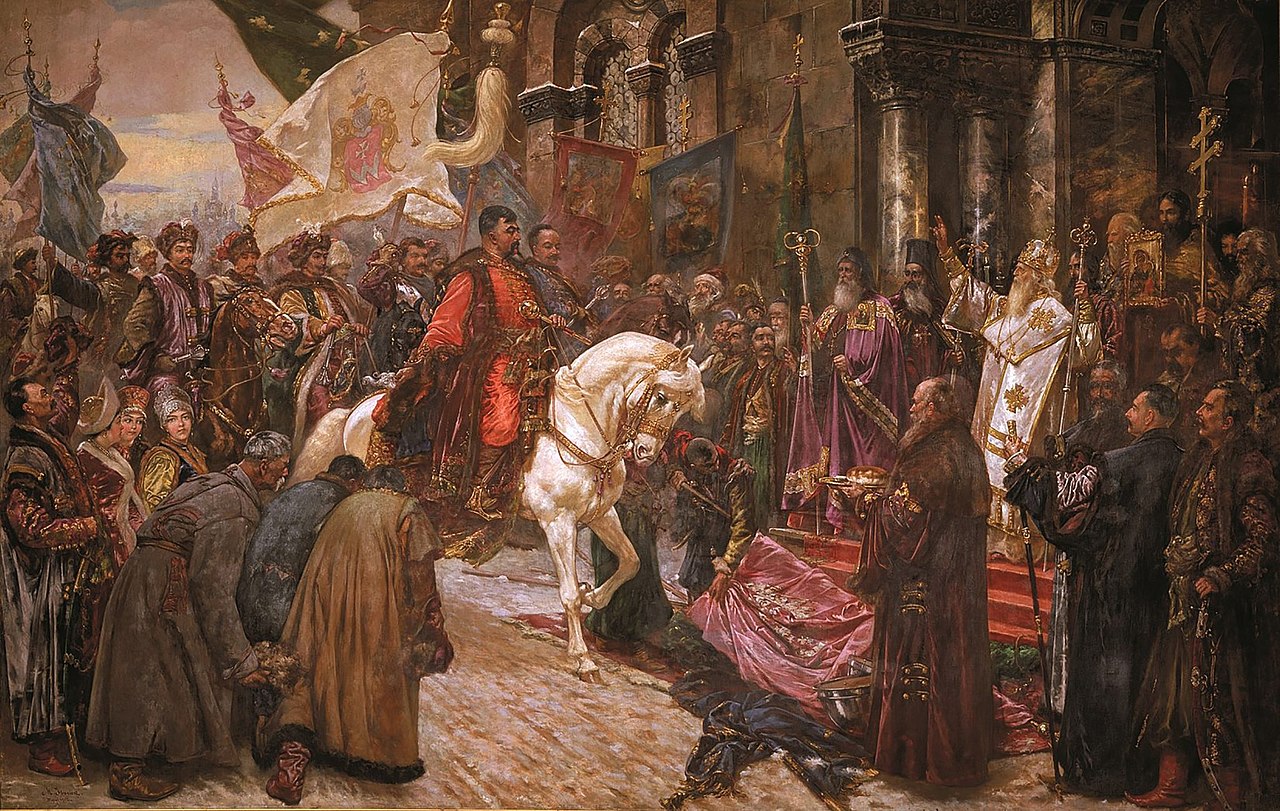
Mykola Ivasiuk · Козаччина зимова. Тріумфальний в’ізд Богдана Хмельницького до Києва. Картина та подія Громадська організація «Департамент воєнно-культурної антропології» · Public domain
- Born
- 1865. · Zastavna.
- Died
- 1937. · Kyiv.
- Nationality
- Austrian Empire.
- Occupation
- painter and artist.
- Education
- Academy of Fine Arts Vienna, Academy of Fine Arts and Munich.
- Languages
- Russian.
VALÉORINE Encyclopedia
VALÉORINE documentary reading
Documentary summary
Illustration — Self-portrait (1887) Mykola Ivanovych Ivasyuk (Ukrainian: Мико́ла Іва́нович Івасю́к: 28 July 1865, Zastavna, Duchy of Bukovina — 25 November 1937, Kyiv) was a Ukrainian realist painter from Bukovina. He specialized in history painting, but is also known for his postage stamp designs. After moving to Soviet Ukraine during the 1920s, Ivasyuk became a victim of political repressions and was executed during the Great Purge.
Admitted source layer · organised and presented by VALÉORINE
Reference Check
Propose documentary evidence for Mykola Ivasiuk. A contribution is never written directly as fact: identity, source, rights and evidence gates still decide.
Sign in to contribute
World of VALÉORINE
Documentary connections
Only confirmed graph relationships appear here. Images are shown only when their identity and reuse rights both pass the documentary gate.

Documentary evidence
Documentary basis
Authority files
wikidata · Q4196954
In this article
Biography
Biography
Mykola Ivasiuk studied at Academy of Fine Arts Vienna and Academy of Fine Arts, Munich. Korneliy Dzerzhyk and Panteleimon Vydynivskyi are recorded as having studied under Mykola Ivasiuk. The recorded working language is Russian. Work by Mykola Ivasiuk is recorded in the collections of National Art Museum of Ukraine.
His father was a carpenter. At the time of his birth, Zastavna, Duchy of Bukovina was part of Austrian Empire, which became the Austro-Hungarian Empire two years later. Due to this his primary education was conducted in German and Romanian. For his secondary studies, he went to Chernivtsi. One of his instructors there was the Ukrainian artist Yustyn Pigulyak, who discovered and encouraged his talent for art by giving him free lessons. Before long, he had decided to become a history painter. In 1884, he was able to gain admission to the Academy of Fine Arts, Vienna. While there, he participated in student excursions to the Ternopil region, where he became acquainted with the nobleman, Volodyslav Fyodorovych and painted portraits of his family. After graduating, he was recommended to the Academy of Fine Arts, Munich, to complete his education. While there, he met the Russian artist, Ilya Repin, who advised him to establish himself in Kyiv. • Illustration — The board and members of the Shevchenko Scientific Society celebrating the 100th anniversary of the publication of Ivan Kotliarevsky's Eneida, Lviv, 31 October 1898: Sitting in the first row: Mykhaylo Pavlyk, Yevheniya Yaroshynska, Natalia Kobrynska, Olha Kobylianska, Sylvester Lepky, Andriy Chaykovsky, Kost Pankivsky. In the second row: Ivan Kopach, Volodymyr Hnatiuk, Osyp Makovej, Mykhailo Hrushevsky, Ivan Franko, Oleksander Kolessa, Bohdan Lepky. Standing in the third row: Ivan Petrushevych, Filaret Kolessa, Yossyp Kyshakevych, Ivan Trush, Denys Lukianovych, Mykola Ivasyuk. He held his first exhibition in Chernivtsi, where he displayed genre works as well as historical scenes. In 1899, he established a school there for "talented but poor youth", which he operated until 1908, when he took Repin's advice about Kyiv. Just prior to World War I, however, the government of Bukovina offered him the sum of 1000 Crowns to establish another art school in Chernivtsi, so he returned. He also opened a workshop for icon painting. It was there that he executed his most famous work; "The Entrance of Bohdan Khmelnytsky to Kyiv in 1649", a reproduction of which was once a common sight in Ukrainian homes. As a supporter of Ukrainian independence, he created many similar paintings, but most of them were lost years later when he once again went to Kyiv. • Illustration — ₴60 postage stamp In 1919, the Directorate of Ukraine commissioned him to design postage stamps for the Ukrainian People's Republic. He produced fourteen designs altogether and they were printed in 1921 but, shortly after, the Soviets took control of Ukraine and they were never used. In 1926 Vlas Chubar, Chairman of the People's Commissariat of Ukraine, invited him and his student, Evzebiy Lipetskiy, to become professors at the Kyiv Art Institute. Lipetskiy was wary of the Soviets and refused the offer; advising Ivasyuk to do the same. He accepted, however, and moved his family there the same year. They were immediately granted Soviet citizenship. At first, he was honored and praised but soon, following instructions from Moscow, he began to be criticized; initially for small things, then for more serious matters. Eventually, he was transferred to Odessa, where he came under harsh criticism for "bourgeois deviations". Finally, it was forbidden to mention his name. In September, 1937, the NKVD conducted a search of his apartment and found nothing incriminating. He was arrested, nevertheless, and taken to Lukyanivska Prison. The following month, he was formally accused of being a terrorist and an agent of German intelligence. He refused to confess. In November, he was convicted and, eleven days later, executed by firing squad. All of his personal property was confiscated and destroyed. His remains were returned to Bukovina. He was rehabilitated in 1980.
Life and career
Dated record
Life and career
The full dated record · 2 entries
1865
Mykola Ivasiuk born at Zastavna.
1937
Mykola Ivasiuk died at Kyiv.
Places
Named by the record
Places
Only places the record itself states, plotted where the house gazetteer settles their coordinates. Nothing is inferred from a name or a nationality.
Zastavna.
Birth place
Kyiv.
Death place
Selected paintings
• Illustration — Bohdan Khmelnytsky in Battle • Illustration — The Kiss • Illustration — The Entrance of Bohdan Khmelnytsky to Kyiv in 1649 • Illustration — The Mother • Illustration — Ivan Bohun at the Battle of Beresteczko

Микола Івасюк
Stanisław Janowski (1866-1942) · http: versii.cv.ua/new/mistetski-detektivi-vid-tetyani-dugayevoyi/28351.html

Микола Івасюк. Кубанський козак у Львові.
Mykola Ivasiuk · Goldens Auction House
References
Citations
References
Each reference names the institution holding it, so a reader may go to the document itself.
authority record
Secondary witness
Further particulars
Held on the record
Further particulars
Open the remaining particulars
Mykola Ivasiuk studied at Academy of Fine Arts Vienna and Academy of Fine Arts, Munich. Each of those relationships is stated by the authority record rather than inferred from style.
Mykola Ivasiuk is connected to 1 other published record in the VALÉORINE Encyclopedia.
Within the Encyclopedia
The Encyclopedia exists whether or not anything is for sale. Corrections are recorded rather than overwritten, and every version of this record is kept. Published 18 August 2026.
Elsewhere in Paintings
19,397 published records in this field, each with its sources named.
- Mykhaylo KhmelkoArtist
- Mykola BurachekArtist
- Mykola HlushchenkoArtist
- Mykola Ivanovych TseluikoArtist
- Mykola MurashkoArtist
- Mykola NedilkoArtist
- Mykola PymonenkoArtist
- Mykola ShevchukArtist
Best supported in this field
For owners
Own a work by Mykola Ivasiuk?
A specialist will read what you send and tell you what the house can establish, what it cannot, and whether the object is suited to sale. There is no charge and no obligation. The object stays with you throughout; nothing is shipped to us unless it is arranged in writing beforehand.