
Mykhailo Parashchuk
Mikhailo Parashchuk (16 November 1878 – 24 December 1963) was a Ukrainian sculptor who was active in Bulgaria from 1921 to his death in 1963 in Karlovo. Posthumously awarded the highest honor for Bulgarian culture: Order of Saints Cyril and Methodius.
Also recorded as Mikhailo Parashchuk · Mykhaylo Parashchuk
Mykhailo Parashchuk

Ikar.us · CC BY 3.0 de
- Born
- 1878 · Varvaryntsi.
- Died
- 1963 · Banya.
- Occupation
- architect · sculptor
- Fields
- art of sculpture
- Education
- Academy of Fine Arts Vienna
- Teachers
- Auguste Rodin
- Languages
- Ukrainian
VALÉORINE Encyclopedia
VALÉORINE documentary reading
Documentary summary
Mikhailo Parashchuk (16 November 1878 – 24 December 1963) was a Ukrainian sculptor who was active in Bulgaria from 1921 to his death in 1963 in Karlovo. Posthumously awarded the highest honor for Bulgarian culture: Order of Saints Cyril and Methodius.
Admitted source layer · organised and presented by VALÉORINE
Reference Check
Propose documentary evidence for Mykhailo Parashchuk. A contribution is never written directly as fact: identity, source, rights and evidence gates still decide.
Sign in to contribute
World of VALÉORINE
Documentary connections
Only confirmed graph relationships appear here. Images are shown only when their identity and reuse rights both pass the documentary gate.

Documentary evidence
Documentary basis
Authority files
wikidata · Q6849793 · wikipedia · Mykhailo Parashchuk
In this article
Biography
Biography
Mykhailo Parashchuk studied at Academy of Fine Arts Vienna. Training under Auguste Rodin is recorded. The recorded working language is Ukrainian. The field of work recorded is art of sculpture. Places of work recorded in the authority are Lviv and Sofia. Employment is recorded with Academy of Fine Arts, Munich.
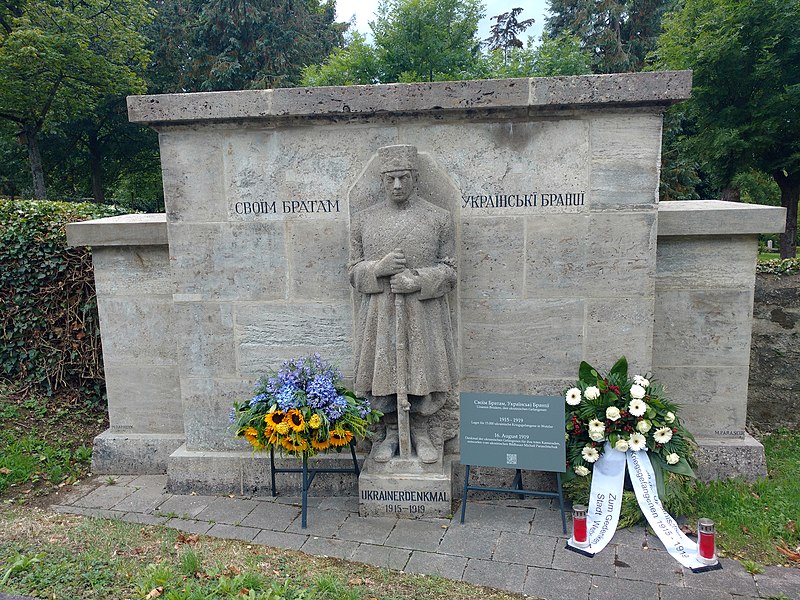
Denkmal zum Gedenken der Opfer des 1. Weltkriegs im Ukrainerlager Büblingshausen bei Wetzlar
August Deitemeier
Key facts
Key facts
• Title — Royal Order of Saints Cyril and Methodius Царски Орден на Кирил и Методий • Caption2 — The ribbon of the Order • Grades — Knight • Date — 18 May 1909 1909 - 1946 (National Order) 1946 - present (House Order) • House — House of Saxe-Coburg-Gotha-Koháry • Religion — Bulgarian Orthodox • Ribbon — Light Orange.
Early life
Early life
Parashchuk was born in Varvaryntsi in Ternopil Oblast (then in Galicia, Austria-Hungary, today in Ukraine). He enrolled in the Academy of Fine Arts Vienna, but graduated from the Julien Academy in Paris, France in 1910; in France, he was reportedly a student of Auguste Rodin. Before his graduation, Parashchuk worked in Lviv on monuments to noted Ukrainian writers.
Life in Bulgaria
Life in Bulgaria
As a lecturer at the Academy of Fine Arts Munich, he was introduced to several Bulgarian artists and actors. During World War I, Parashchuk was a member of the Red Cross and organized an art workshop for Russian Army prisoners of war. Parashchuk arrived in Sofia in 1921 as an International Red Cross volunteer. In the Bulgarian capital, Parashchuk was a very popular sculptor who contributed to the decoration of many major public buildings. Projects that Parashchuk executed include the ornamental frames of the Sofia Court House gates, the Bulgarian National Bank lion decorations and zodiac clock, history-related reliefs in the Rakovski Defence and Staff College, the facade decoration of the SS. Cyril and Methodius National Library, the interior of the Ministry of War and the geometric decoration of the Sofia University rectorate. • Illustration — Aula of Sofia University in the Rectorate, the university main building Outside the capital, Parashchuk created the sculptural decoration of buildings in Pernik, Velingrad, Kardzhali, Varna, Provadia and Sapareva Banya, as well as the Giurgiu-Rousse Friendship Bridge. Besides working in building decoration, Parashchuk was also engaged in sculpting busts and bas-reliefs of noted Bulgarians, including Vasil Levski, Peyo Yavorov, Gotse Delchev, Stefan Karadzha, Dimitar Blagoev, Hristo Botev and Aleko Konstantinov.
Difficulties with Soviet government
Difficulties with Soviet government
Despite his popularity, Parashchuk was twice expelled from the Union of Bulgarian Artists in the 1940s and 1950s because he was accused of being a fascist, western spy or White Russian, although before World War II he was slandered as a "Bolshevik agent" and "Comintern member". It was not until 1963 that he was readmitted to the union after his second expulsion. Parashchuk was one of the leaders of the Ukrainian emigrants in Bulgaria: he was among the founders of the Ukrainian–Bulgarian Association and the Hromada Ukrainian cultural and educational associations. Mikhaylo Parashchuk was married to Tsvetana Pekareva, the daughter of prominent agrarian politician and early BANU activist Yurdan Pekarev, mayor of Varna, Bulgaria in 1921. Reports point to the place of his death in Karlovo, though the most detailed biographies insist he died in Banya near Karlovo.
Resting place
Resting place
Parashchuk was buried in Sofia and his grave is decorated by a bust of the sculptor and a lion created by noted Bulgarian sculptor Vezhdi Rashidov.
Places
Named by the record
Places
Only places the record itself states, plotted where the house gazetteer settles their coordinates. Nothing is inferred from a name or a nationality.
Varvaryntsi.
Birth place
Banya.
Death place
Celebrating his legacy
An exhibition called "Strokes from the work of Mikhailo Parashchuk in Bulgaria" opened in the Sliven Art Gallery in 2024. The author of the exhibition is Ukrainian Yulia Krasovska, a member of the Society of Burgas Artists since 2016.
Primary material
Documents and archives
authority record
- Wikidata, structured authority record Q6849793: Mykhailo Parashchuk
General reference · Wikidata
reference work
- “Mykhailo Parashchuk”, English Wikipedia, consulted as further reading
Reputable secondary · Wikipedia
Notes from the source article
Cited by Wikipedia
Notes from the source article
These works are cited by the source article, in its own numbering. They are recorded as its citations, not as sources VALÉORINE has verified.
- 1.Order of St. Cyril and Methodius Apostles - official website of H.M. Simeon II
- 2.Жукивский, Васил. Един ваятел на парадното стълбище. Български войн. 2005.
- 3.Ценкова, Искра. Клишета и оригинали. ТЕМА. 2006.
- 4.Жукивский, Васил. Кой е украинецът Михайло Парашчук?. Украински вести.
- 5.Аврамов, Богомил. Куо вадис Варна?. Океан Прес. 1997.
- 6.Sliven Art Gallery. ЩРИХИ ОТ ТВОРЧЕСТВОТО НА МИХАЙЛО ПАРАШЧУК В БЪЛГАРИЯ. 2024-08-12.
- 7.Bulgarian Telegraph Agency. Exhibition on Mikhailo Parashchuk to Open in Sliven on September 12. 2024-09-02.
- 8.Украински вести. На паметника на Парашчук отново има бюст и лъв. 2009-04-29.
References
Citations
References
Each reference names the institution holding it, so a reader may go to the document itself.
authority record
Secondary witnessreference work
Secondary witness
The Encyclopedia exists whether or not anything is for sale. Corrections are recorded rather than overwritten, and every version of this record is kept. Published 16 August 2026.
Elsewhere in Sculpture
6,174 published records in this field, each with its sources named.
- Murray FavroArtist
- Mustafa ManwarArtist
- MV Ramana ReddyArtist
- Mykhailo DzyndraArtist
- Mykola MalyshkoArtist
- Mykola MarchenkoArtist
- Mykola ShmatkoArtist
- Myla DalbesioArtist
Best supported in this field
For owners
Own a work by Mykhailo Parashchuk?
A specialist will read what you send and tell you what the house can establish, what it cannot, and whether the object is suited to sale. There is no charge and no obligation. The object stays with you throughout; nothing is shipped to us unless it is arranged in writing beforehand.