
Muammar Gaddafi
Muammar Muhammad Abu Minyar al-Gaddafi (c. 1942 – 20 October 2011) was a Libyan military officer, revolutionary, politician, and political theorist who ruled Libya as a dictator from 1969 until his overthrow by Libyan rebel forces in 2011 during the First Libyan Civil War. He came to power through a bloodless military coup, first becoming Revolutionary Chairman of the Libyan Arab Republic from 1969 to 1977, Secretary General of the General People's Congress from 1977 to 1979, and then the Brotherly Leader of the Great Socialist People's Libyan Arab Jamahiriya from 1979 to 2011.
Also recorded as Colonel Gaddafi · Muammar Mohammed Abu Minyar Gaddafi · Muʿammar al-Gaddafi · Muʿammar al-Qaddafi
Muammar Gaddafi
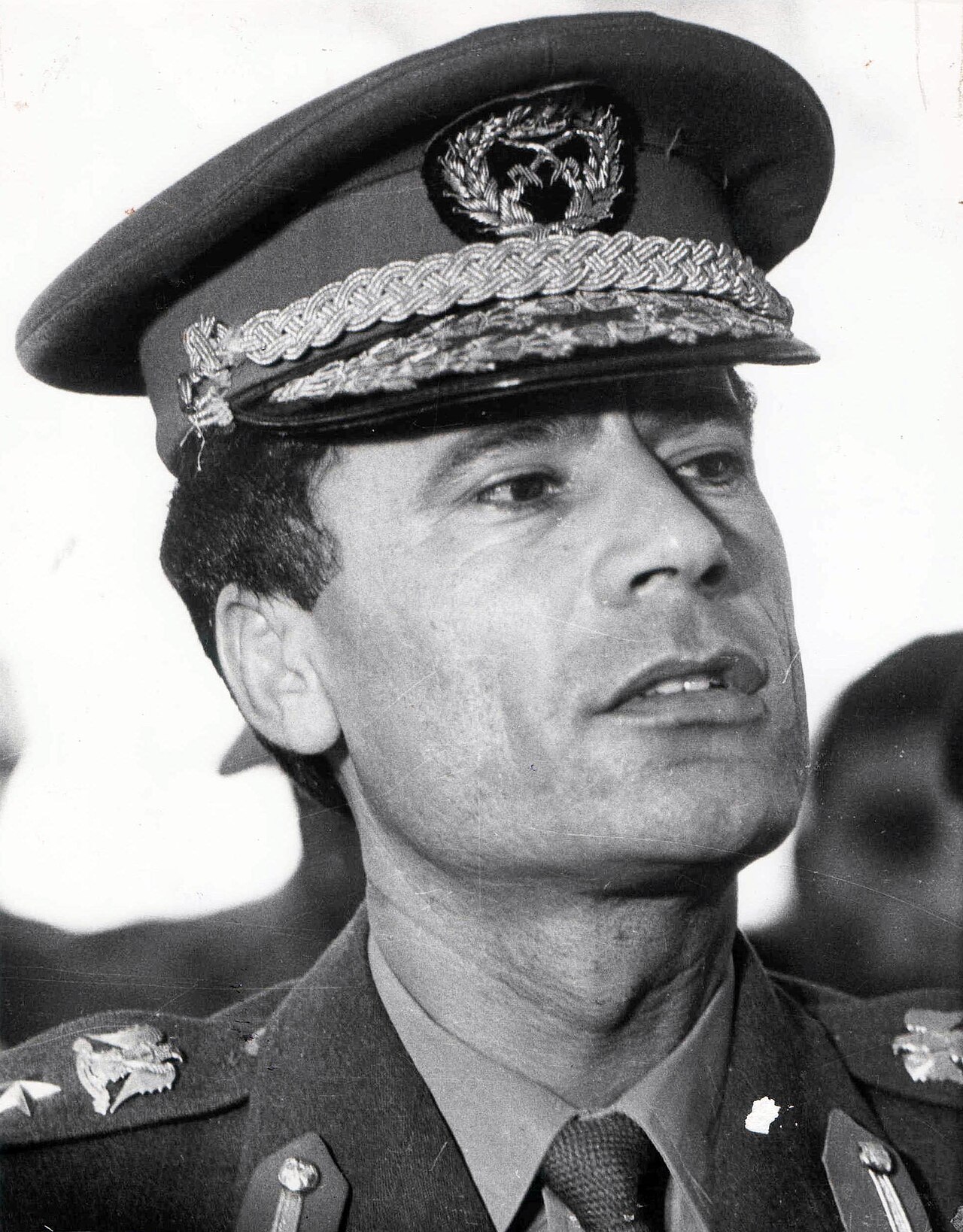
Stevan Kragujević · CC BY-SA 3.0
- Born
- about 1942.
- Nationality
- Kingdom of Libya, Libyan Arab Republic and Great Socialist People's Libyan Arab Jamahiriya.
- Occupation
- politician, writer and military officer.
- Movements
- Pan-Arabism, Anticolonialism, Arab nationalism, Third International Theory and Nasserism.
- Known for
- The Green Book and Third International Theory.
VALÉORINE Encyclopedia
VALÉORINE documentary reading
Documentary summary
Muammar Muhammad Abu Minyar al-Gaddafi (c. 1942 – 20 October 2011) was a Libyan military officer, revolutionary, politician, and political theorist who ruled Libya as a dictator from 1969 until his overthrow by Libyan rebel forces in 2011 during the First Libyan Civil War. He came to power through a bloodless military coup, first becoming Revolutionary Chairman of the Libyan Arab Republic from 1969 to 1977, Secretary General of the General People's Congress from 1977 to 1979, and then the Brotherly Leader of the Great Socialist People's Libyan Arab Jamahiriya from 1979 to 2011.
Admitted source layer · organised and presented by VALÉORINE
Note VALÉORINE
No house-authored Note is published until its assertions and sources pass the VALÉORINE evidence contract. The documentary article remains available in full while that enrichment is being consolidated.
Documentary enrichment in progress · no unsupported statement published
Reference Check
Propose documentary evidence for Muammar Gaddafi. A contribution is never written directly as fact: identity, source, rights and evidence gates still decide.
Sign in to contribute
Documentary evidence
Evidence Panel
not yet certified
- Identity
- resolved
- Independent source families
- 0
- Admitted assertions
- 0
- Open conflicts
- 0
Authority files
wikidata · Q19878 · wikipedia · Muammar Gaddafi
In this article
Early life and career
Early life and career
Initially ideologically committed to Arab nationalism and Arab socialism, Gaddafi later ruled according to his own Third International Theory. Gaddafi became an Arab nationalist while at school in Sabha, later enrolling in the Royal Military Academy, Benghazi. He founded a revolutionary group known as the Free Officers movement which deposed the Western-backed Senussi monarchy of Idris in a 1969 coup. Gaddafi converted Libya into a republic governed by his Revolutionary Command Council. Ruling by decree, he deported Libya's Italian population and ejected its Western military bases. He strengthened ties to Arab nationalist governments and unsuccessfully advocated pan-Arab political union. An Islamic modernist, he introduced sharia law and promoted Islamic socialism. He nationalized the oil industry and used the increasing state revenues to bolster the military, fund foreign revolutionaries, and implement social programs emphasizing housebuilding, healthcare and education projects. In 1973, he initiated a "Popular Revolution" with the formation of Basic People's Congresses, presented as a system of direct democracy, but retained personal control over major decisions. He outlined his Third International Theory that year in The Green Book. In 1977, Gaddafi transformed Libya into a new socialist state called a Jamahiriya ("state of the masses"). He officially adopted a symbolic role in governance but remained head of both the military and the Revolutionary Committees responsible for policing and suppressing dissent. During the 1970s and 1980s, Libya's unsuccessful border conflicts with Egypt and Chad, support for foreign militants, and alleged responsibility for bombings of Pan Am Flight 103 and UTA Flight 772 left it increasingly isolated on the world stage. A particularly hostile relationship developed with Israel, the United States and the United Kingdom, resulting in the 1986 U.S. bombing of Libya and United Nations–imposed economic sanctions. From 1999, Gaddafi shunned pan-Arabism, and encouraged pan-Africanism and rapprochement with Western nations; he was Chairperson of the African Union from 2009 to 2010. Amid the 2011 Arab Spring, protests against widespread corruption and unemployment broke out in eastern Libya. The situation descended into civil war, in which NATO intervened militarily on the side of the anti-Gaddafist National Transitional Council (NTC). Gaddafi's government was overthrown; he retreated to Sirte only to be captured, tortured and killed by NTC militants. A highly divisive figure, Gaddafi dominated Libya's politics for four decades and was the subject of a pervasive cult of personality. He was decorated with various awards and praised for his anti-imperialist stance, support for Arab—and then African—unity, as well as for significant development to the country after the discovery of oil reserves. Conversely, many Libyans strongly opposed Gaddafi's social and economic reforms; he was accused of various human rights violations. He was condemned by many as a dictator whose authoritarian administration systematically violated human rights and financed terrorism in the region and abroad.
Muammar Gaddafi was born near Qasr Abu Hadi, a rural area outside the town of Sirte in the deserts of Tripolitania, Italian western Libya. His family came from a small, relatively uninfluential tribe called the Qadhadhfa, who were of Arab Ashraf heritage, from the lineage of Musa al-Kazim. According to later claims, Gaddafi's paternal grandfather, Abdessalam Bouminyar, was killed by the Italian Army during the Italian invasion of 1911. Subsequently, moving to nearby Sirte to attend elementary school, he progressed through six grades in four years. Growing up, Gaddafi witnessed significant events severely disturb the Arab world, including the 1948 Arab–Israeli War, the Egyptian Revolution of 1952, the Suez Crisis of 1956, and the short-lived existence of the United Arab Republic (UAR) between 1958 and 1961. In October 1961, he led a demonstration protesting against Syria's secession from the UAR and raised funds to send cables of support to Nasser. Twenty students were arrested as a result of the disorder. Gaddafi and his companions also broke windows in a local hotel that was accused of serving alcohol. To punish Gaddafi, the authorities expelled him and his family from Sabha. Gaddafi moved to Misrata, there attending Misrata Secondary School. He graduated from the Benghazi Military College in 1965. In 1966, he went to the United Kingdom for further military training.
Coup d'état: 1969
Coup d'état: 1969
Idris' government was increasingly unpopular by the late 1960s, having exacerbated Libya's traditional regional and tribal divisions by centralizing the country's federal system to take advantage of the country's oil wealth. Corruption and entrenched patronage systems were widespread throughout the oil industry. Arab nationalism was increasingly popular, and protests flared up after Egypt's 1967 defeat in the Six-Day War with Israel; Idris' administration was seen as pro-Israeli due to its alliance with the West. Anti-Western riots broke out in Tripoli and Benghazi, while Libyan workers shut down oil terminals in solidarity with Egypt. By 1969, the US Central Intelligence Agency (CIA) was expecting segments of Libya's armed forces to launch a coup. Although claims have been made that they knew of Gaddafi's Free Officers Movement, they have since claimed ignorance, stating that they were instead monitoring the Black Boots revolutionary group of Abdul Aziz Shalhi, Idris' de facto chief of staff. Shalhi and his brother Omar were the sons of Idris' former chief advisor Ibrahim Shalhi, who had been murdered by Queen Fatima's nephew in 1954. After their father's assassination, they became the favorites of Idris. In mid-1969, Idris spent the summer in Turkey and Greece amid widespread rumors of an abdication or a British-backed coup by the Shalhi brothers on 5 September. Gaddafi's Free Officers, recognizing this as their last chance to preempt the Shelhis in overthrowing the monarchy, initiated "Operation Jerusalem". If Gaddafi's Free Officers had not preempted the Shelhis, they would have almost certainly been defeated by the combined forces of Abdul Aziz Shelhi, the deputy commander of Libya's army, and the prominent families in Cyrenaica that supported the Shelhi family. On 1 September, Gaddafi's Free Officers occupied airports, police depots, radio stations, and government offices in Tripoli and Benghazi. Gaddafi took control of the Berka barracks in Benghazi, while Umar Muhayshi occupied Tripoli barracks and Jalloud seized the city's anti-aircraft batteries. Khweldi Hameidi took over the Tripoli radio station and arrested crown prince Sayyid Hasan ar-Rida al-Mahdi as-Sanussi, forcing him to relinquish his claim to the throne. They met no serious resistance and wielded little violence against the monarchists. Once Gaddafi removed the government, he announced the foundation of the Libyan Arab Republic. Addressing the populace by radio, he proclaimed an end to the "reactionary and corrupt" regime, "the stench of which has sickened and horrified us all". Due to the coup's bloodless nature, it was initially labelled the "White Revolution", although was later renamed the "One September Revolution" after its date. Gaddafi insisted that the Free Officers' coup represented a revolution, marking the start of widespread change in the socio-economic and political nature of Libya. He proclaimed that the revolution meant "freedom, socialism, and unity", and soon implemented measures to achieve this.
Consolidating leadership: 1969–1973
Consolidating leadership: 1969–1973
The 12-member central committee of the Free Officers proclaimed themselves the Revolutionary Command Council (RCC), the government of the new republic. Gaddafi became chairman, and therefore de facto head of state, also appointing himself colonel and becoming commander-in-chief of the armed forces. Jalloud became Prime Minister, while a civilian Council of Ministers headed by Sulaiman Maghribi was founded to implement RCC policy. Libya's administrative capital was moved from al-Beida to Tripoli. Although theoretically a consensus-building collegial body, Gaddafi dominated the RCC. Some of the others attempted to constrain what they saw as his excesses. Gaddafi remained the government's public face, with the identities of the other RCC members only publicly revealed on 10 January 1970. All were young men from lower-class backgrounds without university degrees, which distinguished them from the wealthy, educated conservatives who previously governed the country. The coup completed, the RCC proceeded with consolidating power and modernizing the country. They purged monarchists and members of Idris' Senussi clan from Libya's political world and armed forces; Gaddafi believed them opposed to the will of the Libyan people. People's Courts were founded to try various monarchist politicians and journalists, many of whom were imprisoned, although none executed. Idris was sentenced to execution in absentia. Three months after Gaddafi came to power, the army minister and interior minister, both from the eastern Barqa region, tried to overthrow him in a failed coup. In 1970, Idris' great-nephew Ahmed al-Senussi attempted another coup against Gaddafi; the monarchist plot was foiled in August and Ahmed was sentenced to death (commuted in 1988 and pardoned by Gaddafi in 2001). In May 1970, the Revolutionary Intellectuals Seminar was held to bring intellectuals in line with the revolution, while that year's Legislative Review and Amendment introduced sharia into the legal system. Ruling by decree, the RCC maintained the monarchy's ban on political parties, banned trade unions, and in 1972 outlawed workers' strikes and suspended newspapers. In September 1971, Gaddafi resigned, claiming dissatisfaction with the pace of reform, but returned to his position within a month. In July 1972, amid widespread speculation that Gaddafi had been ousted or jailed by his political opponents, a new 18-man cabinet was formed with only two, Jalloud and Abdel Moneim al-Houni, being military men; the rest were civilian technocrats per Gaddafi's insistence. In February 1973, Gaddafi resigned again, once more returning the next month.
Economic and social reform
Foreign relations
Foreign relations
The influence of Nasser's Arab nationalism over the RCC was immediately apparent. The administration was instantly recognized by the neighbouring Arab nationalist regimes in Egypt, Syria, Iraq, and Sudan, with Egypt sending experts to aid the inexperienced RCC. Gaddafi propounded pan-Arab ideas, proclaiming the need for a single Arab state stretching across North Africa and the Middle East. In December 1969, Libya signed the Tripoli Charter alongside Egypt and Sudan. This established the Arab Revolutionary Front, a pan-national union designed as a first step towards the eventual political unification of the three nations. In 1970 Syria declared its intention to join. Nasser died unexpectedly in September 1970, with Gaddafi playing a prominent role at his funeral. Nasser was succeeded by Anwar Sadat, who replaced the idea of a unified state with a political federation, implemented in April 1971; in doing so, Egypt, Syria, and Sudan received large grants of Libyan oil money. In July 1971, Gaddafi sided with Sadat against the Soviet Union in the 1971 Sudanese coup d'état and dispatched Libyan fighter jets to force down a British Overseas Airways Corporation jetliner carrying the leading coup plotters, Farouk Osman Hamadallah and Babikir al-Nour. They were extradited back to Khartoum, where they were promptly executed by Sudanese leader Jaafar Nimeiry. In February 1972, Gaddafi and Sadat signed an unofficial charter of merger, but it was never implemented because relations broke down the next year. Sadat became increasingly wary of Libya's radical direction, and the September 1973 deadline for implementing the Federation passed with no action taken. After the 1969 coup, representatives of the Four Powers—France, the UK, the US, and the Soviet Union—were called to meet RCC representatives. The UK and the US quickly extended diplomatic recognition, hoping to secure their military bases and fearing further instability. Hoping to ingratiate themselves with Gaddafi, in 1970 the US informed him of at least one planned counter-coup. Such attempts to form a working relationship with the RCC failed; Gaddafi was determined to reassert national sovereignty and expunge what he described as foreign colonial and imperialist influences. His administration insisted that the US and the UK remove their military bases from Libya. The British left in March and the Americans in June 1970. Moving to reduce Italian influence, in October 1970 all Italian-owned assets were expropriated, and the 12,000-strong Italian community was expelled alongside the smaller community of Libyan Jews. The day became a national holiday known as "Vengeance Day". Italy complained that this was in contravention of the 1956 Italo-Libyan Treaty, although no UN sanctions came. Aiming to reduce NATO power in the Mediterranean, in 1971 Libya requested that Malta cease allowing NATO to use its land for a military base, in turn offering Malta foreign aid. Compromising, Malta's government continued allowing NATO to use the island, but only on the condition that NATO would not use it for attacks on Arab territory. Over the coming decade, Libya developed stronger political and economic links with Dom Mintoff's Maltese administration, and under Libya's urging Malta did not renew the UK's airbases in 1980. Orchestrating a military build-up, the RCC began purchasing weapons from France and the Soviet Union. The commercial relationship with the latter led to an increasingly strained relationship with the US, which was then engaged in the Cold War with the Soviets. Gaddafi was especially critical of the US due to its support of Israel and sided with the Palestinians in the Israeli–Palestinian conflict, viewing the creation of Israel as a Western colonial occupation forced upon the Arab world. He believed Palestinian violence against Israeli and Western targets the justified response of an oppressed people fighting against colonization. Calling on Arab states to wage "continuous war" against Israel, in 1970 he initiated a Jihad Fund to finance anti-Israeli militants. In June 1972 Gaddafi created the First Nasserite Volunteers Centre to train anti-Israeli guerrillas. Like Nasser, Gaddafi favoured the Palestinian leader Yasser Arafat and his group, Fatah, over more militant and Marxist Palestinian groups. As the years progressed however, Gaddafi's relationship with Arafat became strained, with Gaddafi considering him too moderate and calling for more violent action. Instead, he supported militias like the Popular Front for the Liberation of Palestine, Popular Front for the Liberation of Palestine – General Command, the Democratic Front for the Liberation of Palestine, As-Sa'iqa, the Palestinian Popular Struggle Front, and the Abu Nidal Organization. He funded the Black September Organization which perpetrated the 1972 Munich massacre of Israeli athletes in West Germany and flew the militants' bodies to Libya for a hero's funeral. Gaddafi financially supported other militant groups across the world, including the Black Panther Party, the Nation of Islam, the Almighty Black P. Stone Nation, the Tupamaros, the 19th of April Movement and the Sandinista National Liberation Front in Nicaragua, the ANC in South Africa, the Provisional Irish Republican Army, ETA, Action Directe, the Red Brigades, and the Red Army Faction in Europe, and the Armenian Secret Army, the Japanese Red Army, the Free Aceh Movement, and the Moro National Liberation Front in the Philippines. Gaddafi was indiscriminate in the causes he funded, sometimes switching sides in a conflict, as in the Eritrean War of Independence. Throughout the 1970s these groups received financial support from Libya, which became a leader in the Third World's struggle against colonialism and neocolonialism. Though many of these groups were labelled "terrorists" by critics, Gaddafi rejected this characterization, instead considering them revolutionaries engaged in liberation struggles.
The "Popular Revolution": 1973–1977
The "Popular Revolution": 1973–1977
On 16 April 1973, Gaddafi proclaimed the start of a "Popular Revolution" in a speech at Zuwarah. He initiated this with a five-point plan, the first point of which dissolved all existing laws, to be replaced by revolutionary enactments. The second point proclaimed that all opponents of the revolution had to be removed, while the third initiated an administrative revolution that Gaddafi proclaimed would remove all traces of bureaucracy and the bourgeoisie. The fourth point announced that the population must form People's Committees and be armed to defend the revolution, while the fifth proclaimed the beginning of the Cultural Revolution in Libya, to expunge the country of "poisonous" foreign influences. He began to lecture on this new phase of the revolution in Libya, Egypt, and France. As a process, it had many similarities with the Cultural Revolution implemented in China. As part of this Popular Revolution, Gaddafi invited Libya's people to found General People's Committees as conduits for raising political consciousness. Although offering little guidance for how to set up these councils, Gaddafi claimed that they would offer a form of direct political participation that was more democratic than a traditional party-based representative system. He hoped that the councils would mobilize the people behind the RCC, erode the power of the traditional leaders and the bureaucracy, and allow for a new legal system chosen by the people. Many such committees were established in schools and colleges, where they were responsible for vetting staff, courses, and textbooks to determine if they were compatible with the country's revolutionary ideology. The People's Committees led to a high percentage of public involvement in decision making, within the limits permitted by the RCC, but exacerbated tribal divisions and tensions. They also served as a surveillance system, aiding the security services in locating individuals with views critical of the RCC, leading to the arrest of Ba'athists, Marxists, and Islamists. Operating in a pyramid structure, the base form of these Committees were local working groups, who sent elected representatives to the district level, and from there to the national level, divided between the General People's Congress and the General People's Committee. Above these remained Gaddafi and the RCC, who remained responsible for all major decisions. In crossing regional and tribal identities, the committee system aided national integration and centralization and tightened Gaddafi's control over the state and administrative apparatus.
Foreign relations
Foreign relations
After Anwar Sadat's ascension to the Egyptian presidency, Libya's relations with Egypt deteriorated. Over the coming years, the two slipped into a state of cold war. Sadat was perturbed by Gaddafi's unpredictability and insistence that Egypt required a cultural revolution akin to that being carried out in Libya. In February 1973, Israeli forces shot down Libyan Arab Airlines Flight 114, which had strayed from Egyptian airspace into Israeli-held territory during a sandstorm. Gaddafi's foreign minister Salah Busir was on board and allegedly targeted by Israel in retaliation for the Munich massacre. Gaddafi was infuriated that Egypt had not done more to prevent the incident, and in retaliation planned to destroy the Queen Elizabeth 2, a British ship chartered by American Jews to sail to Haifa for Israel's 25th anniversary. Gaddafi ordered an Egyptian submarine to target the ship, but Sadat cancelled the order, fearing a military escalation. Gaddafi was later infuriated when Egypt and Syria planned the Yom Kippur War against Israel without consulting him and was angered when Egypt conceded to peace talks rather than continuing the war. Gaddafi became openly hostile to Egypt's leader, calling for Sadat's overthrow. When Sudanese President Gaafar Nimeiry took Sadat's side, Gaddafi also spoke out against him, encouraging the Sudan People's Liberation Army's attempt to overthrow Nimeiry. In 1974, Gaddafi released Abdul-Aziz Shennib, a commander under King Idris, from prison and appointed him Libyan ambassador to Jordan. Shennib had attended the Royal Military Academy Sandhurst with King Hussein of Jordan and was tasked by Gaddafi with Hussein's assassination. Shennib instead informed Hussein of the plot and defected to Jordan. Relations with Syria also soured over the events in the Lebanese Civil War. Initially, both Libya and Syria had contributed troops to the Arab League's peacekeeping force, although after the Syrian army attacked the Lebanese National Movement, Gaddafi openly accused Syrian President Hafez al-Assad of "national treason"; he was the only Arab leader to criticize Syria's actions. In late 1972 and early 1973, Libya invaded Chad to annex the uranium-rich Aouzou Strip. Intent on propagating Islam, in 1973 Gaddafi founded the Islamic Call Society, which had opened 132 centres across Africa within a decade. In 1973 he converted Gabonese President Omar Bongo, an action which he repeated three years later with Jean-Bédel Bokassa, president of the Central African Republic. Between 1973 and 1979, Libya provided $500 million in aid to African countries, namely to Zaire and Uganda, and founded joint-venture companies throughout the countries to aid trade and development. Gaddafi was also keen on reducing Israeli influence within Africa, using financial incentives to successfully convince eight African states to break off diplomatic relations with Israel in 1973. A strong relationship was also established between Gaddafi's Libya and Prime Minister Zulfikar Ali Bhutto's Pakistani government, with the two countries exchanging nuclear research and military assistance. In recognition of Gaddafi's support of Pakistan's right to pursue nuclear weapons and financial support for the "Islamic bomb", Lahore Stadium was renamed Gaddafi Stadium. Gaddafi also provided support for Pakistan in the Bangladesh Liberation War; he reportedly deployed F-5s to Sargodha AFB and penned a strongly worded letter to Indian Prime Minister Indira Gandhi accusing her of aggression against Pakistan. Gaddafi's strong relationship with Pakistan ended after Bhutto was deposed by Muhammad Zia-ul-Haq in 1977 as Zia distrusted Gaddafi and rejected further Libyan financing for the Pakistani nuclear program in favor of Saudi financing. Gaddafi sought to develop closer links in the Maghreb; in January 1974 Libya and Tunisia announced a political union, the Arab Islamic Republic. Although advocated by Gaddafi and Tunisian President Habib Bourguiba, the move was deeply unpopular in Tunisia, and it was soon abandoned. Retaliating, Gaddafi sponsored anti-government militants in Tunisia into the 1980s. Turning his attention to Algeria, in 1975 Libya signed, in Hassi Messaoud, a defensive alliance allegedly to counter alleged "Moroccan expansionism", also funding the Polisario Front of Western Sahara in its independence struggle against Morocco. Seeking to diversify Libya's economy, Gaddafi's government began purchasing shares in major European corporations like Fiat as well as buying real estate in Malta and Italy, which would become a valuable source of income during the 1980s oil slump.
Foundation: 1977
Foundation: 1977
On 2 March 1977, the General People's Congress adopted the "Declaration on the Establishment of the Authority of the People" at Gaddafi's behest. Dissolving the Libyan Arab Republic, it was replaced by the Great Socialist People's Libyan Arab Jamahiriya (Arabic: الجماهيرية العربية الليبية الشعبية الاشتراكية, al-Jamāhīrīyah al-‘Arabīyah al-Lībīyah ash-Sha‘bīyah al-Ishtirākīyah), a "state of the masses" conceptualized by Gaddafi. A new, all-green banner was adopted as the country's flag. Officially, the Jamahiriya was a direct democracy in which the people ruled themselves through the 187 Basic People's Congresses (BPCs), where all adult Libyans participated and voted on national decisions. These then sent members to the annual General People's Congress, which was broadcast live on television. In principle, the People's Congresses were Libya's highest authority, with major decisions proposed by government officials or with Gaddafi himself requiring the consent of the People's Congresses. Gaddafi became General Secretary of the GPC, although he stepped down from this position in early 1979 and appointed himself "Leader of the Revolution". Although all political control was officially vested in the People's Congresses, in reality Libya's existing political leadership continued to exercise varying degrees of power and influence. Debate remained limited, and major decisions regarding the economy and defence were avoided or dealt with cursorily; the GPC largely remained "a rubber stamp" for Gaddafi's policies. On rare occasions, the GPC opposed Gaddafi's suggestions, sometimes successfully; notably, when Gaddafi called on primary schools to be abolished, believing that homeschooling was healthier for children, the GPC rejected the idea. In other instances, Gaddafi pushed through laws without the GPC's support, such as when he desired to allow women into the armed forces. At other times, he ordered snap elections when it appeared that the GPC would enact laws he opposed. Gaddafi proclaimed that the People's Congresses provided for Libya's every political need, rendering other political organizations unnecessary; all non-authorized groups, including political parties, professional associations, independent trade unions, and women's groups, were banned. Despite these restrictions, Ronald Bruce St. John noted that the Jamahiriya system still "introduced a level of representation and participation hitherto unknown in Libya". With preceding legal institutions abolished, Gaddafi envisioned the Jamahiriya as following the Qur'an for legal guidance, adopting sharia law; he proclaimed "man-made" laws unnatural and dictatorial, only permitting Allah's law. Within a year he was backtracking, announcing that sharia was inappropriate for the Jamahiriya because it guaranteed the protection of private property, contravening The Green Book's socialism. His emphasis on placing his own work on a par with the Qur'an led conservative clerics to accuse him of shirk, furthering their opposition to his regime. In July 1977, a border war broke out with Egypt, in which the Egyptians defeated Libya despite their technological inferiority. The conflict lasted one week before both sides agreed to sign a peace treaty that was brokered by several Arab states. Both Egypt and Sudan had aligned themselves with the US, and this pushed Libya into a strategic, although not political, alignment with the Soviet Union. In recognition of the growing commercial relationship between Libya and the Soviets, Gaddafi was invited to visit Moscow in December 1976; there, he entered talks with Leonid Brezhnev. In August 1977, he visited Yugoslavia, where he met its leader Josip Broz Tito, with whom he had a much warmer relationship. He also enjoyed a warm relationship with Romanian leader Nicolae Ceaușescu. According to Romanian spy chief Ion Mihai Pacepa, Gaddafi once exclaimed to Ceaușescu, "My brother! You are my brother for the rest of my life!" After Pacepa defected to the US in July 1978, Gaddafi and Yasser Arafat contributed $1 million each to Ceaușescu's $4 million bounty on Pacepa.
Revolutionary Committees and furthering socialism: 1978–1980
Conflict with the US and its allies: 1981–1986
Conflict with the US and its allies: 1981–1986
The early 80s saw economic trouble in Libya; from 1982 to 1986, annual oil revenues dropped from $21 to $5.4 billion. Focusing on irrigation projects, 1983 saw construction start on Libya's largest and most expensive infrastructure project, the Great Man-Made River; although designed to be finished by the end of the decade, it remained incomplete at the start of the 21st century. Military spending increased, while other administrative budgets were cut. Foreign debt rose, and austerity measures were introduced to promote self-reliance; in 1985 there was a mass deportation of foreign workers, mostly Egyptian and Tunisian. Domestic threats continued to plague Gaddafi; in May 1984, his Bab al-Azizia home was unsuccessfully attacked by a militia—linked to the NFSL or Muslim Brotherhood—and in the aftermath 5,000 dissidents were arrested. In spring 1985, members of the military tried to assassinate Gaddafi twice. The first was a plot by conservative officers to assassinate him at a villa on the outskirts of Tripoli; the second was an assault on his convoy. In November 1985, Colonel Hassan Ishkal, the third most powerful man in Libya, head of the military region of Sirte, died in a suspicious car accident. Ishkal's death was attributed to Jalloud, Khalifa Hunaysh or Gaddafi. Libya had long supported the FROLINAT militia in neighbouring Chad, but FROLINAT became divided over its ties to Libya in 1976. In January 1978, the anti-Libya faction within FROLINAT, led by Hissène Habré, switched sides and allied with Chadian President Félix Malloum. Meanwhile, the pro-Libya faction within FROLINAT, led by Goukouni Oueddei, renamed itself People's Armed Forces (FAP). In December 1980, Gaddafi reinvaded Chad at the request of the FAP-controlled GUNT government to aid in the civil war; in January 1981, Gaddafi suggested a political merger. The Organisation of African Unity (OAU) rejected this and called for a Libyan withdrawal, which came in November 1981. The civil war resumed, and Libya sent troops back in. In 1982, the GUNT government was overthrown by Habré's forces and Oueddei fled to Libya, where Gaddafi provided him with arms to continue to guerrilla war against Habré. In November 1984, Gaddafi met with French President François Mitterrand; both agreed to withdraw from Chad. Oueddei broke with Gaddafi in 1985 due to the former's intentions to negotiate a truce with Habré. Consequently, he was placed under house arrest by Gaddafi and allegedly arrested by Libyan police and shot in the stomach. Oueddei survived the shooting and fled to Algeria, but continued to claim he and Gaddafi enjoyed a good relationship. When Gaddafi ordered the remnant of GUNT to attack Habré in February 1986 in violation of his agreement with Mitterrand, France launched Operation Épervier, which escalated into the Toyota War. Libya suffered a humiliating defeat as it was completely expelled from Chad and its commander Khalifa Haftar captured, along with 600-700 Libyan soldiers. Gaddafi disavowed Haftar and the other prisoners; one possible contributing factor to this repudiation may have been that Gaddafi had signed an agreement to withdraw Libyan forces, and Haftar's operations had been in violation of this. An embittered Haftar then joined the anti-Gaddafi National Front for the Salvation of Libya, became a CIA asset, and was given refuge in the US. Many African nations were tired of Libya's interference in their affairs; by 1980, nine African states had severed diplomatic relations, while in 1982 the OAU cancelled its scheduled conference in Tripoli to prevent Gaddafi gaining chairmanship. Some African states, however, such as Jerry Rawlings's Ghana and Thomas Sankara's Burkina Faso, had warm relations with Libya during the 1980s. Proposing political unity with Morocco, in August 1984, Gaddafi and Moroccan monarch Hassan II signed the Oujda Treaty, forming the Arab–African Union; such a union was considered surprising due to the political differences and longstanding enmity that existed between the two. In a sign of warming relations, Gaddafi promised to stop funding the Polisario Front and Hassan II extradited former RCC member Umar Muhayshi to Libya, where he was immediately killed. But relations deteriorated, particularly due to Morocco's friendship with the US and Israel; in August 1986, Hassan abolished the union. Angered by the snub, Gaddafi plotted with Abu Nidal to assassinate Hassan in 1987, but the plot was aborted. In 1981, the new US president, Ronald Reagan, pursued a hardline approach to Libya, viewing it as a puppet regime of the Soviet Union. Gaddafi played up his commercial relationship with the Soviets, revisiting Moscow in 1981 and 1985, and threatening to join the Warsaw Pact. The Soviets were nevertheless cautious of Gaddafi, seeing him as an unpredictable extremist. In August 1981, the US staged military exercises in the Gulf of Sirte – an area which Libya claimed. The US shot down two Libyan Su-22 planes which were on an intercept course. Closing down Libya's embassy in Washington, Reagan advised US companies operating in Libya to reduce Americans stationed there. In December 1981, the White House claimed Gaddafi had dispatched a hit squad to assassinate Reagan, allegedly led by Carlos the Jackal, who had been living in Libya under Gaddafi's protection after the 1975 OPEC siege. Secretary of State Alexander Haig, Defense Secretary Caspar Weinberger, Counselor to the President Edwin Meese, chief of staff James Baker, and deputy chief of staff Michael Deaver were considered potential targets and given special security. US ambassador to Italy Maxwell M. Rabb, who was Jewish, was urgently recalled due to threats against his life. Gaddafi denied the allegations. Gaddafi was accused of having ties to the Lebanese Armed Revolutionary Factions, which had murdered US military attaché Charles R. Ray and Israeli diplomat Yacov Barsimantov in Paris. In March 1982, the US implemented an embargo of Libyan oil, and in January 1986 ordered all US companies to cease operating in the country, although several hundred workers remained when the Libyan government doubled their pay. In spring 1986, the US Navy again performed exercises in the Gulf of Sirte; the Libyan military retaliated, but failed as the US sank Libyan ships. Diplomatic relations also broke down with the UK, after Libyan diplomats were accused in the killing of Yvonne Fletcher, a British policewoman stationed outside their London embassy, in April 1984. In 1980, Gaddafi hired former CIA agent Edwin P. Wilson, living in Libya as a fugitive from US justice, to plot the murder of an anti-Gaddafi Libyan graduate student at Colorado State University named Faisal Zagallai. Zagallai was shot in the head in October 1980, in Fort Collins, Colorado by a former Green Beret and associate of Wilson named Eugene Tafoya. Zagallai survived the attack and Tafoya was convicted of third-degree assault and conspiracy to commit assault. Wilson was lured back to the US and sentenced to 32 years due to his ties to Gaddafi. In 1984, Gaddafi publicly executed Al-Sadek Hamed Al-Shuwehdy, an aeronautical engineer studying in the US. After the US accused Libya of orchestrating the 1986 Berlin discotheque bombing, in which two US soldiers died, Reagan decided to retaliate. The CIA was critical of the move, believing Syria was a greater threat and that an attack would strengthen Gaddafi's reputation; however, Libya was recognized as a "soft target". Reagan was supported by the UK, but opposed by other European allies, who argued it contravened international law. In Operation El Dorado Canyon, orchestrated on 15 April 1986, US military planes launched air-strikes, bombing military installations, killing around 100 Libyans, including civilians. One target had been Gaddafi's home. Himself unharmed, two of Gaddafi's sons were injured, and he claimed his adopted daughter Hanna was killed, although her existence has since been questioned. Gaddafi retreated to the desert to meditate. There were sporadic clashes between Gaddafists and army officers who wanted to overthrow the government. Although the US was condemned internationally, Reagan received a popularity boost at home. Publicly lambasting US imperialism, Gaddafi's reputation as an anti-imperialist was strengthened domestically and across the Arab world, and, in June 1986, he ordered the names of the months to be changed in Libya.
"Revolution within a Revolution": 1987–1998
"Revolution within a Revolution": 1987–1998
The late 1980s saw a series of liberalizing economic reforms within Libya designed to cope with the decline in oil revenues. In May 1987, Gaddafi announced the start of the "Revolution within a Revolution", which began with reforms to industry and agriculture and saw the re-opening of small business. Restrictions were placed on the activities of the Revolutionary Committees; in March 1988, their role was narrowed by the newly created Ministry for Mass Mobilization and Revolutionary Leadership to restrict their violence and judicial role, while in August 1988 Gaddafi publicly criticized them. In March, hundreds of political prisoners were freed, with Gaddafi falsely claiming that there were no further political prisoners in Libya. In June, Libya's government issued the Great Green Charter on Human Rights in the Era of the Masses, in which 27 articles laid out goals, rights, and guarantees to improve the situation of human rights in Libya, restricting the use of the death penalty and calling for its eventual abolition. Many of the measures suggested in the charter would be implemented the next year, although others remained inactive. Also in 1989, the government founded the Al-Gaddafi International Prize for Human Rights, to be awarded to figures from the Third World who had struggled against colonialism and imperialism; the first year's winner was South African anti-apartheid activist Nelson Mandela. From 1994 through to 1997, the government initiated cleansing committees to root out corruption, particularly in the economic sector. In the aftermath of the 1986 US attack, the army was purged of perceived disloyal elements, and in 1988, Gaddafi announced the creation of a popular militia to replace the army and police. In 1987, Libya began production of mustard gas at a facility in Rabta, although publicly denied it was stockpiling chemical weapons, and unsuccessfully attempted to develop nuclear weapons. The period also saw a growth in domestic Islamist opposition, formulated into groups like the Muslim Brotherhood and the Libyan Islamic Fighting Group. Several assassination attempts against Gaddafi were foiled, and in turn, 1989 saw the security forces raid mosques believed to be centres of counter-revolutionary preaching. In December 1993, former Libyan foreign minister Mansour Rashid El-Kikhia, a leader of an anti-Gaddafi coalition in exile, was abducted in Cairo. His body was not found until 2012 in a morgue that belonged to Gaddafi's intelligence chief Abdullah Senussi. In October 1993, elements of the increasingly marginalized army, led by officers from the powerful Warfalla tribe, initiated a failed coup in Misrata and Bani Walid allegedly with help from the National Front for the Salvation of Libya, Khalifa Haftar, and the CIA, while in September 1995, Islamists launched an insurgency in Benghazi, and in July 1996 an anti-Gaddafist football riot broke out in Tripoli. In March 1996, Haftar again briefly returned to Libya to instigate an uprising against Gaddafi in the mountains of eastern Libya. The Revolutionary Committees experienced a resurgence to combat these Islamists. In 1989, Gaddafi was overjoyed by the foundation of the Arab Maghreb Union, uniting Libya in an economic pact with Mauritania, Morocco, Tunisia, and Algeria, viewing it as beginnings of a new pan-Arab union. Gaddafi was able to recover some influence in Chad after Hissène Habré was overthrown by Idriss Déby in a Libya-sponsored coup in 1990. Déby also gave Gaddafi detailed information about CIA operations in Chad. Meanwhile, Libya stepped up its support for anti-Western militants such as the Provisional IRA, and in 1988, Pan Am Flight 103 was blown up over Lockerbie in Scotland, killing 243 passengers and 16 crew members, plus 11 people on the ground. British police investigations identified two Libyans – Abdelbaset al-Megrahi and Lamin Khalifah Fhimah – as the chief suspects, and in November 1991 issued a declaration demanding that Libya hand them over. When Gaddafi refused, citing the Montreal Convention, the United Nations (UN) imposed Resolution 748 in March 1992, initiating economic sanctions against Libya which had deep repercussions for the country's economy. The country suffered an estimated US$900 million financial loss as a result. On 5 November 1995, US President Bill Clinton declared the US would continue to induce pressure on Libya, also recognizing that Libyan terrorists were responsible for the Lockerbie bombing. Further problems arose with the West when in January 1989, two Libyan warplanes were shot down by the US off the Libyan coast and in September 1989, UTA Flight 772 was blown up over the Ténéré desert in Niger, killing all 170 people on board (156 passengers and 14 crew members). In 1996, Gaddafi wrote a letter to the newly elected Prime Minister of Bangladesh, Sheikh Mujibur Rahman's daughter Sheikh Hasina, pleading with her to spare the lives of her father's assassins Syed Faruque Rahman and Khandaker Abdur Rashid. Rahman and Rashid both had business ties to Libya. Many Arab and African states opposed the UN sanctions, with Mandela criticizing them on a visit to Gaddafi in October 1997, when he praised Libya for its work in fighting apartheid and awarded Gaddafi the Order of Good Hope. They would only be suspended in 1998 when Libya agreed to allow the extradition of the suspects to the Scottish Court in the Netherlands, in a process overseen by Mandela. As a result of the trial, Fhimah was acquitted and al-Megrahi convicted. Privately, Gaddafi maintained that he knew nothing about who perpetrated the bombing and that Libya had nothing to do with it.
Links with Africa and conflicts in the Arab League
Links with Africa and conflicts in the Arab League
During the final years of the 20th century, Gaddafi—frustrated by the failure of his pan-Arab ideals and the refusal of the Arab world to challenge the international air embargo imposed on Libya—increasingly rejected Arab nationalism in favour of pan-Africanism, emphasizing Libya's African identity. In a 1998 interview, Gaddafi claimed that "the Arab world is finished" and expressed his wish for Libya to become a "black country". From 1997 to 2000, Libya initiated cooperative agreements or bilateral aid arrangements with 10 African states, and in 1999 joined the Community of Sahel–Saharan States (CEN–SAD). In June 1999, Gaddafi visited Mandela in South Africa, and the next month attended the OAU summit in Algiers, calling for greater political and economic integration across the continent and advocating the foundation of a United States of Africa. He became one of the founders of the African Union (AU), initiated in July 2002 to replace the OAU. At the opening ceremonies, he called for African states to reject conditional aid from the developed world, a direct contrast to the message of South African President Thabo Mbeki. There was speculation that Gaddafi wanted to become the AU's first chair, raising concerns within Africa that this would damage the Union's international standing, particularly with the West. At the third AU summit, held in Tripoli, Libya, in July 2005, Gaddafi called for greater integration, advocating a single AU passport, a common defence system, and a single currency, using the slogan: "The United States of Africa is the hope." His proposal for a Union of African States, a project originally conceived by Ghana's Kwame Nkrumah in the 1960s, was rejected at the 2001 Assembly of Heads of States and Government (AHSG) summit in Lusaka by African leaders who thought it "unrealistic" and "utopian". In June 2005, Libya joined the Common Market for Eastern and Southern Africa (COMESA). In March 2008 in Uganda, Gaddafi gave a speech once again urging Africa to reject foreign aid. In August 2008, Gaddafi was proclaimed "King of Kings" by a committee of traditional African leaders; they crowned him in February 2009, in a ceremony held in Addis Ababa, Ethiopia. That same month, Gaddafi was elected as the chairperson of the African Union, a position he retained for one year. In October 2010, Gaddafi apologized to African leaders for the historical enslavement of Africans by the Arab slave trade. Meanwhile, Gaddafi continued to have testy relationships with most of his fellow Arab leaders. In the 2003 Arab League summit, Gaddafi was involved in a public verbal altercation with Abdullah of Saudi Arabia, then the Crown Prince. Gaddafi accused Saudi Arabia of having made an "alliance with the devil" when it invited the US to intervene in the 1991 Gulf War. Abdullah responded that Gaddafi was a "liar" and an "agent of colonizers" and threatened Gaddafi that "your grave awaits you." Two weeks after the summit, Gaddafi allegedly plotted with the Emir Hamad bin Khalifa Al Thani of Qatar to assassinate Abdullah. The plot was overseen by Libyan intelligence chief Moussa Koussa, Mohammed Ismail (a colonel in Gaddafi's military intelligence), and Abdul Rahman al-Amoudi (an American citizen and founder of American Muslim Council). The assassination conspiracy was foiled by Saudi intelligence with the help of the FBI and CIA. Amoudi was sentenced to 23 years in prison in the US and stripped of his American citizenship. Ismail was arrested by Saudi Arabia, pardoned by Abdullah in 2005, and later acquired UAE citizenship due to his close ties with its ruler Mohamed bin Zayed Al Nahyan. After the failure of the assassination plot, Gaddafi continued to discuss instigating a regime change in Saudi Arabia with multiple power brokers in the Persian Gulf, including Qatar's Foreign Minister Hamad bin Jassim bin Jaber Al Thani, Oman's foreign minister Yusuf bin Alawi bin Abdullah, and Kuwaiti extremist preacher Hakem al-Mutairi. The Gaddafi–Abdullah feud came into public view again in the 2009 Arab League summit when Gaddafi accused Abdullah, who had become King of Saudi Arabia in 2005, of being created by Britain and protected by the US. Alluding to their 2003 altercation, Gaddafi taunted Abdullah for ostensibly avoiding a confrontation with him for six years and quoted Abdullah's 2003 "grave awaits you" threat back at him before storming out of the meeting to visit a museum. Abdullah also left the meeting hall in anger. A Saudi official later claimed that Gaddafi and Abdullah had held a 30 minutes meeting at the sideline of the summit and that the "personal problem" between them was "over". However, Gaddafi had given weapons and money to the Houthis to attack Saudi Arabia.
Rebuilding links with the West
Rebuilding links with the West
In 1999, Libya began secret talks with the British government to normalize relations. In 2001, Gaddafi publicly condemned the September 11 attacks on the US by al-Qaeda, expressing sympathy with the victims and calling for Libyan involvement in the US-led war on terror against militant Islamism. His government continued suppressing domestic Islamism, at the same time as Gaddafi called for the wider application of sharia law. Libya also cemented connections with China and North Korea, being visited by Chinese President Jiang Zemin in April 2002. However, relations with China became strained in May 2006 due to a visit to Tripoli by Taiwanese President Chen Shui-bian. Influenced by the events of the Iraq War, in December 2003, Libya renounced its possession of weapons of mass destruction, decommissioning its chemical and nuclear weapons programs. Relations with the US improved as a result. British Prime Minister Tony Blair visited Gaddafi in March 2004; the pair developed close personal ties. In 2003, Libya paid US$2.7 billion to the families of the victims of the Lockerbie bombing as it was the condition the US and UK had made for terminating the remaining UN sanctions. Libya continued to deny any role in the bombing. In 2009, Gaddafi attempted to strong-arm global energy companies operating in Libya to cover Libya's settlement with the families of the victims of Lockerbie. In 2004, Gaddafi traveled to the headquarters of the European Union (EU) in Brussels—signifying improved relations between Libya and the EU—and the EU dropped its sanctions on Libya. As a strategic player in Europe's attempts to stem illegal migration from Africa, in October 2010, the EU paid Libya over €50 million to stop African migrants passing into Europe; Gaddafi encouraged the move, saying that it was necessary to prevent the loss of European cultural identity to a new "Black Europe". Gaddafi also completed agreements with the Italian government that they would invest in various infrastructure projects as reparations for past Italian colonial policies in Libya. Italian Prime Minister Silvio Berlusconi gave Libya an official apology in 2006, after which Gaddafi called him the "iron man" for his courage in doing so. In August 2008, Gaddafi and Berlusconi signed a historic cooperation treaty in Benghazi; under its terms, Italy would pay $5 billion to Libya as compensation for its former military occupation. In exchange, Libya would take measures to combat illegal immigration coming from its shores and boost investment in Italian companies. After the US removed Libya from its list of state sponsors of terrorism in 2006, Gaddafi nevertheless continued his anti-Western rhetoric. At the 2008 Arab League summit, held in Syria, he warned fellow Arab leaders that they could be overthrown and executed by the US like Saddam Hussein. At the Second Africa-South America Summit, held in Venezuela in September 2009, he called for a military alliance across Africa and Latin America to rival NATO. That same month he traveled to New York City and addressed the United Nations General Assembly for the first time on 23 September 2009, using it to condemn "Western aggression", and spoke for just over 90 minutes instead of the allotted 15. In the spring of 2010, Gaddafi proclaimed jihad against Switzerland after Swiss police accused two of his family members of criminal activity in the country, resulting in the breakdown of bilateral relations. Gaddafi allegedly financed Nicolas Sarkozy in the 2007 French presidential election. He also financed Austrian far-right politician Jörg Haider starting in 2000. As revealed by documents found in Moussa Koussa's Tripoli office, the CIA and MI6 both extradited terrorism suspects to Libya from 2002 to 2004, with the CIA having sent suspects for questioning to Libya at least 8 times, despite the nation's reputation for torture. A 2012 Human Rights Watch report conducted interviews with 14 former Libyan detainees, mostly members of the anti-Gaddafi Libyan Islamic Fighting Group, who testified to being tortured at CIA prisons through methods such as waterboarding before their extradition to Libya, followed by torture in Libyan prisons by beating and use of electric shocks. The leader of the Libyan Islamist Fighting Group, Abdel-Hakim Belhaj, stated that while being tortured in Abu Salim prison, he was forced to give information regarding Libyans living in the United Kingdom, who were then allegedly arbitrarily arrested by the British government.
Economic reform
Economic reform
Libya's economy witnessed increasing privatization; although rejecting the socialist policies of nationalized industry advocated in The Green Book, government figures asserted that they were forging "people's socialism" rather than capitalism. Gaddafi welcomed these reforms, calling for wide-scale privatization in a March 2003 speech; he promised that Libya would join the World Trade Organization. These reforms encouraged private investment in Libya's economy. By 2004, there was US$40 billion of direct foreign investment in Libya, a six-fold rise over 2003. Sectors of Libya's population reacted against these reforms with public demonstrations, and in March 2006, revolutionary hard-liners took control of the GPC cabinet; although scaling back the pace of the changes, they did not halt them. In 2010, plans were announced that would have seen half the Libyan economy privatized over the next decade, these plans appear to have been soon abandoned however, as the companies that the government stated they were going to float on the stock market, among them the National Commercial Bank and the Libyan Iron and Steel Company were never floated and remained 100% state-owned. Many socialist policies remained however, with subsidiaries of logistics company HB Group being nationalized in 2007. Agriculture remained largely untouched by the reforms, with farms remaining cooperatives, the Agricultural Bank of Libya remaining wholly state-owned and state interventionist policies and price controls remaining. The oil industry remained largely state-owned, with the wholly state-owned National Oil Corporation retaining a 70% share in Libya's oil industry, the government also imposed a 93% tax on all oil that foreign companies produced in Libya. Price controls and subsidies over oil and food remained in place, and state-provided benefits such as free education, universal healthcare, free housing, free water and free electricity remained in place. Libya also changed its stance on the WTO after the removal of technocrat Shukri Ghanem, with Gaddafi condemning the WTO as a neocolonial terrorist organisation, and urging African and Third World countries not to join it. While there was no accompanying political liberalization, with Gaddafi retaining predominant control, in March 2010, the government devolved further powers to the municipal councils. Rising numbers of reformist technocrats attained positions in the country's governance; best known was Gaddafi's son and heir apparent Saif al-Islam Gaddafi, who was openly critical of Libya's human rights record. He led a group who proposed the drafting of a new constitution, although it was never adopted. Involved in encouraging tourism, Saif founded several privately run media channels in 2008, but after criticizing the government, they were nationalized in 2009.
Origins and development: February–August 2011
Origins and development: February–August 2011
After the start of the Arab Spring, in 2011, Gaddafi spoke out in favour of Tunisian President Zine El Abidine Ben Ali, then threatened by the Tunisian Revolution. He suggested that Tunisia's people would be satisfied if Ben Ali introduced a jamahiriyah system there. Fearing domestic protest, Libya's government implemented preventive measures by reducing food prices, purging the army leadership of potential defectors, and releasing several Islamist prisoners. This proved ineffective, and on 17 February 2011, major protests broke out against Gaddafi's government. Unlike Tunisia or Egypt, Libya was largely religiously homogeneous and had no strong Islamist movement, but there was widespread dissatisfaction with the corruption and entrenched systems of patronage, while unemployment had reached around 30 percent. Accusing the rebels of being "drugged" and linked to al-Qaeda, Gaddafi proclaimed that he would die a martyr rather than leave Libya. As he announced that the rebels would be "hunted down street by street, house by house and wardrobe by wardrobe", the army opened fire on protesters in Benghazi, killing hundreds. Shocked at the government's response, a number of senior politicians resigned or defected to the protesters' side. The uprising spread quickly through Libya's less economically developed eastern half. By February's end, eastern cities such as Benghazi, Misrata, al-Bayda, and Tobruk were controlled by rebels, and the Benghazi-based National Transitional Council (NTC) formed to represent them. In the conflict's early months it appeared that Gaddafi's government—with its greater fire-power—would be victorious. Both sides disregarded the laws of war, committing human rights abuses, including arbitrary arrests, torture, extrajudicial executions, and revenge attacks. On 26 February, the United Nations Security Council passed Resolution 1970, suspending Libya from the UN Human Rights Council, implementing sanctions and calling for an International Criminal Court (ICC) investigation into the killing of unarmed civilians. In March, the Security Council declared a no-fly zone to protect the civilian population from aerial bombardment, calling on foreign nations to enforce it; it also specifically prohibited foreign occupation. Ignoring this, Qatar sent hundreds of troops to support the dissidents and, along with France and the United Arab Emirates, provided weaponry and military training to the NTC. NATO announced that it would enforce the no-fly zone. On 30 April a NATO airstrike killed Gaddafi's sixth son and three of his grandsons in Tripoli. This Western military intervention was criticized by various leftist governments, including those that had criticized Gaddafi's response to the protests, because they regarded it as an imperialist attempt to secure control of Libya's resources. In June, the ICC issued arrest warrants for Gaddafi, his son Saif al-Islam, and his brother-in-law Abdullah Senussi, head of state security, for charges concerning crimes against humanity. That month, Amnesty International published their report, finding that Gaddafi's forces were responsible for numerous war crimes but added that a number of allegations of human rights abuses lacked credible evidence. The report added that "much Western media coverage has from the outset presented a very one-sided view of the logic of events, portraying the protest movement as entirely peaceful and repeatedly suggesting that the regime's security forces were unaccountably massacring unarmed demonstrators". In July, over 30 governments recognized the NTC as the legitimate government of Libya; Gaddafi called on his supporters to "Trample on those recognitions, trample on them under your feet... They are worthless". In August, the Arab League recognized the NTC as "the legitimate representative of the Libyan state". Aided by NATO air cover, the rebel militia pushed westward, defeating loyalist armies and securing control of the centre of the country. Gaining the support of Amazigh (Berber) communities of the Nafusa Mountains, who had long been persecuted as non-Arabic speakers under Gaddafi, the NTC armies surrounded Gaddafi loyalists in several key areas of western Libya. In August, the rebels seized Zliten and Tripoli, ending the last vestiges of Gaddafist power. It is probable that without the NATO air strikes supporting the rebels, they would not have been able to advance west and Gaddafi's forces would have ultimately retaken control of eastern Libya.
Capture and killing
Capture and killing
After the fall of Tripoli in August 2011, only a few towns in western Libya such as Bani Walid, Sebha, and Sirte remained Gaddafist strongholds. Gaddafi was reportedly planning to catch up with his Sebha commander Ali Kanna's Tuareg forces and seek asylum in Burkina Faso. Instead, Gaddafi retreated to his hometown of Sirte, where he convened a meeting with his son Mutassim and intelligence chief Abdullah Senussi and learned that his youngest son Khamis had been killed by a NATO airstrike on 29 August. In the weeks that followed, Gaddafi continued to broadcast defiant audio messages through Syria-based Arrai TV. On 10 September, General Massoud Abdel Hafiz announced the formation of the Republic of Fezzan in Sebha, where Gaddafi would be president for life. Sebha fell on 22 September. Surrounding himself with bodyguards and a small entourage, including Mutassim, security chief Mansour Dhao, and defense minister Abu-Bakr Yunis Jabr, Gaddafi continually changed residences to escape NATO and NTC shelling, devoting his days to prayer and reading the Qur'an. On 20 October, Gaddafi recorded a farewell audio message for his family, later publicized by Al-Hadath, and then broke out of Sirte's District 2 in a joint civilian-military convoy. According to Dhao, it was a "suicide mission" as Gaddafi wanted to die in the Jarref Valley, close to where he was born. At around 08:30, NATO bombers attacked, destroying at least 14 vehicles and killing at least 53 people. The convoy scattered, and Gaddafi and those closest to him fled to a nearby villa, which was shelled by rebel militia from Misrata. Fleeing to a construction site, Gaddafi and his inner cohort hid inside drainage pipes while his bodyguards battled the rebels; in the conflict, Gaddafi suffered head injuries from a grenade blast while Jabr was killed. The Misrata militia took Gaddafi prisoner, causing serious injuries as they tried to apprehend him; the events were filmed on a mobile phone. A video appears to picture Gaddafi being poked or stabbed in the anus "with some kind of stick or knife" or possibly a bayonet. Pulled onto the front of a pick-up truck, he fell off as it drove away. His semi-naked body was then placed into an ambulance and taken to Misrata; upon arrival, he was found to be dead. Official NTC accounts claimed that Gaddafi was caught in a crossfire and died from bullet wounds. Other eye-witness accounts claimed that rebels had fatally shot Gaddafi in the stomach. That afternoon, NTC Prime Minister Mahmoud Jibril publicly revealed the news of Gaddafi's death. His corpse was placed in the freezer of a local market alongside the corpses of Yunis Jabr and Mutassim; the bodies were publicly displayed for four days, with Libyans from all over the country coming to view them. Footage of Gaddafi's death was broadcast extensively across media networks internationally. In response to international calls, on 24 October Jibril announced that a commission would investigate Gaddafi's death. On 25 October, the NTC announced that Gaddafi had been buried at an unidentified location in the desert.
Political ideology
Political ideology
Gaddafi's ideological worldview was molded by his environment, namely his Islamic faith, his Bedouin upbringing, and his disgust at the actions of Italian colonialists in Libya. As a schoolboy, Gaddafi adopted the ideologies of Arab nationalism and Arab socialism, influenced in particular by Nasserism, the thought of the Egyptian President Nasser, whom Gaddafi regarded as his hero; Nasser privately described Gaddafi as "a nice boy, but terribly naïve". During the early 1970s, Gaddafi formulated his own particular approach to Arab nationalism and socialism, known as Third International Theory, which The New York Times described as a combination of "utopian socialism, Arab nationalism, and the Third World revolutionary theory that was in vogue at the time". In addition to Nasser, Gaddafi also cited Charles de Gaulle, Sun Yat-sen, Abraham Lincoln and Josip Broz Tito as political inspirations. He regarded this system as a practical alternative to the then-dominant international models of Western capitalism and Marxism–Leninism. He laid out the principles of this Theory in the three volumes of The Green Book, in which he sought to "explain the structure of the ideal society". The Libyan studies specialist Ronald Bruce St. John regarded Arab nationalism as Gaddafi's "primordial value", stating that during the early years of his government, Gaddafi was "the Arab nationalist par excellence". Gaddafi called for the Arab world to regain its dignity and assert a major place on the world stage, blaming Arab backwardness on stagnation resulting from Ottoman rule, European colonialism and imperialism, and corrupt and repressive monarchies. Gaddafi's Arab nationalist views led him to the pan-Arabist belief in the need for unity across the Arab world, combining the Arab nation under a single nation-state. To this end, he had proposed a political union with five neighbouring Arab states by 1974, although without success. In keeping with his views regarding Arabs, his political stance was described as nativist. Gaddafi also had international ambitions, wanting to export his revolutionary ideas throughout the world. Gaddafi saw his socialist Jamahiriyah as a model for the Arab, Islamic, and non-aligned worlds to follow, and in his speeches declared that his Third International Theory would eventually guide the entire planet. He nevertheless had minimal success in exporting the ideology outside of Libya. Along with Arab nationalism, anti-imperialism was also a defining feature of Gaddafi's regime during its early years. He believed in opposing Western imperialism and colonialism in the Arab world, including any Western expansionism through the form of Israel. He offered support to a broad range of political groups abroad that called themselves "anti-imperialist", especially those that set themselves in opposition to the United States. For many years, anti-Zionism was a fundamental component of Gaddafi's ideology. He believed that the state of Israel should not exist and that any Arab compromise with the Israeli government was a betrayal of the Arab people. In large part due to their support of Israel, Gaddafi despised the United States, considering the country to be imperialist and lambasting it as "the embodiment of evil". He sought to distinguish "oriental" Jews who had lived in the Middle East for generations from the European Jews who had migrated to Palestine during the 20th century, calling the latter "vagabonds" and "mercenaries" who should return to Europe. He rallied against Jews in many of his speeches, with David Blundy and Andrew Lycett claiming that his antisemitism was "almost Hitlerian". As Pan-Africanism increasingly became his focus in the early 21st century, Gaddafi became less interested in the Israel-Palestine issue, calling for the two communities to form a new single-state that he termed "Isratin". This would have led the Jewish population to become a minority within the new state.
Islamic modernism and Islamic socialism
Personal life
Personal life
A very private individual, Gaddafi was given to rumination and solitude and could be reclusive. Gaddafi described himself as a "simple revolutionary" and "pious Muslim" called upon by God to continue Nasser's work. Gaddafi was an austere and devout Muslim, although, according to Vandewalle, his interpretation of Islam was "deeply personal and idiosyncratic". He was also a football enthusiast and enjoyed both playing that game and horse-riding as a means of recreation. He regarded himself as an intellectual; he was a fan of Beethoven and said his favourite novels were Uncle Tom's Cabin, Roots, and The Outsider. Gaddafi considered personal appearance important; Blundy and Lycett described him as "extraordinarily vain". Gaddafi had a large wardrobe, and sometimes changed his outfit more than once a day. He favoured either a military uniform or traditional Libyan dress, tending to eschew Western-style suits. He saw himself as a fashion icon, stating "Whatever I wear becomes a fad. I wear a certain shirt and suddenly everyone is wearing it." After his ascension to power, Gaddafi moved to the Bab al-Azizia barracks, a 6-square-kilometre (2.3 square miles) fortified compound, 3.2 kilometres (2 miles) from the centre of Tripoli. In the 1980s, his lifestyle was considered modest in comparison to those of many other Arab leaders. He was preoccupied with his own security, regularly changing where he slept and sometimes grounding all other planes in Libya when he was flying. He made particular requests when travelling to foreign countries. During his trips to Rome, Paris, Madrid, Moscow, and New York City, he lived in a bulletproof tent, following his Bedouin traditions. Gaddafi was confrontational in his approach to foreign powers and generally shunned Western ambassadors and diplomats, believing them to be spies. In the 1970s and 1980s, there were reports of his making sexual advances toward female reporters and members of his entourage. Starting in the 1980s, he travelled with his all-female Amazonian Guard, who were allegedly sworn to a life of celibacy. After Gaddafi's death, a Libyan psychologist, Seham Sergewa, part of a team investigating sexual offences during the civil war, stated that five of the guards told her they had been raped by Gaddafi and senior officials. After Gaddafi's death, a French journalist, Annick Cojean, published a book alleging that Gaddafi had had sexual relations with women, some in their early teenage years, who had been specially selected for him. One of those Cojean interviewed, a woman named Soraya, claimed that Gaddafi kept her imprisoned in a basement for six years, where he repeatedly raped her; urinated on her; and forced her to watch pornography, drink alcohol, and snort cocaine. The sexual abuse was said to have been facilitated by Gaddafi's Chief of Protocol Nuri al-Mismari and Mabrouka Sherif. Gaddafi also hired several Ukrainian nurses to care for him; one described him as kind and considerate and was surprised that allegations of abuse had been made against him. Gaddafi married his first wife, Fatiha al-Nuri, in 1969. They had one son, Muhammad Gaddafi (born 1970); their relationship was strained, and they divorced in 1970. Gaddafi's second wife was Safia Farkash, née el-Brasai, a former nurse from the Obeidat tribe, born in Bayda. They met in 1969, after his ascension to power, when he was hospitalized with appendicitis; he claimed that it was love at first sight. The couple remained married until his death. Together they had seven biological children: Saif al-Islam Gaddafi (1972–2026), Al-Saadi Gaddafi (born 1973), Mutassim Gaddafi (1974–2011), Hannibal Muammar Gaddafi (born 1975), Aisha Gaddafi (born 1976), Saif al-Arab Gaddafi (1982–2011), and Khamis Gaddafi (1983–2011). He also adopted two children, Hana Gaddafi and Milad Gaddafi. Several of his sons gained a reputation for lavish and anti-social behaviour in Libya, which proved a source of resentment toward his administration. At least three of his cousins were prominent figures in Gaddafi's regime. Ahmed Gaddaf al-Dam is Libya's former Special Envoy to Egypt and a leading figure of the Gaddafi regime. Mansour Dhao was his chief of security and led the People's Guard. Sayyid Gaddaf al-Dam was a brigadier general and described as the second most powerful person in Libya in the 1980s. Saif al-Islam Gaddafi, the son who was considered to be Gaddafi's main heir, was assassinated in February 2026.
Public life
Public life
According to Vandewalle, Gaddafi "dominated [Libya's] political life" during his period in power. The sociologist Raymond A. Hinnebusch described the Libyan as "perhaps the most exemplary contemporary case of the politics of charismatic leadership", displaying all of the traits of charismatic authority outlined by the sociologist Max Weber. According to Hinnebusch, the foundations of Gaddafi's "personal charismatic authority" in Libya stemmed from the blessing he had received from Nasser coupled with "nationalist achievements" such as the expulsion of foreign military bases, the extraction of higher prices for Libyan oil, and his vocal support for the Palestinian and anti-imperialist causes. A cult of personality devoted to Gaddafi existed in Libya through most of his rule. His biographer Alison Pargeter noted that "he filled every space, moulding the entire country around himself." Depictions of his face could be found throughout the country, including on postage stamps, watches, and school satchels. Quotations from The Green Book appeared on a wide variety of places, from street walls to airports and pens, and were put to pop music for public release. In private, Gaddafi often complained that he disliked this personality cult surrounding him, but that he tolerated it because the people of Libya adored him. The cult served a political purpose, with Gaddafi helping to provide a central identity for the Libyan state. Several biographers and observers characterized Gaddafi as a populist. He enjoyed attending lengthy, often televised, public sessions where he was questioned. Throughout Libya, crowds of supporters arrived at public events where he appeared. Described as "spontaneous demonstrations" by the government, groups were often coerced or paid to attend. He was typically late to public events, sometimes failing to arrive. Although Bianco thought he had a "gift for oratory", he was considered a poor orator by Blundy and Lycett. The biographer Daniel Kawczynski noted that Gaddafi was famed for his "lengthy, wandering" speeches, which typically involved criticizing Israel and the US. The journalist Ruth First called his speeches "an inexhaustible flow; didactic, at times incoherent; peppered with snatches of half-formed opinions; admonitions; confidences; some sound common sense, and as much prejudice".
Posthumous assessment
Posthumous assessment
International reactions to Gaddafi's death were divided. Gaddafi was mourned as a hero by many across sub-Saharan Africa but was condemned as a brutal dictator in many Western nations. After his defeat in the civil war, Gaddafi's system of governance was dismantled and replaced by the interim government of the NTC, which legalized trade unions and freedom of the press. In January 2013, the GNC officially renamed the Jamahiriyah as the "State of Libya". Gaddafi loyalists then founded a new political party, the Popular Front for the Liberation of Libya. Led by Saif al-Islam Gaddafi, the Popular Front was allowed to participate in the future general election.

Muammar al-Gaddafi, Guide of the Great Revolution of the Great Socialist People's Libyan Arab Jamahiriya, at the 3rd EU/Africa Summit, 29-30/11/2010
Hamza Turkia, © European Union, 2010 · © European Union, 2026 · EC Audiovisual Center
Life and career
Dated record
Life and career
The full dated record · 2 entries
1942
Muammar Gaddafi born at Qasr Abu Hadi.
2011
Muammar Gaddafi died at Sirte.
Third International Theory and The Green Book
In June 1973, Gaddafi created a political ideology as a basis for the Popular Revolution: Third International Theory. This approach regarded both the US and the Soviet Union as imperialist and thus rejected Western capitalism as well as Marxist–Leninist atheism. In this respect, it was similar to the Three Worlds Theory developed by China's political leader Mao Zedong. As part of this theory, Gaddafi praised nationalism as a progressive force and advocated the creation of a pan-Arab state which would lead the Islamic and Third Worlds against imperialism. Gaddafi saw Islam as having a key role in this ideology, calling for an Islamic revival that returned to the origins of the Qur'an, rejecting scholarly interpretations and the Hadith; in doing so, he angered many Libyan clerics. During 1973 and 1974, his government deepened the legal reliance on sharia, for instance by introducing flogging as punishment for those convicted of adultery or homosexual activity. Gaddafi summarized Third International Theory in three short volumes published between 1975 and 1979, collectively known as The Green Book. Volume one was devoted to the issue of democracy, outlining the flaws of representative systems in favour of direct, participatory GPCs. The second dealt with Gaddafi's beliefs regarding socialism, while the third explored social issues regarding the family and the tribe. While the first two volumes advocated radical reform, the third adopted a socially conservative stance, proclaiming that while men and women were equal, they were biologically designed for different roles in life. During the years that followed, Gaddafists adopted quotes from The Green Book, such as "Representation is Fraud", as slogans. Meanwhile, in September 1975, Gaddafi implemented further measures to increase popular mobilization, introducing objectives to improve the relationship between the Councils and the ASU. In 1975, Gaddafi's government declared a state monopoly on foreign trade. Its increasingly radical reforms, coupled with the large amount of oil revenue being spent on foreign causes, generated discontent in Libya, particularly among the country's merchant class. In 1974, Libya saw its first civilian attack on Gaddafi's government when a Benghazi army building was bombed. Much of the opposition centred around RCC member Umar Muhayshi. With fellow RCC members Bashir Saghir al-Hawaadi and Awad Ali Hamza, he began plotting a coup against Gaddafi. In 1975, their plot was exposed and Muhayshi fled to Tunisia, eventually receiving asylum from Sadat's Egypt. Hawaadi, Hamza, and Omar El-Hariri were arrested. Most of the other conspirators were executed in March 1976. Another RCC member, foreign minister Abdul-Munim al-Huni, also fled to Egypt. In the aftermath, only five RCC members remained: Gaddafi, Jalloud, Abu-Bakr Yunis Jabr, Mustafa Kharubi, and Kweldi al-Hamidi. Thus, power was further concentrated in Gaddafi's hands. This ultimately led to the RCC's official abolition in March 1977. In September 1975, Gaddafi purged the army, arresting around 200 senior officers, and in October he founded the clandestine Office for the Security of the Revolution. In April 1976, he called upon his supporters in universities to establish "revolutionary student councils" and drive out "reactionary elements". During that year, anti-Gaddafist student demonstrations broke out at the universities of Tripoli and Benghazi, resulting in clashes with both Gaddafist students and police. The RCC responded with mass arrests and introduced compulsory national service for young people. In January 1977, two dissenting students and a number of army officers were publicly hanged; Amnesty International condemned it as the first time in Gaddafist Libya that dissenters had been executed for purely political crimes. Dissent also arose from conservative clerics and the Muslim Brotherhood, who accused Gaddafi of moving towards Marxism and criticized his abolition of private property as being against the Islamic sunnah; these forces were then persecuted as anti-revolutionary, while all privately owned Islamic colleges and universities were shut down.
Reception and legacy
Supporters praised Gaddafi's administration for the creation of a more equal society through domestic reform. They stressed the regime's achievements in combating homelessness, ensuring access to food and safe drinking water, and to dramatic improvements in education. Supporters have also applauded achievements in medical care, praising the universal free healthcare provided under the Gaddafist administration, with diseases like cholera and typhoid being contained and life expectancy raised. Gaddafi's government's treatment of non-Arab Libyans came in for criticism from human rights activists, with native Berbers, Italian colonists, Jews, refugees, and foreign workers all facing persecution in Gaddafist Libya. Human rights groups also criticized the treatment of migrants, including asylum seekers, who passed through Gaddafi's Libya on their way to Europe. During the Civil War, various leftist groups endorsed the anti-Gaddafist rebels—but not the Western military intervention—by arguing that Gaddafi had become an ally of Western imperialism by cooperating with the war on terror and efforts to block African migration to Europe. Gaddafi was widely perceived as a terrorist, especially in the US and UK.
Primary material
Documents and archives
reference work
- Wikidata, structured authority record Q19878: Muammar Gaddafi
Reputable secondary · Wikimedia Foundation
- “Muammar Gaddafi”, English Wikipedia, consulted as further reading
Reputable secondary · Wikipedia
scholarly publication
- Gaddafi, Muammar (1942–2011), The Palgrave Encyclopedia of Imperialism and Anti-Imperialism, 2019
Scholarly · Crossref registry · 2019
Notes from the source article
Cited by Wikipedia
Notes from the source article
These works are cited by the source article, in its own numbering. They are recorded as its citations, not as sources VALÉORINE has verified.
- 1.Staff (23 August 2011). "Tuesday, 23 August 2011 – 16:19". Libya Live Blog. Al Jazeera. Retrieved 23 August 2011.
- 2.United Nations. After Much Wrangling, General Assembly Seats National Transitional Council of Libya as Country's Representative for Sixty-Sixth Session. 16 September 2011.
- 3.Pereira, Christophe. Encyclopedia of Arabic Language and Linguistics. Brill. 3. 52–58. 2008.
- 4.How are you supposed to spell Muammar Gaddafi/Khadafy/Qadhafi?. The Straight Dope. 1986.
- 5.Gibson, Charles. How Many Different Ways Can You Spell 'Gaddafi'. ABC News. 22 September 2009.
- 6.Saif Gaddafi on How to Spell His Last Name. The Daily Beast. 1 March 2011.
- 7.Fisher, Max. Rebel Discovers Qaddafi Passport, Real Spelling of Leader's Name. The Atlantic. 24 August 2011.
- 8.Anil Kandangath. How Do You Spell Gaddafi's Name?. Doublespeak Blog. 25 February 2011.
- 9.Google Books Ngram Viewer. books.google.com.
- 10.معجم الأسماء العائلية القذاذفة. معجم الأسماء العائلية: القذاذفة.
- 11.LIBYA: Family Troubles. Time. 4 July 1955. 0040-781X.
- 12.Qaddafi – The Man and His Rise to Power – Association for Diplomatic Studies & Training. adst.org. 27 August 2013.
- 13.Fathali, `Umar Ibrahim, `Umar Ibrahim. Political Development and Social Change in Libya. Lexington Books. 40. 1980.
- 14.Ash, Nigel. Qaddafi collaborator Khuwaildi Al-Hamidi dies of heart attack. LibyaHerald. 27 July 2015.
- 15.Reuters Archive Licensing.
- 16.Stock, Jonathan. Gaddafi-Opfer Al-Senussi: "Gott entscheidet, was mit dir passiert". Der Spiegel. 13 March 2011. 2195-1349.
- 17.Arm us to save us: Libyan ex-prisoner appeals - Univision Wires. 23 March 2012.
- 18.COUNCIL IN LIBYA FORMS A CABINET. The New York Times. 17 July 1972. 0362-4331.
- 19.New Cabinet Meets. The New York Times. 18 July 1972. 0362-4331.
- 20.Greenwood, C. J. International Law Reports. Cambridge University Press. 66. 340. 1984. 0-521-46411-0.
- 21.The Riddle of Armand Hammer. The New York Times. 29 November 1981. 0362-4331.
- 22.Occidental-Libya Exploration Pact Set. The New York Times. 8 February 1974. 0362-4331.
- 23.Korn, David A. Assassination in Khartoum. Indiana University Press. 88. 1993. 0253332028.
- 24.Ap. Five Draw Long Sentences for Terrorism Scheme. The New York Times. 31 December 1987. 0362-4331.
- 25.Refugees, United Nations High Commissioner for. Refworld Libya: The role of Omar al-Meheshi in Colonel Qaddafi's revolution; his activities in the 1975 coup attempt and in developing opposition movements in Morocco and Egypt (1969 - present). Refworld.
- 26.Anderson, Jack. Fighter Against Qaddafi Betrayed. The Washington Post. 13 November 1985.
- 27.Libya - Exiled Opposition. www.country-data.com.
- 28.Foreign Relations of the United States, 1969–1976, Volume E–9, Part 1, Documents on North Africa, 1973–1976 - Office of the Historian. history.state.gov.
- 29.Ash, Nigel. Cancer kills top Qaddafi aide ten days before trial verdict. LibyaHerald. 17 July 2015.
- 30.اكتشف 10 معلومات عن اللواء مصطفى الخروبي. www.afrigatenews.net.
- 31.Ufheil-Somers, Amanda. Libya's Revolution Revisited. MERIP. 4 November 1986.
- 32.Watani, Muhammad. Al-Ahram. 16 November 2012.
- 33.For Amal, life (re)begins at 75. Arab News. 19 October 2011.
- 34.Murtaza Razvi. A stadium called Gaddafi. Indian Express (newspaper). 25 February 2011.
- 35.Faridi, Dr. Salman. The iconic Gaddafi Stadium Sports thenews.com.pk. The News International. 4 October 2020.
- 36.Gaddafi's Mental Follies and Megalomania. Israel Defense. 9 March 2016.
- 37.Bowman, Martin. Cold War Jet Combat: Air-to-Air Jet Fighter Operations 1950–1972. Pen and Sword. 112. 2016. 978-1-4738-7463-3.
- 38.Nazar Abbas. Gaddafi is gone, long live Libya. The News International. 26 August 2011.
- 39.Colonel Gaddafi pressurises General Zia-ul-Haq to supply Libya with nuclear weapon. India Today. 13 November 2013.
- 40.Pacepa, Ion Mihai. Red Horizons: Chronicles of a Communist Spy Chief. Regnery Gateway. 101. 1987. 9780895265708.
- 41.Obituaries, Telegraph. Ion Mihai Pacepa, Romanian spy and star defector who revealed the sordid reality of the Ceausescus and their regime – obituary. The Telegraph. 25 February 2021. 0307-1235.
- 42.What ever happened to the Libyan hit squad? - UPI Archives. UPI.
- 43."No One Is Safe": Hunting the Libyan Hit Squads of the 1980s. InsideHook.
- 44.CAIRO FAKES PICTURES AND FOILS LIBYAN DEATH PLOT. The New York Times. Associated Press. 18 November 1984. 0362-4331.
- 45.Murphy, Jamie. Libya: The Doublecross and the Hit Hoax. Time. 3 December 1984. 0040-781X.
- 46.Tyler, Patrick E. Relationship With CIA Aide Gave Credibility to Arms Seller. Washington Post. 10 September 1981. 0190-8286.
- 47.Thomas Van Hare. Italy's Darkest Night. Historic Wings. 27 June 2012.
- 48.The Mystery of Flight 870 , The Guardian, 21 July 2006
- 49.Tirmizie, Brigadier General I.A. The Profile of Intelligence: Libyans. Brigadier General I.A. Tirmiz, Former Officer of Joint Technical Bureau. Congress Publications.
- 50.Shahid Amin. Pakistan - Libya Relations. Peoples' Relation. 26 July 2011.
- 51.Miller, Judith. LIBYAN MILITARY TERMED RESTIVE UNDER QADDAFI. The New York Times. 14 January 1986. 0362-4331.
- 52.Dickey, Christopher. Libya Seen Weighing Government Changes. Washington Post. 27 April 1986. 0190-8286.
- 53.Cousins, Michel. Qaddafi aide Khalifa Hunaysh dies from cancer in hospital in Munich. LibyaHerald. 19 March 2012.
- 54.Wallace, Charles P. Food Scarce, Shops Shuttered : Libya Today Far Cry From Kadafi's Utopian Vision. Los Angeles Times. 17 January 1986.
- 55.A. Gérard, Nimeiry face aux crises tchadiennes, p. 119
- 56.R. Buijtenhuijs, "Le FROLINAT à l'épreuve du pouvoir", p. 19
- 57.James Brooke, "Habre Policy in Chad: Name Ex-Foes to Key Posts" , The New York Times, 18 August 1987.
- 58.Mitterrand meets Qaddafi even as some say Libya still in Chad. Christian Science Monitor. 0882-7729.
- 59.James Brooke, "Chad said to win vast Libyan booty" , The New York Times, 1 April 1987.
- 60.M. Brecher & J. Wilkenfeld, A Study of Crisis, p. 92
- 61.Russ Baker. Is General Khalifa Hifter The CIA's Man in Libya?. Business Insider. 22 April 2014.
- 62.Anderson, Jon Lee. The Unravelling: Libya's New Strongman. The New Yorker. 23 February 2015.
- 63.Morocco-Libya: Gaddafi Plotted to Assassinate Hassan II, CIA Reveals – The North Africa Post.
- 64.Yabiladi.com. 1987, when Muammar Gaddafi was planning to assassinate King Hassan II. en.yabiladi.com.
- 65.Marmaduke, Jacy. Uncover the mystery of a notorious Fort Collins shooting. Fort Collins Coloradoan.
- 66.Upi. DEFENDANT DESCRIBES SHOOTING OF LIBYAN. The New York Times. 26 November 1981. 0362-4331.
- 67.Smith, Philip. It's 2 Convictions, 32 Years, And More Trials for Wilson. Washington Post. 14 March 1983. 0190-8286.
- 68.Nick Meo. 'Huda the executioner' - Libya's devil in female form. The Daily Telegraph. 6 March 2011.
- 69.Murphy, Caryle. LIBYAN DISSIDENT MISSING IN CAIRO, FEARED ABDUCTED. Washington Post. 14 December 1993. 0190-8286.
- 70.Prominent Gaddafi opponent buried after 19 years. ABC News. 2 December 2012.
- 71.Blanchard, Christopher M. Libya: Background and U. S. Relations. DIANE. 12. 2010. 9781437922035.
- 72.Helms, Jesse. Country Reports on Human Rights. 1995.
- 73.Noble, Kenneth B. In Chad, Talk of a Libyan Resurgence. The New York Times. 6 December 1990. 0362-4331.
- 74.Chutel, Lynsey. Why the World Won't Criticize Chad. Foreign Policy. 14 April 2021.
- 75.Riding, Alan. REBELS IN CONTROL OF CHAD'S CAPITAL. The New York Times. 3 December 1990. 0362-4331.
- 76.OUP USA. Dictionary of African Biography. 172–173. 2 February 2012. 9780195382075.
- 77.Despair As Visit Banned By Gaddafi. Sunday Sun. 5 November 1995.
- 78.SAAG. Gaddafi And The Killers Of Sheikh Mujibur Rahman – Analysis. Eurasia Review. 20 September 2011.
- 79.Ahsan, Syed Badrul. Gaddafi and the assassins. The Daily Star. 21 September 2011.
- 80.Schneider, Howard. LIBYA'S GADHAFI SAYS HIS FUTURE IS AFRICAN. Washington Post. 4 October 1998. 0190-8286.
- 81.Kwera, Francis. Gaddafi says Africans must reject conditional aid. Reuters. 17 March 2008.
- 82.Chiwanza, Takudzwa Hillary. Muammar Gaddafi Apologized for the Cruel Treatment of Africans During the Arab Slave Trade The African Exponent. The African Exponent.
- 83.Ghabra, Shafeeq. An Arab House, Openly Divided. Washington Post. 9 March 2003. 0190-8286.
- 84.Libya 'plotted to kill' Saudi Crown Prince. The Irish Times.
- 85.Qatar plotted to assassinate King Abdullah: Saudi Media Advisor. EgyptToday. 17 June 2017.
- 86.'UAE ruler's friend' ran Libyan plot to kill Saudi crown prince. Middle East Eye édition française.
- 87.Tyler, Patrick E. Two Said to Tell Of Libyan Plot Against Saudi. The New York Times. 10 June 2004. 0362-4331.
- 88.Former Qatari Emir conspired with Qaddafi against Saudi Arabia. Al Arabiya English. 8 June 2017.
- 89.Libya's Gaddafi sought to replace Saudi Arabia's ruling family. The Africa Report.com. 27 May 2020.
- 90.Gaddafi, extremist preacher discuss overthrowing Saudi, Kuwaiti governments: Audio. Al Arabiya English. 25 July 2020.
- 91.Muammar Gaddafi accuses Saudi Arabia's King Abdullah of lying at Arab summit. www.telegraph.co.uk. 30 March 2009.
- 92.Libya's Gaddafi hurls insults at Saudi king. The Sydney Morning Herald. 30 March 2009.
- 93.Libyan, Saudi leaders walk out of Arab Summit after a spat. gulfnews.com. 30 March 2009.
- 94.Libyan, Saudi leaders 'make up' at Doha meeting. France 24. 31 March 2009.
- 95.Mana'a and al-Ahmar received money from Gaddafi to shake security of KSA, Yemen. 4 September 2011.
- 96.China blasts Libya over Taiwan president's visit. The Mail & Guardian. 11 May 2006.
- 97.Koike, Yuriko. China's African mischief. www.aljazeera.com.
- 98.Taiwan's Chen stops over in Libya. 11 May 2006.
- 99.Routledge. The Europa World Year: Kazakhstan – Zimbabwe, Volume 2. 2655.
- 100.Lichtblau, Eric. Shady Dealings Helped Qaddafi Build Fortune and Regime. The New York Times. 24 March 2011. 0362-4331.
- 101.Parliament of Italy press release. Ratifica ed esecuzione del Trattato di amicizia, partenariato e cooperazione tra la Repubblica italiana e la Grande Giamahiria araba libica popolare socialista, fatto a Bengasi il 30 August 2008. 6 February 2009.
- 102.ANSA. Gaddafi to Rome for Historic Visit. 10 June 2009.
- 103.Italia-Libia, firmato l'accordo. La Repubblica. 30 August 2008.
- 104.Friedman, Uri. Qaddafi Warns Chuckling Arab Leaders in 2008 That Their End Is Near. The Atlantic. 24 August 2011.
- 105.Gaddafi condemns Arab leaders. www.aljazeera.com.
- 106.Gaddafi Proposed the Creation of a South Atlantic Military Alliance. MercoPress. 28 September 2009.
- 107.MacFarquhar, Neil. Libyan Leader Delivers a Scolding in U.N. Debut. The New York Times. 23 September 2009.
- 108.French police hold ex-president Sarkozy over 'Gaddafi funding'. BBC News. 20 March 2018.
- 109.Matamoros, Cristina Abellan. Sarkozy funding scandal: what does it all mean?. euronews. 20 March 2018.
- 110.Gaddafi relations haunt Sarkozy in 2007 campaign financing case. France 24. 20 March 2018.
- 111.Gaddafi funded 'mentally deficient' Sarkozy, interview claims. France 24. 28 January 2014.
- 112.Lee, Martin A. Ties That Bind Kadafi and Neo-Fascists. Los Angeles Times. 13 August 2000.
- 113.Austria investigates Haider links. www.aljazeera.com.
- 114.Gaddafi backs 'friend' Haider. www.telegraph.co.uk. 16 June 2000.
- 115.Libya: Gaddafi regime's US-UK spy links revealed. BBC News. 3 September 2011.
- 116.Nordland, Rod. Files Note Close C.I.A. Ties to Qaddafi Spy Unit. The New York Times. 2 September 2011.
- 117.McGreal, Chris. Human Rights Watch accuses US of covering up extent of waterboarding. The Guardian. 6 September 2012. 0261-3077.
- 118.CIA tortured Gaddafi opponents, rights group says. France 24. 7 September 2012.
- 119.Britain's MI6 linked to Libya torture scandal. Al Jazeera. 18 December 2013.
- 120.Oliveira, Ingrid. Libya. GFRAS.
- 121.Hargreaves, Steve. Libya oil eyed by Western companies. CNNMoney.
- 122.Gwaambuka, Tatenda. Ten Reasons Libya Under Gaddafi Was a Great Place to Live The African Exponent. The African Exponent.
- 123.Gaddafi issues warning to EU over African trade. Reuters. 29 November 2010.
- 124.Denyer, Simon. Gaddafi's Youngest Son Killed in NATO Airstrike; Russia Condemns Attack. The Washington Post. 30 April 2011.
- 125.Cockburn, Patrick. Amnesty Questions Claim That Gaddafi Ordered Rape as Weapon of War. The Independent. 24 June 2011.
- 126.Vela, Justin. West Prepares to Hand Rebels Gaddafi's Billions. The Independent. 16 July 2011.
- 127.Arab League Gives Its Full Backing to Libya's Rebel Council. The Taipei Times. 26 August 2011.
- 128.Negotiations over Bani Walid. www.aljazeera.com.
- 129.Hunted: A first-hand account of Gaddafi's desperate last days. Washington Post. 0190-8286.
- 130.Gaddafi taunts NATO in new broadcast. France 24. 20 September 2011.
- 131.Gaddafi broadcasts are "sacred right" - TV chief. Reuters. 16 September 2011.
- 132.Gaddafi threatened to wipe my hometown off the map – Jailed Libyan official. Asharq Al-Awsat. 10 September 2011.
- 133.Libya conflict: Anti-Gaddafi fighters take Sabha. BBC News. 22 September 2011.
- 134.Fahim, Kareem. In His Last Days, Qaddafi Wearied of Fugitive's Life. The New York Times. 22 October 2011. 0362-4331.
- 135.Nova, Redazione Agenzia. Libya, Gaddafi's latest message: "Tonight I will die a martyr, be proud of me". Agenzia Nova. 21 October 2021.
- 136.BBC News. Muammar Gaddafi: How He Died. 22 October 2011.
- 137.Ebatamehi, Sebastiane. Gaddafi's Emotional Farewell Message to His Family Before He was Killed The African Exponent. The African Exponent.
- 138.Akhalbey, Francis. Listen to Gaddafi's last audio recording addressed to his family hours before he was killed. Face2Face Africa. 22 October 2018.
- 139.Gaddafi: 'He died an angry and disappointed man'. BBC News. 30 October 2011.
- 140.Hayden, Erik. Qaddafi's Frantic Last Days Get Reexamined. The Atlantic. 31 October 2011.
- 141.CBS. GlobalPost: Qaddafi Apparently Sodomized After Capture. 24 October 2011.
- 142.Chulov, Martin. Gadafy's Killers Will Be Tried, Claims NTC. The Irish Times. 28 October 2011.
- 143.Sebag-Montefiore, Simon. Why Putin Is Right to Fear for His Life. Time. 18 May 2023.
- 144.CNN. Report: Libyan Militias Executed Dozens, Possibly Including Gadhafi. 17 October 2012.
- 145.BBC News. Muammar Gaddafi 'Buried in Desert Grave at Dawn'. 21 October 2011.
- 146.Bazzi, Mohamad. What Did Qaddafi's Green Book Really Say?. The New York Times. 27 May 2011.
- 147.Qaddafi, M., Jouve, E., & Parfitt, A. (2005). My Vision. John Blake.
- 148.Gaddafi, Muammar. The One-State Solution. The New York Times. 22 January 2009.
- 149.Europe Should Convert to Islam: Gaddafi. The Times of India. 31 August 2010.
- 150.ABC. Moammar Gadhafi Won't Stay in Bedford Tent After All. 23 September 2009.
- 151.O'Connor, Anahad. Qaddafi Cancels Plans to Stay in New Jersey. The New York Times. 29 August 2009.
- 152.When in Rome, Gaddafi Will Do as the Bedouins. The Sydney Morning Herald. 11 June 2009.
- 153.Squires, Nick. Gaddafi and His Sons 'Raped Female Bodyguards'. The Telegraph. 29 August 2011.
- 154.Sanai, Leyla. Book Review: Gaddafi's Harem, By Annick Cojean, Trans. Marjolijn de Jager. The Independent. 25 October 2013.
- 155.Cojean, Annick. Muammar Gaddafi's sexual crimes. Salon. 22 September 2013.
- 156.IANS. Gaddafi formed special department to find prostitutes. Business Standard India. 24 September 2013.
- 157.CNN. Gadhafi's Ukrainian Nurse Talks About Life with 'Daddy'. 4 September 2011.
- 158.Libya's First Lady Owns 20 Tons of Gold: Reports. Al Arabiya News. 6 March 2011.
- 159.BBC News. The Gaddafi Family Tree. 20 October 2011.
- 160.Gaddafi cousin arrested in Egypt. 19 March 2013.
- 161.Peralta, Eyder. Gadhafi's Final Weeks, As Told By A Top Security Official. NPR.
- 162.Woodward, Bob. Qaddafi's Authority Said to Be Weakening. The Washington Post. 29 April 1984. 0190-8286.
- 163.Gaddafi's inner circle. The Washington Post. 0190-8286.
- 164.Springate, Nick. Libyan prosecutors launch probe into killing of Gaddafi's son. BBC News. 3 February 2026.
- 165.France 24. Thousands attend Gaddafi son's funeral, highlighting Libya's divided loyalties. 6 February 2026.
- 166.Jackson, David. Obama: Gadhafi Regime Is 'No More'. USA Today. 20 October 2011.
- 167.Kron, Josh. Many in Sub-Saharan Africa Mourn Qaddafi's Death. The New York Times. 22 October 2011.
- 168.Zaptia, Sami. On the First Anniversary of Qaddafi's death – Is Libya Better off a Year On?. Libya Herald. 20 October 2012.
- 169.Zaptia, Sami. GNC Officially Renames Libya the 'State of Libya' – Until the New Constitution. Libya Herald. 9 January 2013.
- 170.Walsh, Declan. Hijacking Ends Peacefully After Libyan Airliner Lands in Malta. The New York Times. 23 December 2016.
- 171.The New Arab. In Saif Hands: Gaddafi's Son to Run for Libya President. alaraby. 19 March 2018.
Bibliography printed in the source article · 36
- Bearman, Jonathan. Qadhafi's Libya. Zed Books. 1986. 978-0-86232-434-6.
- Bianco, Mirella. Gadafi: Voice from the Desert. Longman. 1975. 978-0-582-78062-0.
- Blundy, David. Qaddafi and the Libyan Revolution. Little Brown & Co. 1987. 978-0-316-10042-7.
- Boyd-Judson, Lyn. Strategic Moral Diplomacy: Mandela, Qaddafi, and the Lockerbie Negotiations. Foreign Policy Analysis. 1. 73–97. 2005. 1743-8586.
- Castro, Jose Esteban. Gaddafi and Latin America. Soc. 48. 4. 307–311. 2011. 10.1007/s12115-011-9442-7.
- Cojean, Annick. Gaddafi's Harem: The Story of a Young Woman and the Abuses of Power in Libya. Grove Press. 2013. 978-1-611-85610-1.
- Cooley, John K. Libyan Sandstorm. Sidgwick & Jackson. 1983. 978-0-283-98944-5.
- Davis, J. Qaddafi's Theory and Practice of Non-Representative Government. Government and Opposition. 17. 1. 61–79. 1982. 10.1111/j.1477-7053.1982.tb00679.x.
- El-Khawas, Mohamed. The New Society in Qaddafi's Libya: Can It Endure?. Africa Today. 31. 3. 17–44. 1984. 4186243.
- First, Ruth. Libya: The Elusive Revolution. Penguin. 1974. 978-0-14-041040-2.
- Gardell, Mattias. Gods of the Blood: The Pagan Revival and White Separatism. Duke University Press. 2003. 978-0822330714.
- Hajjar, Sami G. The Marxist Origins of Qadhafi's Economic Thought. The Journal of Modern African Studies. 20. 3. 361–375. 1982. 10.1017/s0022278x00056871.
- Harris, Lillian Craig. Libya: Qadhafi's Revolution and the Modern State. Westview Press. 1986. 978-0-8133-0075-7.
- Haynes, Jeff. Libyan Involvement in West Africa: Qadhaffi's 'Revolutionary' Foreign Policy. Paradigms. 4. 1. 58–73. 1990. 10.1080/13600829008442987.
- Hinnebusch, Raymond A. Charisma, Revolution, and State Formation: Qaddafi and Libya. Third World Quarterly. 6. 1. 59–73. 1984. 10.1080/01436598408419755.
- Human Rights Watch. Death of a Dictator: Bloody Vengeance in Sirte. 2012. 978-1-56432-952-3.
- Kamel, Amir M. Trade and Peace: The EU and Gaddafi's Final Decade. International Affairs. 92. 3. 683–702. 2016. 10.1111/1468-2346.12602.
- Karniel, Yuval. Broadcast Coverage of Gaddafi's Final Hours in Images and Headlines: A Brutal Lynch or the Desired Death of a Terrorist?. The International Communication Gazette. 77. 2. 171–188. 2015. 10.1177/1748048514562686.
- Kawczynski, Daniel. Seeking Gaddafi: Libya, the West and the Arab Spring. Biteback. 2011. 978-1-84954-148-0.
- Martin, Guy. Africa in World Politics: A Pan-African Perspective. Africa World Press. 2002. 978-0-865-43858-3.
- Pargeter, Alison. Libya: The Rise and Fall of Qaddafi. Yale University Press. 2012. 978-0-300-13932-7.
- Ronen, Yehudit. Middle East Contemporary Survey. Volume VIII: 1983–84. Moshe Dayan Center for Middle Eastern and African Studies. 578–603. 1986. 978-965-224-006-4.
- Ramutsindela, Maano. Gaddafi, Continentalism and Sovereignty in Africa. South African Geographical Journal. 91. 1. 1–3. 2009. 10.1080/03736245.2009.9725324.
- Sacerdoti, Giorgio. The Security Council's Asset Freeze against Gaddafi's Libya and its Implementation in Libya. The Italian Yearbook of International Law Online. 21. 1. 61–84. 2011. 10.1163/22116133-90000210.
- Simons, Geoff. Libya: The Struggle for Survival. Macmillan. 1996. 978-0-23038-011-0.
- Simons, Geoff. Libya and the West: From Independence to Lockerbie. Centre for Libyan Studies. 2003. 978-1-86064-988-2.
- St. John, Ronald Bruce. The Ideology of Muammar al-Qadhdhafi: Theory and Practice. International Journal of Middle East Studies. 15. 4. 471–490. 1983. 10.1017/S0020743800051394.
- St. John, Ronald Bruce. Qaddafi's World Design: Libyan Foreign Policy, 1969–1987. Saqi Books. 1987. 978-0-86356-161-0.
- St. John, Ronald Bruce. Redefining the Libyan Revolution: The Changing Ideology of Muammar al-Qaddafi. The Journal of North African Studies. 13. 1. 91–106. 2008. 10.1080/13629380701742819.
- St. John, Ronald Bruce. Libya: From Colony to Revolution. Oneworld. 2012. 978-1-85168-919-4.
- Sykes, Alan. The Radical Right in Britain: Social Imperialism to the BNP. Palgrave Macmillan. 2005. 978-0333599242.
- Tandon, Yash. Whose Dictator Is Qaddafi? The Empire and Its Neo-Colonies. Insight on Africa. 3. 1. 1–21. 2011. 10.1177/0975087814411129.
- Vandewalle, Dirk. A History of Modern Libya. Cambridge University Press. 2006. 978-0-521-61554-9.
- Vandewalle, Dirk. Libya Since 1969: Qadhafi's Revolution Revisited. Palgrave Macmillan. 215–237. 2008a. 978-0-230-33750-3.
- Vandewalle, Dirk. Libya Since 1969: Qadhafi's Revolution Revisited. Palgrave Macmillan. 9–53. 2008b. 978-0-230-33750-3.
- Zoubir, Yahia H. Libya and Europe: Economic Realism at the Rescue of the Qaddafi Authoritarian Regime. Journal of Contemporary European Studies. 17. 3. 401–415. 2009. 10.1080/14782800903339354.
References
Citations
References
Each reference names the institution holding it, so a reader may go to the document itself.
scholarly publication
Gaddafi, Muammar (1942–2011), The Palgrave Encyclopedia of Imperialism and Anti-Imperialism, 2019Crossref registry
Verifiedreference work
Wikidata, structured authority record Q19878: Muammar GaddafiWikimedia Foundation
Partially resolvedreference work
Partially resolved
The Encyclopedia exists whether or not anything is for sale. Corrections are recorded rather than overwritten, and every version of this record is kept. Published 14 August 2026.
Elsewhere in Books
38,661 published records in this field, each with its sources named.
- Mu ShiyingAuthor
- Mu'awiya IAuthor
- Mu'ayyad fi'l-Din al-ShiraziAuthor
- Muallim NaciAuthor
- Mubarak Al-SabahAuthor
- Mubarkah Bent al-BarraAuthor
- MuddupalaniAuthor
- Mudhafar Al-NawabAuthor
Best supported in this field
For owners
Own a work by Muammar Gaddafi?
A specialist will read what you send and tell you what the house can establish, what it cannot, and whether the object is suited to sale. There is no charge and no obligation. The object stays with you throughout; nothing is shipped to us unless it is arranged in writing beforehand.