
Modesto Lafuente
Illustration — Modesto Lafuente y Zamalloa Modesto Lafuente y Zamalloa (1 May 1806 at Rabanal de los Caballeros, Cervera de Pisuerga, Palencia Province – 25 October 1866 at Madrid) was a Spanish critic and historian. In 1861 he was elected Vice President of the Congress of Deputies and, in February 7, 1862, he assumed the office of acting president of the Congress due to the death in office of Francisco Martínez de la Rosa until February 18, 1862.
Also recorded as Modesto Lafuente Zamalloa · Modesto Lafuente y Zamalloa
Modesto Lafuente

José Vallejo y Galeazo · Biblioteca Digital Hispánica CC BY 4.0 · Public domain
- Born
- Modesto Lafuente was born on 1 May 1806. · Rabanal de los Caballeros.
- Died
- Modesto Lafuente died on 25 October 1866. · Madrid.
- Nationality
- Spain
- Occupation
- journalist · historian · writer
- Movements
- Romanticism
- Education
- University of Valladolid
- Honours
- Grand Cross of the Order of Isabella the Catholic
- Languages
- Spanish
VALÉORINE Encyclopedia
VALÉORINE documentary reading
Documentary summary
Illustration — Modesto Lafuente y Zamalloa Modesto Lafuente y Zamalloa (1 May 1806 at Rabanal de los Caballeros, Cervera de Pisuerga, Palencia Province – 25 October 1866 at Madrid) was a Spanish critic and historian. In 1861 he was elected Vice President of the Congress of Deputies and, in February 7, 1862, he assumed the office of acting president of the Congress due to the death in office of Francisco Martínez de la Rosa until February 18, 1862.
Admitted source layer · organised and presented by VALÉORINE
Note VALÉORINE
No house-authored Note is published until its assertions and sources pass the VALÉORINE evidence contract. The documentary article remains available in full while that enrichment is being consolidated.
Documentary enrichment in progress · no unsupported statement published
Reference Check
Propose documentary evidence for Modesto Lafuente. A contribution is never written directly as fact: identity, source, rights and evidence gates still decide.
Sign in to contribute
World of VALÉORINE
Documentary connections
Only confirmed graph relationships appear here. Images are shown only when their identity and reuse rights both pass the documentary gate.
Documentary evidence
Evidence Panel
not yet certified
- Identity
- resolved
- Independent source families
- 0
- Admitted assertions
- 0
- Open conflicts
- 0
Authority files
wikidata · Q627987 · wikipedia · Modesto Lafuente
In this article
Biography
Biography
Modesto Lafuente studied at University of Valladolid. The recorded working language is Spanish. Positions recorded include member of the Cortes during the reign of Isabel II and member of the Real Academia de la Historia. Distinctions recorded are Grand Cross of the Order of Isabella the Catholic.
He received his early education in his native town, but later took courses at the Universities of Santiago, Astorga and Valladolid, receiving at the last institution the degree of Bachelor of Theology in 1832. He was appointed to the chair of philosophy and later to that of theology at the University of Astorga, but he remained only a short time, for he decided to devote himself to journalism, and moved to Madrid.
Career and activity
Career and activity
His work is associated with Romanticism. Recorded positions include member of the Cortes during the reign of Isabel II, member of the Real Academia de la Historia and Academic of the Royal Academy of Moral and Political Sciences. He belonged to Royal Academy of History and Royal Academy of Moral and Political Sciences.
Identity
Identity
Modesto Lafuente is recorded with the occupation journalist. Recorded as journalist, historian and writer.
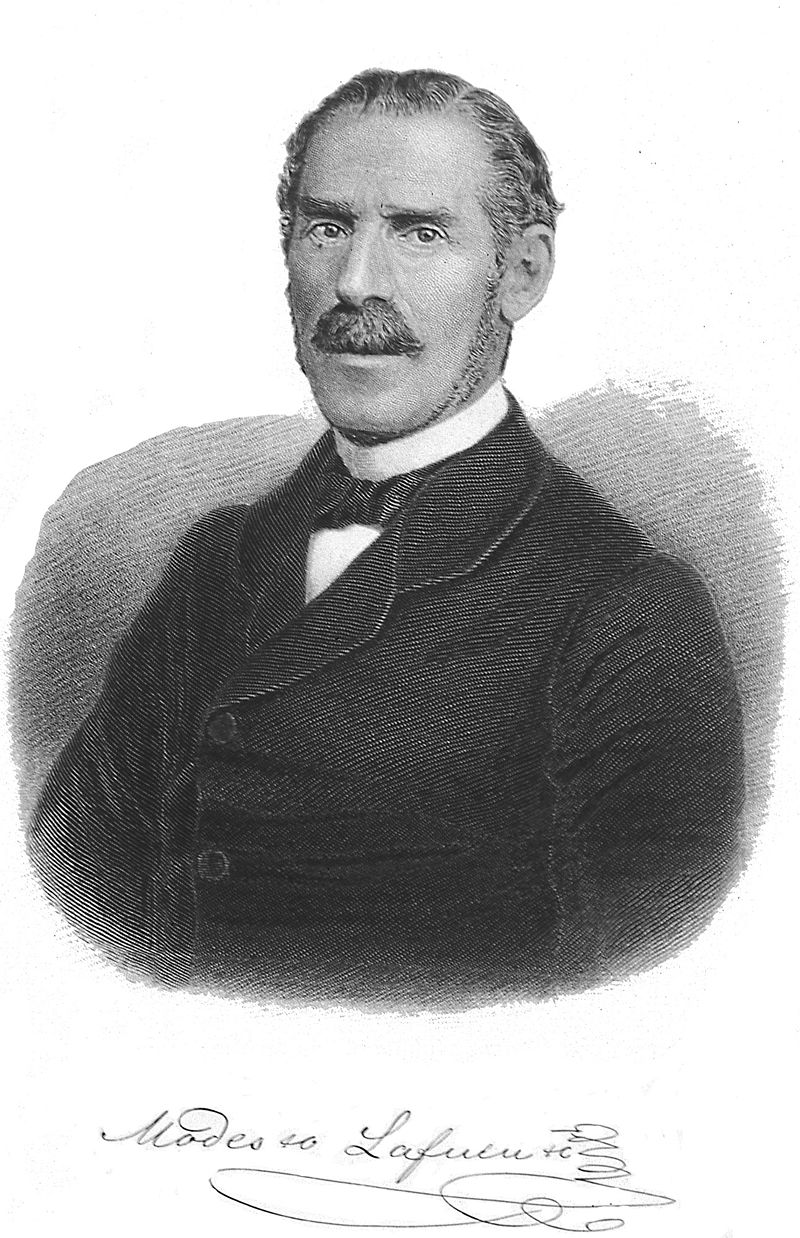
Retrato de Modesto Lafuente y Zamalloa
Ilustración de Historia general de España por Modesto Lafuente.

Retrato de Modesto Lafuente.
José Vallejo y Galeazo · Biblioteca Digital Hispánica CC BY 4.0
Life and career
Dated record
Life and career
The full dated record · 2 entries
1806
Modesto Lafuente born at Rabanal de los Caballeros.
1866
Modesto Lafuente died on 25 October 1866.
Places
Named by the record
Places
Only places the record itself states, plotted where the house gazetteer settles their coordinates. Nothing is inferred from a name or a nationality.
Modesto Lafuente was born at Rabanal de los Caballeros.
Birthplace
Modesto Lafuente died at Madrid.
Deathplace
Rabanal de los Caballeros.
Birth place
Madrid.
Death place
Writings
Under the pseudonyms of Fray Gerundio and Pelegrin Tirabeque, he wrote many capilladas or essays on a great variety of subjects, including the political questions of the day. According to Ferrer del Rio, he borrowed the pseudonym Fray Gerundio from the work of Father Isla. His essays, and all his works, were written in an easy, flowing, popular style, and they became so popular that it was not long before his paper was read in every corner of Spain. The essays were collected as Capilladas (1837–40) and as Teatro social del siglo XIX (1846), the latter dealing with the manners and customs of the day. Lafuente's chief work, by which he is best known, is his Historia general de España, which he published in Madrid (1850–1869, 30 volumes). A second edition (13 volumes) was published in 1874–1875. It was later edited and revised by Juan Valera (25 vols., 1887–90). Another notable work is Viaje aerostático del Fray Gerundio y Tirabeque. It is divided into two parts, the first being a review of aerial navigation, and the second, a satire on the political situation in Europe. The important events of 1848 caused him to write his Revista Europea which he published as a periodical for about one year.
Primary material
Documents and archives
reference work
- Wikidata, structured authority record Q627987: Modesto Lafuente
Reputable secondary · Wikidata
- “Modesto Lafuente”, English Wikipedia, consulted as further reading
Reputable secondary · Wikipedia
authority file
Notes from the source article
Cited by Wikipedia
Notes from the source article
These works are cited by the source article, in its own numbering. They are recorded as its citations, not as sources VALÉORINE has verified.
- 1.Modesto Lafuente y Zamalloa Real Academia de la Historia.
- 2.Fray Gerundio es un fraile exclaustrado de resultas de la ley de desamortización de Mendizábal, lo cual implica un particular punto de vista con el que aborda la realidad contemporánea. Se dedica al periodismo para ganarse la vida, primero en León y después en Madrid, ayudado por su lego Tirabeque, y tiene una educación y formación religiosa muy sólida, que deja entrever en sus artículos: mitología, sermones, salmos e historias del Antiguo Testamento. Ambos se conocieron en el seminario de León y, desde entonces, no se separaron. Tirabeque es cojo y mal parecido, y a menudo no entiende o interpreta mal las capilladas de su amo. Por las simplezas que dice Ramón Mesonero Romanos juzgó precipitadamente las capilladas como propias del gusto del populacho, pero en realidad Tirabeque es el Sancho Panza de Fray Gerundio, contrapunto de su conciencia política. Encarna la opinión del Pueblo y no sabe explicar por qué no se acaba de constituir un gobierno sólido y capaz en España que resuelva los problemas más acuciantes. Entiende la realidad inmediata que le afecta directamente, como el hambre, la interminable guerra civil, el aumento de huérfanos y viudas, las irregularidades en las votaciones o la inefectiva ayuda internacional tras el tratado de la Cuádruple Alianza. Cf. la tesis de Mònica Fuertes-Arboix La sátira política en "Fray Gerundio" (1837-1842) de Modesto Lafuente, Biblioteca Virtual Miguel de Cervantes, 2010, http://bib.cervantesvirtual.com/FichaObra.html?Ref=37253
- 3.http://www.arrayanes.net/rabanal/RABANAL%20%2020-6-2006.pdf
- 4.López Serrano, Francisco de Asís: Modesto Lafuente como paradigma oficial de la historiografía española del siglo XIX (2001). en Chronica nova. Revista de historia moderna de la Universidad de Granada Núm. 28 Pág. 315-336
- 5.La sátira política en la primera mitad del siglo XIX: Fray Gerundio (1837-1842) de Modesto Lafuente, Mònica Fuertes Arboix - Universidad de Alicante, 14 abr. 2014
- 6.Real Academia de la Historia. Académicos Numerarios - Relación de Medallas: 21.
- 7.Celia Villar. Historia de España y América. 84-670-0316-2.
- 8.Cf. Roberto López Vela, "De Numancia a Zaragoza. La construcción del pasado nacional en las historias de España del ochocientos", en R. García-Cárcel (ed.), La construcción de las historias de España, pp. 195-299.
- 9.https://dialnet.unirioja.es/descarga/articulo/421790.pdf Modesto Lafuente como paradigma oficial de la Historiagrafía española del siglo XIX: una revisión bibliográfica, Francisco de Asís López Serrano
- 10.La Reconquista: una construcción historiográfica (siglos XVI-XIX). 978-84-92820-47-4.
References
Citations
References
Each reference names the institution holding it, so a reader may go to the document itself.
authority file
Partially resolvedreference work
Partially resolvedreference work
Partially resolved
The Encyclopedia exists whether or not anything is for sale. Corrections are recorded rather than overwritten, and every version of this record is kept. Published 15 August 2026.
Elsewhere in Books
38,661 published records in this field, each with its sources named.
- Mochtar LubisAuthor
- Moderata FonteAuthor
- Modest MorariuAuthor
- Modest TchaikovskyAuthor
- Modison Salayedvwa MagagulaAuthor
- ModuinAuthor
- Moe HeinAuthor
- Moeen FaruqiAuthor
Best supported in this field
For owners
Own a work by Modesto Lafuente?
A specialist will read what you send and tell you what the house can establish, what it cannot, and whether the object is suited to sale. There is no charge and no obligation. The object stays with you throughout; nothing is shipped to us unless it is arranged in writing beforehand.