
Mike Gold
Michael Gold (April 12, 1893 – May 14, 1967) was the pen-name of Jewish-American writer Itzhok Isaak Granich. A lifelong communist, Gold was a novelist, journalist, magazine editor, newspaper columnist, playwright, and literary critic. His semi-autobiographical novel Jews Without Money (1930) was a bestseller.
Also recorded as Michael Gold · Michael "Mike" Gold
Mike Gold
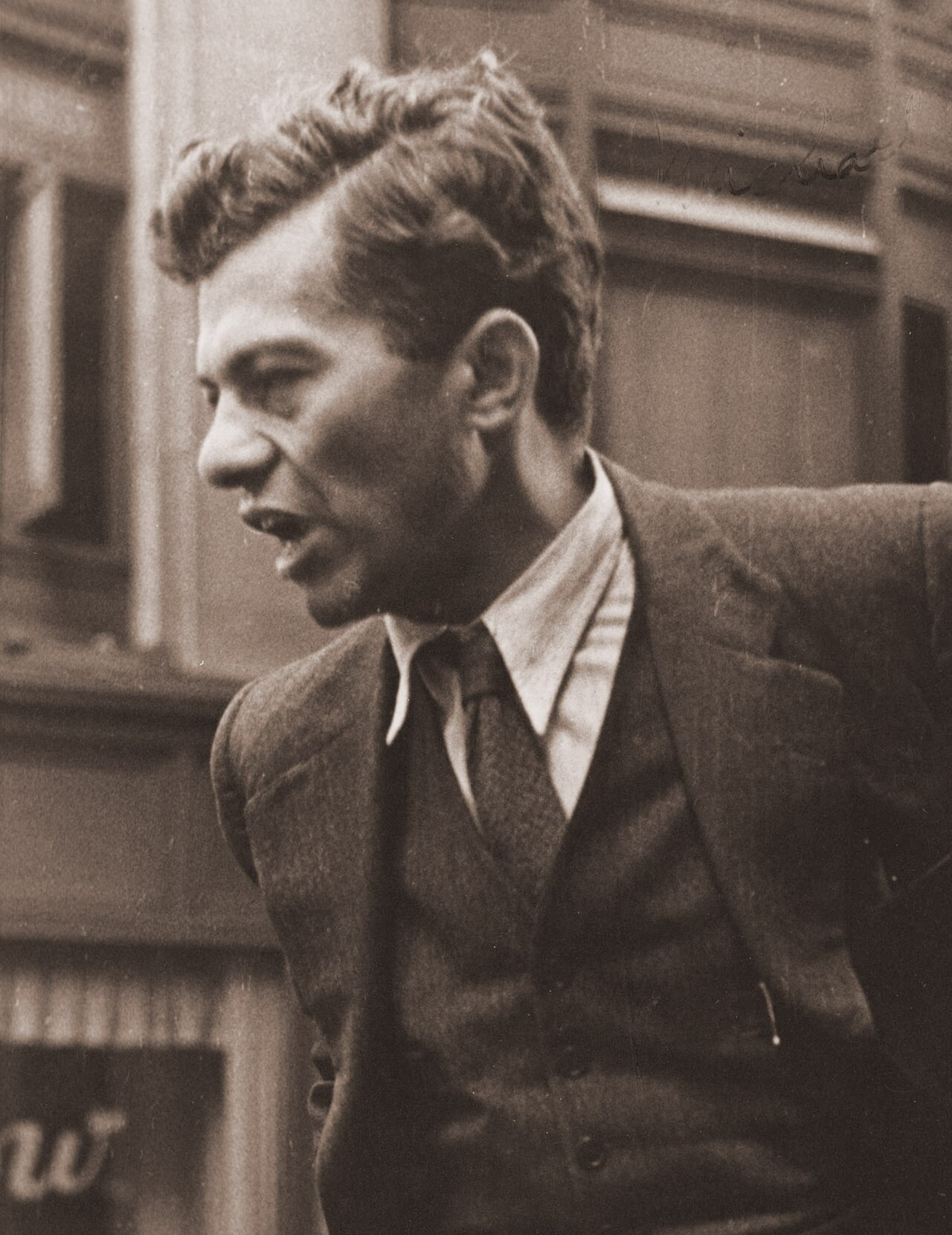
Tim Davenport (Carrite at English Wikipedia) · Digital image from the Tim Davenport collection Additional digital editing by Tim Davenport for Wikipedia · CC BY-SA 3.0
- Died
- 1967. · Terra Linda.
- Nationality
- United States.
- Occupation
- journalist, novelist, writer, poet and literary critic.
- Movements
- proletarian literature.
- Known for
- Jews Without Money.
- Languages
- American English.
VALÉORINE Encyclopedia
VALÉORINE documentary reading
Documentary summary
Michael Gold (April 12, 1893 – May 14, 1967) was the pen-name of Jewish-American writer Itzhok Isaak Granich. A lifelong communist, Gold was a novelist, journalist, magazine editor, newspaper columnist, playwright, and literary critic. His semi-autobiographical novel Jews Without Money (1930) was a bestseller.
Admitted source layer · organised and presented by VALÉORINE
Note VALÉORINE
Mike Gold (died 1967) was an American journalist, literary critic and novelist, among other activities. Born in Manhattan, the journalist died in Terra Linda. Mike Gold was also known as Michael Gold.
Mike Gold held the position of editor-in-chief. The journalist was associated with proletarian literature.
Works include Jews Without Money. Languages used include American English.
Composed from admitted, traceable facts · 26 September 2026
VALÉORINE
Reference Check
Propose documentary evidence for Mike Gold. A contribution is never written directly as fact: identity, source, rights and evidence gates still decide.
Sign in to contribute
World of VALÉORINE
Documentary connections
Only confirmed graph relationships appear here. Images are shown only when their identity and reuse rights both pass the documentary gate.
Documentary evidence
Evidence Panel
original value insufficient · checked 25 September 2026
- Identity
- resolved
- Independent source families
- 0
- Admitted assertions
- 0
- Open conflicts
- 0
Authority files
wikidata · Q1964117 · wikipedia · Mike Gold
In this article
Early life
Early life
During the 1930s and 1940s, Gold was considered the preeminent author and editor of U.S. proletarian literature.
Gold was born Itzhok Isaak Granich on April 12, 1893 on Delancey Street on the Lower East Side of Manhattan in New York City. His parents, Chaim Granich and Gittel Schwartz Granich, were Romanian Jewish immigrants. He had two younger brothers, Emmanuel and George, and a sister, Esther. When Chaim's small business failed and he became ill, the twelve-year-old Itzhok was forced, after a half year of high school, into a series of grinding jobs: errand boy in garment factories, shipping clerk, printer's assistant, night porter, driver's helper for the Adams Express Company, and filing clerk for the Southern Pacific Railroad. An early radicalizing experience occurred in April 1914. Itzhok was out of work and happened to wander into Union Square where an unemployment protest was in progress. He heard "passionate anticapitalist speeches" before the crowd was attacked by police. While trying to help an elderly woman who had been beaten, he himself was clubbed and bloodied by a policeman. The next day, Itzhok bought his first copy of the socialist journal The Masses. He later said, "I have always been grateful to that cop and that club. He introduced me to literature and the revolution."
Career
Career
Itzhok Granich began his writing career by submitting poems and articles to The Masses, edited by Floyd Dell and Max Eastman. He also wrote one-act plays of tenement life for the Provincetown Players. For his initial writings, he chose the pseudonym Irwin Granich. Shortly after the 1919-20 Palmer Raids on radicals, he switched to Michael Gold, reportedly because it was the name of a Jewish Civil War veteran and abolitionist whom he admired for having fought to "free the slaves". His first published work, a poem entitled "Three Whose Hatred Killed Them", appeared in the August 1914 edition of The Masses. The poem describes anarchists killed in a Lexington Avenue tenement by their own bomb. The poem opens with the lines: "These wild, bitter men, whose iron hatred burst too soon, / Judge them not harshly, O comrades. / Forgive them their sin, for they loved much. / They hated, but it was the enemy of man they hated." In 1924–25, Gold made his first visit to Moscow. Until his death, he remained an ardent supporter of the Bolshevik Revolution and of the Soviet Union in all its phases. In 1922, he had written:The Russian Bolsheviks will leave the world a better place than Jesus left it. They will leave it on the threshold of the final victory—the poor will have bread and peace and culture in another generation, not churches and a swarm of lying parasite minister dogs, the legacy of Jesus. In 1921–22, Gold and Claude McKay became Executive Editors of Max Eastman's magazine The Liberator. In 1926, Gold and Joseph Freeman co-founded New Masses magazine, which featured leftist literature, satirical cartoons, and journalistic pieces, and also helped establish radical theater groups. Gold was the New Masses reporter who covered the Sacco and Vanzetti case up until their executions in Boston in September 1927. He served as New Masses editor-in-chief from June 1928 till 1934. The February 1921 issue of The Liberator included Gold's seminal essay, "Towards Proletarian Art". He argued that "a mighty national art cannot arise save out of the soil of the masses." The essay was, according to Walter Rideout, "the first attempt in America to formulate a definition for what was to become the most important critical term among radical literary groups of the early thirties—'proletarian literature.'" At the end of the decade, in the January 1929 issue of New Masses, Gold's call to action "Go Left, Young Writers!" sparked the proletarian literature movement in the U.S., which saw the emergence of writers with true working-class credentials. In his editorial decisions at The Liberator and New Masses, Gold preferred journalism, poems, letters, and short stories by ordinary workers over the writings of literary leftists from bourgeois backgrounds. Gold derided fiction that he determined did not meet the "proletarian literature" standard. In a New Masses article entitled "Gertrude Stein: A Literary Idiot", he charged that her works "resemble the monotonous gibberings of paranoiacs in the private wards of asylums... The literary idiocy of Gertrude Stein only reflects the madness of the whole system of capitalist values. It is part of the signs of doom that are written largely everywhere on the walls of bourgeois society." In "Proletarian Realism" (1930), he said of Marcel Proust: "The worst example and the best of what we do not want to do is the spectacle of Proust, master-masturbator of the bourgeois literature. We know the suffering of hungry, persecuted and heroic millions is enough of a theme for anyone, without inventing these precious silly little agonies." In a 1930 New Republic article, "Wilder: Prophet of the Genteel Christ", Gold assailed the Pulitzer Prize winner Thornton Wilder in equally vitriolic terms. Throughout the 1920s, Gold worked on his novel, Jews Without Money (it was to be his only novel). It was a fictionalized autobiography about growing up in the impoverished world of the Lower East Side. Published in February 1930, shortly after the onset of the Great Depression, it was an immediate success. By October of that year, it had already gone into its eleventh printing. The book was soon translated into sixteen languages. Jews Without Money became a prototype for the American proletarian novel. In his "Author's Note" to the novel (added in the 1935 reprint), Gold wrote, "I have told in my book a tale of Jewish poverty in one ghetto, that of New York. The same story can be told of a hundred other ghettoes scattered over all the world. For centuries the Jew has lived in this universal ghetto. Yiddish literature is saturated with the ghetto melancholy and poverty." Critic Richard Tuerk called Jews Without Money "the story of the education of a radical" and "a carefully worked, unified piece of art." The popularity of the novel made Gold a national figure. He was portrayed as the left's "literary czar" and the "cultural commissar" of the Communist Party (CPUSA). He was referred to as "America's most famous Communist writer". In 1933, Gold launched his "Change the World!" column in the CPUSA's newspaper The Daily Worker (and later in People's Daily World). He would write the column off and on for over a quarter century. It served as a platform to voice his sometimes caustic opinions about the literary artists and trends of that era. In 1936, Gold continued his longtime interest in American abolitionist John Brown (Gold's first published book was a biography of Brown) by co-authoring with Michael Blankfort the play Battle Hymn. Produced by the Federal Theatre Project of the Works Progress Administration (WPA), the play contains scenes from Brown's life. It ran for 72 performances at the Experimental Theatre on 63rd Street in New York. Gold's combative nature earned him numerous enemies. When labor organizer Fred Beal described the 1930s "American Communist Colony in Moscow" (of which Gold was sometimes a part), he scornfully characterized Gold as a "sentimental revolutionist", with an intense detestation for liberals, who was "anxious to impress people with his 'proletarian' childhood among bedbugs, rats and roaches." As a literary critic, Gold fiercely denounced left-wing authors who he believed had deviated from the Communist Party line. Among those he denounced were Albert Maltz, John Howard Lawson, and the "renegade" Ernest Hemingway, who while never a Communist had been sympathetic to leftist causes but came under fire for his writing on the Spanish Civil War in For Whom the Bell Tolls. Hemingway did not appreciate Gold's harsh criticism and dropped by The Daily Worker office to speak with Gold. When informed that Gold was out that day and asked if there was any message to leave for him, Hemingway replied, "Ok, tell Mike Gold that Ernest Hemingway says he should go fuck himself." Gold spent the McCarthy era "blacklisted and broke". In 1951, after a visit from two FBI agents, he noted that "Such visits are becoming terribly commonplace in the land of Walt Whitman", and that "Writers are being sent to prison for their opinions." Due to sharply declining circulation, The Daily Worker laid him off and he had to resort to odd jobs, including "in a print shop, at a summer camp, and as a janitor. He flirted with opening a coin laundry." His wife Elizabeth, a Sorbonne-trained lawyer, was also blacklisted and could only get custodial and factory work. In late 1956, Gold and his family relocated to San Francisco where he was hired by the West Coast-based People's Daily World to resume the "Change the World!" column. For the next decade, his columns contained book reviews and other literary criticism, but his tone was mellower and less judgmental than it had been in the 1930s and '40s. He wrote about the major events of the period such as the Civil Rights movement, Space Race, and Vietnam War. By 1966, he was losing his eyesight from the effects of diabetes and had to dictate his writing.
Personal life and death
Personal life and death
The social activist Dorothy Day was romantically involved with Gold for several years after they met in 1917. Michael Gold died in Terra Linda, California, on May 14, 1967, from complications following a stroke. He was 74 years old. He was survived by his wife Elizabeth and two sons, Nicholas and Carl.
Works
Works
Life of John Brown. Girard, KS: Haldeman-Julius, 1924. Proletarian Song Book of Lyrics from the Operetta "The Last Revolution." With J. Ramirez and Rudolph Liebich. Chicago: Local Chicago, Workers Party of America, 1925. The Damned Agitator and Other Stories. Chicago: Daily Worker Publishing, 1927. —Little Red Library #7. Hoboken Blues: or The Black Rip Van Winkle: A Modern Negro Fantasia on an Old American Theme. New York: New Playwrights Theatre, 1928. 120 Million. New York: International Publishers. 1929. LCCN 29003997. Fiesta: A Play in Three Acts. 1929. Money: A Play in One Act. New York: Samuel French, 1930. Jews Without Money. New York: Horace Liveright. 1930. LCCN 30005614. Charlie Chaplin's Parade. New York: Harcourt, Brace, 1930. Proletarian Literature in the United States: An Anthology. (Contributor.) New York: International Publishers, 1935. "Battle Hymn": A Play in Three Acts. With Michael Blankfort. New York: Play Bureau, Federal Theatre Project, 1936. Change the World!. New York: International Publishers. 1937. LCCN 37008580. The Hollow Men. New York: International Publishers. 1941. LCCN 41011939. David Burliuk: Artist-Scholar, Father of Russian Futurism. New York: A.C.A. Gallery, 1944. Rhymes for Our Times. With Bill Silverman and William Avstreih. Bronx, NY: Lodge 600, Jewish People's Fraternal Order of the International Workers Order, 1946. The Mike Gold Reader. New York: International Publishers. 1954. LCCN 54009643.
Places
Named by the record
Places
Only places the record itself states, plotted where the house gazetteer settles their coordinates. Nothing is inferred from a name or a nationality.
Manhattan.
Birth place
Terra Linda.
Death place
Legacy
Gold's papers reside at the Tamiment Library and Robert F. Wagner Archives at New York University in New York City. Alice Neel painted Gold's portrait in 1952 and then again after his death.
Notes from the source article
Cited by Wikipedia
Notes from the source article
These works are cited by the source article, in its own numbering. They are recorded as its citations, not as sources VALÉORINE has verified.
- 1.Chura, Patrick. Michael Gold: The People's Writer. State University of New York Press. 2020. 978-1438480978.
- 2.Michael Gold, Author, Is Dead; His Theme Was Social Protest. The New York Times. 15 May 1967.
- 3.Sternlicht, Sanford. The Tenement Saga: The Lower East Side and Early Jewish American Writers. Terrace Books. 111. 2004. 978-0274725083.
- 4.Mike Gold. Jews Without Money. Horace Liveright. 1930.
- 5.Dorrell, Taylor. Mike Gold Was a Working-Class Hero. Jacobin. 16 October 2022.
- 6.Sillen, Samuel. The Mike Gold Reader. International Publishers. 8. 1954.
- 7.Gross, Barry. The Heath Anthology of American Literature: Volume D: Modern Period (1910-1945). Houghton Mifflin Company. 2005. 978-0618533008.
- 8.Damned Agitator: A Michael Gold Reader. JSTOR Daily. 25 January 2023.
- 9.Chura, Patrick. Leftist 'life hacks' from Mike Gold's farewell columns in 'People's Daily World'. People's World. 1 February 2023.
- 10.Applegate, Edd C. American Naturalistic and Realistic Novelists: A Biographical Dictionary. Greenwood Press. 170. 2001. 978-0313315725.
- 11.Books: Ghetto. Time. February 24, 1930.
- 12.Gold, Michael. The Jesus-Thinkers. The Liberator. 5. 9. 11. September 1922.
- 13.Gold, Michael. Lynchers in Frock Coats. New Masses. 3. 5. September 1927.
- 14.Magil, A.B. Rebirth of New Masses. The Daily Worker. 2 June 1928.
- 15.Granich, Irwin. Towards Proletarian Art. The Liberator. February 1921.
- 16.Pietaro, John. Mike Gold, 'Jews Without Money' author, gets overdue recognition in new bio. People's World. 18 May 2021.
- 17.Rideout, Walter B. The Radical Novel in the United States: 1900-1954: Some Interrelations of Literature and Society. Hill & Wang. 123. 1966.
- 18.Gold, Michael. Go Left, Young Writers!. New Masses. 4. 8. 3–4. January 1929.
- 19.Balthaser, Benjamin. Mike Gold, the Writer Who Believed Workers Could Speak for Themselves. Jacobin. 12 July 2021.
- 20.Gold, Michael. Change the World!. International Publishers. 23–26. 1937.
- 21.International Publishers. Mike Gold: A Literary Anthology. 197–202. 1972.
- 22.Rubin, Rachel. Jewish Gangsters of Modern Literature. University of Illinois Press. 2000.
- 23.Gold, Michael. Jews Without Money. Carroll & Graf Publishers. 10. 1996. 0786703709.
- 24.Tuerk, Richard. 'Jews Without Money' as a Work of Art. Studies in American Jewish Literature (1981-). 7. 1. 67–79. Spring 1988. 41205675.
- 25.Dorrell, Taylor. Michael Gold: Red Scare Victim. JSTOR Daily. 25 January 2023.
- 26.Buhle, Paul. Marxism in the United States: A History of the American Left. Verso. 177. 2013. 978-1781680155.
- 27.In his Jacobin article, Balthaser quotes from Gold's unpublished memoir that the author grew "sick" of these mainstream representations of himself. He disliked being caricatured as a "beetle-brow gangster commissar" who was trying to take over American literature "by every manner of brutal means."
- 28.Wald, Alan M. Writing from the Left: New Essays on Radical Culture and Politics. Verso. 58. 1994. 1859840019.
- 29.Hoberman, J. Mike Gold, Avant-Garde Bard of Proletarian New York. The Nation. 12 May 2021.
- 30.Internet Broadway Database (IBDB). Battle Hymn: About This Production.
- 31.Beal, Fred Erwin. Proletarian journey: New England, Gastonia, Moscow. Hillman-Curl. 258. 1937.
- 32.Billingsley, Kenneth Lloyd. Hollywood Party: How Communism Seduced the American Film Industry in the 1930s and 1940s. Prima Publishing. 1998. 978-0761513766.
- 33.Robinson, Nathan J. The Old Left Renaissance of the 'New Masses' Magazine. Current Affairs. 11 December 2023.
- 34.O'Hara, Michael M. John Howard Lawson. The Sticking Place. July 2014.
- 35.Horne, Gerald. The Final Victim of the Blacklist: John Howard Lawson, Dean of the Hollywood Ten. University of California Press. 83. 2006. 978-0520243729.
- 36.Baker, Carlos. Ernest Hemingway: A Life Story. Charles Scribner's Sons. 459. 1969. 978-1122020671.
- 37.Whitman, Alden. Dorothy Day, Outspoken Catholic Activist, Dies at 83. The New York Times. 30 November 1980.
- 38."Michael Gold Manuscripts on Peter V. Cacchione TAM.339," Tamiment Library and Robert F. Wagner Labor Archive, New York University.
- 39.AliceNeel.com. Mike Gold in Memoriam.
- 40.Allen, Kelcey. Amusements. Women's Wear Daily. 20 February 1928.
- 41.Tuerk, Richard. Michael Gold's Hoboken Blues: An Experiment that Failed. MELUS. 20. 4. 3–15. December 1995. 10.2307/467886.
- 42.Internet Broadway Database (IBDB). Fiesta: About This Production.
- 43.Moran, Charles. The New Plays on Broadway. The Billboard. 28 September 1929.
- 44."Money: A Play in One Act". Worldcat.org. Retrieved 24 January 2020.
Bibliography printed in the source article · 7
- Berman, Paul. Radical America (Vol. 17, No. 4) July - August, 1983. 1983.
- Bloom, James. Left Letters: The Culture Wars of Mike Gold and Joseph Freeman. Columbia University Press, 1992.
- Booker, M. Keith, ed. Encyclopedia of Literature and Politics: Censorship, Revolution, and Writing A-Z. [3 vols.] Greenwood Publishing Group, 2005.
- Chura, Patrick. Michael Gold: The People's Writer. State University of New York Press. 2020. 978-1438480978.
- Foley, Barbara. Radical Representations: Politics and Form in U.S. Proletarian Fiction, 1929-1941. Duke University Press, 1993.
- Pyros, John. Mike Gold: Dean of American Proletarian Literature. New York: Dramatika, 1979.
- Rubin, Rachel (2000). Jewish Gangsters of Modern Literature, Chicago: University of Illinois Press.
References
Citations
References
Each reference names the institution holding it, so a reader may go to the document itself.
reference work
Partially resolvedreference work
Partially resolved
The Encyclopedia exists whether or not anything is for sale. Corrections are recorded rather than overwritten, and every version of this record is kept. Published 14 August 2026.
Elsewhere in Books
38,377 published records in this field, each with its sources named.
- Mike DavisAuthor
- Mike EppsAuthor
- Mike GayleAuthor
- Mike GodwinAuthor
- Mike GravelAuthor
- Mike LindellAuthor
- Mike MentzerAuthor
- Mike O'MalleyAuthor
Best supported in this field
For owners
Own a work by Mike Gold?
A specialist will read what you send and tell you what the house can establish, what it cannot, and whether the object is suited to sale. There is no charge and no obligation. The object stays with you throughout; nothing is shipped to us unless it is arranged in writing beforehand.