
Michael Madhusudan Dutt
Michael Madhusudan Dutt (Bengali: মাইকেল মধুসূদন দত্ত, pronounced [mai̯kel mod̪ʱuʃud̪ɔn d̪ɔt̪ːo]; 25 January 1824 – 29 June 1873) was a Bengali poet and playwright. He is considered one of the pioneers of Bengali literature.
Also recorded as Michael Dutta · Michael Madhusudan Datta · Madhusudan Dutt · Michael Madhusudan Dutta
Michael Madhusudan Dutt

Sastri, Sibnath, 1847-1919 · Internet Archive identifier: ramtanulahiribra00sastiala · Public domain
- Full name
- মধুসূদন দত্ত.
- Born
- 1824. · Sagardari.
- Nationality
- British Raj.
- Occupation
- poet, writer, editor, translator, barrister and playwright.
- Education
- Presidency University and Hindu School.
- Languages
- English and Bangla.
VALÉORINE Encyclopedia
VALÉORINE documentary reading
Documentary summary
Michael Madhusudan Dutt (Bengali: মাইকেল মধুসূদন দত্ত, pronounced [mai̯kel mod̪ʱuʃud̪ɔn d̪ɔt̪ːo]; 25 January 1824 – 29 June 1873) was a Bengali poet and playwright. He is considered one of the pioneers of Bengali literature.
Admitted source layer · organised and presented by VALÉORINE
Reference Check
Propose documentary evidence for Michael Madhusudan Dutt. A contribution is never written directly as fact: identity, source, rights and evidence gates still decide.
Sign in to contribute
World of VALÉORINE
Documentary connections
Only confirmed graph relationships appear here. Images are shown only when their identity and reuse rights both pass the documentary gate.
Documentary evidence
Documentary basis
Authority files
bnf · gnd · loc · wikidata · Q666864 · wikipedia · Michael Madhusudan Dutt
In this article
Early life
Early life
Madhusudan was born in Sagardari, a village in Keshabpur Upazila, Jessore District of Bengal (present-day Bangladesh), to a Hindu family. His father was Rajnarayan Dutta, who was a lawyer and his mother was Jahnabi Devi. His family, being reasonably well-off, ensured that Madhusudan received an education in the English language and additional tutorship in English at home. Rajnarayan had intended for this Western education to open the doors for a government position for his son.
College and religious conversion
College and religious conversion
After he finished his education in Sagardari at roughly the age of fifteen, Rajnarayan sent Madhusudhan to Calcutta to attend Hindu College with the eventual aim of becoming a barrister. At Hindu College, Michael studied under a westernized curriculum in a university which had been expressly founded for the "uplift of the natives". The college required all students to wear Western clothing, eat European cuisine with cutlery, learn British songs, and speak exclusively in English—with the aim of creating an anglicized Indian middle class to serve as officials in the colonial administration. During his time at Hindu College, Madhusudhan developed an aversion to Indian culture and a deep yearning to be accepted into European culture. He expressed these sentiments in one of his poems. An early and formative influence on Dutt was his teacher at Hindu College, David Lester Richardson. Richardson was a poet and inspired in Dutt a love of English poetry, particularly by that of Byron. Dutt began writing English poetry aged around 17 years, sending his works to publications in England, including Blackwood's Magazine and Bentley's Miscellany. They were, however, never accepted for publication. This was also when he began a correspondence with his friend, Gour Das Bysack, which today forms the bulk of sources on his life. On 9 February 1843, Madhusudan embraced Christianity at the Old Mission Church, in spite of the objections of his parents and relatives. He did not take the name Michael until his marriage in 1848. He describes the day as: He had to leave Hindu College on account of converting to Christianity. In 1844, he resumed his education at Bishop's College, where he stayed for three years. In 1847, he moved to Madras (Chennai) due to family tensions and economic hardship, having been disinherited by his father. While in Madras, he stayed in the Black Town neighbourhood, and began working as an "usher" at the Madras Male Orphan Asylum. Four years later, in 1851, he became a Second Tutor in the Madras University High School. He edited and assisted in editing the periodicals Madras Circulator and General Chronicle, Athenaeum, Spectator and Hindoo Chronicle.
Early works (1849–1855)
Early works (1849–1855)
Dutt wrote exclusively in English in his early writing years. The Captive Ladie was published in 1849 and, like Derozio's The Fakeer of Jungheera, takes on the form of a long narrative poem. In The Anglo-Saxon and the Hindu (1854), an essay in florid, even purple prose, are references to and quotations from almost the whole of Macaulay's shelf of European books. He was greatly influenced by the works of William Wordsworth and John Milton. Dutt was a spirited bohemian and Romantic.
Calcutta years (1858–1862)
Calcutta years (1858–1862)
The period during which he worked as a head clerk and later as the Chief Interpreter in the court marked his transition to writing in his native Bengali, following the advice of Bethune and Bysack. He wrote 5 plays: Sermista (1859), Padmavati (1859), Ekei Ki Boley Sabyata (1860), Krishna Kumari (1860) and Buro Shaliker Ghare Ron (1860). Then followed the narrative poems: Tilottama Sambhava Kavya (1861), Meghnad Badh Kavya (1861), Brajagana Kavya (1861) and Veerangana Kavya (1861). He also translated three plays from Bangla to English, including his own Sermista.
Final years (1866–1873)
Final years (1866–1873)
A volume of his Bangla sonnets was published in 1866. His final play, Maya Kannan, was written in 1872. The Slaying of Hector, his prose version of the Iliad, remains incomplete.
Linguistic abilities
Linguistic abilities
Madhusudan was a gifted linguist and polyglot. He studied English, Bengali, Hebrew, Latin, Greek, Tamil, Telugu and Sanskrit.
Work with the sonnet
Work with the sonnet
He pioneered the Bengali sonnet and introduced European-style blank verse into Bengali poetry, revolutionizing its metrical structure. Michael Madhusudan Dutt dedicated his first sonnet to his friend Rajnarayan Basu, which he accompanied with a letter: "What say you to this, my good friend? In my humble opinion, if cultivated by men of genius, our sonnet in time would rival the Italian." His most famous sonnet is Kapatakkha River. When Dutt later stayed in Versailles, the sixth centenary of the Italian poet Dante Alighieri was being celebrated all over Europe. He composed a poem in honour of the poet, translated it into French and Italian, and sent it to the king of Italy. Victor Emmanuel II, then monarch, liked the poem and wrote to Dutt, saying, "It will be a ring which will connect the Orient with the Occident."
Work in blank verse
Work in blank verse
Sharmistha (spelt as Sermista in English) was Dutt's first attempt at blank verse in Bengali literature. Kaliprasanna Singha organised a felicitation ceremony for Madhusudan to mark the introduction of blank verse in Bengali poetry. His famous epic, quoted as the only epic of Bengali kind, Meghnadbad-Kabya is also totally written in blank verse. Praising Dutt's blank verse, Sir Ashutosh Mukherjee, observed: "As long as the Bengali race and Bengali literature would exist, the sweet lyre of Madhusudan would never cease playing." He added: "Ordinarily, reading of poetry causes a soporific effect, but the intoxicating vigour of Madhusudan's poems makes even a sick man sit up on his bed." In his The Autobiography of an Unknown Indian, Nirad C. Chaudhuri has remarked that during his childhood days in Kishoreganj, a common standard for testing guests' erudition in the Bengali language during family gatherings was to require them to recite the poetry of Dutt, without an accent. Purabi Panwar's review "Lured by Hope: A Biography of Michael Madhusudan Dutt by Ghulam Murshid and Gopa Majumdar"centres on how Ghulam Murshid's biography rescues Michael Madhusudan Dutt from myth and misconception presenting a fact based portrait of the poet's rebellious life and his pioneering role in Bengali Literature. Panwar highlights that translator Gopa Majumdar was drawn to the book because it separated hearsay from the truth, drama from reality", a phrase that captures the review's central claim: that Murshid's work finally gives Dutt an unbiased, well-researched account after decades of legends overshadowing his actual literary achievements.
Barrister-at-law
Barrister-at-law
Dutt went to England in 1862 to become a barrister-at-law and enrolled at the Gray's Inn. On the eve of his departure to England: His family joined him in 1863, and thereafter they shifted to the much cheaper Versailles, due to the miserable state of their finances. Funds were not arriving from India according to his plans. He was only able to relocate to England in 1865 and study for the bar due to the generosity of Ishwar Chandra Vidyasagar. For this, Dutt was to regard Vidyasagar as Dayar Sagar (meaning the ocean of kindness) for as long as he lived. He was admitted to the High Court in Calcutta on his return in February 1867. His family followed him in 1869. His stay in England had left him disillusioned with European culture. He wrote to his friend Bysack from France: If there be any one among us anxious to leave a name behind him, and not pass away into oblivion like a brute, let him devote himself to his mother-tongue. That is his legitimate sphere his proper element.
Marriage and family
Marriage and family
Dutt had refused to enter into an arranged marriage which his father had decided for him. He had no respect for that tradition and wanted to break free from the confines of caste-based endogamous marriage. His knowledge of the European tradition convinced him of his choice of marriages made by mutual consent (or love marriages). While in Madras, he married Rebecca Thompson McTavish, a 17-year-old of Scottish-Indian parentage, a resident of the Madras Female Orphan Asylum, on 31 July 1848. Dutt assumed the name Michael when the marriage was registered in the baptismal register. They had four children together. He wrote to Bysack in December 1855:Yes, dearest Gour, I have a fine English Wife and four children. Dutt returned from Madras to Calcutta in February 1856, after his father's death (in 1855), abandoning his wife and four children in Madras. No records of his divorce from Rebecca or remarriage have been found. In 1858, he was joined there by a 22-year old woman of French Eurasian extraction, Emelia Henrietta Sophie White, the daughter of his colleague at the Madras Male Orphan Asylum. They had two sons, Frederick Michael Milton (23 July 1861 – 11 June 1875) and Albert Napoleon (1869 – 22 August 1909), and a daughter, Henrietta Elizabeth Sermista (1859 – 15 February 1879). A fourth child was stillborn. Their relationship lasted until the end of her life, Henrietta pre-deceasing him by three days, on 26 June 1873. Rebecca died in Madras in July 1892. Only a daughter (Phoebe Rebecca Salfelt Dutt) and a son (George John McTavish-Dutt) survived her. The son, McTavish-Dutt, practised as a pleader in the Court of Small Causes in Madras. The tennis player Leander Paes is a direct descendant of Dutt, who is his great-great-grandson on his mother's side.
Death
Death
Dutt died in Presidency General Hospital on 29 June 1873. Three days before his death, he recited a passage from Shakespeare's Macbeth to his dear friend Bysack, to express his deepest conviction of life:
In India
In India
Michael Madhusudan Dutta College in Tripura is named after him. Michael Madhusudan Memorial College in West Bengal is named after him. Madhusudan Mancha in West Bengal is named after him.
Narrative poems
Narrative poems
King Porus: A Legend of Old (1843) The Captive Ladie (1849) Visions of the Past (1849) Tilōttamāsambhav Kāvya ("Birth of Tilottama"; 1860) — তিলোত্তমাসম্ভব কাব্য
Epic poems
Epic poems
Mēghanādbadh Kāvya ("The Slaying of Meghnada"; 1861) — মেঘনাদবধ কাব্য Hēkṭar Badh ("The Slaying of Hector"; 1871) — হেক্টর বধ The Upsori: A Story from Hindu Mythology (1942)
Lyric poems
Lyric poems
Brajāṅganā Kāvya ("Woman of Braja"; 1861) — ব্রজাঙ্গনা কাব্য
Epistolary poems
Epistolary poems
Vīrāṅganā Kāvya ("War Heroine"; 1861) — বীরাঙ্গনা কাব্য
Sonnets
Sonnets
Caturddaśpadī Kavitāvalī ("Sonnets"; 1866) — চতুর্দ্দশপদী কবিতাবলী
Others
Others
Duḥkhēr Hētu ("The Cause of Suffering"; 1908) — দুঃখের হেতু Vividha Kāvya ("Miscellaneous Poetry"; 1940) — বিবিধ কাব্য Collected Poems (1942)
Verse dramas
Verse dramas
Rizia: Empress of Inde (1849)
Historical dramas
Historical dramas
Nil Darpan, or The Indigo Planting Mirror (1861) — নীলদর্পণ Māyā-Kānan ("The Enchanted Grove"; 1878) — মায়া-কানন
Mythological dramas
Mythological dramas
Śarmmiṣṭhā Nāṭak/Sermisṭá (1859) — শর্ম্মিষ্ঠা নাটক
Farces/Comedies
Farces/Comedies
Ratnāvalī ("Jewel Necklace"; 1858) Ēkēi Ki Balē Sabhyatā? ("Is This Called Civilization?"; 1862) — একেই কি বলে সভ্যতা? Buṛōsālikēr Ghāṛē Rōm̐ ("The Old Mynah’s Neck Feathers"; 1883) — বুড়সালিকের ঘাড়ে রোঁ
Tragedies
Tragedies
Kṛṣṇakumārī Nāṭak ("The Tragedy of Krishnakumari"; 1875) — কৃষ্ণকুমারী নাটক
Essays
Essays
The Anglo-Saxon and the Hindu (1854) On Poetry, Etc. An Essay A Synopsis of the Rukmiṇīharaṇ Nāṭak

Bengal Celebrities
Srikanta Ray · Internet Archive identifier: GIPE000995 Internet Archive source: http: dspace.gipe.ac.in/xmlui/handle/10973/19015
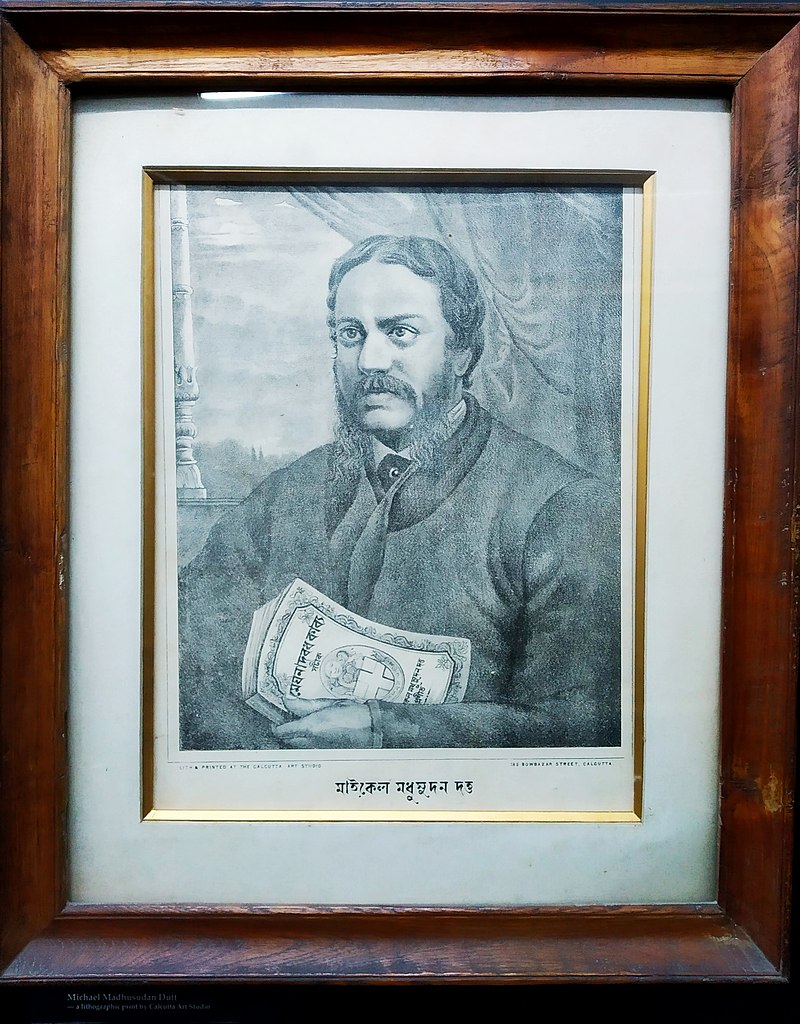
Michael Madhusudan Dutt
Sufe
Life and career
Dated record
Life and career
The full dated record · 2 entries
1824
Michael Madhusudan Dutt born at Sagardari.
1873
Michael Madhusudan Dutt died at Kolkata.
Places
Named by the record
Places
Only places the record itself states, plotted where the house gazetteer settles their coordinates. Nothing is inferred from a name or a nationality.
Kolkata.
Residences
Sagardari.
Birth place
Legacy and honours
Dutt was largely ignored for 15 years after his death. The belated tribute was a tomb erected at his gravesite. His epitaph, a verse of his own, reads: Michael Madhusudhan is a 1950 Indian Bengali-language drama film by Modhu Bose which starred Utpal Dutt in the titular role. Author Namita Gokhale published a play about Madhusudhan in 2021, based largely on letters written by him to friends and other authors, called Betrayed by Hope. In honour of Dutt, every year on his birthday, a fair is held in his home at Sagardari, which is organized by the District Council of Jessore. Every year, various MPs and ministers of the national parliament of Bangladesh attend this fair. In honour of Dutt a school and a college are named after him in Jessore District. And a university was proposed to be set up in this birthplace. They are: Michael Madhusudan College Sagardari Michael Madhusadan Institution Micheal Madhusudan Specialized University A 12 km Long Road which connects Keshabpur with Sagardari Named after him, The road Known as Modhu Sarak. His Ancestors House known as Modhu Polli is also named after him.
Primary material
Documents and archives
institutional register
- Bibliothèque nationale de France authority file 121908251
General reference · Bibliothèque nationale de France
- FAST authority file 90905
General reference · FAST
- GND (German National Library) authority file 12160196X
General reference · GND (German National Library)
- IdRef (French universities) authority file 030508045
General reference · IdRef (French universities)
- ISNI authority file 0000000083899138
General reference · ISNI
- Library of Congress authority file n82054945
General reference · Library of Congress
scholarly publication
- Michael Madhusudan Dutt, Anglophone Poetry in Colonial India, 1780-1913
Scholarly · Crossref registry
- Michael Madhusudan Dutt: The Prodigal’s Progress, Making India: Colonialism, National Culture, and the Afterlife of Indian English Authority, 2012
Scholarly · Crossref registry · 2012
reference work
- “Michael Madhusudan Dutt”, English Wikipedia, consulted as further reading
Reputable secondary · Wikipedia
Notes from the source article
Cited by Wikipedia
Notes from the source article
These works are cited by the source article, in its own numbering. They are recorded as its citations, not as sources VALÉORINE has verified.
- 1.Michael Madhusudan Dutt: A Pioneer in Bengali Drama. Bangladesh.com.
- 2.Dutt, Michael Madhusudan - Banglapedia. en.banglapedia.org.
- 3.Michael Madhusudan Datta Poet, Playwright, Dramatist Britannica. www.britannica.com.
- 4.Shuvo, Golam Azam. Michael Madhusudan Dutt : Pioneer of Bengali Literature -. My Pen Arts. 2023-03-18.
- 5.Das, Alisha. Michael Madhusudan Dutt: A Pioneer With An English Heart. The Talented Indian. 2024-01-25.
- 6.Secondary - 2018 - Class - 9&10 - Bangla Sahitto-9 BV PDF Web .pdf. Google Docs.
- 7.Michael Madhusudan Dutta Making Britain. www5.open.ac.uk.
- 8.Dutt, Michael Madhusudan - Banglapedia. en.banglapedia.org.
- 9.Dipesh Chakrabarty. Provincializing Europe: Postcolonial Thought and Historical Difference. Princeton University Press. 33–. 15 February 2001. 978-0-691-13001-9.
- 10.Bhowmik, Dulal. Banglapedia: National Encyclopedia of Bangladesh. Asiatic Society of Bangladesh. 2012.
- 11.Mitra. Indian Poetry in English: Critical Essays. PHI Learning Pvt. Ltd. 32. 2012. 978-8120345713.
- 12.Dutt, Michael Madhusudhan. The Slaying of Meghanada: A Ramayana from Colonial Bengal. Oxford University Press. 16, 22–23. 2004. 9780195167993.
- 13.Atlantic Publishers & Dist. The Atlantic Companion to Literature in English. 154–. 2007. 978-81-269-0832-5.
- 14.Ghose, Subhas Chandra. Socio-Political Dynamics. Northern Book Centre. 178. 1 January 1996. 9788172110703.
- 15.Chaudhuri, Rosinka. The Literary Thing: History, Poetry and the Making of a Modern Cultural Sphere. Peter Lang. 2014. 978-3-0343-1760-3.
- 16.Sri Aurobindo Ashram. Mother India. 56. February 1961.
- 17.Ramanial Kanaiyaial Yajnik. The Indian Theatre: Its Origins and Its Later Developments Under European Influence, with Special Reference to Western India. Ardent Media. 219–. 1933.
- 18.Mother India: Monthly Review of Culture. 13. 57. 1961.
- 19.ভার্সাইতে মাইকেল মধুসূদন.
- 20.Panwar, Purabi. Review of Lured by Hope: A Biography of Michael Madhusudan Dutt. Indian Literature. 49. 2 (226). 231–234. 2005. 0019-5804.
- 21.Choudhuri, Mrinmaya. Glimpses of the Justice System of Presidency Towns, 1687-1973. Regency Publications. 2006. 978-81-89233-32-7.
- 22.Sri Aurobindo Ashram. Mother India. 55. February 1961.
- 23.Paranjape, Makarand R. Making India: Colonialism, National Culture, and the Afterlife of Indian English Authority. Springer. 76–78. 2012. 9789400746602.
- 24.Arabinda Poddāra. Renaissance in Bengal: quests and confrontations, 1800–1860. Indian Institute of Advanced Study. 216. 1970.
- 25.Michael Madhusudan Dutt(Bengali Authors).
- 26.Moreno, H. W. B. Michael Madhu Sudhan Dutta and His Anglo-Indian Wives. Bengal Past and Present. 26. July–December 1923.
- 27.Oxford University Press. Lured by hope: a biography of Michael Madhusudan Dutt. 30 October 2003. 978-0-19-565362-5.
- 28.Gibson, Mary Ellis. Indian Angles: English Verse in Colonial India from Jones to Tagore. Ohio University Press. 166. 2011. 978-0821419410.
- 29.Bose, Amalendu. Makers Of Indian Literature: Michael Madhusudan Dutt. Sahitya Akademi. 49. 1979.
- 30.I'm waiting for the right opportunity to join politics: Leander Paes. Times of India.
- 31."A Review": Ghulam Murshid, Lured by Hope: A Biography of Michael Madhusudan Dutt , translated from Bengali by Gopa Majumdar, Oxford University Press, New Delhi, 2003. . Pp 238 + xvi, at Parabaas
- 32.A poet of epic proportions. The Daily Star. 29 June 2010.
- 33.Taylor & Francis. Popular Cinema in Bengal: Genre, Stars, Public Cultures. 92. 9 June 2020. 978-1-00-044892-4.
- 34.Ghosh, Paramita. Review: Betrayed by Hope, a play on the life of Michael Madhusudan Dutta. Hindustan Times. 12 February 2021.
- 35.EKHON TV. মাইকেল মধুসূদনের স্মরণে চলছে ৯ দিনব্যাপী মেলা Michael Madhusudan Dutt Madhu Mela Ekhon TV. 2024-01-22.
- 36.MADHU MELA. beautifulbangladesh.gov.bd.
- 37.Michael Madhusudan Dutt's 197th birth anniversary being observed. 25 January 2021.
- 38.Madhusudan Dutt's birth bicentenary today.
Bibliography printed in the source article · 4
- Murshid, Ghulam. Lured by Hope: A Biography of Michael Madhusudan Dutta. Oxford University Press. 2003. 978-0-19-565362-5.
- Roy, Pinarki. Indian Poetry in English: Critical Essays. PHI Learning Pvt. Ltd. 17–32. 2016. 978-81-203-5261-2.
- Modhusudoner Engreji Kabita by Sayeed Abubakar, Bhumika Prakashani, Bangla Bazar, Dhaka-1100, (2009)
- Modhusudoner Engreji Sonnet, Translation and Preface: Sayeed Abubakar, Kabitirtha, 50/3, Kabitirtha Saroni, Kolkata-23
References
Citations
References
Each reference names the institution holding it, so a reader may go to the document itself.
scholarly publication
Institutional witnessscholarly publication
Michael Madhusudan Dutt: The Prodigal’s Progress, Making India: Colonialism, National Culture, and the Afterlife of Indian English Authority, 2012Crossref registry
Institutional witnessinstitutional register
Bibliothèque nationale de France authority file 121908251Bibliothèque nationale de France
Secondary witnessinstitutional register
Secondary witnessinstitutional register
GND (German National Library) authority file 12160196XGND (German National Library)
Secondary witnessinstitutional register
IdRef (French universities) authority file 030508045IdRef (French universities)
Secondary witnessinstitutional register
Secondary witnessinstitutional register
Library of Congress authority file n82054945Library of Congress
Secondary witness
Every cited source · 12
- 01
Michael Madhusudan Dutt, Anglophone Poetry in Colonial India, 1780-1913
scholarly publication · Scholarly
Consult the source - 02
Michael Madhusudan Dutt: The Prodigal’s Progress, Making India: Colonialism, National Culture, and the Afterlife of Indian English Authority, 2012
scholarly publication · Scholarly
Consult the source - 03
Bibliothèque nationale de France authority file 121908251
institutional register · General reference · Bibliothèque nationale de France
Consult the source - 04
- 05
GND (German National Library) authority file 12160196X
institutional register · General reference · GND (German National Library)
Consult the source - 06
IdRef (French universities) authority file 030508045
institutional register · General reference · IdRef (French universities)
Consult the source - 07
ISNI authority file 0000000083899138
institutional register · General reference · ISNI
Consult the source - 08
Library of Congress authority file n82054945
institutional register · General reference · Library of Congress
Consult the source - 09
National Library of Australia authority file 35135951
institutional register · General reference · National Library of Australia
Consult the source - 10
- 11
“Michael Madhusudan Dutt”, English Wikipedia, consulted as further reading
reference work · Reputable secondary · Wikipedia
Consult the source - 12
Wikidata, structured authority record Q666864: Michael Madhusudan Dutt
institutional register · General reference · Wikimedia Foundation
Consult the source
The Encyclopedia exists whether or not anything is for sale. Corrections are recorded rather than overwritten, and every version of this record is kept. Published 14 August 2026.
Elsewhere in Books
38,661 published records in this field, each with its sources named.
- Michael LortAuthor
- Michael M. BadenAuthor
- Michael M. CorozaAuthor
- Michael MaarAuthor
- Michael MandoAuthor
- Michael MannAuthor
- Michael Marshall SmithAuthor
- Michael Massey RobinsonAuthor
Best supported in this field
For owners
Own a work by Michael Madhusudan Dutt?
A specialist will read what you send and tell you what the house can establish, what it cannot, and whether the object is suited to sale. There is no charge and no obligation. The object stays with you throughout; nothing is shipped to us unless it is arranged in writing beforehand.