
Maxime Du Camp
Maxime Du Camp (8 February 1822 – 9 February 1894) was a French writer and photographer. • Illustration — Bust of Maxime Du Camp. • Illustration — Stele of Karnak, Egypt, about 1850. Photo taken by Du Camp
Also recorded as Maksim Di︠u︡kan · Maximos Dykan · Maxime DuCamp · Maxine de Camp
Maxime Du Camp
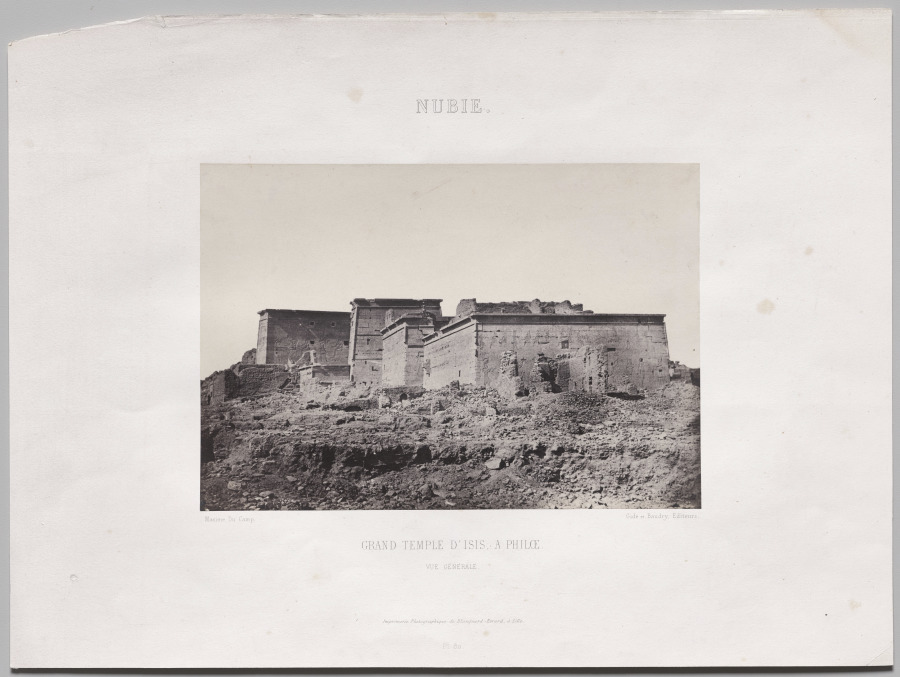
Maxime Du Camp · The Cleveland Museum of Art · Severance and Greta Millikin Purchase Fund · CC0
- Name
- Maxime Du Camp
- Born
- 8 February 1822
- Died
- 9 February 1894
- Birthplace
- Paris, France
- Place of death
- Baden-Baden, German Empire
- Occupation
- Writer and photographer
- Movement
- Realism and Late Romanticism
- Nationality
- France
- Movements
- literary realism
VALÉORINE Encyclopedia
VALÉORINE documentary reading
Documentary summary
Maxime Du Camp (8 February 1822 – 9 February 1894) was a French writer and photographer. • Illustration — Bust of Maxime Du Camp. • Illustration — Stele of Karnak, Egypt, about 1850. Photo taken by Du Camp
Admitted source layer · organised and presented by VALÉORINE
Reference Check
Propose documentary evidence for Maxime Du Camp. A contribution is never written directly as fact: identity, source, rights and evidence gates still decide.
Sign in to contribute
Documentary evidence
Documentary basis
Authority files
wikidata · Q918268 · wikipedia · Maxime Du Camp
In this article
Key facts
Key facts
• Name — Maxime Du Camp • Birth Name — Maxime Du Camp • Born — 8 February 1822 • Died — 9 February 1894 • Birthplace — Paris, France • Place of death — Baden-Baden, German Empire • Resting Place — Montmartre Cemetery • Occupation — Writer and photographer • Movement — Realism and Late Romanticism
Biography
Biography
Born in Paris, Du Camp was the son of a successful surgeon. After finishing college, he indulged in his strong desire for travel, thanks to his father's assets. Du Camp traveled in Europe and the East between 1844 and 1845, and again between 1849 and 1851 in company with Gustave Flaubert. After his return, Du Camp wrote about his traveling experiences. Flaubert also wrote about his experiences with Maxime. In 1851, Du Camp became a founder of the Revue de Paris (suppressed in 1858), in which his friend Flaubert's Madame Bovary was first published in serialised form in 1856, as well as a frequent contributor to the Revue des deux mondes. In 1853, he became an officer of the Legion of Honour. Serving as a volunteer with Garibaldi in his 1860 conquest of the Kingdom of the Two Sicilies, Du Camp recounted his experiences in Expédition des deux Siciles (1861). In 1870 he was nominated for the senate, but his election was frustrated by the downfall of the Empire. He was elected a member of the Académie française in 1880, mainly, it is said, on account of his history of the Commune, published under the title of Les Convulsions de Paris (1878–1880). Du Camp was an early amateur photographer who learned the craft from Gustave Le Gray shortly prior to departing on his 1849–1859 trip to Egypt. His travel books were among the first to be illustrated with photographs. Du Camp, the most famous traveller of his time, was the dedicatee of the final poem, Le Voyage, written in 1859, from Baudelaire's Les Fleurs du Mal. Du Camp's 1855 poetry collection, Les Chants Modernes, includes a poem titled Le Voyageur. Baudelaire's original title for Le Voyage was Les Voyageurs. The original title has obvious echoes of Du Camp’s poem. Maxime Du Camp died in 1894 and was buried in the Cimetière de Montmartre in the Montmartre Quarter of Paris.
Works
Works
• Illustration — Expédition des Deux-Siciles, 1861 • Chants modernes (1855) • Convictions (1858) Works on travel: • Souvenirs et paysages d'orient (1848) • Egypte, Nubie, Palestine, Syrie (1852) Works of art criticism: • Les Salons de 1857, 1859, 1861 Novels: • L'Homme au bracelet d'or (1862) • Une histoire d'amour (1889) Literary studies: • Théophile Gautier (1890) Du Camp authored a valuable 6-volume book on the daily life of Paris, Paris, ses organes, ses fonctions, sa vie dans la seconde moitié du XIX e siècle (1869–1875). He published several works on social questions, one of which, the Auteurs de mon temps, was to be kept sealed in the Bibliothèque Nationale until 1910. His Souvenirs littéraires (2 vols., 1882–1883) contain much information about contemporary writers, especially Gustave Flaubert, of whom Du Camp was an early and intimate friend. In 1878, he published an account of the Paris Commune called Les Convulsions de Paris, drawing from articles on the subject he had written for the Revue des deux mondes.
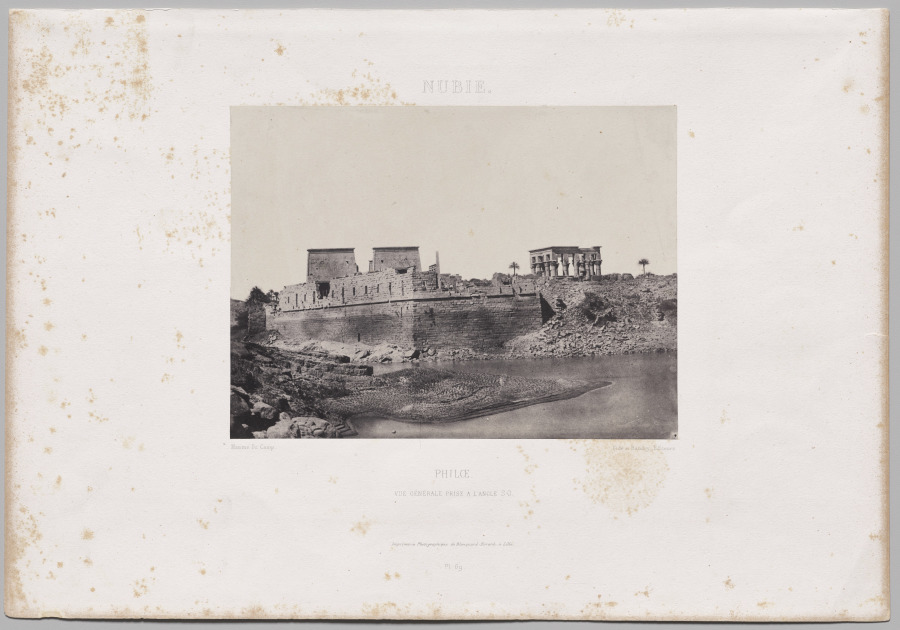
Vue générale prise à l'angle sud-ouest, Philoe, 1849–50, by Maxime Du Camp
Maxime Du Camp · The Cleveland Museum of Art · Severance and Greta Millikin Purchase Fund
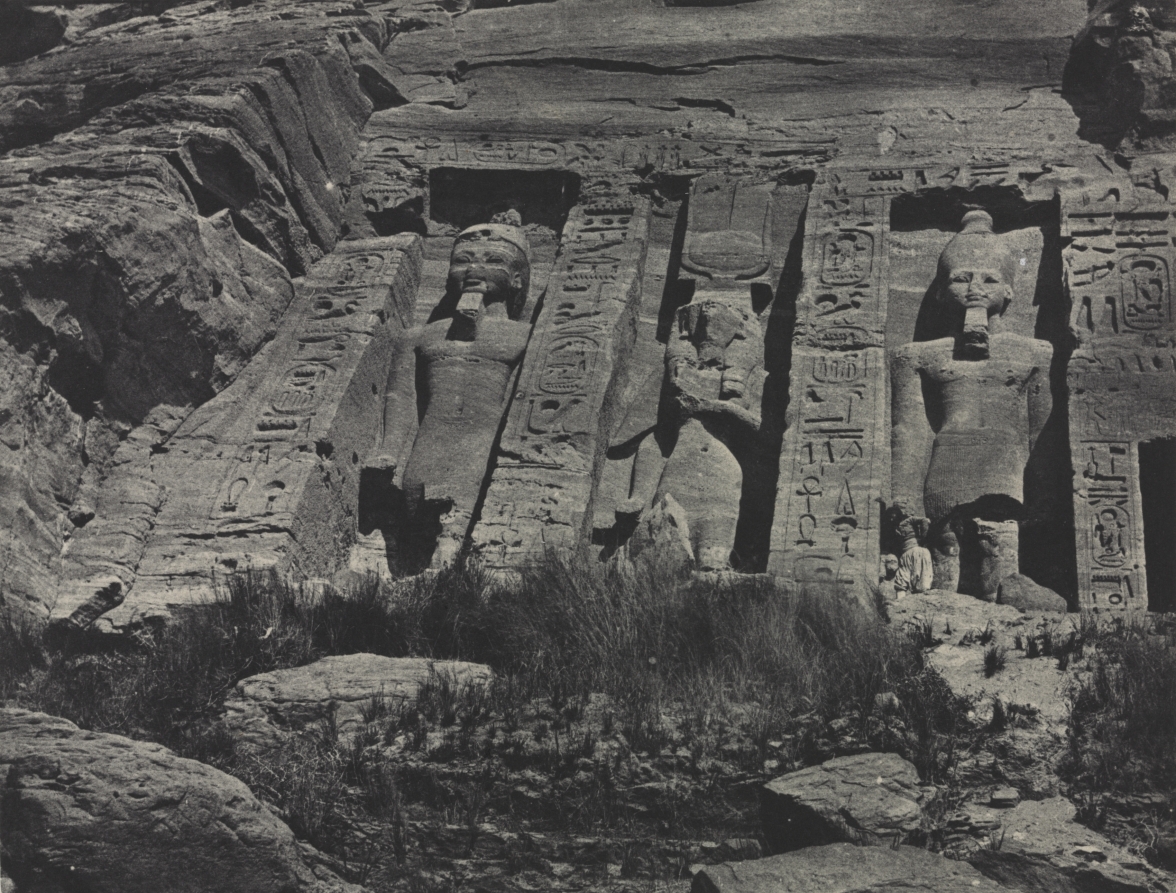
Southern Portion of the Rock-cut Temple of Hathor, Abu Simbel, 1850, by Maxime Du Camp
Maxime Du Camp · The Cleveland Museum of Art · John L. Severance Fund
Life and career
Dated record
Life and career
Explore 1822–1894
The full dated record · 3 entries
1822
Maxime Du Camp was born in 1822.
1847
Par les champs et par les greves is dated 1847.
1894
Maxime Du Camp died at Baden-Baden.
Notes from the source article
Cited by Wikipedia
Notes from the source article
These works are cited by the source article, in its own numbering. They are recorded as its citations, not as sources VALÉORINE has verified.
- 1.Francine Du Plessix Gray. Rage and Fire: A Life of Louise Colet—Pioneer, Feminist, Literary Star, Flaubert's Muse. Simon and Schuster. 192. 1995. 0-684-80453-0.
- 2.Gustave Flaubert, Francis Steegmüller. The Letters of Gustave Flaubert: 1830–1857. Harvard University Press. 112. 1980. 0-674-52636-8.
- 3.Deborah Hayden. Pox: genius, madness, and the mysteries of syphilis. Basic Books. 138. 2003. 0-465-02881-0.
- 4.Metropolitan Museum of Art. Heilbrunn Timeline of Art History.
- 5.Alexandra Smith, University of Canterbury, New Zealand, Towards Poetics of Exile, Ars Interpres, No. 2
- 6.Du Camp, Maxime. Théophile Gautier. Hachette. 1890.
- 7.Review of Théophile Gautier by Maxime Du Camp, translated by J. E. Gordon, preface by Andrew Lang. The Academy. 44. 1121. 362–363. 28 October 1893.
- 8.Du Camp, Maxime. Paris, ses organes, ses fonctions, sa vie dans la seconde moitié du XIX e siècle. Hachette.
- 9.Du Camp, Maxime. Souvenirs littéraires. Hachette.
- 10.The Nation. Du Camp's 'Convulsions of Paris'. 210–211. 1878-03-08.
References
Citations
References
Each reference names the institution holding it, so a reader may go to the document itself.
reference work
Wikidata, structured authority record Q918268: Maxime Du CampWikimedia Foundation
Secondary witnessreference work
Secondary witness
Further particulars
Held on the record
Further particulars
Open the remaining particulars
The authorities additionally record the headings Maksim Di︠u︡kan, Maximos Dykan, Maxime DuCamp, Maxine de Camp and Maxime DuChamp. His recorded language was French. His work is associated with literary realism. Recorded position is seat 33 of the Académie française. He belonged to Académie Française and Société héliographique. He worked at Paris and rue du Rocher. Camp received Officer of the Legion of Honour. Recorded as writer, photographer, poet and journalist.
Identity and origins
Career and activity
Recognition and collections
Work by Maxime Du Camp is
Art Institute of Chicago, The Nelson-Atkins Museum of Art, National Gallery of Victoria and National Gallery of Canada
Par les champs et par les greves
1847
The Encyclopedia exists whether or not anything is for sale. Corrections are recorded rather than overwritten, and every version of this record is kept. Published 14 August 2026.
Elsewhere in Photography
11,392 published records in this field, each with its sources named.
- Max WolfPhotographer
- Max YavnoPhotographer
- Maxim BilovitskiyPhotographer
- Maxim DondyukPhotographer
- Maximilian MundtPhotographer
- Maximilian SchönherrPhotographer
- Maxine WalkerPhotographer
- May MirinPhotographer
Best supported in this field
For owners
Own a work by Maxime Du Camp?
A specialist will read what you send and tell you what the house can establish, what it cannot, and whether the object is suited to sale. There is no charge and no obligation. The object stays with you throughout; nothing is shipped to us unless it is arranged in writing beforehand.