
Max Mannheimer
Illustration — Mannheimer speaking about the liberation of Dachau on May 5, 2002 Max Mannheimer (6 February 1920 – 23 September 2016) was an author, painter and survivor of the Holocaust. Except for one brother, he lost his entire family in the Holocaust, including his new wife. For decades, he did not speak about his experiences, despite nightmares and depression.
Also recorded as ben jakov
Max Mannheimer

Freud · CC BY-SA 3.0
- Nationality
- Czechoslovakia · West Germany
- Occupation
- writer · painter · merchant
- Honours
- Munich München leuchtet award · Bavarian Order of Merit · Bayerische Verfassungsmedaille in Gold · Knight Commander's Cross of the Order of Merit of the Federal Republic of Germany · honorary doctor of the University of Munich · Knight of the Legion of Honour
- Languages
- German · Hebrew
VALÉORINE Encyclopedia
VALÉORINE documentary reading
Documentary summary
Illustration — Mannheimer speaking about the liberation of Dachau on May 5, 2002 Max Mannheimer (6 February 1920 – 23 September 2016) was an author, painter and survivor of the Holocaust. Except for one brother, he lost his entire family in the Holocaust, including his new wife. For decades, he did not speak about his experiences, despite nightmares and depression.
Admitted source layer · organised and presented by VALÉORINE
Reference Check
Propose documentary evidence for Max Mannheimer. A contribution is never written directly as fact: identity, source, rights and evidence gates still decide.
Sign in to contribute
World of VALÉORINE
Documentary connections
Only confirmed graph relationships appear here. Images are shown only when their identity and reuse rights both pass the documentary gate.
Documentary evidence
Documentary basis
Authority files
wikidata · Q872108 · wikipedia · Max Mannheimer
In this article
Early life
Early life
In 1986, while traveling in the United States, he happened to see a swastika and the sight of it triggered a nervous breakdown. After that, he began to speak about his experiences at the hand of the Nazis, giving talks to young people and adults, at school and universities. Mannheimer won many honors and awards for his work.
Mannheimer was born in Neutitschein, North Moravia, in what was then Czechoslovakia and is today in the Czech Republic. His mother, Margarethe (Markéta), née Gelb, was born 4 April 1893 in Uherský Brod, near the Hungarian border. His father was Jakob Leib Mannheimer, born 24 May 1888 in Myślenice, Poland. • Illustration — Mannheimer in 2005
Nazi era
Nazi era
In October 1938, however, Nazi Germany annexed the Sudetenland, according to the Munich Agreement dated 29 September 1938. Weeks later, on the night of November 9th, Kristallnacht, his father was arrested and taken into "protective custody". At 18, Mannheimer would have been taken too, but his mother lied to the police about his age. His father was released after promising to leave Germany within eight days and, on 27 January 1939, the family moved to Ungarisch Brod, today known as Uherský Brod. Within months, Nazi troops and military units were being seen in their new city and the square near their home was renamed after Adolf Hitler. Their freedoms were increasingly restricted by the laws against Jews, but Mannheimer nonetheless was married and began to make a life for himself. In 1942, Mannheimer's brother, Erich, was deported to Auschwitz. In January 1943, Mannheimer, his mother, father, brothers Ernst (Arnošt) and Edgar, his 15-year-old sister, Katharina (called Käthe), and his 22-year-old wife, Eva (née Bock), were transported from Uherský Brod and after a brief stop at Theresienstadt, on 1 February 1943 (four days before Mannheimer's 23rd birthday) they all were deported to Auschwitz. Mannheimer lost most of his family upon arrival at Auschwitz. His parents, sister and wife were taken in the first selektion. Shortly thereafter, his brothers Erich and Ernst were taken. Mannheimer survived three selections — and an operation in the Auschwitz hospital by a doctor who was also a prisoner. In October 1943, Mannheimer and his younger brother, Edgar, were sent to the Warsaw Ghetto to clear rubble. In July 1944, he was sent on a death march to Dachau, arriving on 6 August 1944. After three weeks in quarantine, he was sent to Allach, a Dachau subcamp where he worked at a BMW factory. At the beginning of 1945, he and his brother were sent to Mühldorf subcamp, which was evacuated by train on 28 April 1945. The train was liberated by American troops on 30 April 1945 in Seeshaupt. In the end, only Mannheimer and his brother Edgar survived.
After liberation
After liberation
After his release from a lazaret, and weighing a scant 75 pounds (34 kilograms), he swore he would never again set foot on German soil. However, shortly thereafter, he fell in love with a young German, Elfriede Eiselt, who had been in the German Resistance, whom he married, returning to Germany in 1946. His second wife died from cancer in 1964. Until his death, he was married to an American and lived near Munich. He had a daughter from his second marriage and a son from his third. From 1947 to 1962, he worked at a Jewish welfare agency and a newspaper. He began painting under the name ben jakov (son of Jakob), in the 1950s. His first attempt to make paintings about the past was in 1954. His first show was in 1975 and numerous one-man shows in Germany and other countries followed. Paintings by "ben jakov" are untitled. He became known through his lectures about his experiences in the concentration camps. For decades, he never spoke about his experiences, but had suffered nightmares and depression. On a trip to the United States in 1986, he happened to see a swastika and fell apart, suffering a nervous breakdown. Since the mid-1980s, he has been giving lectures to young people and adults in schools, universities and elsewhere as an eyewitness to the horrors of Third Reich and the Nazi era. He also gives groups of school children tours of Dachau. He says that the lectures are a form of therapy for him, that he'd like to forget the past because it has given him nightmares and caused him depression, but feels a duty to those who did not survive to never forget. Mannheimer was an honorary member of Gegen Vergessen – Für Demokratie ("Against Forgetting - For Democracy"), the chairman of which was Joachim Gauck. Mannheimer was also chairman of "Lagergemeinschaft Dachau" and vice president of Comité International de Dachau (International Dachau Committee).
Later years
Later years
• Illustration — Mannheimer touring Dachau with Vice President Joe Biden in 2015 During campaigning for the 2013 German federal election, he invited Chancellor Angela Merkel to visit Dachau, making her the first chancellor to visit the former concentration camp. Though residents praised Merkel's move, it was also viewed as a potential electoral ploy. He died on 23 September 2016, aged 96.
Life and career
Dated record
Life and career
The full dated record · 2 entries
1920
Max Mannheimer born at Nový Jičín.
2016
Max Mannheimer died at Munich.
Places
Named by the record
Places
Only places the record itself states, plotted where the house gazetteer settles their coordinates. Nothing is inferred from a name or a nationality.
Nový Jičín.
Birth place
Munich.
Death place
Books
• Spätes Tagebuch. Pendo Verlag, Zürich 2005, • A Diary Delayed. (English translation by Kathryn Woodard). Oettingen Press, 2018.

Max Mannheimer, author, painter and survivor of the Holocaust
Michael Lucan
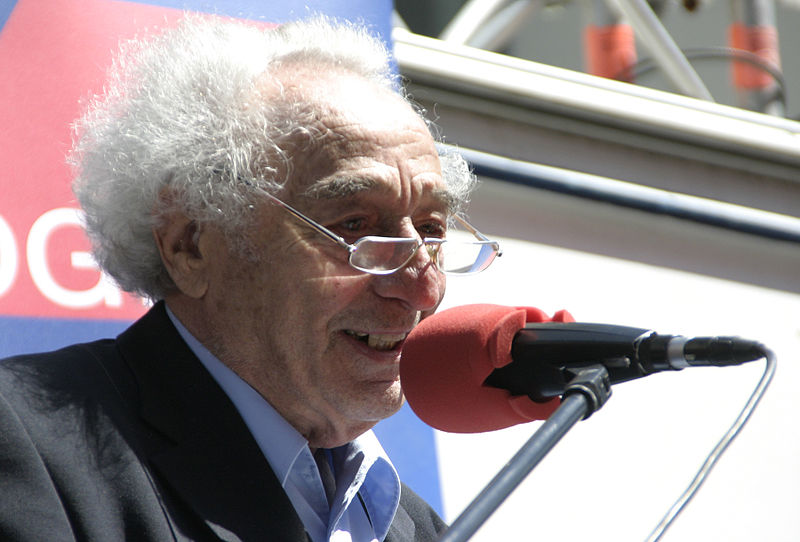
Max Mannheimer, author, painter and survivor of the Holocaust
Michael Lucan
Where the work is held
Recognition and collections
Max Mannheimer received Munich "München leuchtet" award, Bavarian Order of Merit, Bayerische Verfassungsmedaille in Gold, Knight Commander's Cross of the Order of Merit of the Federal Republic of Germany, honorary doctor of the University of Munich and Knight of the Legion of Honour.
Honors and awards
Mannheimer was awarded the Waldemar von Knoeringen Prize from the Georg von Vollmar Academy. The prize is awarded every two years to outstanding individuals who advance the cause of labour and democratic socialism. Other awards and honors include: • Knight of the French Legion of Honor (Chevalier de la Légion d'Honneur) • Georg von Vollmar Medal • Wilhelm Hoegner Prize • Auschwitz Cross • Honorary citizen, City of Neutitschein • Upper Bavarian Cultural Prize, 2005 • Federal Cross of Merit • Bavarian Order of Merit • Bavarian Constitutional Medal, (silver) • Honorary doctorate, LMU Munich, 2000 • Bavarian Constitutional Medal, (gold), 2009
Notes from the source article
Cited by Wikipedia
Notes from the source article
These works are cited by the source article, in its own numbering. They are recorded as its citations, not as sources VALÉORINE has verified.
- 1."Der weiße Rabe - Max Mannheimer" Bayerischer Rundfunk. Article about the film Der weiße Rabe ("The white raven") about Mannheimer. Retrieved May 3, 2010
- 2."10. November 1938 - 'Kristallnacht'", Mannheimer's memories of Kristallnacht, republished from haGalil onLine (9 November 1996) Retrieved April 2, 2019
- 3."About Dr. Max Mannheimer" Short biography.
- 4.Database of victims: Markéta Mannheimerová. Holocaust.cz.
- 5.Database of victims: Jakub Leib Mannheimer. Holocaust.cz.
- 6.Database of victims: Arnošt Mannheimer. Holocaust.cz.
- 7.Database of victims: Kateřina Mannheimerová. Holocaust.cz.
- 8.Database of victims: Eva Mannheimerová. Holocaust.cz.
- 9."Ich konnte nie hassen" Süddeutsche Zeitung online (6 February 2010). "I could never hate", an article on Mannheimer's 90th birthday. Retrieved 3 May 2010
- 10.Brief timeline from Mannheimer's life Retrieved 3 May 2010
- 11.Max Mannheimer aka ben jakov + the white raven Retrieved 3 May 2010
- 12."Anders als Cäsar oder Napoleon kann man mich buchen" Zeit Online (30 March 2010) Retrieved 3 May 2010
- 13.German chancellor visits former Nazi camp. Al Jazeera.
- 14.European Pressphoto Agency. Max Mannheimer dead at 96.
References
Citations
References
Each reference names the institution holding it, so a reader may go to the document itself.
reference work
Secondary witnessreference work
Secondary witness
Further particulars
Held on the record
Further particulars
Open the remaining particulars
Max Mannheimer is recorded as having received Munich "München leuchtet" award, Bavarian Order of Merit and Bayerische Verfassungsmedaille in Gold.
The Encyclopedia exists whether or not anything is for sale. Corrections are recorded rather than overwritten, and every version of this record is kept. Published 16 August 2026.
Elsewhere in Books
39,078 published records in this field, each with its sources named.
- Max LinderAuthor
- Max LoreauAuthor
- Max LucadoAuthor
- Max LüscherAuthor
- Max ManusAuthor
- Max MellAuthor
- Max MichelsonAuthor
- Max MutchnickAuthor
Best supported in this field
For owners
Own a work by Max Mannheimer?
A specialist will read what you send and tell you what the house can establish, what it cannot, and whether the object is suited to sale. There is no charge and no obligation. The object stays with you throughout; nothing is shipped to us unless it is arranged in writing beforehand.