
Matteo di Giovanni
Illustration — Mystical Crucifixion by Matteo di Giovanni, Princeton University Art Museum, 1450 • Illustration — Judith with the Head of Holofernes, painted between c. 1490 and c. 1495 (Eskenazi Museum of Art) Matteo di Giovanni (c.
Also recorded as Matteo · Matteo di Giovanni di Bartolo · Matteo da Siena · Matteo di Giovanni gen Matteo da Siena
Matteo di Giovanni

Attributed to Matteo di Giovanni · Own work, Croquant · Public domain
- Died
- 1495 · Siena.
- Occupation
- painter
- Fields
- Scuola degli Albanesi
- Movements
- Sienese school
- Known for
- The Birth of the Virgin · Adoration by the Shepherds lunette · Saint Augustine's Vision of Saints Jerome and John the Baptist · The Dream of Saint Jerome · Altarpiece of St. Pietro a Ovile and Annunciation · Assumption of the Virgin and Four Saints · Floor mosaic of the Slaughter of the Innocents · Madonna and Child with four Saints
VALÉORINE Encyclopedia
VALÉORINE documentary reading
Documentary summary
Illustration — Mystical Crucifixion by Matteo di Giovanni, Princeton University Art Museum, 1450 • Illustration — Judith with the Head of Holofernes, painted between c. 1490 and c. 1495 (Eskenazi Museum of Art) Matteo di Giovanni (c.
Admitted source layer · organised and presented by VALÉORINE
Reference Check
Propose documentary evidence for Matteo di Giovanni. A contribution is never written directly as fact: identity, source, rights and evidence gates still decide.
Sign in to contribute
World of VALÉORINE
Documentary connections
Only confirmed graph relationships appear here. Images are shown only when their identity and reuse rights both pass the documentary gate.

Documentary evidence
Documentary basis
Authority files
wikidata · Q1373474 · wikipedia · Matteo di Giovanni
In this article
Biography
Biography
1430 – 1495) was an Italian Renaissance artist from the Sienese School.
The field of work recorded is Scuola degli Albanesi. Places of work recorded in the authority are Siena. Works named in the authority record are The Birth of the Virgin, Adoration by the Shepherds lunette, Saint Augustine's Vision of Saints Jerome and John the Baptist, The Dream of Saint Jerome, Altarpiece of St. Work by Matteo di Giovanni is recorded in the collections of Städel Museum, Harvard University Center for Italian Renaissance Studies, Metropolitan Museum of Art, Diocesan Museum of Holy Art and Santa Maria della Scala.
Matteo di Giovanni di Bartolo was born in Borgo Sansepolcro around 1430. His family relocated to Siena and he is firmly associated with the art of that city. Matteo was twice married—first in 1463 to a wealthy noble woman and, after her death, to a rich widow, who made it possible for Matteo to buy real estate and by whom he fathered many children. Documentation concerning the early phases of Matteo's life and career as an artist is scanty and nothing is recorded about his apprenticeship. Left to conjecture, we might imagine him as having been trained in the workshop of sculptor/painter Lorenzo di Pietro, better known as Vecchietta but he clearly was influenced by Stefano di Giovanni, called Sassetta and Domenico di Bartolo. The miniaturist Girolamo da Cremona and the Florentine painter Antonio del Pollaiuolo also seemed to have contributed to Matteo's distinctive style. In 1452, Matteo entered into partnership with the painter Giovanni di Pietro, and the two shared living quarters in the San Salvatore neighborhood of Siena in 1453. That Matteo, at this time, is recorded as having colored and gilded a sculpture of the Archangel Gabriel by the celebrated Sienese sculptor Jacopo della Quercia is a reminder of the sort of tasks performed by an artist in the 15th century. Matteo and Giovanni also collaborated in the embellishment of organ shutters in the Siena Cathedral and in the decoration of the San Bernardino Chapel in that cathedral. That Matteo had succeeded in establishing an artistic reputation is demonstrated by his selection as one of four Sienese painters who were to furnish altarpieces for the chapels of the Pienza Cathedral erected as part of the urban renewal of the town. For this prestigious commission Matteo painted three altarpieces. Dating to the years 1460–62, these paintings offer a secure point from which to evaluate Matteo's early style and to reconstruct his development as an artist. The three paintings in Pienza also help to explain the next phase in his style. The first of these altarpieces, a large Madonna and Saints signed "Opus Matthei Johannis De Senis" depicts the enthroned Madonna surrounded by Sts. Catherine, Matthew, Bartholomew, and Lucy. The composition and figure types are reminiscent of those found in Sano di Pietro's paintings while the draperies recall the work of Vecchietta and the St. Catherine type is derived from Domenico di Bartolo. Above this panel, in a lunette, is a Flagellation of Christ scene, which, with its violent action, twisted but anatomically correct bodies, and volumetric plasticity, shows a familiarity with the progressive Florentine draftsmanship of Pollaiuolo. Work from Matteo's middle period includes an altarpiece dated to 1477 for the oratory of Santa Maria delle Nevi in Siena; the altarpiece of Santa Barbara, dated to 1478–79 commissioned by the baker's guild for their chapel in the Church of San Domenico, Siena; and what is considered Matteo di Giovanni's masterpiece, the Massacre of the Innocents, which is signed and dated 1482. • Illustration — Matteo di Giovanni, Santa Barbara with Mary Magdalene and Catherine of Alessandria, c. 1478 During his mature period, Matteo began to paint idyllic and naturalistic landscape scenes employing delicate, lyrical colors derived from the Umbrian school of painting. Matteo's brand of eclecticism tended to evolve from local taste and tradition. For this reason it is not surprising to find him producing delicate, sweet panels of the Madonna and Child, such as the panel from the Kress Collection now in the Columbia Museum of Art, depicting the Madonna and child with Saints Sebastian and Catherine of Siena and the Madonna and Child with Saint Christopher and Saint Catherine now in the Pushkin Museum in Moscow, at almost the same moment that he was painting Judith with the Head of Holofernes (c.1490) now in the Indiana University Art Museum, Bloomington and the horrific events of The Massacre of the Innocents. Matteo di Giovanni died in Siena in 1495. He is credited with teaching Guidoccio Cozzarelli (1450–1516/17) of Siena, an altarpiece painter and miniaturist.
Gallery
Gallery
• Illustration — The Calling of Saints Peter and Andrew (1470s), tempera with oil and gold on panel, 11 9/16 x 12 7/8 in. (29.3 x 32.7 cm), Clark Art Institute
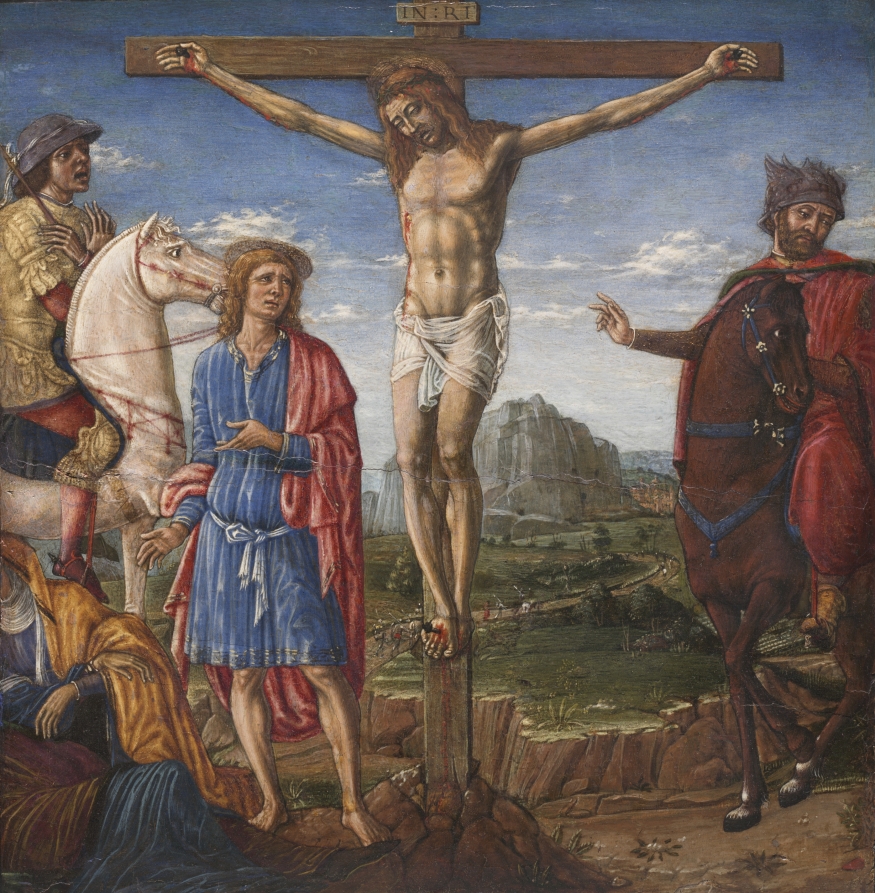
The Crucifixion, 1470s, by Matteo di Giovanni
Matteo di Giovanni · The Cleveland Museum of Art · Bequest of James Parmelee
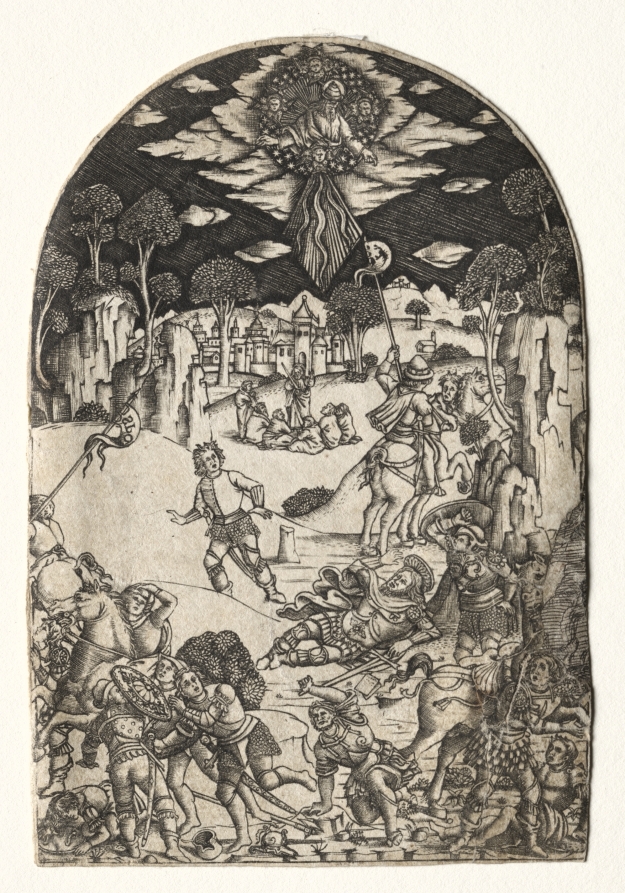
The Conversion of Saint Paul, late 1400s, by Matteo di Giovanni
Matteo di Giovanni · The Cleveland Museum of Art · Gift of The Print Club of Cleveland
Life and career
Dated record
Life and career
The full dated record · 2 entries
1435
Matteo di Giovanni born at Sansepolcro.
1495
Matteo di Giovanni died at Siena.
Places
Named by the record
Places
Only places the record itself states, plotted where the house gazetteer settles their coordinates. Nothing is inferred from a name or a nationality.
Sansepolcro.
Birth place
Siena.
Death place
Primary material
Documents and archives
authority record
- Wikidata, structured authority record Q1373474: Matteo di Giovanni
General reference · Wikidata
reference work
- “Matteo di Giovanni”, English Wikipedia, consulted as further reading
Reputable secondary · Wikipedia
Notes from the source article
Cited by Wikipedia
Notes from the source article
These works are cited by the source article, in its own numbering. They are recorded as its citations, not as sources VALÉORINE has verified.
- 1.This survey of Matteo di Giovanni's career is based upon that given by Alecia Holland Harper for an entry in Charles R. Mack, European Art in the Columbia Museum of Art, including the Samuel H. Kress Collection, Vol. I: The Thirteenth through the Sixteenth Century, 105–06
- 2.The contract for the altarpiece has survived, documented in: Creighton E. Gilbert, Italian Art 1400-1500: Sources and Documents Prentice-Hall, 1980. , p. 38–40.
Bibliography printed in the source article · 3
References
Citations
References
Each reference names the institution holding it, so a reader may go to the document itself.
authority record
Secondary witnessreference work
Secondary witness
People, houses and institutions
Knowledge graph
People, houses and institutions
Teachers, collaborators, publishers and institutions recorded against this person, each on a stated basis.
Associated with
1- Sienese schoolMovement
Established from a fact already recorded on a verified source.
The Encyclopedia exists whether or not anything is for sale. Corrections are recorded rather than overwritten, and every version of this record is kept. Published 17 August 2026.
Elsewhere in Paintings
19,261 published records in this field, each with its sources named.
- Matteo BonechiArtist
- Matteo BorboniArtist
- Mattéo BrondyArtist
- Matteo CesaArtist
- Matteo GhidoniArtist
- Matteo GiovanettiArtist
- Matteo IngoliArtist
- Matteo LappoliArtist
Best supported in this field
For owners
Own a work by Matteo di Giovanni?
A specialist will read what you send and tell you what the house can establish, what it cannot, and whether the object is suited to sale. There is no charge and no obligation. The object stays with you throughout; nothing is shipped to us unless it is arranged in writing beforehand.