
Master E. S.
1420; previously known as the Master of 1466) is an unidentified German engraver, goldsmith, and printmaker of the late Gothic period. He was the first major German artist of old master prints and was greatly copied and imitated. The name assigned to him by art historians, Master E. S, is derived from the monogram, E. S, which appears on eighteen of his prints (variants appear on others).
Also recorded as Monogrammist E. S. · Master E S · Monogrammist E S · Meister E. S.
Master E. S.
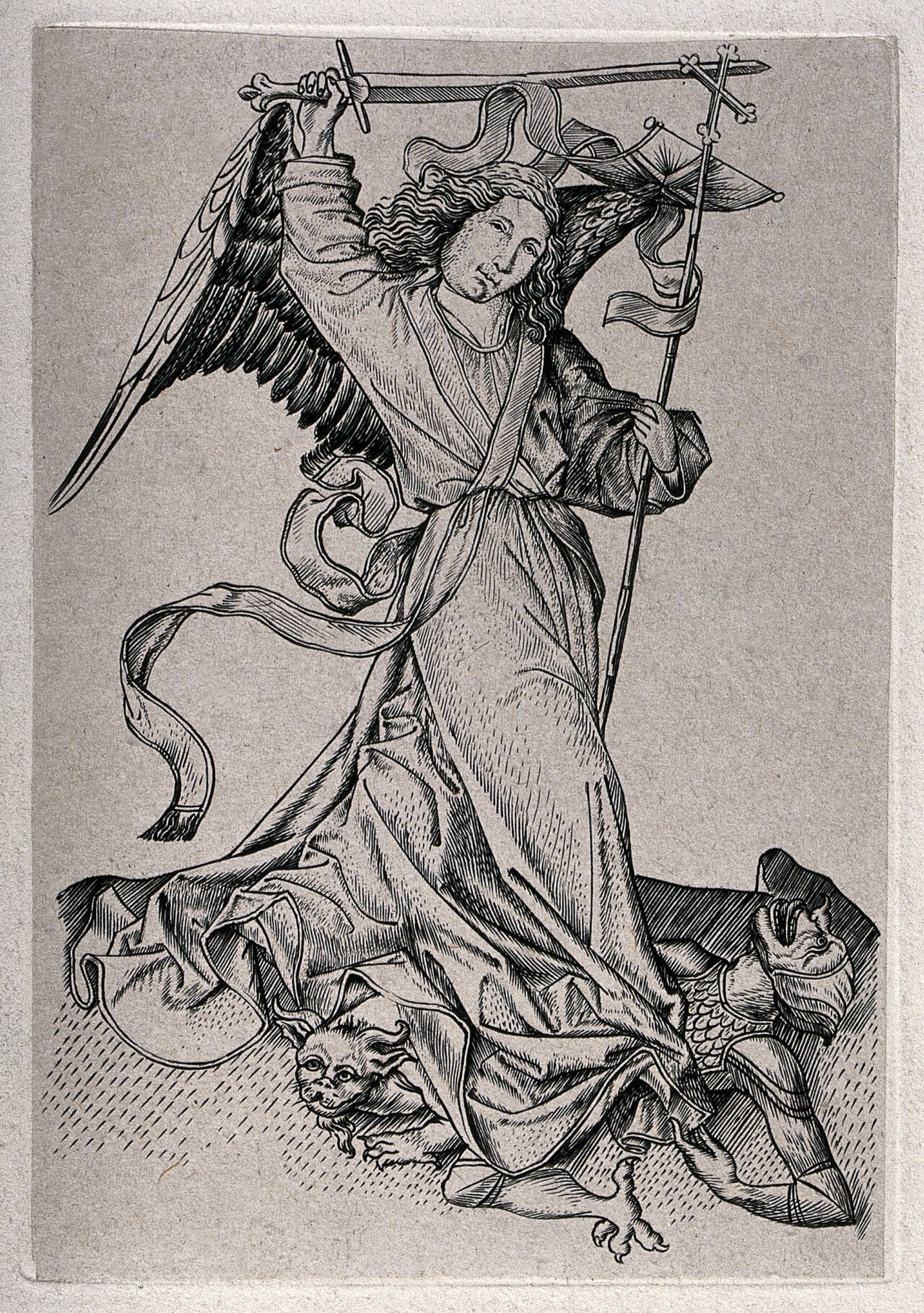
Master E. S. · Wellcome Collection, London · Wellcome Collection · Public Domain Mark
- Born
- Master E. S. was born, sources differ on the date (in 1420 and about 1430).
- Died
- the 1460s.
- Nationality
- Germany.
- Occupation
- goldsmith, painter, engraver, copper engraver, graphic artist, draftsperson and artist.
- Movements
- Gothic art.
- Known for
- Saint Antony Abbot, Saint Sebastian on the tree and Madonna and Child.
VALÉORINE Encyclopedia
VALÉORINE documentary reading
Documentary summary
1420; previously known as the Master of 1466) is an unidentified German engraver, goldsmith, and printmaker of the late Gothic period. He was the first major German artist of old master prints and was greatly copied and imitated. The name assigned to him by art historians, Master E. S, is derived from the monogram, E. S, which appears on eighteen of his prints (variants appear on others).
Admitted source layer · organised and presented by VALÉORINE
Note VALÉORINE
Master E. S. was a German artisan, artist and copper engraver, among other activities.
The artisan worked in Constance. Master E. S. was associated with Gothic art.
Works include Madonna and Child, Saint Antony Abbot and Saint Sebastian on the tree. Languages used include German.
Composed from admitted, traceable facts · 30 September 2026
VALÉORINE
Reference Check
Propose documentary evidence for Master E. S.. A contribution is never written directly as fact: identity, source, rights and evidence gates still decide.
Sign in to contribute
Documentary evidence
Documentary basis
Authority files
wikidata · Q70783 · wikipedia · Master E. S.
In this article
Life
Life
The title, Master, is used for unidentified artists who operated independently. He was probably the first printmaker to place his initials on his work. • Illustration — Delilah cutting Samson's hair, c. 1460 Remaining signed works by E. S. indicate that he was active in printmaking from 1450 to 1467, the latest date to appear on one of his prints. After this date, he is presumed to have died. He was the most distinguished German engraver before Martin Schongauer.
• Illustration — Lovers on a Grassy Bank. The man has discarded his patten overshoes; the woman still wears hers. Master E. S. probably came from southwestern Germany or Switzerland, as did the engraver called the Master of the Playing Cards. This view rests mainly on stylistic comparisons with the contemporary painting of that region. Although evidence indicates that he was most active in the Upper Rhine region, there also is evidence that he visited Mainz, to the south on the Rhine at the confluence of the Main River opposite Wiesbaden, a major economic and cultural centre. None of the attempts to match documented persons with his initials have met with general acceptance. The term master meant someone who had completed an apprenticeship and ran his own workshop, as E. S. clearly did. Marriage and employing apprentices to learn the skills could sometimes also be requirements. E. S. probably came from a background and training as a goldsmith, rather than as a painter. He sometimes used goldsmith punches in his prints (for example, to make the circles on the borders of the clothes in the Delilah print above) and some works are clearly designs for metalwork. He was the first printmaker to sign his prints with an engraved monogram, which was standard practice on significant pieces of metalwork. He engraved two images of Saint Eligius, the patron-saint of goldsmiths. He liked to fill his engravings with decorative detail, sometimes overloading the composition, and only slowly does a sense of volume or recession develop in his work. Since his earliest prints show a practiced use of the burin, he is presumed to have worked as a goldsmith for some years before beginning printmaking. His date of birth is estimated on this basis. His level of production of prints probably means that he worked on these only during his later years. Another important printmaker and goldsmith, Israhel van Meckenem, was probably his leading assistant at the end of his career and forty-one of his plates passed to him, being reworked by van Meckenem.
Work
Work
• Illustration — Letter N of the Fantastic Alphabet, Master E. S., c. 1465 Shestack divides the engravings of E. S. into three stylistic periods: around 1450, up to 1460, and after 1460. During the second period he made significant technical developments. Firstly, deeper incisions with the burin, which allowed more impressions to be taken from each plate, although the number still may have been limited to about sixty or so, before wear on the plate began to show and reworking was necessary for it to be used again. His use of hatching (parallel lines) and cross-hatching to depict shading and volume, steadily grew more sophisticated and his figure-drawing became more confident, sometimes overconfident. Many figures of this period have contorted poses even when at rest. In works from the third period, his figures are more relaxed and flat surfaces are given prominence in the compositions. Many faces of his subjects have a rather pudding-like appearance, and are overly-large for their bodies, which diminishes the quality of otherwise, fine works. Much of his work still has great charm, and the secular and comic subjects he engraved are rarely found in the surviving painting of the period. Lehrs catalogues three hundred and eighteen engravings by E. S. and of these, ninety-five are unique, and fifty exist in only two impressions (copies). There are a further thirty-eight engravings by his probable assistant, Israhel van Meckenem, which are considered to be copies of engravings by E. S. which have not survived. In total, Shestack estimates, there may have been about five hundred engravings by E. S. Hind notes the influence of the Master of the Playing Cards on the work of Master E. S. He adds that "E. S. does not rank high as an artist, but on the technical side he was one of the greatest influences in the progress of the art of engraving."
Ars Moriendi
Ars Moriendi
He produced a series of eleven engravings for the Ars moriendi (The Art of Dying), a very popular devotional work. These were no doubt intended to be inserted into a manuscript copy of the book. The very controversial question of whether these were copies of woodcut versions of the same compositions in blockbooks was effectively solved in 1942, when Fritz Saxl published a set of manuscript illuminations using the same compositions found in the London library of the Wellcome Institute. These clearly predated all printed versions, all of which now can be seen to be derived from no doubt different versions of manuscript drawings in the same tradition. It has also been suggested that E. S. later designed the woodcuts for the earliest of the blockbooks, which are now seen as being created later than his engravings. • Illustration — Christ as Man of Sorrows between Four Angels • Illustration — Madonna with Angel Giving Roses • Illustration — Temptation of Despair, from the Ars Moriendi series • Illustration — The Knight and the Lady • Illustration — Designs for Goldsmiths • Illustration — Madonna and Child, with later hand-colouring • Illustration — Playing-card: Jack of Birds
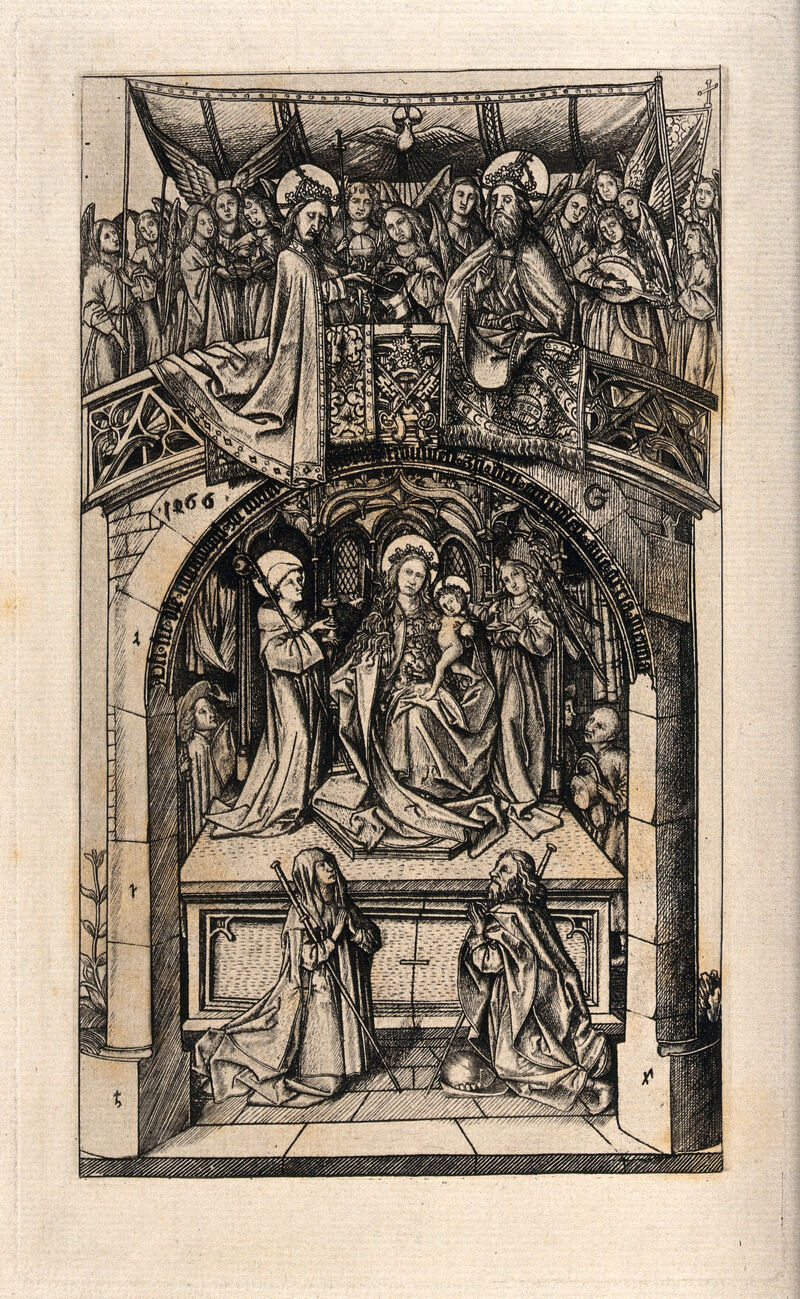
The Holy Trinity and Saint Mary (as the Blessed Virgin of Einsiedeln) with the Christ Child, Saint Meinrad and pilgrims. Photoengraving after the Master E.S., 1466., by Master E. S.
Master E. S. · Wellcome Collection, London · Wellcome Collection
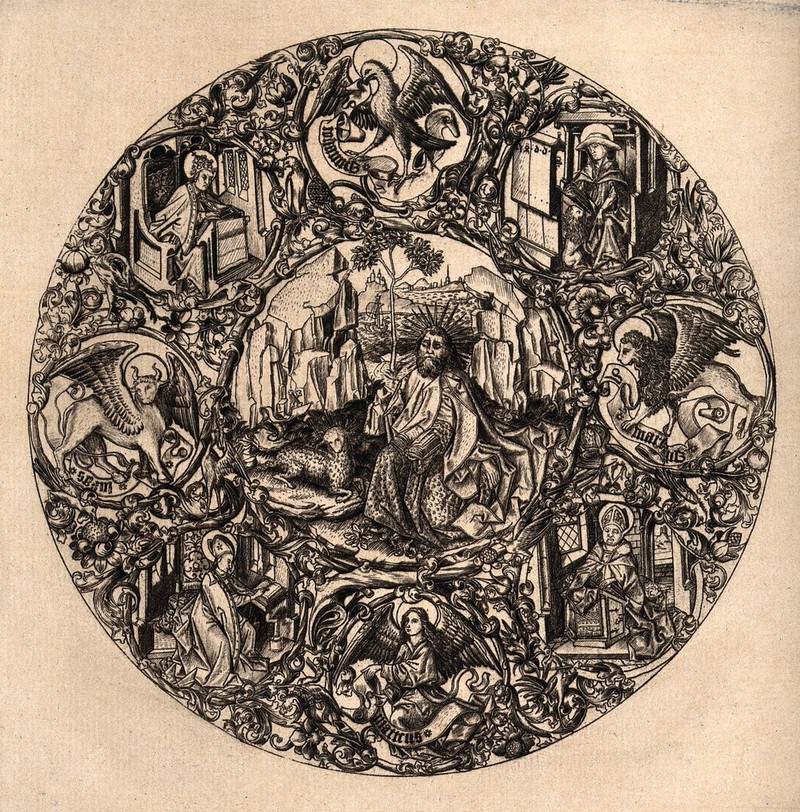
Saint John the Baptist or the Evangelist (?), with the Doctors of the Church and the symbols of the evangelists. Etching (?) after the Master E.S., 1466., by Master E. S.
Master E. S. · Wellcome Collection, London · Wellcome Collection
Drawings
• Illustration — Baptism of Christ a drawing attributed to Master E. S., Louvre Two very fine drawings, universally accepted as works by E. S., are in Berlin and the Louvre, but there are others which are disputed. The composition of the Baptism of Christ (picture at right), which is in the Louvre, was turned into two engravings by E. S., in doing which he complicated the compositions, filling empty spaces with new detail. Shestack considers that this reveals that his compositional method, here and perhaps commonly, was to begin by copying accurately a painting or other work by someone else. He then, in working on the engraving, introduced extra detail in a goldsmith's style.
Primary material
Documents and archives
Institutional database
- Wikidata, structured authority record Q70783: Master E. S.
Scholarly · Wikimedia Foundation
reference work
- “Master E. S.”, English Wikipedia, consulted as further reading
Reputable secondary · Wikipedia
Notes from the source article
Cited by Wikipedia
Notes from the source article
These works are cited by the source article, in its own numbering. They are recorded as its citations, not as sources VALÉORINE has verified.
References
Citations
References
Each reference names the institution holding it, so a reader may go to the document itself.
Institutional database
Wikidata, structured authority record Q70783: Master E. S.Wikimedia Foundation
Institutional witnessreference work
Secondary witness
The Encyclopedia exists whether or not anything is for sale. Corrections are recorded rather than overwritten, and every version of this record is kept. Published 14 August 2026.
Elsewhere in Prints
4,138 published records in this field, each with its sources named.
- Mary Nimmo MoranEngraver
- Mary OberingEngraver
- Mary TannahillEngraver
- Massimo CampigliEngraver
- Master M ZEngraver
- Master of the Death of the VirginEngraver
- Master of the HousebookEngraver
- Master of the Lübeck BibleEngraver
Best supported in this field
For owners
Own a work by Master E. S.?
A specialist will read what you send and tell you what the house can establish, what it cannot, and whether the object is suited to sale. There is no charge and no obligation. The object stays with you throughout; nothing is shipped to us unless it is arranged in writing beforehand.