
Martín Luis Guzmán
Illustration — Martín Luis Guzmán. Guzmán Franco (October 6, 1887 – December 22, 1976) was a Mexican novelist and journalist. Along with Mariano Azuela and Nellie Campobello, he is considered a pioneer of the revolutionary novel, a genre inspired by the experiences of the Mexican Revolution of 1910.
Also recorded as Martin Luis Guzman · Martín Luis Guzmán Franco
Martín Luis Guzmán

User:Tatehuari el 14 de Agosto de 2007 · (AGN) Archivo General de la Nación · Public domain
- Born
- 1887. · Chihuahua City.
- Died
- 1976. · Mexico City.
- Nationality
- Mexico.
- Occupation
- journalist, writer, military personnel, diplomat and politician.
- Honours
- National Prize for Arts and Sciences.
- Languages
- Spanish.
VALÉORINE Encyclopedia
VALÉORINE documentary reading
Documentary summary
Illustration — Martín Luis Guzmán. Guzmán Franco (October 6, 1887 – December 22, 1976) was a Mexican novelist and journalist. Along with Mariano Azuela and Nellie Campobello, he is considered a pioneer of the revolutionary novel, a genre inspired by the experiences of the Mexican Revolution of 1910.
Admitted source layer · organised and presented by VALÉORINE
Note VALÉORINE
Martín Luis Guzmán (1887–1976) was a diplomat, journalist and military personnel, among other activities, of Mexican nationality. The diplomat was born in Chihuahua City and died in Mexico City. Martín Luis Guzmán was a member of Academia Mexicana de la Lengua and held the positions of Member of the Chamber of Deputies of Mexico and member of the Senate of Mexico.
Languages used include Spanish. Works are held at Biblioteca Virtual Miguel de Cervantes. Honours include National Prize for Arts and Sciences.
Composed from admitted, traceable facts · 26 September 2026
VALÉORINE
Reference Check
Propose documentary evidence for Martín Luis Guzmán. A contribution is never written directly as fact: identity, source, rights and evidence gates still decide.
Sign in to contribute
Documentary evidence
Evidence Panel
original value insufficient · checked 25 September 2026
- Identity
- resolved
- Independent source families
- 0
- Admitted assertions
- 0
- Open conflicts
- 0
Authority files
wikidata · Q267209 · wikipedia · Martín Luis Guzmán
In this article
Life
Life
He spent periods in exile in the United States and Spain. He founded newspapers, weekly magazines, and publishing companies. In 1958, he was awarded Mexico's National Prize in Literature.
The recorded working language is Spanish. Positions recorded include Member of the Chamber of Deputies of Mexico and member of the Senate of Mexico. Work by Martín Luis Guzmán is recorded in the collections of Biblioteca Virtual Miguel de Cervantes. Distinctions recorded are National Prize for Arts and Sciences.
Guzmán was born in Chihuahua, Chihuahua, the son of a colonel in the Federal Army, who was attached to the Mexican consulate in Phoenix, Arizona, U.S. His father was killed in one of the early skirmishes of the Mexican Revolution and Guzmán left for Mexico City. For several months in 1914, he was under the direct orders of General Francisco "Pancho" Villa, later writing a five-volume biography of Villa, Memorias de Pancho Villa (1936–1951). On Villa's orders, Guzmán witnessed the entry of Venustiano Carranza's Constitutionalist Army to Mexico City, following the fall of Victoriano Huerta's government in July 1914. Carranza had him jailed, since as an adherent of Villa, formerly a Constitutionalist general who had broken with Carranza, Guzmán was a political enemy. He was released during the factional dispute between the Constitutionalists and the Army of the Convention, led by Villa. Guzmán went abroad to Paris and Madrid in 1914, where he began writing articles for the Spanish weekly magazine, España, founded by José Ortega y Gasset, and became part of the circle of Spanish intellectuals. His first published work, La querella de México, was his assessment of Mexico's problems and limitations. Leaving Spain for the United States, he represented España and taught a short course at University of Minnesota, returning to Mexico briefly, where he worked at Mexican newspapers. Following the ouster of Carranza in 1920 by Sonoran generals Alvaro Obregón, Plutarco Elías Calles, and Adolfo de la Huerta, Guzmán returned to Mexico and became the private secretary to Alberto J. Pani, President Obregón's minister of foreign affairs. Guzmán was involved in the 1921 centenary of the achievement of Mexico's independence. He subsequently ran afoul of Obregón's government when Obregón sought to impose Calles as his successor. Guzmán backed Adolfo de la Huerta's 1923 unsuccessful rebellion against Obregón and Calles, and was forced into exile to Spain for a decade, becoming a Spanish citizen. He again became involved in journalism, but his largest contribution to writing was his work of revolutionary fiction, El águila y la serpiente. With the presidency of Lázaro Cárdenas (1934–40), who had turned against his political patron Calles, Guzmán was invited to return to Mexico, where he returned to journalism and began writing Memorias de Pancho Villa. Martin Luis Guzmán was a public figure in Mexico: he was elected to the Chamber of Deputies for the Federal District's 6th congressional district in 1922 and served as a senator for the Federal District from 1970 to 1976. He was also a member of the Mexican Academy of Language. He died suddenly on December 22, 1976, in Mexico City due an acute myocardial infarction. His widow Ana West died seven years after him, on October 21, 1983. She was 95 years old when, after being hospitalized for some days due to an acute bilateral pneumonia, she suffered a cardiac arrest and died.
Works
Works
His novels La sombra del caudillo (1929) and El águila y la serpiente (1928) depict the Mexican Revolution and its political aftermath, with both of which the author was familiar, having contributed both to revolutionary agitation and to the formation of the new revolutionary government. • La querella de México (1915) • A orillas del Hudson (1920) • El águila y la serpiente (1928) • La sombra del caudillo (1929) • Aventuras democráticas (1931) • Mina al mozo: Héroe de Navarra (1932) • Filadelfia: Paraíso de conspiradores (1933) • Kinchil (1946) • Memorias de Pancho Villa (1951) • Apunte sobre una personalidad (1954) • Muertes Históricas (1958) • Islas Marías, novela y drama (1959) • Pábulo para la historia (1961) • Necesidad de cumplir las Leyes de Reforma (1963) • Febrero de 1913 (1963) • Crónica de mi destierro (1964)
Life and career
Dated record
Life and career
The full dated record · 2 entries
1887
Martín Luis Guzmán was born in 1887 at Chihuahua City.
1976
Martín Luis Guzmán died in 1976 at Mexico City.
Places
Named by the record
Places
Only places the record itself states, plotted where the house gazetteer settles their coordinates. Nothing is inferred from a name or a nationality.
Chihuahua City.
Birth place
Mexico City.
Death place
References ==== Sources
References ==== Sources
• Encyclopædia Britannica
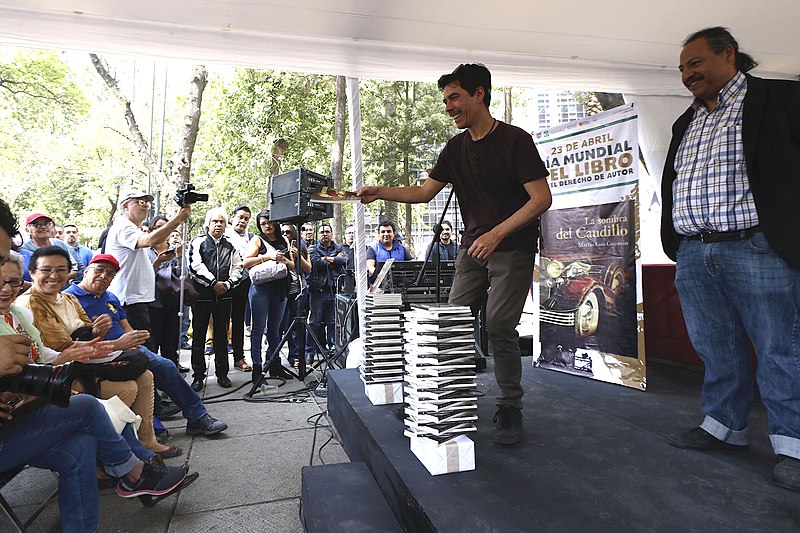
El martes, 23 de abril de 2019, en la Columna de la Independencia, inició la conmemoración del Día Mundial del Libro y de los Derechos de Autor, con la entrega del libro La sombra del caudillo, de Martín Luis Guzmán, de forma gratuita a transeúntes y automovilista; con la presencia de Paco Ignacio Taibo II y Francisco Pérez Arce, encargados y miembro del equipo editorial del FCE, respectivamente,
Milton Martínez / Secretaría de Cultura de la Ciudad de México
Notes from the source article
Cited by Wikipedia
Notes from the source article
These works are cited by the source article, in its own numbering. They are recorded as its citations, not as sources VALÉORINE has verified.
- 1.Camp, Roderic Ai. "Martín Luis Guzmán" in Encyclopedia of Latin American History and Culture, vol. 3, p. 157. New York: Charles Scribner's Sons 1996.
- 2.Perea, Héctor, "Martin Luis Guzmán Franco". p. 622.
- 3.Pera, "Martin Luis Guzmán Franco". p. 622-23.
- 4.Cámara de Diputados. Legislatura 30.
- 5.Perea, p. 623.
- 6.FLM–CONACULTA. Martín Luis Guzmán. Enciclopedia de la literatura en México.
- 7.Academia Mexicana de la Lengua. Martín Luis Guzmán. Académicos.
Bibliography printed in the source article · 10
- Encyclopædia Britannica
- Bruce-Novoa, Juan. "Martin Luis Guzmán's Necessary Overtures." Discurso Literario 4:1 (1986).
- Camp, Roderic Ai. "Martín Luis Guzmán" in Encyclopedia of Latin American History and Culture, vol. 3, p. 157. New York: Charles Scribner's Sons 1996.
- Foster, David William. "Escrutando el texto de la revolución;" "El aguila" y "La serpiente" de Martin Luis Guzman." Revista de Crítica Literaria Latinoamericana 15.30 (1989): 79-90.
- Gyurko, Lanin. "Martin Luis Guzmán" in Latin American Writers, ed. Carlos A. Solé and Maria Isabel Abreu. New York: Scribner 1989.
- Legrás, Horacio. "Martín Luis Guzmán: el viaje de la revolución." MLN (2003): 427-454.
- McGenney, William, ed. Five essays on Martín Luis Guzmán. (1978).
- Perea, Héctor. "Martín Luis Guzmán Franco" in Encyclopedia of Mexico. Chicago: Fitzroy Dearborn 1997, pp. 622–23.
- Stanton, Ruth. "Martín Luis Guzmán's Place in Modern Mexican Literature," in Hispania 26 (1943), 136-38.
- Notes on Mexico and the U.S. translation
References
Citations
References
Each reference names the institution holding it, so a reader may go to the document itself.
reference work
Partially resolvedreference work
Partially resolved
The Encyclopedia exists whether or not anything is for sale. Corrections are recorded rather than overwritten, and every version of this record is kept. Published 14 August 2026.
Elsewhere in Books
38,377 published records in this field, each with its sources named.
- Martin LawrenceAuthor
- Martin le FrancAuthor
- Martin LingsAuthor
- Martin LippAuthor
- Martin LutherAuthor
- Martin Luther King Jr.Author
- Martin MosebachAuthor
- Martin NewellAuthor
Best supported in this field
For owners
Own a work by Martín Luis Guzmán?
A specialist will read what you send and tell you what the house can establish, what it cannot, and whether the object is suited to sale. There is no charge and no obligation. The object stays with you throughout; nothing is shipped to us unless it is arranged in writing beforehand.