
Mark 6 nuclear bomb
The Mark 6 nuclear bomb was an American nuclear bomb based on the earlier Mark 4 nuclear bomb and its predecessor, the Mark 3 Fat Man nuclear bomb design. The Mark 6 was in production from 1951 to 1955 and saw service until 1962. Seven variants and versions were produced, with a total production run of all models of 1100 bombs.
Also recorded as MK-6
Mark 6 nuclear bomb

Wikimedia Commons · Public domain
- Field
- aerial bomb.
VALÉORINE Encyclopedia
VALÉORINE documentary reading
Documentary summary
The Mark 6 nuclear bomb was an American nuclear bomb based on the earlier Mark 4 nuclear bomb and its predecessor, the Mark 3 Fat Man nuclear bomb design. The Mark 6 was in production from 1951 to 1955 and saw service until 1962. Seven variants and versions were produced, with a total production run of all models of 1100 bombs.
Admitted source layer · organised and presented by VALÉORINE
Note VALÉORINE
No house-authored Note is published until its assertions and sources pass the VALÉORINE evidence contract. The documentary article remains available in full while that enrichment is being consolidated.
Documentary enrichment in progress · no unsupported statement published
Reference Check
Propose documentary evidence for Mark 6 nuclear bomb. A contribution is never written directly as fact: identity, source, rights and evidence gates still decide.
Sign in to contribute
Documentary evidence
Evidence Panel
not yet certified
- Identity
- resolved
- Independent source families
- 0
- Admitted assertions
- 0
- Open conflicts
- 0
Authority files
wikidata · Q2500558 · wikipedia · Mark 6 nuclear bomb
In this article
Survivors
Survivors
The basic Mark 6 design was 61 inches (150 cm) in diameter and 128 inches (330 cm) long, the same basic dimensions as the Mark 4. Various models of the Mark 6 were roughly 25% lighter than either the Mark 4 or Fat Man, and weighed 7,600 to 8,500 pounds (3,400–3,900 kg). Early models of the Mark 6 used the same 32-point implosion system design concept as the earlier Mark 4 and Mark 3; the Mark 6 Mod 2 and later used a different, 60-point implosion system. Various models and pit options gave nuclear yields of 18, 26, 80, 154, and 160 kilotons for Mark 6 models.
There are several Mark 6 casings on display: Defense Nuclear Weapons School on Kirtland Air Force Base in Albuquerque, New Mexico Cold War Gallery of the National Museum of the United States Air Force in Dayton, Ohio Museum of Aviation (Warner Robins) in Warner Robins, Georgia Hill Aerospace Museum in Ogden, Utah
Mark 13
Mark 13
The Mark 13 nuclear bomb and W13 missile warhead were developed as higher-efficiency Mark 6 successors, the same size and basic configuration as the Mark 6 but utilizing an improved 92-point implosion system. The Mark 13 was cancelled in August 1954 and the W13 cancelled September 1954, in both cases without ever seeing production service.
Mark 18
Mark 18
The Mark 18 nuclear bomb was a follow-on to the Mark 6 and Mark 13, utilizing a fissile pit assembly with around 60 kilograms of HEU and delivering a yield of 500 kilotons, the largest pure-fission (non-thermonuclear) bomb design ever developed by the US. Mark 18 bombs were eventually recycled into Mark 6 Mod 6 bombs after thermonuclear weapons were deployed in quantity. The Mark 18 was tested once in Operation Ivy King.
XM1 Atomic Demolition Munition
XM1 Atomic Demolition Munition
An Atomic Demolition Munition, the XM1 was developed. Few details on the system exist.

1,100 Mark 6 Nuclear Bombs were produced between 1951 and 1955, and remained in service until 1962. It was based on the Mark 4, which in turn was developed from the Mark 3 'Fat Man' bomb which was the type used over Nagasaki in 1945. This example is on display next to a B-29B Superfortress in the WW2 Hangar at the Warner Robins Museum of Aviation. Georgia, USA. 18-4-2013
Alan Wilson from Weston, Spalding, Lincs, UK · Mark 6 Nuclear Bomb and B-29 at Robins Museum
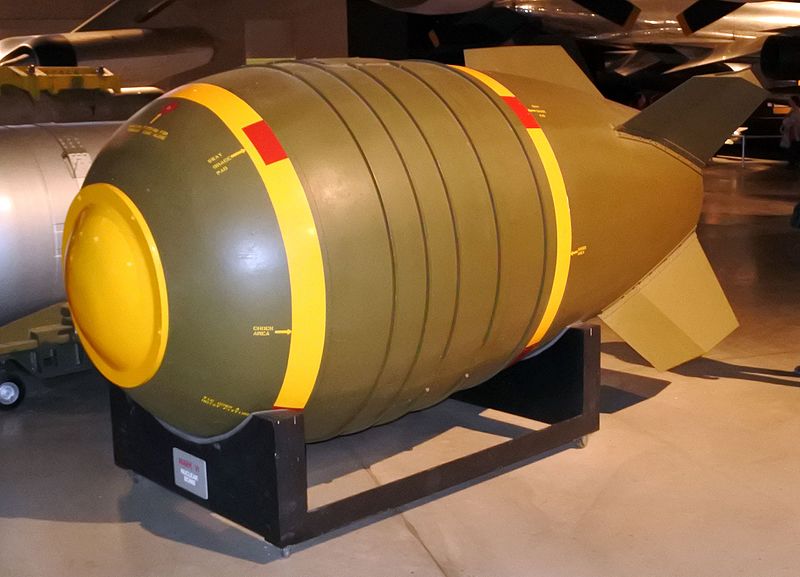
Mark VI nuclear bomb at the National Museum of the United States Air Force.
Wilson44691
Primary material
Documents and archives
authority record
- Wikidata, structured authority record Q2500558: Mark 6 nuclear bomb
Unverified · Wikidata
reference work
- “Mark 6 nuclear bomb”, English Wikipedia, consulted as further reading
Reputable secondary · Wikipedia
Notes from the source article
Cited by Wikipedia
Notes from the source article
These works are cited by the source article, in its own numbering. They are recorded as its citations, not as sources VALÉORINE has verified.
References
Citations
References
Each reference names the institution holding it, so a reader may go to the document itself.
authority record
Partially resolvedreference work
Partially resolved
The Encyclopedia exists whether or not anything is for sale. Corrections are recorded rather than overwritten, and every version of this record is kept. Published 14 August 2026.
Elsewhere in Militaria
6,095 published records in this field, each with its sources named.
- Mark 48 torpedoTerminology
- Mark 5 nuclear bombTerminology
- Mark 50 torpedoTerminology
- Mark 54 Lightweight TorpedoTerminology
- Mark 60 CAPTORTerminology
- Mark 65 bombTerminology
- Mark 7 nuclear bombTerminology
- Mark 77 bombTerminology
Best supported in this field
For owners
Own an object connected with Mark 6 nuclear bomb?
A specialist will read what you send and tell you what the house can establish, what it cannot, and whether the object is suited to sale. There is no charge and no obligation. The object stays with you throughout; nothing is shipped to us unless it is arranged in writing beforehand.