
Mariano Fortuny
Illustration — Delphos dress by Henriette Negrin and Mariano Fortuny • Illustration — Mariano Fortuny furnishing textile, c.1920 • Illustration — 1926 Fortuny gold lamé dress and printed gauze aba style tunic • Illustration — Green silk velvet evening cape. Fortuny y Madrazo (Marià Fortuny i de Madrazo; 11 May 1871 – 3 May 1949) was a Spanish polymath, artist, inventor, and fashion designer who opened his couture house in 1906 and continued until 1946. He was the son of the painter Mariano Fortuny y Marsal.
Also recorded as Fortuny y Madrazo · Mariano Fortuny y Madrazo · Mariano Fortuny Y Madrazo · Mariano Fortuny i Madrazo
Mariano Fortuny

Didier Descouens · Public domain
- Name
- Mariano Fortuny y Madrazo
- Born
- 11 May 1871
- Birthplace
- Granada, Spain
- Died
- 3 May 1949
- Place of death
- Venice, Italy
- Spouse
- Henriette Negrin
- Field
- * textile design
- Nationality
- Spain
- Occupation
- painter · engineer · sculptor · photographer · inventor · dressmaker · designer · draftsperson · printmaker · artist
- Known for
- Delphos gown
VALÉORINE Encyclopedia
VALÉORINE documentary reading
Documentary summary
Illustration — Delphos dress by Henriette Negrin and Mariano Fortuny • Illustration — Mariano Fortuny furnishing textile, c.1920 • Illustration — 1926 Fortuny gold lamé dress and printed gauze aba style tunic • Illustration — Green silk velvet evening cape. Fortuny y Madrazo (Marià Fortuny i de Madrazo; 11 May 1871 – 3 May 1949) was a Spanish polymath, artist, inventor, and fashion designer who opened his couture house in 1906 and continued until 1946. He was the son of the painter Mariano Fortuny y Marsal.
Admitted source layer · organised and presented by VALÉORINE
Note VALÉORINE
No house-authored Note is published until its assertions and sources pass the VALÉORINE evidence contract. The documentary article remains available in full while that enrichment is being consolidated.
Documentary enrichment in progress · no unsupported statement published
Reference Check
Propose documentary evidence for Mariano Fortuny. A contribution is never written directly as fact: identity, source, rights and evidence gates still decide.
Sign in to contribute
Documentary evidence
Evidence Panel
not yet certified
- Identity
- resolved
- Independent source families
- 0
- Admitted assertions
- 0
- Open conflicts
- 0
Authority files
gnd · 1139496883 · wikidata · Q1113061
In this article
Key facts
Key facts
• Name — Mariano Fortuny y Madrazo • Born — 11 May 1871 • Birthplace — Granada, Spain • Died — 3 May 1949 • Place of death — Venice, Italy • Spouse — Henriette Negrin • Field — * textile design • fashion design
Life
Life
Fortuny was born on 11 May 1871, to an artistic family in Granada, Spain. His father, a genre painter, died when Fortuny was three years old and his mother, Cecilia, moved the family to Paris, France. It was apparent at a young age that Fortuny was a gifted artist, showing a talent for painting as well as a passion for textiles. During his childhood he was introduced to many different textiles and fabrics, which greatly imprinted upon his creativity. His parents were passionate about materials and had their own collections of textiles from various shops they had visited in Europe. His father also collected metalwork and armour from previous ages as a hobby. As a young child he was fascinated with all of these textiles and would dye pieces of material for amusement. It was this exposure that led him to designing and producing his own textiles and dresses. The family moved again in 1889 to Venice, Italy. As a young man, Fortuny travelled throughout Europe seeking out artists he admired, among them the German composer Richard Wagner. Fortuny became quite varied in his talents, which included inventing, painting, photography, sculpting, architecture, etching, and theatrical stage lighting. In 1897, he met the woman he would marry, Henriette Negrin, in Paris. She came to live with him in 1902, when she filed for divorce from her first husband. They were together for the rest of Fortuny's life, eventually marrying in Paris in 1924. While in Paris, Fortuny registered and patented more than 20 inventions between 1901 and 1934. He died in his home in Venice and was buried in the Campo Verano in Rome. His work was a source of inspiration to the French novelist Marcel Proust.
Lighting engineer
Lighting engineer
In 1892, after experiencing some of Richard Wagner's work in Paris, Fortuny traveled to Bayreuth, Germany where Wagner had built a theater specifically designed to put on his operas. He was mesmerized by Wagner's work and began to paint scenes for his operas when he returned to Venice. In Wagnerian drama, painting, architecture, song, dance, and poetry all worked together towards a common goal. This affected Fortuny's outlook and was the inspiration for a brand new type of theater design where the designer and the technician would work together on a project from idea to realization. Fortuny and other followers of this concept believed that one can only improve the quality of a product by having a good knowledge of something's raw materials and the process of its construction. He also thought that the best type of design was created when the artist knew how to realize the design and controlled all of the steps in the creative process. Through his experiences with Wagner and the theatre, Fortuny became a lighting engineer, architect, inventor, director, and set designer. As a set designer, he wanted to create a more seamless way of transitioning from one scene to another other than flying out a backdrop and bringing in a new one. He began experimenting with light and different ways to do this in the attic of his palazzo in Italy. With his experimentation, he found that reflecting light off different surfaces could change the color, intensity and other properties of light. His 1904 treatise Eclairage Scenique ("Stage Lighting") describes the discovery that formed the basis of his indirect lighting technique. He concluded that, "... it is not the quantity but the quality of light that makes things visible and allows the pupil... to open properly." He used these indirect lighting techniques in his new invention, the Fortuny cyclorama dome, a quarter-dome-shaped structure of plaster or cloth. Fortuny first filed a patent for his indirect theatrical lighting system in 1901 and constantly refined his invention thereafter. The shape created the look of a more extensive sky, and Fortuny could create any type of sky he wanted by reflecting light onto it in a certain way. He could even reflect clouds on the backdrop by painting different things on the mirrors that reflected light onto the dome. During the 1920s, Fortuny's contribution to the theatre gained widespread recognition. After studying and perfecting his dome, its use was becoming more popular in many theatres in Europe. He was soon contracted to install his dome in the famous opera house, La Scala of Milan. However, for this project he was required to make some adaptations for the dome to be used at its maximum potential. The theatre was much larger than his original dome, so he increased the size so that he could allow the dome to fill the space with the stage completely. He also made it so that the dome was "electrically controlled, and could fold and unfold like a giant accordion in the space of 90 seconds. Even more impressively, he invented a suction fan, specifically for this project, which forced out the air to keep the structure taut. From the audience’s point of view, this helped the backdrop’s depth to seem almost infinite, as if you were looking at a night sky that never ended. After all the adaptations were made and the construction was completed, the dome successfully opened on 7 January 1922, with a production of Parsifal. From the same concept of the dome, Fortuny created a lamp that could be used to recreate indoor lighting onstage, the Fortuny Moda Lamp. Although originally intended for use as a stage lamp and patented in 1903, this lighting fixture remains popular as a floor lamp. • Illustration — Henriette Fortuny painted by Mariano Fortuny in 1935, in Fortuny garments. (Fortuny Museum)
Fashion designer
Fashion designer
• Illustration — View of the Palazzo Fortuny in Venice where Mariano Fortuny lived and worked The achievements that Fortuny is most well known for were made in the field of fashion design. His wife, Henriette Negrin, was an experienced dressmaker who helped to construct many of their designs. From 1902 they lived in the Palazzo Pesaro Orfei in Venice, which Fortuny filled with the artwork of his father, art that his father collected, and other art and artefacts that inspired him. He called the palazzo his "think tank" where he had many rooms set up for experiments and inventions as well as rooms for inspiration. It is not clear if Fortuny had any interest in, or aptitude for, fashion design before meeting Negrin. His first works in fabric appeared after they began cohabitating, and there is little documentation to attest which creations were hers or his - except the silk-pleating process, which was Negrin's invention. Fortuny and Negrin drew from styles of the past for their fashion design as well, inspired by the light, airy clothing of Greek women that clung to the body and accentuated the natural curves and shape of a woman's body. Fortuny and Negrin rebelled against the style lines that were popular during his time period, and Henriette created the Delphos gown, a shift dress made of finely pleated silk weighed down by glass beads that held its shape and flowed on the body. No one has been able to recreate pleating as fine as theirs, or that has held its shape like their dresses have for many years. They also manufactured their own dyes and pigments for their fabrics using ancient methods. With these dyes they began printing on velvets and silks and dyed them using a press that they invented with wooden blocks onto which they engraved the pattern. Their dresses are seen as fine works of art today and many survive, still pleated, in museums and personal collections. In Paris, Fortuny garments were retailed by Babani, who sold Delphos dresses and other garments to the actress Eleonora Duse. In 2012, the Queen Sofia Spanish Institute in New York City mounted an exhibition of his work. A wide collection of his work can be seen at the Museo del Traje in Madrid His clients were Élisabeth, Countess Greffulhe and her daughter Élaine Greffulhe, Eleonora Duse, Ellen Terry and Oona O'Neill.
Museum
Museum
The Fortuny Museum is housed in the Venetian Gothic Palazzo Pesaro Orfei in Venice. It contains work by Fortuny in the fields of textile design, fashion design, painting, sculpture, photography and lighting, and also a number of paintings by his father Mariano Fortuny y Marsal.
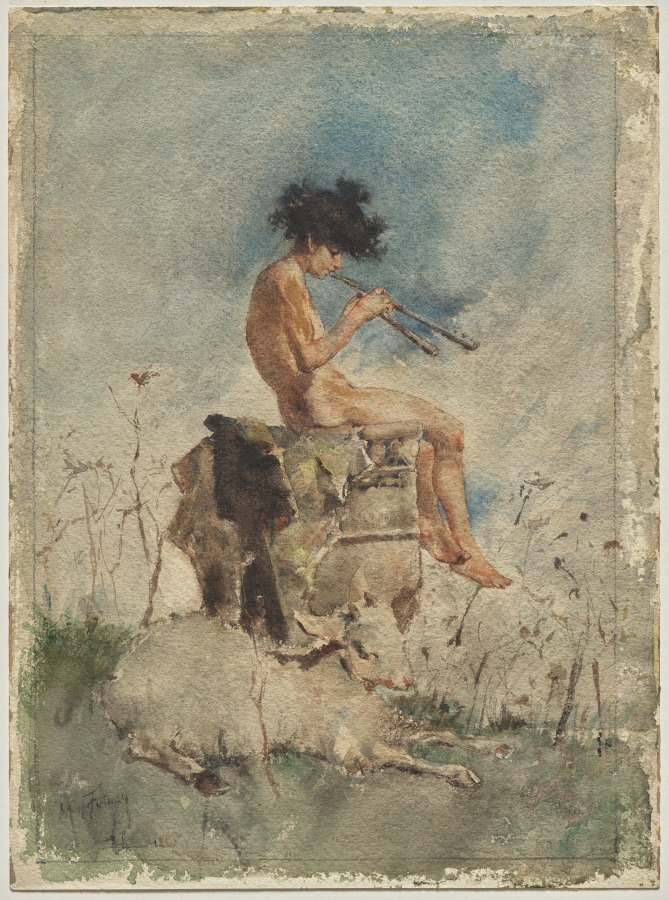
The Pipes of Pan, 1865, by Mariano Fortuny
Mariano Fortuny · The Cleveland Museum of Art · Bequest of Muriel Butkin
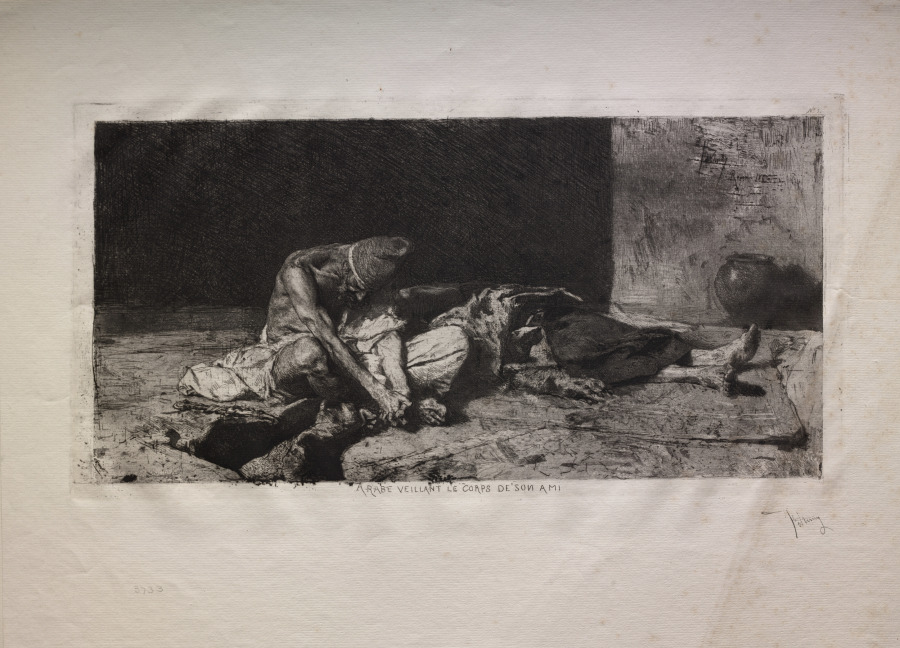
Arab Watching over the Body of His Friend, 1866, by Mariano Fortuny
Mariano Fortuny · The Cleveland Museum of Art · Gift of Knoedler and Company, through The Print Club of Cleveland
Life and career
Dated record
Life and career
Explore 1871–1949
The full dated record · 7 entries
1871
Mariano Fortuny was born on 11 May 1871.
Undated
Mariano Fortuny is also recorded as Fortuny y Madrazo; Mariano Fortuny y Madrazo; Mariano Fortuny Y Madrazo; Mariano Fortuny i Madrazo; Mariano Fortuny y de Madrazo; Mariano Fortuny (1871-1949).
1895
Self-Portrait (Museo Fortuny).
1915
Portrait of Madame Henriette Fortuny (Museo Fortuny).
1935
Portrait of the artist's wife in a Pompeiian costume (Museo Fortuny).
1947
Self-portrait of the artist (Museo Fortuny).
1949
Mariano Fortuny died on 3 May 1949.
Primary material
Documents and archives
scholarly publication
- Fortuny y de Madrazo, Mariano, Benezit Dictionary of Artists, 2011
Scholarly · Crossref registry · 2011
- Fortuny y Marsal, Mariano, Benezit Dictionary of Artists, 2011
Scholarly · Crossref registry · 2011
authority file
- Gemeinsame Normdatei 1139496883, La scena di Mariano Fortuny (Veranstaltung : 2013 : Padua; Venedig).
Unverified · Deutsche Nationalbibliothek
reference work
- Wikidata, structured authority record Q1113061: Mariano Fortuny
Reputable secondary · Wikimedia Foundation
Citations
References
Each reference names the institution holding it, so a reader may go to the document itself.
scholarly publication
Fortuny y de Madrazo, Mariano, Benezit Dictionary of Artists, 2011Crossref registry
Verifiedscholarly publication
Fortuny y Marsal, Mariano, Benezit Dictionary of Artists, 2011Crossref registry
Verifiedauthority file
Gemeinsame Normdatei 1139496883, La scena di Mariano Fortuny (Veranstaltung : 2013 : Padua; Venedig).Deutsche Nationalbibliothek
Partially resolvedreference work
Wikidata, structured authority record Q1113061: Mariano FortunyWikimedia Foundation
Partially resolved
The Encyclopedia exists whether or not anything is for sale. Corrections are recorded rather than overwritten, and every version of this record is kept. Published 14 August 2026.
Elsewhere in Sculpture
6,174 published records in this field, each with its sources named.
- Marianne PerettiArtist
- Marianne PitzenArtist
- Marianne van HirtumArtist
- Mariano BenlliureArtist
- Marie BashkirtsevaArtist
- Marie CazinArtist
- Marie CochranArtist
- Marie HaugeArtist
Best supported in this field
For owners
Own a work by Mariano Fortuny?
A specialist will read what you send and tell you what the house can establish, what it cannot, and whether the object is suited to sale. There is no charge and no obligation. The object stays with you throughout; nothing is shipped to us unless it is arranged in writing beforehand.