
Margrethe II of Denmark
Margrethe II (lang; Margrethe Alexandrine Þórhildur Ingrid, born 16 April 1940) is a member of the Danish royal family who reigned as Queen of Denmark from 14 January 1972 until her abdication on 14 January 2024. She became heir presumptive to her father in 1953 when a constitutional amendment allowed women to inherit the throne. In 1967 she married Henri de Laborde de Monpezat, with whom she had two sons, Frederik and Joachim.
Also recorded as Margrethe II · Ingahild Grathmer
Margrethe II of Denmark
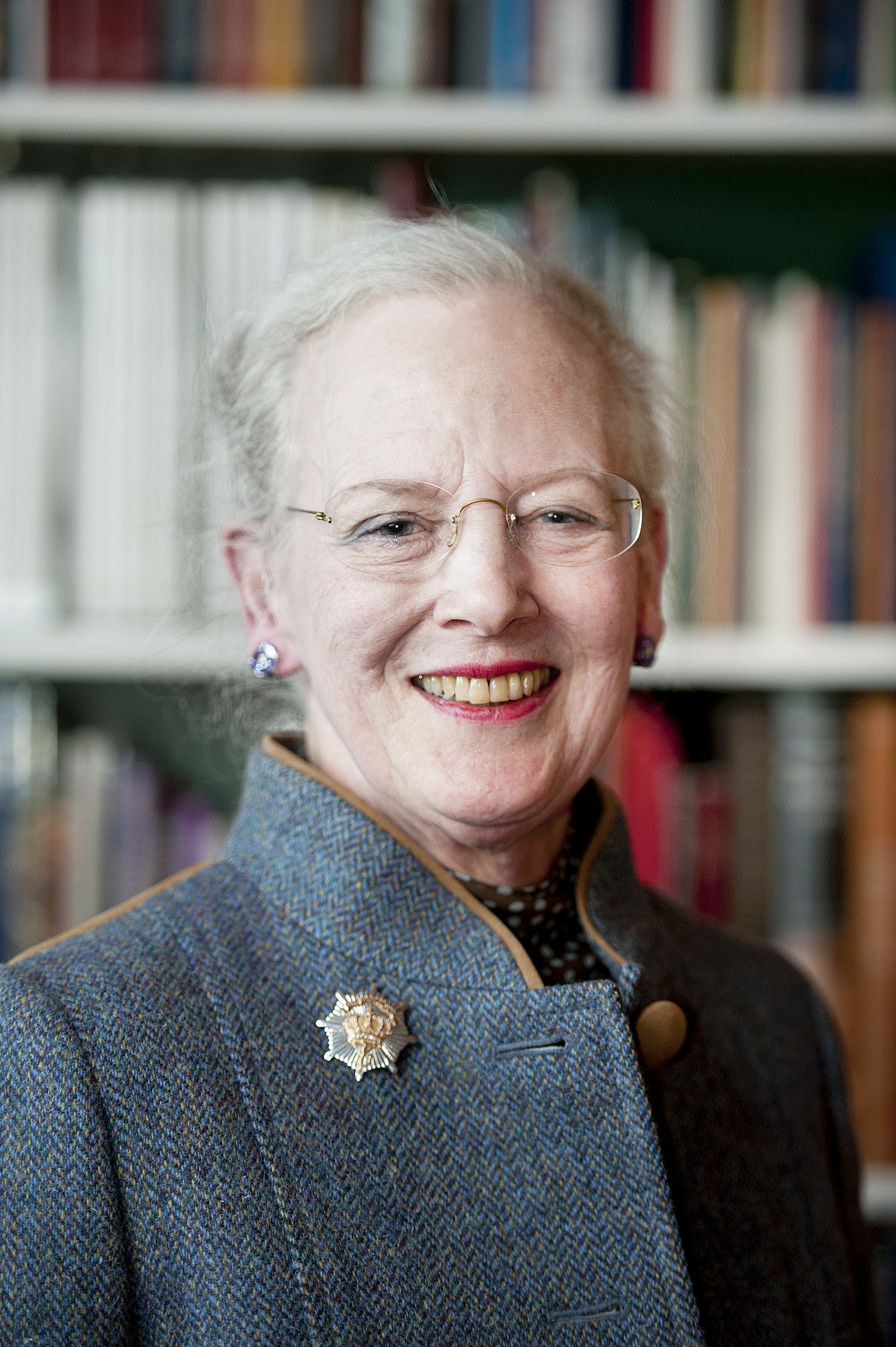
Johannes Jansson · Johannes Jansson/norden.org · Nordic Co-operation website (norden.org) · CC BY 2.5 dk
- Name
- Margrethe II
- Born
- 16 April 1940
- Birthplace
- Amalienborg, Copenhagen, Denmark
- Nationality
- Kingdom of Denmark.
- Occupation
- monarch, painter, screenwriter and textile artist.
- Fields
- translator, illustrator, production designer and archaeologist.
- Education
- University of Cambridge, London School of Economics and Political Science, Girton College and Aarhus University.
- Honours
- Grand Cross of the Legion of Honour, Dame Grand Cross of the Royal Victorian Order, Grand Cross of the Order of Wissam Alaouite, Order of the White Eagle, Order of Pius IX and Nersornaat in gold.
- Languages
- Danish, English and French.
VALÉORINE Encyclopedia
VALÉORINE documentary reading
Documentary summary
Margrethe II (lang; Margrethe Alexandrine Þórhildur Ingrid, born 16 April 1940) is a member of the Danish royal family who reigned as Queen of Denmark from 14 January 1972 until her abdication on 14 January 2024. She became heir presumptive to her father in 1953 when a constitutional amendment allowed women to inherit the throne. In 1967 she married Henri de Laborde de Monpezat, with whom she had two sons, Frederik and Joachim.
Admitted source layer · organised and presented by VALÉORINE
Note VALÉORINE
No house-authored Note is published until its assertions and sources pass the VALÉORINE evidence contract. The documentary article remains available in full while that enrichment is being consolidated.
Documentary enrichment in progress · no unsupported statement published
Reference Check
Propose documentary evidence for Margrethe II of Denmark. A contribution is never written directly as fact: identity, source, rights and evidence gates still decide.
Sign in to contribute
World of VALÉORINE
Documentary connections
Only confirmed graph relationships appear here. Images are shown only when their identity and reuse rights both pass the documentary gate.
Documentary evidence
Evidence Panel
not yet certified
- Identity
- resolved
- Independent source families
- 0
- Admitted assertions
- 0
- Open conflicts
- 0
Authority files
wikidata · Q102139 · wikipedia · Margrethe II
In this article
Biography
Biography
Margrethe succeeded her father upon his death in January 1972. Margrethe has worked as a scenographer, costume designer, and illustrator of works by J. Support for the monarchy in Denmark, alongside her personal popularity, gradually rose throughout the course of her reign, attaining around eighty per cent by the time of her abdication. She was succeeded by her elder son, Frederik X.
Margrethe II of Denmark studied at University of Cambridge, London School of Economics and Political Science and Girton College. The recorded working language is Danish, English and French. The field of work recorded is translator, illustrator and production designer. Places of work recorded in the authority are Copenhagen. Residence is recorded at Amalienborg and Fredensborg Palace. Positions recorded include monarch of Denmark. Work by Margrethe II of Denmark is recorded in the collections of Statens Museum for Kunst. Distinctions recorded are Grand Cross of the Legion of Honour, Dame Grand Cross of the Royal Victorian Order, Grand Cross of the Order of Wissam Alaouite and Order of the White Eagle.
![Collectie / Archief: Fotocollectie Anefo Reportage / Serie: [onbekend] Beschrijving: Staatsbezoek Koningin Margarethe en Prins Henrik van Denemarken; bezoek aan Fokkerfabriek; v.l.n.r. hr. Klapwijk, Koningin Margarethe en hr. Buley (voorzitter Raad van Bestuur) Datum: 30 oktober 1975 Locatie: Noord-Holland, Schiphol Trefwoorden: fabrieken, luchtvaart, staatsbezoeken, vliegtuigen Persoonsna](https://upload.wikimedia.org/wikipedia/commons/thumb/4/4d/Staatsbezoek_Koningin_Margarethe_en_Prins_Henrik_van_Denemarken_bezoek_aan_Fokk%2C_Bestanddeelnr_928-2416.jpg/800px-Staatsbezoek_Koningin_Margarethe_en_Prins_Henrik_van_Denemarken_bezoek_aan_Fokk%2C_Bestanddeelnr_928-2416.jpg)
Collectie / Archief: Fotocollectie Anefo Reportage / Serie: [onbekend] Beschrijving: Staatsbezoek Koningin Margarethe en Prins Henrik van Denemarken; bezoek aan Fokkerfabriek; v.l.n.r. hr. Klapwijk, Koningin Margarethe en hr. Buley (voorzitter Raad van Bestuur) Datum: 30 oktober 1975 Locatie: Noord-Holland, Schiphol Trefwoorden: fabrieken, luchtvaart, staatsbezoeken, vliegtuigen Persoonsna
Hans Peters for Anefo
Key facts
Key facts
• Name — Margrethe II • Succession — Queen of Denmark • Reign — 14 January 1972 – 14 January 2024 • Predecessor — Frederik IX • Successor — Frederik X • Born — 16 April 1940 • Birthplace — Amalienborg, Copenhagen, Denmark • Issue — * Frederik X • Prince Joachim • Full Name — Margrethe Alexandrine Þórhildur Ingrid • House — Glücksburg • Father — Frederik IX • Mother — Ingrid of Sweden • Religion — Evangelical Lutheran
Early life and education
Early life and education
• Illustration — Margrethe (left) with her parents and sisters, 1954 Margrethe was born on 16 April 1940 at 10:10 CET at Frederik VIII's Palace, in her parents' residence at Amalienborg, the principal residence of the Danish royal family in the district of Frederiksstaden in central Copenhagen. She was the first child of Crown Prince Frederik (later King Frederik IX) and Crown Princess Ingrid (later Queen Ingrid). Her father was the elder son of the then-reigning King Christian X, while her mother was the only daughter of Crown Prince Gustaf Adolf of Sweden (later King Gustaf VI Adolf). Her birth took place just one week after the beginning of Nazi Germany's occupation of Denmark following the war invasion. Margrethe was baptised on 14 May at the Holmen Church in Copenhagen. Her godparents were her grandfathers, King Christian X of Denmark and Crown Prince Gustaf Adolf of Sweden; her maternal great-grandfathers, King Gustaf V of Sweden and Prince Arthur, Duke of Connaught and Strathearn; her uncles Prince Knud of Denmark and Prince Gustaf Adolf, Duke of Västerbotten; as well as her first cousin twice removed, Prince Axel of Denmark. She was named Margrethe—the Danish variation of her late maternal grandmother Crown Princess Margareta of Sweden's name—Alexandrine after her paternal grandmother, Queen Alexandrine, and Ingrid after her mother. Since her paternal grandfather was also King of Iceland and she herself a Princess of Iceland at the time of her birth, she was given the Icelandic name Þórhildur ("Thor's battle" or "Thor's strength"). Like her maternal grandmother, Margrethe is known affectionately as "Daisy" to her family and close friends. • Illustration — Princess Margrethe in 1960. The birth of Margrethe's younger sisters Benedikte and Anne-Marie followed in 1944 and 1946, respectively. The princesses grew up in apartments at Frederik VIII's Palace at Amalienborg in Copenhagen and in Fredensborg Palace in North Zealand. Margrethe spent holidays with the royal family in her parents' residences at Gråsten Palace in Southern Jutland and Trend Hunting Lodge in Vesthimmerland in Northern Jutland. On 20 April 1947, following the death of Christian X, Margrethe's father acceded to the throne as Frederik IX.
Education
Education
Margrethe received her early education at home at Amalienborg Palace alongside a group of 6 girls her age. From 1949, she was educated at the private school, N. Zahle's School, in Copenhagen, with Danish author Helle Stangerup among others. She spent a year at North Foreland Lodge, a boarding school for girls in Hampshire, England, in 1955, before sitting for her studentereksamen in 1959. Margrethe doesn't hold a full university degree but passed the examen philosophicum at University of Copenhagen in 1960 and subsequently undertook courses at several European universities: She studied prehistoric archaeology at Girton College, Cambridge, between 1960 and 1961 and political science at Aarhus University between 1961 and 1962, the Sorbonne in 1963 and the London School of Economics in 1965. She is a Fellow of the Society of Antiquaries of London. Between 1958 and 1970, Margrethe performed voluntary service with the Women's Flying Corps, a branch of the Home Guard, where she eventually rose to the rank of lieutenant. In a 2015 interview, she noted that she had wished to serve conscription if it had been an opportunity. However, women were not allowed to volunteer for conscription in the Danish Armed Forces until 1968.
Heir presumptive
Heir presumptive
• Illustration — Margrethe received by Egyptian president Gamal Abdel Nasser and First Lady Tahia Abdel Nasser at the Abdeen Palace, Cairo, in November 1962 • Illustration — Princess Margrethe in August 1966 At the time of her birth, only males could accede to the throne of Denmark, owing to the changes in succession laws enacted in the 1850s when the Glücksburg branch was chosen to succeed. As Margrethe had no brothers, it was assumed that her uncle Prince Knud would one day assume the throne. The process of changing the constitution started in 1947, not long after Margrethe's father acceded to the throne and it became clear that Queen Ingrid would have no more children. The popularity of Frederik and his daughters and the more prominent role of women in Danish life started the complicated process of altering the constitution. The law required that the proposal be passed by two successive Parliaments and then by a referendum, which occurred on 27 March 1953. The new Act of Succession permitted female succession to the throne of Denmark, according to male-preference cognatic primogeniture, where a female can accede to the throne only if she does not have a brother. Princess Margrethe therefore became heir presumptive. In 2009, the law of succession was modified into absolute primogeniture. Margrethe attended the traditional New Year Courts for the first time in 1956. On her eighteenth birthday, 16 April 1958, Margrethe was given a seat in the Council of State. She subsequently chaired the meetings of the Council in the absence of the King. In 1960, with her first cousin, Princess Margaretha of Sweden, and Princess Astrid of Norway, she travelled to the United States, which included a visit to Los Angeles, and to the Paramount Studios, where they met several celebrities, including Dean Martin, Jerry Lewis and Elvis Presley. She paid her first visit to the Faroe Islands in 1959, alongside her parents and sisters, and to Greenland in 1960.
Marriage and family
Marriage and family
• Illustration — Margrethe and Henri in 1966 While Margrethe studied in London, she met the French diplomat Henri de Laborde de Monpezat, who was legation secretary at the French Embassy in London. Their engagement was announced on 5 October 1966. They were married on 10 June 1967, at the Holmen Church in Copenhagen, and the wedding reception was held at Fredensborg Palace. Laborde de Monpezat received the style and title of "His Royal Highness Prince Henrik of Denmark" because of his new position as the spouse of the heir presumptive to the Danish throne. They were married for more than fifty years, until his death on 13 February 2018. Less than a year after the wedding, Margrethe gave birth to her first child, a son, on 26 May 1968. By tradition, Danish kings were alternately named either Frederik or Christian. She chose to maintain this by assuming the position of a Christian, and thus named her elder son Frederik. The following year, a second child, named Joachim, was born on 7 June 1969. In 1974, she and Henrik purchased Château de Cayx in the wine district of Cahors in Southern France. Among others, Margrethe is the godmother of King Willem-Alexander of the Netherlands, King Haakon VIII of Norway, and Prince Carl Philip of Sweden as well as actress Ellen Hillingsø and politician Marcus Knuth. She is a close personal friend of Queen Sonja of Norway with whom she shares a love of the arts. They previously went on yearly skiing trips together. Margrethe announced in 2008 that her male-line descendants would bear the additional title of Count or Countess of Monpezat in recognition of her husband's ancestry. In 2022, the Queen announced that, from the start of 2023, the descendants of Prince Joachim will only be able to use their titles of Count and Countess of Monpezat, their previous titles of Prince and Princess of Denmark ceasing to exist. To allow the children, who were never expected to hold an official role within the royal family, to have normal lives, the Queen wanted "to create a framework for the four grandchildren, to a much greater degree, to be able to shape their own existence without being limited by the special considerations and obligations that a formal affiliation with the Royal House as an institution implies". Her son, Joachim, daughter-in-law, Marie, former daughter-in-law, Alexandra, and eldest grandson, Nikolai, publicly expressed shock and confusion because of the decision, after which Margrethe released a statement in which she said that it saddened her that she had upset Joachim's family. Along with her late husband, Margrethe has kept dachshunds since the 1970s. As of April 2026, she has one dog, the dachshund Tilia, who was Prince Henrik's dog until his death in 2018 (her own dog, Helike, passed away the same year).
Accession
Accession
• Illustration — Margrethe (seated right) chairing a meeting of the Council of State on the day of her proclamation On 3 January 1972, three days after King Frederik IX delivered his New Year's address, he suffered a heart attack and was admitted to the Copenhagen Municipal Hospital. Margrethe was subsequently designated regent due to her father's declining health. She ascended the throne on Frederik's death on 14 January, becoming the first female Danish sovereign under the new Act of Succession. The following day, Prime Minister Jens Otto Krag led her formal proclamation ceremony from the balcony of Christiansborg Palace, in which she also announced her royal motto as "God's help, the love of the people, Denmark's strength" (Guds hjælp, folkets kærlighed, Danmarks styrke). Her regnal number was chosen in recognition of Margrethe I, the 14th-century queen regnant of the Kalmar Union. As queen, she relinquished all the monarch's former titles except the title to Denmark, hence her style "By the Grace of God, Queen of Denmark" (Margrethe den Anden, af Guds Nåde Danmarks Dronning).
Constitutional role
Constitutional role
• Illustration — Margrethe hosting Russian President Dmitry Medvedev in Denmark, April 2010 The Queen's main tasks were to represent the kingdom abroad and to be a unifying figure at home. She performed the latter by opening exhibitions, attending anniversaries and inaugurating bridges, among other things. She received foreign ambassadors and awards, honours and medals. As a constitutional sovereign, Margrethe took no part in party politics and does not express any political opinions. Although she had the right to vote, she opted not to do so to avoid even the appearance of partisanship. The Queen held a meeting with the prime minister and the foreign affairs minister every Wednesday, unless either she or the prime minister was outside of the kingdom. After an election where the incumbent prime minister does not have a majority behind him or her, the Queen held a "Dronningerunde" (Queen's meeting) in which she met the chairmen of each of the Danish political parties. • Illustration — Margrethe with Michelle Obama at the White House, June 2011 Each party has the choice of selecting a royal investigator to lead these negotiations or alternatively, give the incumbent prime minister the mandate to continue his or her government as is. In theory each party could choose its own leader as royal investigator, as the social liberal Det Radikale Venstre did in 2006, but often only one royal investigator is chosen plus the prime minister, before each election. The leader who, at that meeting, succeeds in securing a majority of the seats in the Folketing, is, by royal decree, charged with the task of forming a new government. (No party has held an absolute majority in the Folketing since 1903.) Once the government had been formed, the Queen formally appointed it. Officially, it was the monarch who was the head of state, and she therefore presided over the Council of State (privy council), where the acts of legislation which have been passed by the parliament are signed into law. In practice, nearly all of the Queen's formal powers were exercised by the Cabinet of Denmark. It was customary for Margrethe, as the Danish monarch, to host the annual New Year levées. Every year on 1 January, a banquet was held for the government, the Speaker of the Danish Parliament, representatives of official Denmark and the Royal Court at Christian VIII's Palace at Amalienborg. On day two, a levée was held at Christian VIII's Palace for the justices of Supreme Court of Denmark and the Officer Corps of the Royal Life Guards and the Guard Hussar Regiment, followed by a levée at Christiansborg Palace for the diplomatic corps. On day three, a levée was held for officers from the Ministry of Defence and the Danish Emergency Management Agency, the I., II. and III. ranking classes as well as invited representatives of major national organisations and the royal patronages.
Official duties
Official duties
• Illustration — Margrethe surrounded by her family waving to crowds on her 70th birthday in April 2010 Up to the end of her reign, Margrethe held 72 Danish and eight foreign patronages as queen, including Aarhus Festuge, ARoS Aarhus Kunstmuseum, DaneAge Association, Danes Worldwide, the Dyrenes Beskyttelse, the Kræftens Bekæmpelse, Den Gamle By, Det Classenske Fideicommis, the Det Danske Bibelselskab, Det Kongelige Vajsenhus, Diakonissestiftelsen, Foreningen Norden, Land of Legends (Sagnlandet Lejre), M/S Maritime Museum of Denmark, Moesgaard Museum, National Olympic Committee and Sports Confederation of Denmark, Nyborg Slot, Rebild National Park, the Royal Danish Academy of Music, Royal Danish Academy of Sciences and Letters, Royal Danish Yacht Club, Rungstedlundfonden, Sankt Lukas Stiftelsen, Vallø stift and Vemmetofte. A pillar of her reign was an intricate knowledge of and connection to all parts of the Danish Realm. In 2016, she contributed to a book about Denmark's history. Until her abdication, Margrethe served as colonel-in-chief of the Princess of Wales's Royal Regiment, an infantry regiment of the British Army, following a tradition dating back to 1906 when Edward VII, married to Alexandra of Denmark, appointed his brother-in-law, Frederik VIII of Denmark, colonel-in-chief of the then Buffs (Royal East Kent Regiment). As sovereign, Margrethe received 42 official state visits and she undertook 55 foreign state visits herself. She and the royal family have made several other foreign visits.
Residences
Residences
As queen, Margrethe's official residences were Amalienborg (where she resides at Christian IX's Palace) in Copenhagen and Fredensborg Palace near Hillerød. Her summer residences were Marselisborg Palace near Aarhus and Gråsten Palace near Sønderborg, the former home of her mother, Queen Ingrid, who died in 2000.
Immigration debate
Immigration debate
In her New Year's address at the end of 1984, the Queen addressed the xenophobia experienced by many immigrants in Denmark: The term "cocky remarks" (dumsmarte bemærkninger, dumb-slick remarks) has since become an integrated part of the Danish vocabulary. In an interview within the 2016 book De dybeste rødder (The Deepest Roots), according to historians at the Saxo Institute of the University of Copenhagen, Margrethe showed a change in attitude to immigration towards a more conservative stance. She stated that the Danish people should have more explicitly clarified the rules and values of Danish culture in order to be able to teach them to new arrivals. She further stated that the Danes in general have underestimated the difficulties involved in successful integration of immigrants, exemplified with the rules of a democracy not being clarified to Muslim immigrants and a lack of readiness to enforce those rules. This was received as a change in line with the attitude of the Danish people.
Silver, Ruby and Golden Jubilees
Silver, Ruby and Golden Jubilees
Margrethe marked her Silver Jubilee in 1997 with a religious service and a gala dinner attended by fellow Scandinavian royals. She celebrated her Ruby Jubilee, the 40th year on the throne, on 14 January 2012. This was marked by a church service, concert, carriage procession, gala banquet at Christiansborg Palace and numerous TV interviews. The Queen's Golden Jubilee was marked on 14 January 2022, with celebrations to take place later in the year. In September, following the death of Queen Elizabeth II of the United Kingdom, it was announced by the Royal House that it was "Her Majesty The Queen's wish that a number of adjustments be made" to the upcoming celebrations. Between Elizabeth II's death and her abdication, Margrethe was Europe's longest-reigning monarch, the world's only queen regnant, and the longest-serving incumbent female head of state.
Sitting reign record
Sitting reign record
In July 2023, the Danish Royal House recognized Margrethe II as Denmark's longest-reigning sitting monarch. Though Christian IV reigned for more than 59 years between 1588 and 1648, he was not officially installed until 1596, ruling with a "guardian government" up until then.
Abdication
Abdication
• Illustration — Margrethe greeting her sister Benedikte at the 2025 opening of parliament In her annual live broadcast New Year's Eve address on 31 December 2023, Margrethe announced her abdication, which took place on 14 January 2024, the 52nd anniversary of her accession to the throne. She said that time had taken its "toll", that her number of "ailments" had increased, and that she cannot undertake as many duties as in the past. She cited her extensive back surgery in February, and said that the operation made her reassess her position and consider "whether now would be an appropriate time to pass on the responsibility to the next generation". Margrethe's elder son, Frederik, assumed the throne as Frederik X. Mirroring her first New Year Address in 1973, she said of the succession: "The support and assistance which I have received throughout the years, have been crucial to the success of my task. It is my hope that the new King and Queen will be met with the same trust and devotion which have fallen to my lot." Since her abdication, she has been referred to as "Her Majesty Queen Margrethe". She is eligible to serve as regent in the event of the incapacity or absence of the King and Crown Prince Christian. In October 2025, Margrethe undertook her first official visit abroad after her abdication when she visited Rome, Italy, in honour of the 10th anniversary of Queen Margrethe's Roman Prize, which aims to strengthen cultural ties between Denmark and Italy.
Health issues
Health issues
• Illustration — Henrik lighting a cigarette for Margrethe, 1966 Queen Margrethe II has had a number of health issues. Since the 1990s, she has undergone several operations on her right knee due to injuries and osteoarthritis. In 1994, she was treated for cervical cancer. In 2003, she underwent a four-and-a-half-hour-long operation for spinal stenosis. On 9 February 2022, the Danish court disclosed in a press release that the Queen had contracted COVID-19. On 13 February, the Queen was able to leave home isolation after having had a mild case of the virus. On 21 September 2022, the Danish Royal House disclosed in a press release that Margrethe had tested positive for COVID-19 a second time after attending the state funeral of Elizabeth II, her third cousin, in London. She left home isolation again on 26 September and resumed her official duties immediately, stating that she felt fine. On 22 February 2023, the Queen underwent "major back surgery" at Rigshospitalet due to continued back pain. In a statement the following day, a representative for the Queen said that the surgery had gone well and that she had already been up for a walk. She was discharged from the hospital on 2 March, and returned from sick leave on her birthday on 16 April. Margrethe has been a chain smoker and was well known for her tobacco habit. On 23 November 2006, the Danish newspaper B.T. printed an announcement from the Royal Court that the Queen would henceforth smoke only in private. In 2023, the Court confirmed that Margrethe had quit smoking in connection with her back surgery the same year. In September 2024, she was hospitalised after a fall at Fredensborg Castle where she sustained a fractured wrist and injuries to the vertebrae of the neck for which she needed to wear a neck brace for more than a month. In May 2025, she was hospitalised for two days due to a cold. In May 2026, she was hospitalised due to angina pectoris. On 15 May, the monarchy released a statement saying that she had undergone a successful angioplasty and was recovering at Rigshospitalet. A week after being discharged, she was admitted to hospital again on 25 May for a blood clot in the hip region which was said to have developed following a fall in September 2025. Originally expected to attend the funeral of her second cousin Harald V of Norway, it was later announced that Margrethe would miss the event after being hospitalised on 6 September 2026 and diagnosed with mild dehydration and a blood clot in the hip region.
Public image and style
Public image and style
• Illustration — Margrethe wearing her famous yellow and floral raincoat, which was sewn out of a waxy outdoor tablecloth Margrethe wears designs by former Pierre Balmain designer Erik Mortensen, Jørgen Bender, and Birgitte Taulow. In March 2013, The Guardian listed her as one of the fifty best-dressed over-50s. In connection with her 80th birthday, British Vogue published an article calling her "An Unsung Style Heroine." A 2012 poll showed support for the monarchy in Denmark remained consistently high at around 82%, compared to less than half when she acceded to the throne in 1972. The Queen has been depicted on the annual christmas seal twice—as a child in 1942 and following her accession to the throne in 1972. Margrethe was included in Andy Warhol's portrait series in 1985 as one of four Reigning Queens, along with queens Ntfombi of Eswatini, Elizabeth II and Beatrix of the Netherlands.
Personal interests and artistic work
Personal interests and artistic work
Alongside her sisters, Margrethe started dancing ballet as a child and she continued to take weekly lessons even after her accession to the throne. She first visited the Royal Danish Theatre in 1945 alongside her father for a performance of Elves' Hill. Margrethe has maintained avid engagement with the creative arts throughout her reign.
Archaeology
Archaeology
Margrethe is known for her strong archaeological passion and has participated in several excavations, including in Italy, Egypt, Denmark, Sudan and South America. In 1952, she visited the archaeological site at Illerup Ådal with her paternal grandmother, Queen Alexandrine, which was her first visit to an excavation site. She shared this interest with her grandfather, Gustaf VI Adolf of Sweden, with whom she visited multiple archaeological digs, among them in Etruria in 1962. In the 2019 biography Dronning Margrethe, Margrethe revealed that if she hadn't been destined to become queen, she would have "tried to become an archaeologist".
Church textiles
Church textiles
Since the 1970s, Margrethe has designed and embroidered several vestments and church textiles for churches in Denmark, Greenland, Germany and England. She has designed a chasuble for Fredensborg Palace Church which was since embroidered by her mother, Queen Ingrid, and appliquéd by her sister, Princess Benedikte. The textile was presented to the church on its 250th anniversary in 1976. In 1989, Margrethe designed the bishop's robe for the Diocese of Viborg. In 2017, she designed the antependium for the All Saints' Church, Wittenberg, Germany. In 2020, she designed the chasuble for the Danish Church of St Katharine in the London Borough of Camden. In addition to the church textiles, Margrethe has designed various other things including an altarpiece for Skei Mountain Church in Norway, a Christmas spoon, the annual Danish Christmas seals in 1970, 2003 and 2015, and Greenland's Christmas seal in 1983.
Découpage
Découpage
Since the mid-1970s, Margrethe has been using the découpage technique, which involves combining clippings from periodicals and books for new motifs. This technique is used in auction catalogues, home magazines, and furniture decorations. The découpage often references literary, mythological, or art-historical topics, and is often displayed in royal palaces, particularly Christian VII's Palace at Amalienborg. Sealed with a protective lacquer, the Queen's découpage works generally have references to literary, mythological or art-historical topics. Margrethe's découpage works have also been used in various books and films, including Prince Henrik's poetry collections Cantabile (2000) and Frihjul (2010). Eighty-one découpages she designed were the basis for the sets of the 2023 film Ehrengard: The Art of Seduction.
Embroidery
Embroidery
As a child, Margrethe preferred drawing rather than needlework, but since 1960, numerous embroideries have been presented as gifts or used in the Queen's own rooms. The embroideries are made from patterns that Margrethe herself creates on graph paper, which includes twining shapes and the recipient's monogram. The Queen has designed several embroideries for the Danish Handcraft Guild, including patterns for calendars, cushion covers and dinner mats. Margrethe has also designed evening bags and spectacle cases for friends and family members, including Christmas calendars for all of the grandchildren, cushion covers and furniture covers for the palaces, and fireplace screens for Fredensborg Palace. The Queen's private embroideries were exhibited at Koldinghus Castle in 2021.
Monograms
Monograms
In 2004, Margrethe designed the official monogram of her second cousin twice removed, Princess Ingrid Alexandra of Norway.
Scenography and costume design
Scenography and costume design
Over the years, Margrethe has become involved in ballet as a scenographer and costume designer. She designed the costumes for the Royal Danish Ballet's production of A Folk Tale and for the 2009 Peter Flinth film, De vilde svaner (The Wild Swans). She also designs her own clothes and is known for her colourful and sometimes eccentric clothing choices. The Queen designed 51 costumes for the 2023 film Ehrengard: The Art of Seduction as well as 81 découpages that were the basis for the sets. • Illustration — Performance of The Nutcracker in Tivoli Concert Hall in 2022 with costumes designed by Her Majesty Queen Margrethe Margrethe has designed sets and costumes for numerous ballets. Since 2001, she has worked with the Tivoli Ballet Theatre: • 1991: A Folk Tale, Royal Danish Theatre • 2005 & 2011: Thumbelina, Pantomimeteatret • 2007, 2013 & 2018: The Tinderbox, Pantomimeteatret • 2009: The Swineherd, Pantomimeteatret • 2012, 2014, 2016, 2018, 2022 & 2024: The Nutcracker, Tivoli Concert Hall • 2013: The Steadfast Tin Soldier, Pantomimeteatret • 2016 & 2025: Cinderella, Pantomimeteatret • 2019, 2021, 2023 & 2025: The Snow Queen, Tivoli Concert Hall • 2024 & 2025: Blockhead Hans, Pantomimeteatret
National
National
• Denmark: • 20 April 1947: Knight of the Order of the Elephant (R.E.) • 14 January 1972 – 14 January 2024: Sovereign of the Order of the Elephant • 14 January 1972: Grand Commander of the Order of the Dannebrog (S.Kmd.) • 14 January 1972 – 14 January 2024: Sovereign of the Order of the Dannebrog • Knight of the Decoration of the Cross of Honour of the Dannebrog (D.Ht.) • Homeguard Medal of Merit • 25 years of Homeguard Service Medal • Medal of Honour of the League of Civil Defence • Medal of Honour of the Reserve Officers League • 100th Anniversary Medal of the Birth of King Christian X • 50th Anniversary Medal of the arrival of Queen Ingrid to Denmark • 100th Anniversary Medal of the Birth of King Frederik IX • Queen Ingrid Commemorative Medal • Greenland: • Nersornaat Medal for Meritorious Service, 1st Class
Fellowships
Fellowships
• Country — Date — School — Position • England — 1975 — London School of Economics — Honorary Fellow • 1989 — Lucy Cavendish College, Cambridge • 1992 — Girton College, Cambridge • Sweden — 2026 — Lund University
Geographic locations
Geographic locations
• Denmark: Margretheholm (1945) • Denmark: Dronningens Boulevard (1979) • Greenland: Queen Margrethe II Land in Northeast Greenland was named in her honour on 16 April 1990 on the occasion of her 50th birthday
Objects
Objects
• Denmark: Margretheskålen designed by her uncle, Sigvard Bernadotte, for Rosti-Mepal in 1947
Structures
Structures
• Denmark: Margrethekirken (Københavns Kommune) in Valby (1968) • Denmark: Dronning Margrethe II's Bro (2026)
Identity and origins
Identity and origins
She also worked under the name Ingahild Grathmer. The authorities additionally record the headings Margrethe II and Ingahild Grathmer. Her recorded languages were Danish, English, French and Swedish. Her recorded confession was Church of Denmark. She was the child of Frederik IX of Denmark and Ingrid of Sweden. She married Henrik, Prince Consort of Denmark. 2 children are recorded: Frederik X of Denmark and Prince Joachim of Denmark. Other recorded relations include Carl XVI Gustaf of Sweden, Constantine II of Greece, Harald V of Norway and Baudouin I of Belgium.
Career and activity
Career and activity
Margrethe II of Denmark worked in translator, illustrator, production designer and archaeologist. Recorded position is monarch of Denmark. She belonged to Royal Swedish Academy of Letters, History and Antiquities, Danish Royal Family and Margrethe II of Denmark and Prince Henrik. She worked at Copenhagen, Amalienborg, Fredensborg Palace and Marselisborg Palace.
Identity
Identity
Margrethe II of Denmark is recorded as having studied at University of Cambridge, London School of Economics and Political Science and Girton College. Formation and teaching. Denmark studied at University of Cambridge, London School of Economics and Political Science, Girton College and Aarhus University.
Life and career
Dated record
Life and career
The full dated record · 1 entries
1940
Margrethe II of Denmark born at Amalienborg.
Places
Named by the record
Places
Only places the record itself states, plotted where the house gazetteer settles their coordinates. Nothing is inferred from a name or a nationality.
Amalienborg, Fredensborg Palace and Marselisborg Palace.
Residences
Amalienborg.
Birth place
Films
Films
The Queen has worked as a screenwriter alongside Per Brink Abrahamsen on the two Hans Christian Andersen adaptations Snedronningen (film fra 2000) from 2000 and De vilde svaner (film fra 2009) from 2009. Additionally, she narrated the former and made an uncredited acting cameo as a "member of the mob" in the latter. Using decoupage as her primary craft, she has also been a set designer for: • Snedronningen (film fra 2000) (2000) • De vilde svaner (film fra 2009) (2009) • Ehrengard: The Art of Seduction (2023) For her work on Ehrengard: The Art of Seduction, Margrethe won the Robert Award for Best Costume Design at the 41st Robert Awards on 3 February 2024. She was also nominated in the category Best Production Design.
Visual art
Visual art
Ingahild Grathmer Margrethe is an accomplished painter and has exhibited many of her works over the years. In 2000, she illustrated Prince Henrik's poetry collection Cantabile. Under the title From mountains to coast, she and her close friend, Queen Sonja of Norway, exhibited selected works inspired by nature at the Barony Rosendal in 2015. Under the pseudonym Ingahild Grathmer (the latter being an anagram for Margrethe and the former made up of her secondary names Ingrid, Alexandrine and Þórhildur), her illustrations were used for Danish editions of The Lord of the Rings, which she was encouraged to illustrate in the early 1970s. She sent them to J. R. R. Tolkien, who was struck by the similarity of her drawings to his own style.
Tributes
Margrethe, a musical about Margrethe II premiered under Danish conductor Mikkel Rønnow's direction in June 2023 at The Royal Danish Theatre and since The Concert Hall of Aarhus. A drama series titled:da:Margrethe (serie) created by Søren Sveistrup and based on Queen Margrethe II's life from her birth to her becoming heir presumptive in 1953 will premiere on TV2 in 2027. Upon her abdication in 2024, tributes were paid to Margrethe, not only in Denmark, but from around the world.
Where the work is held
Recognition and collections
Margrethe II of Denmark received Grand Cross of the Legion of Honour, Dame Grand Cross of the Royal Victorian Order, Grand Cross of the Order of Wissam Alaouite, Order of the White Eagle, Order of Pius IX and Nersornaat in gold.
Awards
Awards
• 1989: Modersmål-Prisen • 2004: The Hans Christian Andersen Award Committee's Honorary Award • 2022: Foreningen Norden's Nordic Language Prize • 2024: Robert Award for Best Costume Design at the 41st Robert Awards • 2024: Forening for Boghaandværk Honorary Award
Honorary degrees
Honorary degrees
• Country — Date — School — Degree • England — 1975 — University of Cambridge — Doctor of Laws (LLD) • England — 1980 — University of London — Doctor of Laws (LLD) • Iceland — 1986 — University of Iceland — Doctor of Laws (LLD) • England — 1992 — University of Oxford — Doctor of Laws (LLD) • Scotland — 2000 — University of Edinburgh — Doctor of Laws (LLD)
Awards
Awards
• Denmark: Dronning Margrethe II's Videnskabspris (2015)
Honorary military appointments
Honorary military appointments
• 1972–1992: Colonel-in-Chief of the Queen's Regiment • 1992–1997: Allied Colonel-in-Chief (with Diana, Princess of Wales) of the Princess of Wales's Royal Regiment • 1997–2024: Colonel-in-Chief of the Princess of Wales's Royal Regiment
Citations
References
Each reference names the institution holding it, so a reader may go to the document itself.
reference work
Partially resolvedreference work
Partially resolved
The Encyclopedia exists whether or not anything is for sale. Corrections are recorded rather than overwritten, and every version of this record is kept. Published 14 August 2026.
Elsewhere in Paintings
18,717 published records in this field, each with its sources named.
- Margit VargaArtist
- Margo HoffArtist
- Margot PeetArtist
- Margot PerrymanArtist
- Marguerite ArosaArtist
- Marguerite Burnat-ProvinsArtist
- Marguerite CharpentierArtist
- Marguerite CrookesArtist
Best supported in this field
For owners
Own a work by Margrethe II of Denmark?
A specialist will read what you send and tell you what the house can establish, what it cannot, and whether the object is suited to sale. There is no charge and no obligation. The object stays with you throughout; nothing is shipped to us unless it is arranged in writing beforehand.