
Marco Dente
Illustration — Battle scene in a landscape with soldiers on horseback, c. 1520, engraving Marco Dente da Ravenna (1493–1527), usually just called Marco Dente, was an Italian engraver born in Ravenna in the latter part of the 15th Century. He was a prominent figure within the circle of printmakers around Marcantonio Raimondi in Rome, and is known for the imitative nature of the reproductive prints or close copies of other prints that were most of his output.
Also recorded as Marco Da Ravenna Dente · Marco da Ravenna · Marco Dente da Ravenna · Marcus Ravennas
Marco Dente
Marco Dente · The Cleveland Museum of Art · Gift of Ralph King · CC0
- Born
- Marco Dente was born in 1493. · Ravenna.
- Died
- Marco Dente died in 1527. · Rome.
- Occupation
- printmaker and graphic artist.
- Languages
- Italian.
VALÉORINE Encyclopedia
VALÉORINE documentary reading
Documentary summary
Illustration — Battle scene in a landscape with soldiers on horseback, c. 1520, engraving Marco Dente da Ravenna (1493–1527), usually just called Marco Dente, was an Italian engraver born in Ravenna in the latter part of the 15th Century. He was a prominent figure within the circle of printmakers around Marcantonio Raimondi in Rome, and is known for the imitative nature of the reproductive prints or close copies of other prints that were most of his output.
Admitted source layer · organised and presented by VALÉORINE
Reference Check
Propose documentary evidence for Marco Dente. A contribution is never written directly as fact: identity, source, rights and evidence gates still decide.
Sign in to contribute
Documentary evidence
Documentary basis
Authority files
wikidata · Q712750 · wikipedia · Marco Dente
In this article
Early life and career
Early life and career
His prints in specific cases are also of certain interest in that we can see the impact and design of sculptural restorations. Killed in the tumult of the Sack of Rome in 1527. He used the accompanying monogram, D-B; albeit sparingly. Not a well-known figure in the Renaissance. The reproductive nature of his works contributed to the subversion of his identity. There was much debate surrounding the attribution of artists within Marcantonio Raimondi's School, and their respective plates. Also contributing to the subversion of his identity was that every plate in Dente's studio was destroyed during the Sack of Rome. Killed in the same war; and very few of his plates were later reissued by publishers.
The recorded working language is Italian. Places of work recorded in the authority are Rome. Work by Marco Dente is recorded in the collections of Museum Boijmans Van Beuningen, Minneapolis Institute of Art, Auckland Art Gallery, Finnish National Gallery and Nationalmuseum.
• Illustration — Venus removing a thorn from her left foot The artist was a member of a patrician family who grew up and lived in Ravenna for the majority of his life. He was an integral member of Marcantonio Raimondi's school of art, joining in 1516; Dente was likely an apprentice alongside Agostino di Musi, another Italian engraver. Dente and Agostino di Musi formed the first generation of Marcantonio's school. However, between the two artists, Dente was considered to have come closest to mastering the technique of engraving. The characteristic that defines Marco Dente's work is the reproductive nature of his works. The reproductive nature of Dente's work served three functions. The first was to replicate an event in history; the second was to advance financially; the third was to produce with an intent to distribute the print, and as an extension, the print's conceptual elements too. There was a growing demand for depictions of antique relief in the middle of the sixteenth century. The school's commercial function was facilitated by the markets within La Bottega del Cartolaio; this is largely where prints by Marcantonio and Marco Dente were able to be exchanged or acquired.
Works
Works
Marco Dente's most notable work is his depiction of the Laocoön and his two sons. However, the majority of his known pieces like his depiction of The Massacre of the innocents, and The Judgement of Paris, are all reproductive in nature. Dente and the other members of Raimondi's school were specifically influenced by the works of Raphael. The workshop frequently used preliminary drawings from Raphael's studio to inform its practice, his studies of the city's archaeological remains were specifically influential. Both Raphael and Dente had 'mutual interests in the ruins of Rome' - mirroring the general trend of Roman and the Greek classical antiquity becoming more influential throughout the Renaissance.
Laocoon
Laocoon
• Illustration — Fig. 1 Marco Dente, Laocoön, 1519 One of the most notable of Dente's pieces, and the one which seems to define the relatively unknown printmaker, is his version of the Laocoon. (Fig. 1) The Laocoon is described in Virgil's passage in The Aeneid. This print by Dente is significant in that it was engraved just after he witnessed the excavation of an ancient statue of the same subject in 1506. Dente was heavily influenced by classical antiquity. His pieces Hercules and Antaeus, and Entellus and Dares, also depict figures based on ancient sculptures. The sculpture of Laocoon and His Sons that was uncovered (Fig. 2) served as the foundation for Dente's subsequent print. Dente's print contributed to establishing a genre of reproductive engravings in the Renaissance depicting antiquity. The Laocoon is the only plate on which the engraver inscribed his name, 'Mrcus Ravenas'. Adolfo Venturi, an Italian art historian has argued Dente's print was based on a lost Raphael drawing. The link suggesting Raphael's influence is clear. Dente's effort to reintegrate the sculpture with the ruins of Ancient Rome is a commentary on the restoration of Rome that was likely dictated by Raphael himself. Dente's engraving of the Laocoon was completed before the restorations occurred on the excavated sculpture in 1530. It is the discrepancy in Dente's depiction of a complete sculpture, and the fact restorations occurred on the sculpture after Dente's death, that links Raphael, whose long-standing involvement with the Laocoon is known, to co-operating with regard to ideas for this specific plate. The engraving attempts to combine the narrative and visual aspects of the Laocoon. Dente was also a member of Raphael's social circle. • Illustration — Fig. 2 Laocoön and His Sons, Marble, (?)copy after an Hellenistic original from ca. 200 BC. Found in Rome in 1506. Raphael's involvement with the conceptual production of the plate is further corroborated by the fact that Il Baviera, Raphael's publisher, retained Marco Dente's plate for the Laocoon - evidence that Dente's print, or the design for it, belonged to Raphael. The piece was not like other works executed by Raimondi's School, which were usually copies of other artists' preliminary drawings for paintings or frescoes. This piece was intentionally created to be distributed through the medium of print. The engraving attempts to illustrate a glimpse of the history of the subject, but also convey Raphael's commentary on the restorations of antiquity. In Dente's print of the Laocoon and his Sons, he uses the 'R S' monogram to record a different version of the fate of the Trojan priest. Raphael wanted to see Rome restored to its former glory. The piece seeks to 'harmonize the Plinian sculpture with the Virgilian narrative'. Evidenced by the inscription of an excerpt from Book II of the Aeneid, and the inscription of text from Pliny's Natural History. The evidence of Rome is seen through architectural structures and fragments; the depiction of an obelisk, as well as the style of the temple on the hill is equally iconically Roman. Two of Dente's other famous works are his 'Battle of the Innocents', produced from a piece of the same title by Baccio Bandinelli, and his 'Judgment of Paris', an engraving he imitated from a piece completed by Marcantonio, who had based his after Raphael.
Imitation in Works
Imitation in Works
Marco Dente's skill as an imitator was clear. The artist is said to have 'forged so precisely' in so many of his prints. It is common to see evidence of Dente's precision through his replication of arduously minute details of the master copy. Michael Bryan, in his Dictionary of Painters and Engravers, portrays Dente as a professional forger, with deceptive intents of his imitation. This portrayal has merit. Many of Dente's works were copied line by line; others have inscriptions and signatures that directly correspond to originals by Marcantonio. However, the artist's dedication to accuracy in his reproductive method had a purpose. It was not to deceive the buyer, who could be fooled with less effort; it also was not to deceive Marcantonio, who as an experienced engraver, would have been able to identify it is a forgery regardless of Dente's efforts. Il Baviera was the keeper of all the original plates made by Marcantonio and his colleagues; the accuracy of Dente's imitation was fore mostly intended to mislead Il Baviera, the keeper of the original plates. The marketing of Dente's works as masterpieces by Il Baviera would have meant both Dente and Baviera would have profited from the forgery.
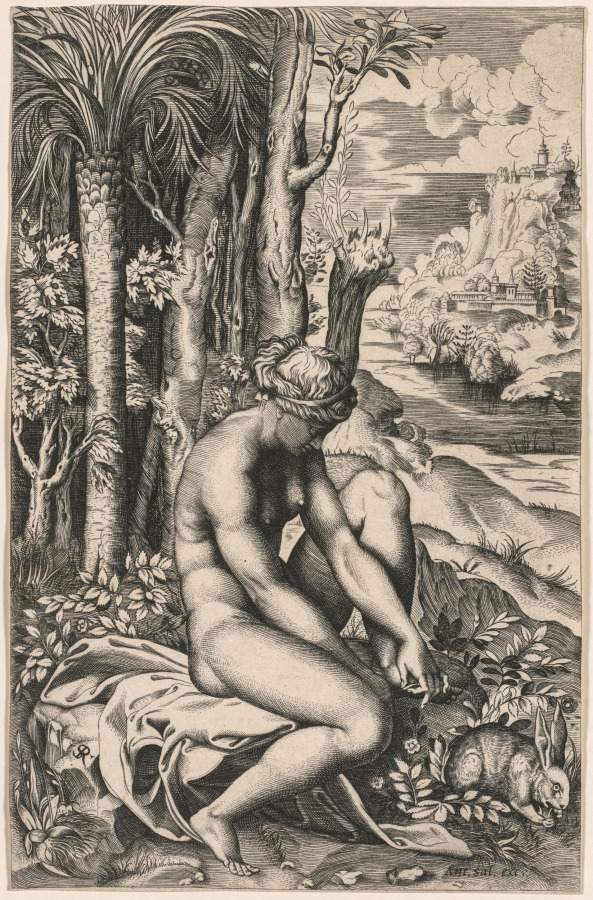
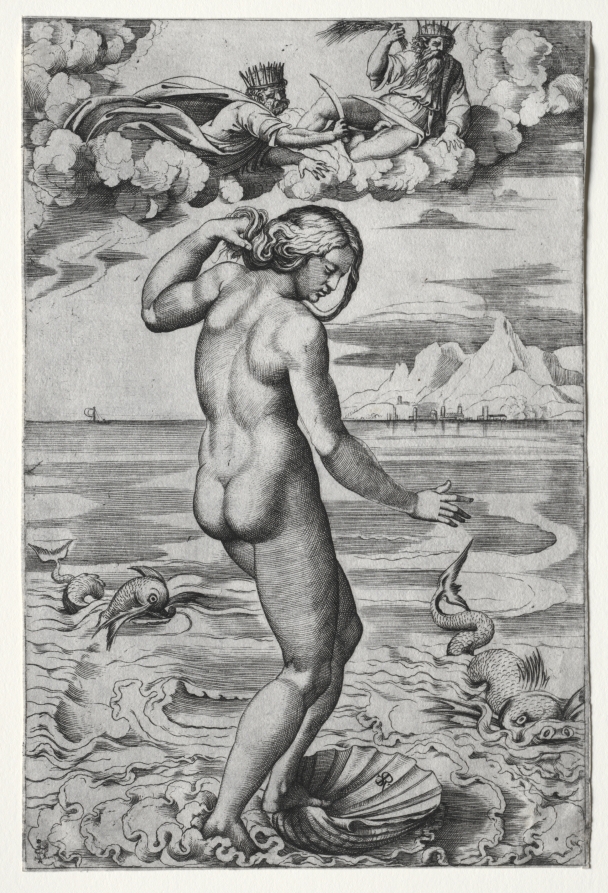
Venus Wounded by a Rose's Thorn, c. 1516, by Marco Dente
Marco Dente · The Cleveland Museum of Art · Dudley P. Allen Fund
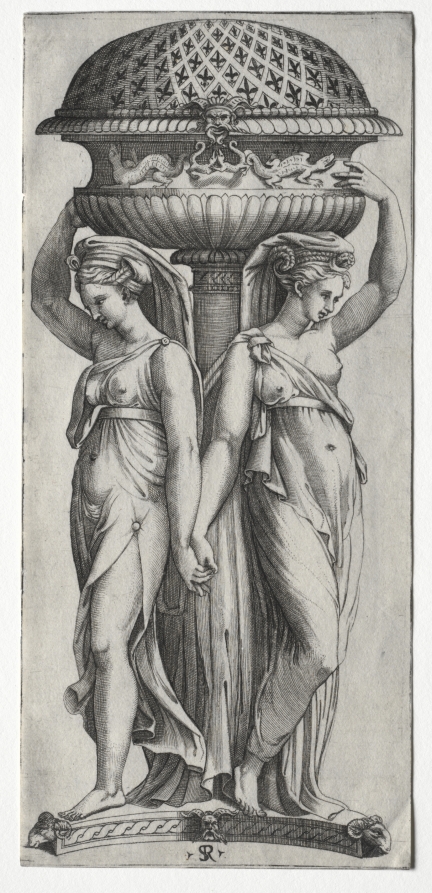
The Cassollette: Women Supporting an Urn, c. 1520–27, by Marco Dente
Marco Dente · The Cleveland Museum of Art · Gift of The Print Club of Cleveland
Life and career
Dated record
Life and career
The full dated record · 2 entries
1493
Marco Dente was born in 1493 at Ravenna.
1527
Marco Dente died in 1527 at Rome.
Places
Named by the record
Places
Only places the record itself states, plotted where the house gazetteer settles their coordinates. Nothing is inferred from a name or a nationality.
Marco Dente was born in Ravenna.
Birthplace
Marco Dente died in Rome.
Deathplace
Ravenna.
Birth place
Rome.
Death place
Primary material
Documents and archives
authority record
- Wikidata, structured authority record Q712750: Marco Dente
General reference · Wikidata
reference work
- “Marco Dente”, English Wikipedia, consulted as further reading
Reputable secondary · Wikipedia
Notes from the source article
Cited by Wikipedia
Notes from the source article
These works are cited by the source article, in its own numbering. They are recorded as its citations, not as sources VALÉORINE has verified.
- 1.McG., K. W. Prints by Old Masters. Bulletin of the Art Institute of Chicago. 103–106. 1919.
- 2.Hind, Arthur M. A History of Engraving & Etching from the 15th Century to the year 1914. Dover Publications. 97. 1963.
- 3.Bryan, Michael. Dictionary of Painters and Engravers, Biographical and Critical. Macmillan. 398. 1903.
- 4.Bury, Michael. Beatrizet and the 'reproduction' of antique relief sculpture. Print Quarterly Limited. 121. 1996.
- 5.Landau, David. The Renaissance print, 1470-1550. Yale University Press. 295; 131–142; 120–125. 1994.
- 6.Viljoen, Madeleine. Raphael and the Restorative Power of Prints. Pint Quarterly. 18. 378–379, 380, 382, 384. December 2001.
- 7.Lord, Carla. Raphael, Marcantonio Raimondi, and Virgil. Notes in the History of Art. 3. 27. Summer 1984.
- 8.Viljoen, Madeleine. Prints and False Antiquities in the Age of Raphael. Print Quarterly. 21. 237. September 2004.
- 9.Fisher, Richard. Catalogue of a Collection of Engravings, Etchings, and Woodcuts. J.C. Wilkins. 58–60. 1879.
- 10.Wright, David H. The Vatica Vergil: A Masterpiece of Late Antique Art. Classical World. 89. 497.
References
Citations
References
Each reference names the institution holding it, so a reader may go to the document itself.
authority record
Secondary witnessreference work
Secondary witness
Further particulars
Held on the record
Further particulars
Open the remaining particulars
His recorded language was Italian.
Identity and origins
Recognition and collections
Work by Marco Dente is
Museum Boijmans Van Beuningen, Minneapolis Institute of Art, Auckland Art Gallery and Finnish National Gallery
The Encyclopedia exists whether or not anything is for sale. Corrections are recorded rather than overwritten, and every version of this record is kept. Published 16 August 2026.
Elsewhere in Prints
4,138 published records in this field, each with its sources named.
- Marcellin JobardEngraver
- Marcin WichaEngraver
- Marco BoschiniEngraver
- Marco CárdenasEngraver
- Marco RicciEngraver
- Marcus BehmerEngraver
- Marek LaczynskiEngraver
- Margaret Bruce WellsEngraver
Best supported in this field
For owners
Own a work by Marco Dente?
A specialist will read what you send and tell you what the house can establish, what it cannot, and whether the object is suited to sale. There is no charge and no obligation. The object stays with you throughout; nothing is shipped to us unless it is arranged in writing beforehand.