
Mameluke sword
A Mameluke sword is a cross-hilted, curved, scimitar-like sword historically derived from sabres used by Mamluk warriors of Ottoman Egypt after whom the sword is named. Egypt was, at least nominally, part of the Ottoman Empire and the sword most commonly used in Egypt was the same as used elsewhere in the empire, the kilij. The curved sabre was originally of Central Asian Turkic in origin from where the style migrated to the Middle East, Europe, India and North Africa.
Mameluke sword
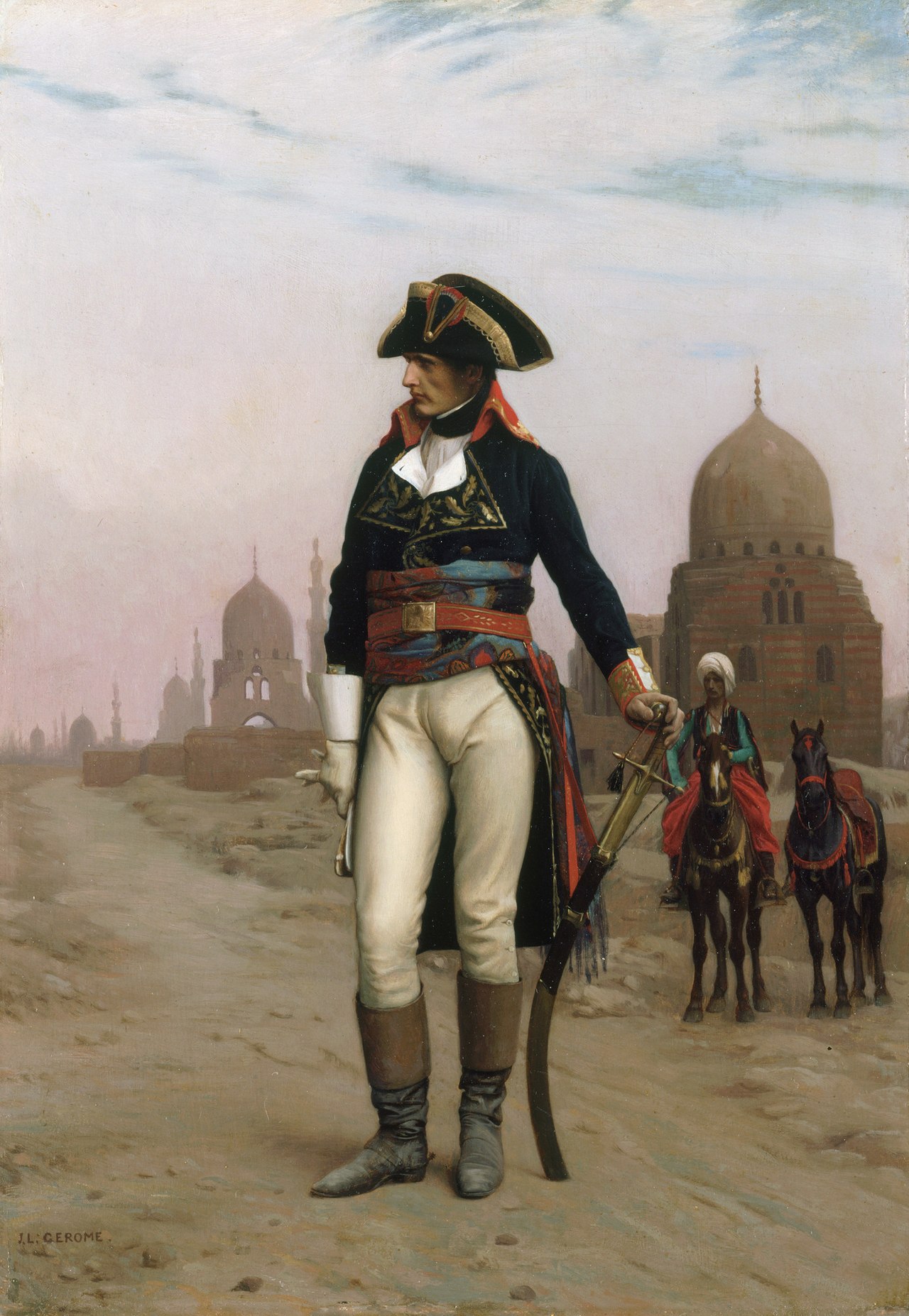
Jean-Léon Gérôme · The Yorck Project (2002) 10.000 Meisterwerke der Malerei (DVD-ROM), distributed by DIRECTMEDIA Publishing GmbH. ISBN: 3936122202. · Public domain
- Field
- sword.
- Region
- Egypt eyalet.
VALÉORINE Encyclopedia
VALÉORINE documentary reading
Documentary summary
A Mameluke sword is a cross-hilted, curved, scimitar-like sword historically derived from sabres used by Mamluk warriors of Ottoman Egypt after whom the sword is named. Egypt was, at least nominally, part of the Ottoman Empire and the sword most commonly used in Egypt was the same as used elsewhere in the empire, the kilij. The curved sabre was originally of Central Asian Turkic in origin from where the style migrated to the Middle East, Europe, India and North Africa.
Admitted source layer · organised and presented by VALÉORINE
Note VALÉORINE
No house-authored Note is published until its assertions and sources pass the VALÉORINE evidence contract. The documentary article remains available in full while that enrichment is being consolidated.
Documentary enrichment in progress · no unsupported statement published
Reference Check
Propose documentary evidence for Mameluke sword. A contribution is never written directly as fact: identity, source, rights and evidence gates still decide.
Sign in to contribute
World of VALÉORINE
Documentary connections
Only confirmed graph relationships appear here. Images are shown only when their identity and reuse rights both pass the documentary gate.

Documentary evidence
Evidence Panel
original value insufficient · checked 25 September 2026
- Identity
- resolved
- Independent source families
- 0
- Admitted assertions
- 0
- Open conflicts
- 0
Authority files
wikidata · Q1774709 · wikipedia · Mameluke sword
In this article
United States Marine Corps
United States Marine Corps
In Anatolia and the Balkans the sabre developed characteristics that eventually produced the Ottoman kilij. It was adopted in the 19th century by several Western militaries, including the French Army, British Army, Royal Sardinian Army, Royal Italian Army and the United States Marine Corps. Although some genuine Ottoman sabres were used by Westerners, most "mameluke sabres" were manufactured in Europe or America; their hilts were very similar in form to the Ottoman prototype, but their blades tended to be longer, narrower and less curved than those of the true kilij, while being wider and also less curved than the Persian shamshir. In short, the hilt retained its original shape. But the blade tended to resemble the blade-form typical of contemporary Western military sabres. The Mameluke sword remains the ceremonial sidearm for some units to this day.
Marine Corps history states that a Mameluke sword was presented to Marine First Lieutenant Presley O'Bannon by the Ottoman Empire viceroy, Prince Hamet, on December 8, 1805, during the First Barbary War, in Libya, as a gesture of respect and praise for the Marines' actions at the Battle of Derna (1805). Upon his return to the United States, the state of Virginia presented him with a silver-hilted sword featuring an eaglehead hilt and a curved blade modeled after the original Mameluke sword given to him by Hamet. Its blade is inscribed with his name and a commemoration of the Battle of Tripoli Harbor. Perhaps due to the Marines' distinguished record during this campaign, including the capture of the Tripolitan city of Derna after a long and dangerous desert march, Marine Corps Commandant Archibald Henderson adopted the Mameluke sword in 1825 for wear by Marine officers. After initial distribution in 1826, Mameluke swords have been worn except for the years 1859–1875 (when Marine officers were required to wear the U.S. Model 1850 Army foot officers' sword), and a brief period when swords were suspended during World War II. Since that time, Mameluke swords have been worn by Marine officers in a continuing tradition to the present day.
British Army
British Army
Mameluke swords were adopted by officers of light cavalry regiments in the first decade of the 19th century, some were used as 'walking out swords' (for ornamental wear on social occasions on foot) but others were employed on active campaign. They are prominent in images of officers of the Hussars painted by Robert Dighton in 1807. As officially regulated dress or levée swords they first appear in 1822 for lancer regiments. Later, other light cavalry and some heavy cavalry regiments also adopted similar patterns. Though broadly similar in form, each regiment's swords had individual variations in the decoration of both blade and hilt. The current regulation sword for generals, the 1831 Pattern, is a Mameluke-style sword, as were various Army Band swords. There are a number of factors which influenced the fashion for Mameluke swords in the British Army. Napoleon raised a number of Mameluke units during his Egyptian campaigns in the French Revolutionary Wars, leading to the adoption of this style of sword by many French officers. In the post-Napoleonic period French military fashion was widely adopted in Britain. The Duke of Wellington carried a Mameluke sword from his days serving in India and throughout his career. After he defeated Napoleon his status was a national hero, Commander-in-Chief of the Forces, and then prime minister; as such, his tastes had considerable weight. The United States Marine Corps sword, discussed above, has been suggested as also being influential. The 1831 Pattern General Officers' Sword is very similar to the USMC Mameluke that pre-dated it.
Australian Army
Australian Army
The Mameluke is still used today by the Australian Army, carried by the rank of Major General or above on ceremonial occasions.
Places
Named by the record
Places
Only places the record itself states, plotted where the house gazetteer settles their coordinates. Nothing is inferred from a name or a nationality.
Egypt eyalet.
Country
Mameluke sword is associated with Egypt eyalet.
Country
Primary material
Documents and archives
authority record
- Wikidata, structured authority record Q1774709: Mameluke sword
Unverified · Wikidata
reference work
- “Mameluke sword”, English Wikipedia, consulted as further reading
Reputable secondary · Wikipedia
Notes from the source article
Cited by Wikipedia
Notes from the source article
These works are cited by the source article, in its own numbering. They are recorded as its citations, not as sources VALÉORINE has verified.
- 1.James E. Lindsay. Daily life in the medieval Islamic world. Greenwood Publishing Group. 64. 2005. 0-313-32270-8.
- 2.Kirill Rivkin. A Study of the Eastern Sword. Yamna Publishing. 2017. 978-1532340017.
- 3.Castagno, Joseph P. Encyclopedia Americana. Scholastic Library Publishing, 2006, Volume 30
- 4.Roffe, Michael. United States Marine Corps. Osprey Publishing. 5. 1972. 0-85045-115-9.
- 5.United States Marine Corps. First Lieutenant Presley O'Bannon. United States Marine Corps History Division. October 2023.
- 6.United States Marine Corps. The Sword.
- 7.Mollo, J. (1997) The Prince's Dolls: Scandals, Skirmishes and Splendours of the Hussars, 1739-1815, Pen & Sword, Barnsley, plate 13
- 8.Robson, B. (1975) Swords of the British Army, Arms and Armour Press, pp. 67–69, 144–145
- 9.Holmes, Richard. The Oxford companion to military history. Oxford University Press. 2001. 0-19-866209-2.
- 10.Robson, Brian. Swords of the British Army, The Regulation Patterns 1788 to 1914. National Army Museum. 1996. 0-901721-33-6.
- 11.Australian Army. The Sword.
References
Citations
References
Each reference names the institution holding it, so a reader may go to the document itself.
authority record
Partially resolvedreference work
Partially resolved
The Encyclopedia exists whether or not anything is for sale. Corrections are recorded rather than overwritten, and every version of this record is kept. Published 14 August 2026.
Elsewhere in Militaria
6,095 published records in this field, each with its sources named.
- MAM-L Smart Micro MunitionTerminology
- Mamba PistolTerminology
- mambeleTerminology
- Mambi AMRTerminology
- man catcherTerminology
- man-portable air-defense systemTerminology
- Mandarin's ringsTerminology
- mangonelTerminology
Best supported in this field
For owners
Own an object connected with Mameluke sword?
A specialist will read what you send and tell you what the house can establish, what it cannot, and whether the object is suited to sale. There is no charge and no obligation. The object stays with you throughout; nothing is shipped to us unless it is arranged in writing beforehand.