
Majestatis
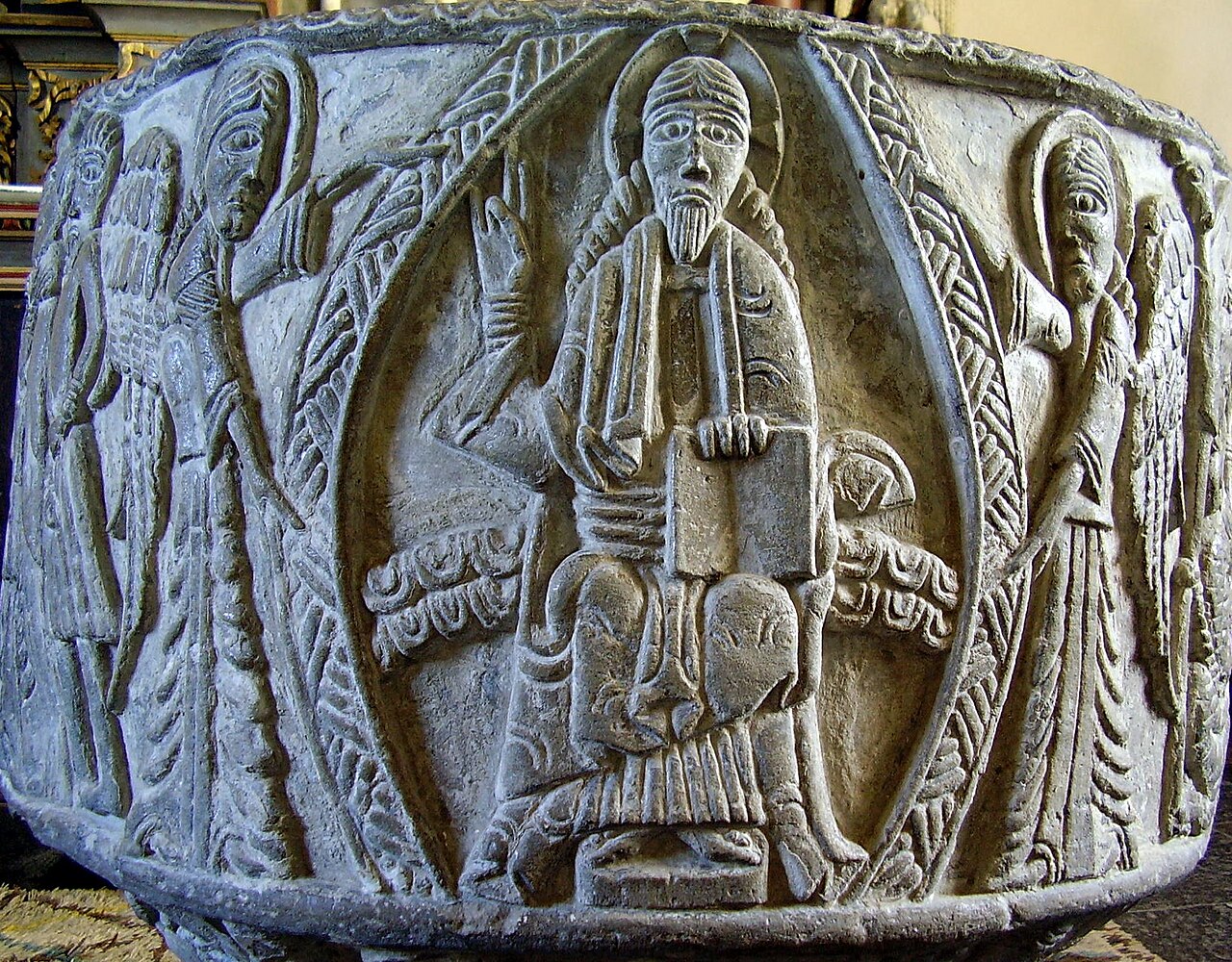
Illustration — Illustration of detail on the Tryde baptismal font, by Majestatis Majestatis (Magister Majestatis Domini, The Master of Christ in Majesty, usually shortened to Majestatis and sometimes referred to as the Tryde Master, fl. Second half of the 12th century) was a Romanesque stone sculptor and the creator of several richly decorated baptismal fonts mainly in Scania and on Gotland (present-day Sweden).
Also recorded as Master Majestatis
Majestatis
Tomas Pettersson · CC BY-SA 3.0
- Born
- 1150
- Nationality
- Sweden
- Occupation
- sculptor
VALÉORINE Encyclopedia
VALÉORINE documentary reading
Documentary summary
Illustration — Illustration of detail on the Tryde baptismal font, by Majestatis Majestatis (Magister Majestatis Domini, The Master of Christ in Majesty, usually shortened to Majestatis and sometimes referred to as the Tryde Master, fl. Second half of the 12th century) was a Romanesque stone sculptor and the creator of several richly decorated baptismal fonts mainly in Scania and on Gotland (present-day Sweden).
Admitted source layer · organised and presented by VALÉORINE
Reference Check
Propose documentary evidence for Majestatis. A contribution is never written directly as fact: identity, source, rights and evidence gates still decide.
Sign in to contribute
World of VALÉORINE
Documentary connections
Only confirmed graph relationships appear here. Images are shown only when their identity and reuse rights both pass the documentary gate.
Documentary evidence
Documentary basis
Authority files
gnd · 1120048214 · wikidata · Q3425986 · wikipedia · Majestatis
In this article
Life and works
Life and works
The name Majestatis is a notname assigned to the artist or workshop; it is possible that an atelier rather than a single artist was responsible for the works attributed to Majestatis. Art historian Johnny Roosval coined the name in the 20th century. It derives from a subject often used by the artist, Christ in Majesty sitting on a rainbow and surrounded by a mandorla and angels. No written sources exist about the life or background of the artist, but it has been speculated that Majestatis was trained in Burgundy or Alsace or may have come from there. Majestatis initially seems to have worked in Scania, probably for the local nobility and possibly the (at the time Danish) royal family. Majestatis appears to have worked at the construction site of Lund Cathedral. Later Majestatis seems to have moved to Gotland. The chef d'oeuvre of Majestatis is the baptismal font of the church of Tryde, Scania, Sweden. The sculptures probably depict, apart from a scene with Christ in Majesty, the legend of St. Stanislaus. It is probable that the motive has some connection to, and the font may even have been commissioned by, the then reigning queen of Denmark (as Scania was then a part of Denmark), queen Sophia, spouse of Valdemar I of Denmark. Sophia had Polish ancestors and not least for that reason the creation of the font has been connected with the royal family. Another theory is that the carvings on the font depict the legend of Saint Fridolin. The font from Tryde was displayed at the International Exposition of 1867 in Paris, and awarded a bronze medal. Majestatis made an additional four or possibly five baptismal fonts for churches in Scania; these were probably all made for local noblemen as they display a high degree of refinement. This group of fonts include the fonts in Löderup, Östra Hoby, Valleberga and Simris churches, and possibly Östra Nöbbelöv. They are all located in the south-eastern part of the province. The baptismal fonts and other stone sculpture identified to be by Majestatis on Gotland island are of a later date than those in Scania. Perhaps the best of the sculptor's works on Gotland is the northern portal of Hablingbo Church. Other works include baptismal fonts in Lokrume, Vall, Sproge, Stenkyrka, Väskinde and Gerum churches, as well as a few others, for example in Denmark and Hälsingland, Sweden. Stylistically, Majestatis is recognisable through his elongated figures with well-kept, often braided hair, pear-shaped faces and large, rather pointed, oval eyes. The sculptor is known for the profusely adorned, but not overdecorated, baptismal fonts.
Gallery
Gallery
• Illustration — Font in Tryde Church, Scania • Illustration — Font in Löderup Church, Scania • Illustration — Font in Valleberga Church, Scania • Illustration — Font in Östra Hoby Church, Scania • Illustration — Font in Vall Church, Gotland • Illustration — North portal of Hablingbo Church, Gotland

Detail of the font "Majestatis Domini" 12th Century.
Helen Simonsson

Notera Av dokumentationsskäl har originalbeskrivningen från Riksantikvarieämbetet behållits. Tillrättalägganden och alternativa beskrivningar bör införas separat från nedanstående information. Felaktigheter kan även anmälas till denna sida. Dopfunt av sandsten. Medeltida.
{ } · Kulturmiljöbild, Riksantikvarieämbetet This file was provided to Wikimedia Commons by the Swedish National Heritage Board as part of the cooperation project Connected Open Heritage with Wikimedia Sver
Primary material
Documents and archives
reference work
- Wikidata, structured authority record Q3425986: Majestatis
Reputable secondary · Wikidata
- “Majestatis”, English Wikipedia, consulted as further reading
Reputable secondary · Wikipedia
authority file
- Gemeinsame Normdatei 1120048214, Rex tremendae majestatis.
General reference · Deutsche Nationalbibliothek
Notes from the source article
Cited by Wikipedia
Notes from the source article
These works are cited by the source article, in its own numbering. They are recorded as its citations, not as sources VALÉORINE has verified.
- 1.Nationalencyklopedin. Majestatis.
- 2.Svanberg, Jan. Signums svenska konsthistoria. Den romanska konsten. Signum förlag. 166–180; 189–192. 1995. 91-87896-23-0.
- 3.Princeton University. Tryde Church. Index of Christian Art.
- 4.Svanberg, Jan. The legend of Saint Stanislaus and King Boleslaus on the 12th century font in Tryde, Sweden. Folia Historiae Artium. 5/6. 25–42. 2001. 83-86956-78-X.
- 5.Marian Plezia. Dookoła sprawy św. Stanisława: studium źródłoznawcze. Homini. 1999. 978-83-87933-10-4.
- 6.Lagerlöf, Erland. Gotlands kyrkor. Rabén & Sjögren. 204. 1973. 9129410355.
- 7.guteinfo.com. Gotländska stenmästare, skulptur, Gotland.
References
Citations
References
Each reference names the institution holding it, so a reader may go to the document itself.
authority file
Gemeinsame Normdatei 1120048214, Rex tremendae majestatis.Deutsche Nationalbibliothek
Secondary witnessreference work
Secondary witnessreference work
Secondary witness
People, houses and institutions
Knowledge graph
People, houses and institutions
Teachers, collaborators, publishers and institutions recorded against this person, each on a stated basis.
Citizenship
1- SwedenPlace
Established from a fact already recorded on a verified source.
The Encyclopedia exists whether or not anything is for sale. Corrections are recorded rather than overwritten, and every version of this record is kept. Published 17 August 2026.
Elsewhere in Sculpture
6,174 published records in this field, each with its sources named.
- Maïté DuvalArtist
- Maitre de ChaourceArtist
- Maja RefsumArtist
- Maja SacherArtist
- Malangatana NgwenyaArtist
- Malcolm MorleyArtist
- Małgorzata ChodakowskaArtist
- Małgorzata Mirga-TasArtist
Best supported in this field
For owners
Own a work by Majestatis?
A specialist will read what you send and tell you what the house can establish, what it cannot, and whether the object is suited to sale. There is no charge and no obligation. The object stays with you throughout; nothing is shipped to us unless it is arranged in writing beforehand.