
M3 fighting knife
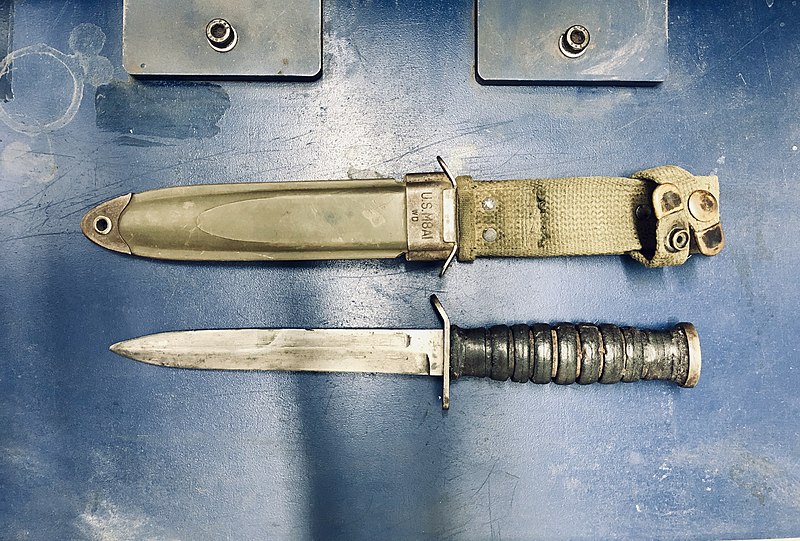
The M3 trench knife or M3 fighting knife was an American military combat knife first issued in March 1943.
M3 fighting knife

Eytancal · CC BY-SA 4.0
- Name
- M3 trench knife
- Field
- fighting knife
- Region
- United States
VALÉORINE Encyclopedia
VALÉORINE documentary reading
Documentary summary
The M3 trench knife or M3 fighting knife was an American military combat knife first issued in March 1943.
Admitted source layer · organised and presented by VALÉORINE
Note VALÉORINE
No house-authored Note is published until its assertions and sources pass the VALÉORINE evidence contract. The documentary article remains available in full while that enrichment is being consolidated.
Documentary enrichment in progress · no unsupported statement published
Reference Check
Propose documentary evidence for M3 fighting knife. A contribution is never written directly as fact: identity, source, rights and evidence gates still decide.
Sign in to contribute
Documentary evidence
Evidence Panel
not yet certified
- Identity
- resolved
- Independent source families
- 0
- Admitted assertions
- 0
- Open conflicts
- 0
Authority files
wikidata · Q6713795
In this article
Key facts
Key facts
• Name — M3 trench knife • Origin — United States • Type — Fighting knife • Is Bladed — yes • Service — 1943–1945 • Wars — *World War II • Indochina War • Korean War • Algerian War • Vietnam War • Iran–Iraq War • Design Date — 1943 • Manufacturer — *Aerial Cutlery Co. • W.R. Case & Sons Co. • Imperial Knife Co. • Pal Blade and Tool Co. • Camillus Cutlery Co. • Robeson Cutlery Co. • Kinfolks, Inc. • Utica Cutlery Co. • H. Boker & Sons Co. • Production Date — March 1943-August 1944 • Number — 2,590,247 • Variants — *M4 bayonet for M1 carbine • M5 bayonet for M1 Garand • M6 bayonet for M14 rifle • M7 bayonet for M16 rifle • Length — 11.75 in • Part Length — 6.75 in • Blade Type — Spear point • Sheath Type — M6, M8, & M8A1
Design
Design
Designed for rapid production using a minimum amount of strategic metals and machine processes to maximize efficiency, the M3 trench knife used a relatively narrow 6.75 in bayonet-style spear-point blade with a sharpened 3.5 in secondary edge. The M3 blade was made of carbon steel, and was either blued or parkerized. Production of the grooved leather handle was later simplified by forming the grip of stacked leather washers that were shaped by turning on a lathe, then polished and lacquered. The M3's steel crossguard had an angular bend at one end to facilitate a thumb rest.
Scabbards
Scabbards
The M3 was initially issued with a stitched and riveted leather M6 scabbard with a protective steel tip designed to prevent the point from piercing the sheath and injuring the wearer. A rawhide thong on the end of the sheath allowed the user to tie the sheathed knife to his leg to prevent it from flapping when running. U.S. paratroopers frequently wore an M3 and sheath tied to a boot for emergency use in cutting parachute lines or close-quarters defense. The M6 was quickly dropped in favor of the M8 scabbard. The M8 and the later M8A1 scabbards both have a resin-impregnated cotton canvas body, painted olive drab, with a steel throat. The early M8 scabbard only had a belt loop to fit over a pistol or trouser belt, and lacked the wire hook that earlier bayonet scabbards had for attaching to the M1910 series of load carrying equipment. The improved M8A1 scabbard manufactured later in WWII added the wire hook. Some M8 scabbards were later modified by adding the hook. The scabbard throat is stamped "US M8" or "US M8A1" on the flat steel part along with the manufacturer's initials. Later M8A1 scabbards were manufactured with a modified extended tab on the web hanger to provide more clearance for the M5 bayonet which rubbed against the wider bayonet handle. This sheath is also correct for all post-war U.S. bayonets including the M4, M5, M6, and M7.
Production
Production
• Approximate M3 production (1943–44) by manufacturer — Number • Imperial Knife Co. — 854,015 • Utica Cutlery Co. — 656,520 • Camillus Cutlery Co. — 402,909 • W.R. Case & Sons Co. — 300,465 • Kinfolks, Inc. — 135,548 • Pal Blade and Tool Co. — 121,131 • Aerial Cutlery Co. — 51,784 • Robeson Cutlery Co. — 36,575 • H. Boker & Sons Co. — 31,300
History
History
The M3 was developed as a replacement for the World War I-era U.S. Mark I trench knife, primarily to conserve strategic metal resources. The prototype for what became the M3 was evaluated in December 1942 by the civilian board of directors of the Smaller War Plants Corporation Board (SWPC) against another competing design, the US Marine Corps' KA-BAR fighting utility knife. While specified priority steel supplies for both knives were available, the M3's lower production cost compared with that of the KA-BAR convinced the SWPC board of directors to approve the M3 prototype for quantity production. Although the M3 had competed with the USMC KA-BAR for approval by the Army, the M3, unlike the Marine Corps knife, was not a dual-purpose weapon designed both for close combat (fighting knife) and general use (utility knife). As the U.S. Catalog of Standard Ordnance Items of 1943 clearly explained: The Trench Knife M3 has been developed to fill the need in modern warfare for hand-to-hand fighting. While designated for issue to soldiers not armed with the bayonet, it was especially designed for such shock units as parachute troops and rangers.
Distribution
Distribution
The M3 trench knife was developed as a replacement for the World War I-era U.S. Mark I trench knife, primarily to conserve strategic metal resources. The M3 was originally designated for issue to soldiers, not otherwise equipped with a bayonet. However, it was particularly designed for use by forces in need of a close combat knife, such as Airborne Units and Army Rangers, so these units received priority for the M3 at the start of production. The M3 was first issued to U.S. Army soldiers in March 1943, with the first knives going to elite units such as airborne troops and the U.S. Army Rangers. As more M3 knives became available in 1943 and 1944, the knife was issued to other soldiers such as Army Air Corps crewmen and soldiers not otherwise equipped with a bayonet, including soldiers issued the M1 carbine or a submachine gun such as the Thompson or M3 submachine gun "grease gun". The M3 would also replace the Fairbairn–Sykes fighting knife or OSS dagger in U.S. service in 1944.
Replacement
Replacement
After the Ordnance Department began developing a proprietary bayonet for use on the M1 carbine, it was realized that the new carbine bayonet, which already incorporated the M3 blade design and leather-wrap grip, could also replace the M3 in service in a secondary role as a fighting knife. In August 1944, the M3 fighting knife evolved into the M4 bayonet for the M1 carbine with the addition of a bayonet ring to the hilt and a locking mechanism in the pommel. The carbine bayonet, now designated the Bayonet, U.S. M4, was added to the Company Table of Organization in June 1944, and the M3 was declared to be a limited standard ordnance item, with supplies to be issued until exhausted. The final M3 production run did not take place until August 1944, by which time 2,590,247 M3 trench knives had been produced. At termination of production in August 1944, the M3 trench knife had one of the shortest production and service records of any U.S. combat knife. The M3's blade design continued in U.S. military service in the form of the U.S. M4, M5, M6, and M7 bayonets.
Places
Named by the record
Places
Only places the record itself states, plotted where the house gazetteer settles their coordinates. Nothing is inferred from a name or a nationality.
- United States
Named but not plotted · 1
M3 fighting knife is associated with United States.
Country
Reception
Despite Ordnance descriptions of the knife as being designed for hand-to-hand warfare, the M3 did not receive universal praise as a close-quarters fighting knife upon issue to combat units. While the knife itself was generally well-made and balanced (some paratroopers and rangers mastered the art of using the M3 as a throwing knife), the long, narrow, dagger-like steel blade, designed to economize on priority steel requirements, was best used as a thrusting or stabbing weapon, and performed less well when used for cutting or slashing strokes. Reports of blade failures on M3s in service increased as soldiers began to use their trench knives for ordinary utility tasks such as opening ammunition crates and food ration tins, a role for which the M3 had not been designed. Some soldiers also found the M3's cutting edge to be difficult to maintain in the field. As issued, the blade's secondary or false edge was intentionally sharpened and beveled for only a portion of its length, leaving an unsharpened spine on the top of the blade in an effort to stiffen the relatively narrow blade. This limited the usefulness of the M3 when employed for backhand slashing strokes.
M3 knife
Eytancal
Literature
Scholarly footprint
A count of publications is evidence of attention, not of standing, and is given here only as a measure.
Notes from the source article
Cited by Wikipedia
Notes from the source article
These works are cited by the source article, in its own numbering. They are recorded as its citations, not as sources VALÉORINE has verified.
- 1.Blending Metals to Arm Our Fighting Men, Popular Science, Vol. 142 No. 6 (June 1943), p. 104
- 2.Somers, R.H. (Brig. Gen., U.S. Army, ret.) (ed.), Ordnance, American Ordnance Association, Volume 24, No. 138 (May–June 1943), pp. 553-554
- 3.Cassidy, William L. (1997), The Complete Book of Knife Fighting, , (1997), pp. 47-48
- 4.KNIFE – U.S. KNIFE MODEL 1918 MKI TRENCH Springfield Armory Museum – Collection Record
- 5.Canfield, Bruce N., U.S. INFANTRY WEAPONS OF WORLD WAR II, Lincoln, RI: Andrew Mowbray Publishers, , (1994)
- 6.Whitman, L., New Army Trench Knife, Army & Navy Journal, Vol. 80, 6 February 1943, p. 649
- 7.Trzaska, Frank, (1996), U.S. Fighting Knives of World War II, Chapter VII: M3 Trench Knife, OKCA (May 1996)
- 8.Graf, John F., Warman's World War II Collectibles: Identification and Price Guide, Krause Publications, (2007), p. 217
- 9.The History of the M4 Bayonet/Fighting Knife, MilitaryItems.com, retrieved 3 July 2011
- 10.Foster, Lawrence G., Robert Wood Johnson: the gentleman rebel, (1st ed.), Lillian Press, , (1999), p. 256, 263-264: The SWPC was chaired by industrial tycoon Robert Wood Johnson II, who was given a commission as a brigadier general. Johnson was known for overruling production item requests by the service branches in favor of designs that could be produced more quickly or more economically by small businesses with limited tooling, freeing up material for private industry to begin a reconversion to peacetime goods production.
- 11.Edged Weapons: US M3 Knife.
- 12.Catalog of Standard Ordnance Items, Washington, D.C: U.S. Army Ordnance Publications (1943)
- 13.Chambers, John W., OSS Training in the National Parks and Service Abroad in World War II, Washington, D.C., U.S. National Park Service (2008), p. 191
- 14.Brunner, John W., OSS Weapons (2nd ed.), Williamstown, N.J.: Phillips Publications (2005), pp. 68-72
References
Citations
References
Each reference names the institution holding it, so a reader may go to the document itself.
authority record
Partially resolved
The Encyclopedia exists whether or not anything is for sale. Corrections are recorded rather than overwritten, and every version of this record is kept. Published 14 August 2026.
Elsewhere in Militaria
6,095 published records in this field, each with its sources named.
- M26 Modular Accessory Shotgun SystemTerminology
- M27 Infantry Automatic RifleTerminology
- M270 Multiple Launch Rocket SystemTerminology
- M29 cluster bombTerminology
- M3 Gun Motor CarriageTerminology
- M3 submachine gunTerminology
- M30 Luftwaffe drillingTerminology
- M31 HEAT rifle grenadeTerminology
Best supported in this field
For owners
Own an object connected with M3 fighting knife?
A specialist will read what you send and tell you what the house can establish, what it cannot, and whether the object is suited to sale. There is no charge and no obligation. The object stays with you throughout; nothing is shipped to us unless it is arranged in writing beforehand.