
Livingstone College
Livingstone College is a private historically black Christian college in Salisbury, North Carolina. It is affiliated with the African Methodist Episcopal Zion Church. Accredited by the Southern Association of Colleges and Schools to award bachelor's degrees.
Livingstone College
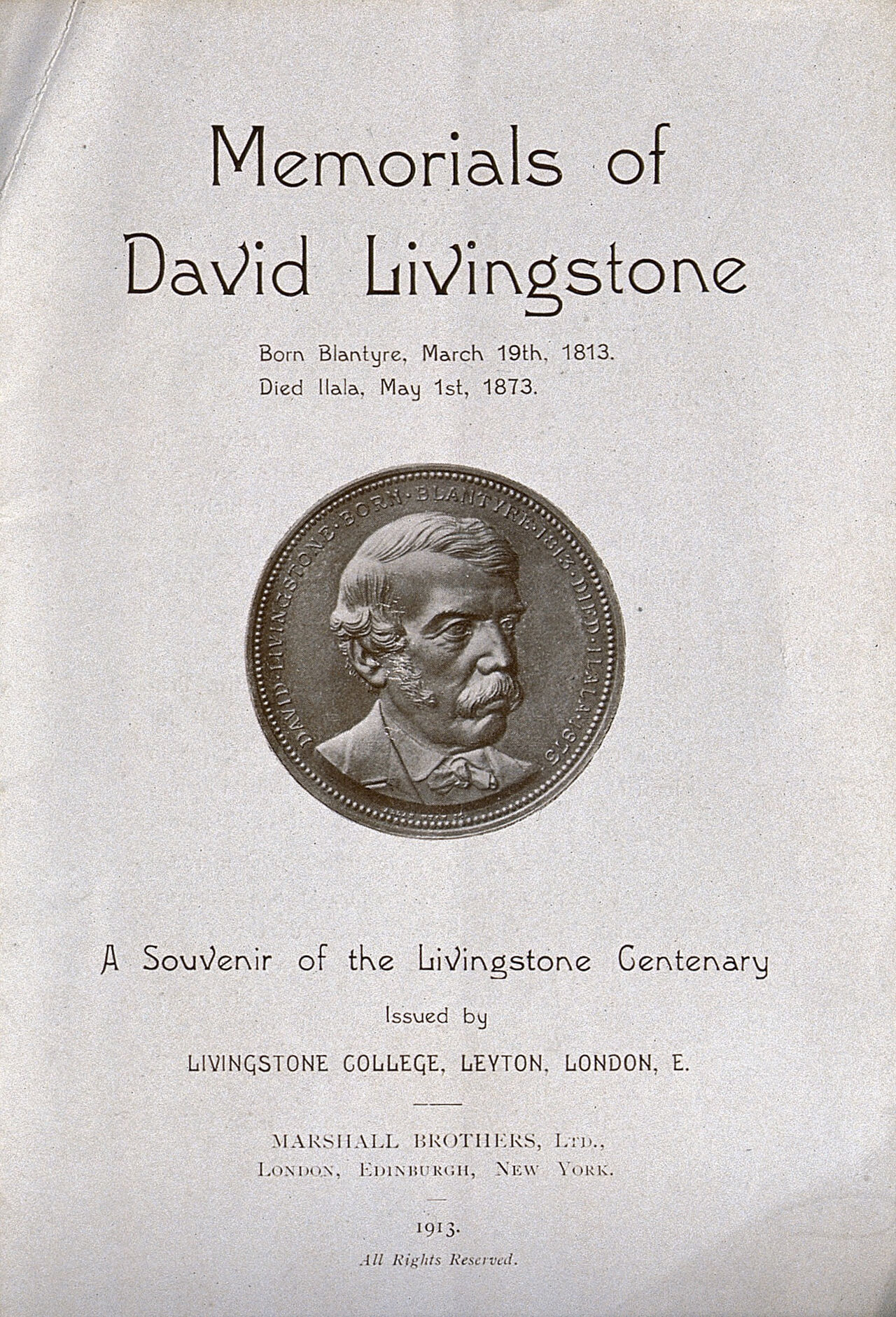
Livingstone College · Wellcome Collection, London · Wellcome Collection · Public Domain Mark
- Name
- Livingstone College
Reference Check
Propose documentary evidence for Livingstone College. A contribution is never written directly as fact: identity, source, rights and evidence gates still decide.
Sign in to contribute
World of VALÉORINE
Documentary connections
Only confirmed graph relationships appear here. Images are shown only when their identity and reuse rights both pass the documentary gate.
In this article
Key facts
Key facts
• Name — Livingstone College • Former Names — Zion Wesley Institute (1879–1887) • Motto — A Call To Commitment. Taking Livingstone College to the next level • Type — Private historically black college • Religious Affiliation — African Methodist Episcopal Zion Church • President — Anthony Davis • Faculty — 57 full time, 17 part time (fall 2024) • Students — 936 (fall 2024) • Undergrad — 924 • Postgrad — 12 • City — Salisbury • State — North Carolina • Country — U.S. • Campus — Small town, 272 acre • Colors — Columbia blue and black • Sports Nickname — Blue Bears • Mascot — The Blue Bear • Sporting Affiliations — * NCAA Division II • Central Intercollegiate Athletic Association
History
History
Livingstone College along with Hood Theological Seminary began as Zion Wesley Institute in Concord, North Carolina in 1879. After fundraising by Joseph C. Price and J. W. Hood, the school was closed in Concord and reopened in 1882 a few miles north in Salisbury. Zion Wesley Institute was founded by the African Methodist Episcopal (AME) Zion Church. The institute changed its name to Livingstone College in 1887 to honor African missionary David Livingstone. That same year, the school granted its first degree. The first group of students to graduate included eight men and two women, the first black women to earn bachelor's degrees in North Carolina. Originally beginning with 40 acres on a Salisbury farm called Delta Grove, Livingstone College's main campus now consists of 272 acres. In August 2014, Livingstone submitted plans for converting a former Holiday Inn on Jake Alexander Boulevard into a hospitality school. Livingstone's School of Hospitality Management & Culinary Arts, a program accredited in 2012, had moved to the new location by 2015.
Livingstone College Historic District
Livingstone College Historic District
The Livingstone College Historic District is a national historic district listed on the National Register of Historic Places in 1982. The district encompasses 16 contributing buildings, 1 contributing structure, and 1 contributing object on the Livingstone College campus and adjacent residential sections in Salisbury. Notable buildings include the Price house (1884), Harris house (1889), Aggrey house (1912), Ballard Hall (1887), Dodge Hall (1886), Carnegie Library (1908), Goler Hall (1917), Hood Building (1910), and Price Memorial Building (1930–1943).
Athletics
Athletics
On the campus is an athletic marker erected in 1956 to commemorate the first African-American intercollegiate football game, in 1892. Livingstone is a member of the National Collegiate Athletic Association (NCAA), Division II, and the Central Intercollegiate Athletic Association (CIAA). Its intercollegiate sports programs include basketball, bowling, cross-country, football, softball, volleyball, tennis, golf, and track and field. The nickname for the school's teams is the Blue Bears. The Livingstone College football team has had a long history since playing in the first Black college football game in 1892 against Johnson C. Smith University (then called Biddle University). The rivalry between the two schools continues to this day as the Commemorative Classic. The Blue Bears also maintain a rivalry with their cross town rival Catawba College Indians. The early October game between the two schools is called the Mayors' Cup. The current football stadium that the university uses for matches is named Alumni Memorial Stadium.
Text attribution
Licensing
Text attribution
Part of the biographical narrative on this page reuses licensed material. Its origin, revision and licence are recorded here.
The biographical narrative on this page is based on the Wikipedia article Livingstone College, revision 1373482091 (EN edition), by its contributors. VALÉORINE has edited that text and built its own documentary record around it. The reused material is available under CC BY-SA 4.0, and this page's reuse of it is offered under the same licence. Everything else on this page — the chronology, the holdings, the evidence, the plates and the connections — is VALÉORINE's own record. Sources and licences.
Notes from the source article
Cited by Wikipedia
Notes from the source article
These works are cited by the source article, in its own numbering. They are recorded as its citations, not as sources VALÉORINE has verified.
- 1.College Navigator – Livingstone College.
- 2.82003509. 2010a.
- 3.Livingstone College. About Livingstone.
- 4.Franz, Alyssa. Livingstone College (1879-- ). Online Encyclopedia of Significant People and Places in African American History. BlackPast.org. 11 March 2010.
- 5.Gilmore, Glenda Elizabeth. Gender and Jim Crow: Women and the Politics of White Supremacy in North Carolina, 1896–1920. The University of North Carolina Press. 40. 1996. 978-0807845967.
- 6.Campbell, Sarah. Livingstone College has history of producing leaders. The Salisbury Post. February 14, 2011.
- 7.City approves new Holiday Inn, Livingstone buying old hotel. The Salisbury Post. August 20, 2014.
- 8.Groh, Jeanie. City approves new Holiday Inn, Livingstone buying old hotel. The Salisbury Post. January 3, 2015.
- 9.Willis, Laurie D. Livingstone hosts fundraiser for Heritage Hall renovation. The Salisbury Post. October 8, 2015.
- 10.Dave Brown. Livingstone College Historic District. National Register of Historic Places – Nomination and Inventory. North Carolina State Historic Preservation Office. June 1980.
- 11.Greenlee, Craig T. Small schools – Where Football Is An Activity, Not a Business. Diverse Issues in Higher Education. June 17, 2007.
- 12.Bernard Anderson Tuskegee University. tuskegee.edu.
- 13.CSMGEP Profiles: Bernard E. Anderson, University of Pennsylvania. aeaweb.org.
- 14.ESI Senior Advisor Bernard Anderson to Receive UAC Living Legacy Award. Econsult Solutions, Inc. 2016-11-08.
- 15.Award Recipients 2022. leraweb.org.
- 16.Smith, Gerald L. The Kentucky African American Encyclopedia. University Press of Kentucky. 41. 2015-08-28. 978-0-8131-6066-5.
- 17.Ploski, Harry A. Reference Library of Black America. Gale Research Incorporated. 1410. 1990.
- 18.Henderson, Ashyia N. Who's Who Among African Americans. Gale Group. 647. 2000. 978-0-7876-3634-0.
- 19.Smith, J. Clay Jr. Rebels in Law: Voices in History of Black Women Lawyers. University of Michigan Press. 18. 1998. 0472108832.
The Encyclopedia exists whether or not anything is for sale. Corrections are recorded rather than overwritten, and every version of this record is kept. Published 26 September 2026.
Elsewhere in General
22,760 published records in this field, each with its sources named.
- Liverpool John Moores UniversityOrganisation
- LivingstonPlace
- Livingston CountyPlace
- Livingston High SchoolOrganisation
- LivornoPlace
- Livry-GarganPlace
- LjubljanaPlace
- LjubnoPlace
Best supported in this field
For owners
Own an object connected with Livingstone College?
A specialist will read what you send and tell you what the house can establish, what it cannot, and whether the object is suited to sale. There is no charge and no obligation. The object stays with you throughout; nothing is shipped to us unless it is arranged in writing beforehand.