
lirone
The lirone (or lira da gamba) is the bass member of the lira family of instruments that was popular in the late 16th and early 17th centuries. It is a bowed string instrument with between 9 and 16 gut strings and a fretted neck. When played, it is held between the legs in the manner of a cello or viol (viola da gamba).
Also recorded as lira da gamba
lirone

Pier Francesco Mola · kunst-fuer-alle.de · Public domain
- Name
- Lirone
- Field
- necked box lute played with a bow
VALÉORINE Encyclopedia
VALÉORINE documentary reading
Documentary summary
The lirone (or lira da gamba) is the bass member of the lira family of instruments that was popular in the late 16th and early 17th centuries. It is a bowed string instrument with between 9 and 16 gut strings and a fretted neck. When played, it is held between the legs in the manner of a cello or viol (viola da gamba).
Admitted source layer · organised and presented by VALÉORINE
Reference Check
Propose documentary evidence for lirone. A contribution is never written directly as fact: identity, source, rights and evidence gates still decide.
Sign in to contribute
Documentary evidence
Documentary basis
Authority files
wikidata · Q361424
In this article
Overview
Overview
It was used in italian operas and oratoriums to accompany the human voice, especially the gods. Because the lira da gambe can not play the bass, there must be a bass instrument, theorbo, harpsichord or viola da gamba.

Lira da gamba, MfM.Uni-Leipzig References ULEI:M0000780 Lira da Gamba, Francesco Bertolotti da Salò, in Brescia, um 1612, Inv.-Nr.783. Musical Instrument Museums Online (MIMO). " In Brescia um 1612 von Francesco Bertolotti da Salò erbaut. " Georg
Thomas Quine · Flickr: Antique strings
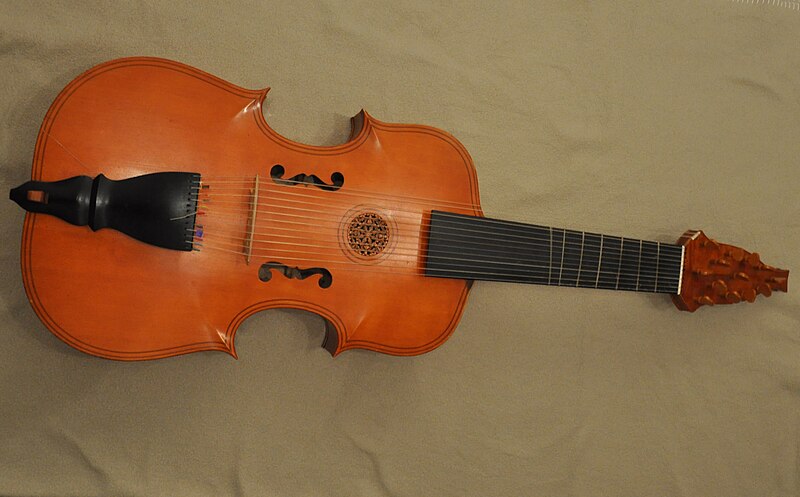
Lira da gamba
GeorgWildermann
Key facts
Key facts
• Name — Lirone • Names — Lira da gamba; lyrone; lyra da gamba • Classification — Bowed string instrument • Related — Lira da braccio
History
History
• Illustration — Lirone player painted by Pier Francesco Mola The lirone was primarily used in Italy during the late 16th and early 17th centuries (and particularly in the time of Claudio Monteverdi) to provide continuo, or harmony for the accompaniment of vocal music. It was frequently used in Catholic churches, particularly by Jesuits.
Performers
Performers
Despite the resurgence in Baroque instrument performance during the 20th century, only a handful of musicians play the lirone. Notable performers on the instrument include Erin Headley of England; Imke David, Claas Harders and Hille Perl of Germany; Annalisa Pappano of the United States; Laura Vaughan of Australia, and Paulina van Laarhoven of the Netherlands.
Description
The Grove Dictionary of Music and Musicians describes the lirone as essentially a larger version of the lira da braccio, which has a similar wide fingerboard, flat bridge, and leaf-shaped pegbox with frontal pegs. Its flat bridge allows for the playing of chords of between three and five notes.
Literature
Scholarly footprint
A count of publications is evidence of attention, not of standing, and is given here only as a measure.
Notes from the source article
Cited by Wikipedia
Notes from the source article
These works are cited by the source article, in its own numbering. They are recorded as its citations, not as sources VALÉORINE has verified.
- 1.Grove Dictionary of Music and Musicians, ed. L. Macy (accessed 11 November 2006).
- 2.Pio Stefano. Viol and Lute Makers of Venice. Venice research. 441. 2012. 9788890725203.
- 3.Catacoustic Consort. Baroque Musical Instruments.
- 4.Erin Headley. Lirone. Grove Dictionary of Music and Musicians.
- 5.claas harders – viola da gamba – lirone. Claasharders.de.
- 6.Laura Vaughan | Viols and Lirone. Lauravaughan.com.
- 7.Facebook laviolettapaulinavanlaarhoven Paulina van Laarhoven
Bibliography printed in the source article · 2
- Imke David, "Die sechzehn Saiten der italienischen Lira da gamba", orfeo Verlag, 1999,
- John Weretka.
References
Citations
References
Each reference names the institution holding it, so a reader may go to the document itself.
reference work
Secondary witness
The Encyclopedia exists whether or not anything is for sale. Corrections are recorded rather than overwritten, and every version of this record is kept. Published 16 August 2026.
Elsewhere in Collectables
20,755 published records in this field, each with its sources named.
- lip-ribbon microphoneTerminology
- Lipstick pickupTerminology
- Liquid KidsWork
- lira da braccioTerminology
- LISA the JoyfulWork
- Lister CarsOrganisation
- Litex MotorsOrganisation
- lithophoneTerminology
Best supported in this field
For owners
Own an object connected with lirone?
A specialist will read what you send and tell you what the house can establish, what it cannot, and whether the object is suited to sale. There is no charge and no obligation. The object stays with you throughout; nothing is shipped to us unless it is arranged in writing beforehand.