
Lightnin' Hopkins
Samuel John "Lightnin'" Hopkins (March 15, 1912 – January 30, 1982) was an American country blues singer, songwriter, guitarist and occasional pianist from Centerville, Texas. In 2010, Rolling Stone magazine ranked him No. 71 on its list of the 100 greatest guitarists of all time.
Also recorded as Lightning Hopkins · Lightnin Hopkins · Sam John Hopkins · Sam ("Lightnin'") Hopkins
Lightnin' Hopkins

33stradale · CC BY-SA 3.0
- Name
- Lightnin' Hopkins
- Birth Name
- Samuel John Hopkins
- Born
- 15 March 1912
- Birthplace
- Centerville, Texas, U.S.
- Died
- 30 January 1982
- Place of death
- Houston, Texas, U.S.
- Occupation
- * Musician
- Full name
- Samuel John Hopkins.
- Nationality
- United States
- Fields
- electric blues · country blues · Texas blues · blues
- Honours
- Grammy Lifetime Achievement Award
- Languages
- English
VALÉORINE Encyclopedia
VALÉORINE documentary reading
Documentary summary
Samuel John "Lightnin'" Hopkins (March 15, 1912 – January 30, 1982) was an American country blues singer, songwriter, guitarist and occasional pianist from Centerville, Texas. In 2010, Rolling Stone magazine ranked him No. 71 on its list of the 100 greatest guitarists of all time.
Admitted source layer · organised and presented by VALÉORINE
Note VALÉORINE
Lightnin' Hopkins (1912–1982) was a blues musician, composer and guitarist, among other activities, of American nationality. The blues musician was born Samuel John Hopkins in Centerville and died in Houston.
The work spans blues, country blues and electric blues, among others. Languages used include English. Honours include Grammy Lifetime Achievement Award.
Composed from admitted, traceable facts · 27 September 2026
VALÉORINE
Reference Check
Propose documentary evidence for Lightnin' Hopkins. A contribution is never written directly as fact: identity, source, rights and evidence gates still decide.
Sign in to contribute
World of VALÉORINE
Documentary connections
Only confirmed graph relationships appear here. Images are shown only when their identity and reuse rights both pass the documentary gate.
Documentary evidence
Evidence Panel
not yet certified
- Identity
- resolved
- Independent source families
- 0
- Admitted assertions
- 0
- Open conflicts
- 0
Authority files
wikidata · Q435552 · wikipedia · Lightnin' Hopkins
In this article
Key facts
Key facts
• Name — Lightnin' Hopkins • Birth Name — Samuel John Hopkins • Born — 15 March 1912 • Birthplace — Centerville, Texas, U.S. • Died — 30 January 1982 • Place of death — Houston, Texas, U.S. • Instrument — * Guitar • piano • organ • vocals • Genre — * Electric blues • country blues • Texas blues • Occupation — * Musician • songwriter • Years Active — 1946–1982 • Label — * Aladdin • Modern • RPM • Gold Star • Sittin' in With/Jax • Mercury • Decca • Herald • Folkways • World Pacific • Vee-Jay • Arhoolie • Bluesville • Tradition • Fire • Candid • Imperial • Prestige • Verve • Jewel
Background
Background
The musicologist Robert "Mack" McCormick opined that Hopkins is "the embodiment of the jazz-and-poetry spirit, representing its ancient form in the single creator whose words and music are one act". He influenced Townes Van Zandt, Hank Williams, Jr., and a generation of blues musicians such as Stevie Ray Vaughan, whose Grammy-nominated song "Rude Mood" was directly inspired by the Texan's song "Hopkins' Sky Hop". In his own lifetime, Hopkins was one of the initial inductees in 1980 to the Blues Hall of Fame. Hopkins was born in Centerville, Texas. As a child, he was immersed in the sounds of the blues. He developed a deep appreciation for the music at the age of eight, when he met Blind Lemon Jefferson at a church picnic in Buffalo, Texas. He went on to learn from his distant older cousin, the country blues singer Alger "Texas" Alexander; Hopkins had another cousin, the Texas electric blues guitarist Frankie Lee Sims, with whom he later recorded. Hopkins began accompanying Jefferson on guitar at informal church gatherings. Jefferson reputedly never let anyone play with him except Hopkins, and Hopkins learned much from Jefferson at these gatherings. In the mid-1930s, Hopkins was sent to Houston County Prison Farm, but why he was imprisoned is unknown. During his time, he worked with, and backed singer / tap dancer / drummer L.C. Williams.
Career
Career
In the late 1930s, he moved to Houston with Alexander in an unsuccessful attempt to break into the music scene there. By the early 1940s, he was back in Centerville, working as a farm hand. Hopkins took a second shot at Houston in 1946. While singing on Dowling Street in Houston's Third Ward, which would become his home base, he was discovered by Lola Anne Cullum of Aladdin Records, based in Los Angeles. She convinced Hopkins to travel to Los Angeles, where he accompanied the pianist Wilson Smith. The duo recorded twelve tracks in their first sessions in 1946. An Aladdin executive decided the pair needed more dynamism in their names and dubbed Hopkins "Lightnin'" and Wilson "Thunder". • Illustration — Gold Star promotional photograph, 1948 Hopkins recorded more sides for Aladdin in 1947. He returned to Houston and began recording for Gold Star Records. He also played piano and guitar on L.C. Williams' first record that was released the same year. Hopkins would work with Williams on later recordings. In the late 1940s and 1950s he rarely performed outside Texas, only occasionally traveling to the Midwest and the East for recording sessions and concert appearances. He performed regularly at nightclubs in and around Houston, particularly on Dowling Street, where he had been discovered by Aladdin. He recorded the hit records "T-Model Blues" and "Tim Moore's Farm" at SugarHill Recording Studios in Houston. By the mid- to late 1950s, his prodigious output of high-quality recordings had gained him a following among African Americans and blues aficionados. In 1959, the blues researcher Robert "Mack" McCormick contacted Hopkins, hoping to bring him to the attention of a broader musical audience engaged in the folk revival. McCormack presented Hopkins to integrated audiences first in Houston and then in California. He made his debut at Carnegie Hall on October 14, 1960, alongside Joan Baez and Pete Seeger, performing the spiritual "Mary Don't You Weep". In 1960, he signed with Tradition Records. The recordings which followed included his song "Mojo Hand" in 1962. In 1968, Hopkins recorded the album Free Form Patterns, backed by the rhythm section of the psychedelic rock band 13th Floor Elevators. Through the 1960s and into the 1970s, he released one or sometimes two albums a year and toured, playing at major folk music festivals and at folk clubs and on college campuses in the U.S. and internationally. He toured extensively in the United States and played a six-city tour of Japan in 1978. Hopkins was Houston's poet-in-residence for 35 years. He recorded more albums than any other blues musician. Hopkins was one of the initial inductees to the Blues Hall of Fame in 1980. Hopkins died of esophageal cancer in Houston on January 30, 1982, at the age of 69. His obituary in the New York Times described him as "one of the great country blues singers and perhaps the greatest single influence on rock guitar players". Hopkins is buried at Forest Park Lawndale Cemetery in Houston, Texas. A statue of Hopkins, unveiled in 2003, sits in Crockett, Texas. His Gibson J-160e "hollowbox" is on display at the Rock and Roll Hall of Fame in Cleveland, Ohio, and his Guild Starfire at the National Museum of African American History and Culture in Washington, D.C., both on loan from the Joe Kessler Collection.
Musical style
Musical style
Hopkins's style was born from spending many hours playing informally without a backing band. His distinctive fingerstyle technique often included playing, in effect, bass, rhythm, lead, and percussion at the same time. He played both "alternating" and "monotonic" bass styles incorporating imaginative, often chromatic turnarounds and single-note lead lines. Tapping or slapping the body of his guitar added rhythmic accompaniment. Much of Hopkins's music follows the standard 12-bar blues template, but his phrasing was free and loose. Many of his songs were in the talking blues style, but he was a powerful and confident singer. Lyrically, his songs expressed the problems of life in the segregated South, bad luck in love and other subjects common in the blues idiom. He dealt with these subjects with humor and good nature. He often referred to himself as "Po' Lightnin'" in his songs when talking about himself or referring to himself as the protagonist of the song. This is also the name of one of his albums. Many of his songs are filled with double entendres, and he was known for his humorous introductions to songs. Some of his songs were of warning and sour prediction, such as "Fast Life Woman": You may see a fast life woman sittin' round a whiskey joint, Yes, you know, she'll be sittin' there smilin', 'Cause she knows some man gonna buy her half a pint, Take it easy, fast life woman, 'cause you ain't gon' live always...
Early compilations of previously issued material
Early compilations of previously issued material
• Early Recordings (Arhoolie, 1946-50 [1969]) - collection of Gold Star recordings • Early Recordings Vol. 2 (Arhoolie, 1946-50 [1971]) - collection of Gold Star releases • Lightnin' Hopkins Strums the Blues (Score, 1946-48 [1958]) - collection of Aladdin releases • Lightning Hopkins Sings the Blues (Crown, 1947-1951 [1961]) - collection of RPM releases • Last of the Great Blues Singers (Time, 1950-51 [1960]) - collection of Sittin' in With releases • Lightnin' and the Blues (Herald, 1954 [1960]) - collection of Herald releases
Original LP releases
Original LP releases
• The Rooster Crowed in England (77, 1959 [1960]) • Lightnin' Hopkins (Folkways, 1959) - reissued as The Roots of Lightnin' Hopkins • Country Blues (Tradition, 1959) • Autobiography in Blues (Tradition, 1960) • Down South Summit Meetin (World Pacific, 1960) with Brownie McGhee, Big Joe Williams and Sonny Terry - reissued as Summit Meetin' • Last Night Blues (Bluesville, 1960) with Sonny Terry • Lightnin (Bluesville, 1960) • Lightnin' in New York (Candid, 1960) • Mojo Hand (Fire, 1960 [1962]) • Blues in My Bottle (Bluesville, 1961) • Blues Hoot (Horizon, 1961 [1963]) with Brownie McGhee and Sonny Terry - reissued as Coffee House Blues • On Stage (Imperial Records, [1962]) reissued Dolchess 2013 • Lightnin' Sam Hopkins (Arhoolie, 1962) • Walkin' This Road by Myself (Bluesville, 1962) • Lightnin' and Co. (Bluesville, 1962) • Smokes Like Lightning (Bluesville, 1962 [1963]) • Lightnin' Strikes (Vee-Jay, 1962) • Hootin' the Blues (Prestige Folklore, 1962 [1965]) • Goin' Away (Bluesville, 1963) • The Swarthmore Concert (Prestige, 1964 [1993]) • Down Home Blues (Bluesville, 1964) • Soul Blues (Prestige, 1964 [1965]) • Lightning Hopkins with His Brothers Joel and John Henry / with Barbara Dane (Arhoolie, 1964 [1966]) • My Life in the Blues (Prestige, 1964 [1965]) • Live at the Bird Lounge (Guest Star, 1964) • The King of the Blues (Pickwick, 1965) - reissued as Let's Work Awhile • Blue Lightnin (Jewel, 1965 [1967]) • Live at Newport (Vanguard, 1965 [2002]) • Lightnin' Strikes (Verve Folkways, 1965 [1966]) - reissued as Nothin' But the Blues • Something Blue (Verve Folkways, 1967) • Thats My Story (Polydor, 1965 [1970]) • Blues Festival Song & Dance (Arhoolie, 1967) shared disc with Mance Lipscomb and Clifton Chenier • Texas Blues Man (Arhoolie, 1967) • Free Form Patterns (International Artists, 1968) • Talkin' Some Sense (Jewel, 1968) • Lightnin' Hopkins Strikes Again (Home Cooking, 1968 [1975]) • The Great Electric Show and Dance (Jewel, 1969) • California Mudslide (and Earthquake) (Vault Records, 1969) • Lightnin'! (Poppy, 1969) - rereleased on Arhoolie in 1993 • In the Key of Lightnin (Tomato, 1969 [2002]) • Lightning Hopkins in Berkeley (Arhoolie, 1969 [1970]) • Po' Lightnin (Arhoolie, 1961/69 [1983]) • The Legacy of the Blues Vol. 12 (Sonet, 1974 [1977]) • New Orleans Jazz and Heritage Festival 1976 (Island, 1977) shared disc with various artists • The Rising Sun Collection Vol. 9 (Just a Memory, 1977 [1996]) • Mighty Crazy (Catfish, 1980 [2002]) shared disc with Big Mama Thornton • The Rising Sun Collection (Just a Memory, 1980 [1996]) shared disc with Louisiana Red, Sonny Terry and Brownie McGhee • Forever (Paris Album, 1981 [1983])
As sideman
As sideman
With Sonny Terry • Sonny Is King (Bluesville, 1963)
Identity and origins
Identity and origins
Lightnin' Hopkins was recorded at birth as Samuel John Hopkins. He also worked under the name Lightnin' Hopkins. The authorities additionally record the headings Lightning Hopkins, Lightnin Hopkins, Sam John Hopkins, Sam ("Lightnin'") Hopkins and Sam Hopkins. His recorded language was English.
Identity
Identity
Lightnin' Hopkins is recorded as guitarist, singer, songwriter, musician and composer.
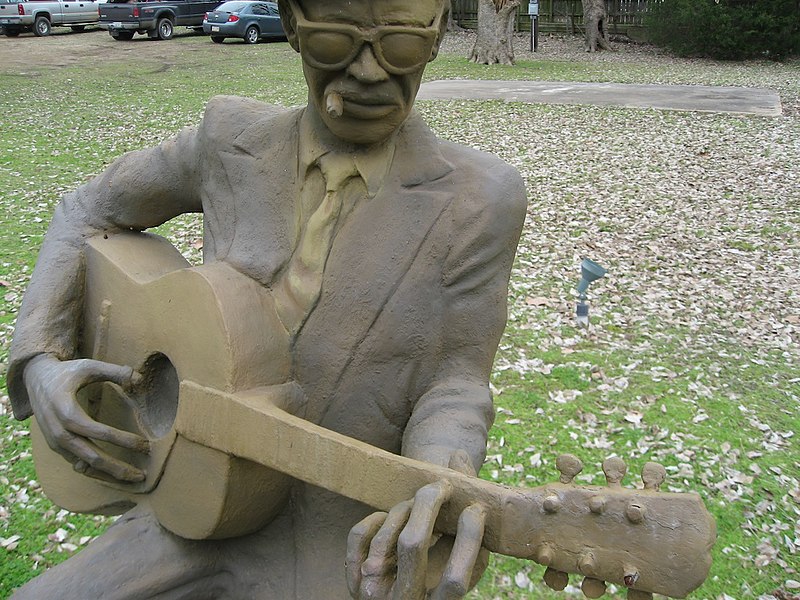
Lightnin' Hopkins, LightningHopkins
Wikimedia Commons
Life and career
Dated record
Life and career
Explore 1960–1982
The full dated record · 4 entries
1960
Lightnin' Hopkins - Country Blues (1960) is digitised and catalogued by Internet Archive.
1968
Free Form Patterns | Lightnin' Hopkins | 1968 | Instrumental (1968) is digitised and catalogued by Internet Archive.
1974
Legacy Of The Blues Vol. 12 - Lightnin' Hopkins (1974) is digitised and catalogued by Internet Archive.
1982
Lightnin' Hopkins died at Houston.
Places
Named by the record
Places
Only places the record itself states, plotted where the house gazetteer settles their coordinates. Nothing is inferred from a name or a nationality.
Centerville.
Birth place
Houston.
Death place
Books
• Mojo Hand: An Orphic Tale, by J.J. Phillips (Serpent's Tail),. • Lightnin' Hopkins: Blues Guitar Legend, by Dan Bowden,. • Deep Down Hard Blues: Tribute to Lightnin, by Sarah Ann West,. • Lightnin' Hopkins: His Life and Blues, by Alan Govenar (Chicago Review Press),. • Mojo Hand: The Life and Music of Lightnin' Hopkins, by Timothy J. O'Brien and David Ensminger (University of Texas Press),.
Films
• The Blues Accordin' to Lightnin' Hopkins (1968), directed by Les Blank and Skip Gerson (Flower Films & Video) • The Sun's Gonna Shine (1969), directed by Les Blank with Skip Gerson (Flower Films & Video) • Sounder (1972), directed by Martin Ritt (the soundtrack included Taj Mahal singing a version of Hopkins "Needed Time") • His song "Once a Gambler" is on the soundtrack of the 2009 film Crazy Heart.
Literature
Scholarly footprint
A count of publications is evidence of attention, not of standing, and is given here only as a measure.
Notes from the source article
Cited by Wikipedia
Notes from the source article
These works are cited by the source article, in its own numbering. They are recorded as its citations, not as sources VALÉORINE has verified.
- 1.Eagle, Bob. Blues: A Regional Experience. Praeger. 294. 2013. 978-0313344237.
- 2.Lightnin' Hopkins Rolling Stone Music Lists. Rolling Stone.
- 3.Russell, Tony. The Blues: From Robert Johnson to Robert Cray. Carlton Books. 64. 1997. 1-85868-255-X.
- 4.Rock on the Net. 26th Grammy Awards - 1984.
- 5.Stevie Ray Vaughan - Interview 06/23/88. 23 June 1988.
- 6.1980 Blues Hall of Fame Inductees. Blues.org.
- 7.Nicholas, A. X. Woke Up This Mornin': Poetry of the Blues. Bantam Books. 87. 1973.
- 8.Lightnin' Hopkins Songs, Albums, Reviews, Bio & More. AllMusic.
- 9.Dahl, Bill. Frankie Lee Sims: Biography. AllMusic.
- 10.Big Road Blues - Big Road Blues Show 3/2/08: Lightnin’ Special – Lightnin’ Hopkins & His Buddies
- 11.Smithsonian Magazine, November 7, 2023 - Meet the Man Who Recorded the Music of America’s Front Porches and Backyard Parties
- 12.Illustrated Sam Lightnin' Hopkins discography. Wirz.de.
- 13.Colin Larkin. The Guinness Who's Who of Blues. Guinness Publishing. 181/3. 1995. 0-85112-673-1.
- 14.Govenar, Alan. Lightnin' Hopkins: His Life and Blues. Chicago Review Press. 208-210. 2010. 9781556529627.
- 15.1980 Hall of Fame Inductees.
- 16.Saxon, Wolfgang. Obituary: Sam (Lightnin') Hopkins, 69; Blues Singer and Guitarist. The New York Times. February 1, 1982.
- 17.Rice University Fondren Library Woodson Research Center Special Collections & Archives. Lightnin' Hopkins' grave. rice.edu. 2001.
- 18.Marty Racine. Houston Chronicle article. Campstreetcafe.com. 2002.
- 19.The Team. Wherelightninstrikes.com. 2011-02-28.
- 20.The Sun's Gonna Shine (1969) - Les Blank Films. Lesblank.com. July 7, 2024.
- 21.Christgau, Robert. Christgau's Record Guide: Rock Albums of the Seventies. Ticknor & Fields. 1981. 978-0899190266.
- 22.Crazy Heart [Original Motion Picture Soundtrac. AllMusic.
References
Citations
References
Each reference names the institution holding it, so a reader may go to the document itself.
reference work
Partially resolvedreference work
Partially resolved
The Encyclopedia exists whether or not anything is for sale. Corrections are recorded rather than overwritten, and every version of this record is kept. Published 14 August 2026.
Elsewhere in Music memorabilia
42,307 published records in this field, each with its sources named.
- Liesl KarlstadtPerson
- Life RecordsOrganisation
- Lifeforce RecordsOrganisation
- Light in the Attic RecordsOrganisation
- LightsPerson
- Lightyear EntertainmentOrganisation
- Ligia BranicePerson
- Liis JürgensPerson
Best supported in this field
For owners
Own a work by Lightnin' Hopkins?
A specialist will read what you send and tell you what the house can establish, what it cannot, and whether the object is suited to sale. There is no charge and no obligation. The object stays with you throughout; nothing is shipped to us unless it is arranged in writing beforehand.