
Leó Weiner
Weiner Leó • Illustration — Leó Weiner Leó Weiner (16 April 1885 – 13 September 1960) was one of the leading Hungarian music educators of the first half of the twentieth century, and a composer.
Also recorded as Leo Weiner
Leó Weiner

Dr Varga József · CC BY-SA 3.0
- Born
- 1885 · Budapest.
- Died
- 1960 · Budapest.
- Nationality
- Hungary
- Occupation
- composer · musicologist · music educator · university teacher · classical pianist
- Fields
- music composing · music education · music
- Education
- Franz Liszt Academy of Music
- Teachers
- Hans von Koessler
- Honours
- Kossuth Prize · Great Artist of Hungary Award · Order of the Red Banner of Labour
- Languages
- Hungarian · German
Reference Check
Propose documentary evidence for Leó Weiner. A contribution is never written directly as fact: identity, source, rights and evidence gates still decide.
Sign in to contribute
Documentary evidence
Documentary basis
Authority files
wikidata · Q535323 · wikipedia · Leó Weiner
In this article
Education
Education
Leó Weiner studied at Franz Liszt Academy of Music. Training under Hans von Koessler is recorded. György Ferenczy, Mihály Kuttner and Péter Komlós are recorded as having studied under Leó Weiner. The recorded working language is Hungarian and German. The field of work recorded is music composing, music education and music. Subjects and genres recorded for the work are classical music. Employment is recorded with Franz Liszt Academy of Music. Distinctions recorded are Kossuth Prize, Great Artist of Hungary Award and Order of the Red Banner of Labour.
Weiner was born in Budapest to a Jewish family. His brother gave him his first music and piano lessons. As children, he and Fritz Reiner played piano four hands. Weiner later studied at the Academy of Music in Budapest, studying with János (Hans) Koessler. While there, he won numerous prizes, including the Franz Liszt Stipend, the Volkmann Prize and the Erkel Prize (all for one composition, his Serenade Op. 3); the Haynald Prize for his Agnus Dei; and the Schunda Prize for the Hungarian Fantasy for tárogató and cimbalom.
Teaching career
Teaching career
In 1908 he was appointed music theory teacher at the Budapest Academy of Music, professor of composition in 1912 and professor of chamber music in 1920. In 1949 he retired as emeritus professor, but continued to teach until the end of his life. Among his many notable students were conductors Antal Doráti, Peter Erős, Béla Síki, and Georg Solti; violinist Tibor Varga; cellists Edmund Kurtz and János Starker; and pianist György Sebők. He died in Budapest.
Compositions
The early Romantics from Beethoven through Mendelssohn most strongly influenced Weiner's compositional style. His orchestration seems much indebted to later Romantic French composers not notably affected by Wagner, Bizet in particular. This conservative Romantic approach formed the basis of his style, to which elements of Hungarian folk music were added sometime later, although he was not an active field researcher of folk music as were his contemporaries Bartók and Kodály, but simply shared an interest in the subject and added elements of folk music into his established harmonic language without significantly changing it. Among Weiner's notable compositions are a string trio, three string quartets, two violin sonatas, five divertimenti for orchestra, a symphonic poem, and numerous chamber and piano pieces. On July 1, 2003, his Carnival Humoresque (Fasching), Op. 5, had its US premiere when it was performed at the Naumburg Orchestral Concerts, in the Naumburg Bandshell, Central Park, in the summer series.
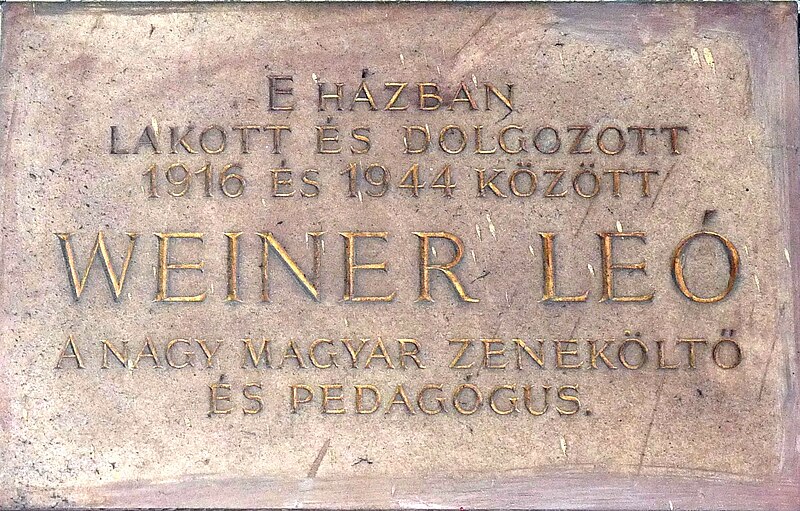
Commemorative plaque to Mr. Leo Weiner (1885–1960) Hungarian music educator and composer. It is affixed on the wall of his former home where he lived and worked between 1916 and 1944. (Budapest, District VI, Teréz Boulvard Nr 32).
Fekist

Weiner Leó (Budapest, 1885. április 16. – Budapest, 1960. szeptember 13.) kétszeres Kossuth-díjas magyar zeneszerző, a 20. századi magyar zene konzervatív ágának egyik legkiválóbb képviselője sírja a Fiumei Úti Sírkertben. (34/2-1-23.) Kisfaludi Strobl Zsigmond műve. Avatás 1962. május 13. https: www.kozterkep.hu/21323/weiner-leo-siremleke - Nemzeti Sírhely https: intezet.nori.gov.hu/public/nemz
Thaler
Text attribution
Licensing
Text attribution
Part of the biographical narrative on this page reuses licensed material. Its origin, revision and licence are recorded here.
The biographical narrative on this page is based on the Wikipedia article Leó Weiner, revision 1351765643 (EN edition), by its contributors. VALÉORINE has edited that text and built its own documentary record around it. The reused material is available under CC BY-SA 4.0, and this page's reuse of it is offered under the same licence. Everything else on this page — the chronology, the holdings, the evidence, the plates and the connections — is VALÉORINE's own record. Sources and licences.
Notes from the source article
Cited by Wikipedia
Notes from the source article
These works are cited by the source article, in its own numbering. They are recorded as its citations, not as sources VALÉORINE has verified.
- 1.Lyman, Darryl. Great Jews in Music. Jonathan David Publishers. 164. 1986. 0-8246-0315-X.
- 2.Weissmann, John S. The New Grove Dictionary of Music and Musicians. Macmillan Publishers. 27: Wagon to Zywny. 2001.
- 3.Lyman (1986). p. 62 in "Antal Doráti, Outstanding Trainer of Orchestras (1906–)": "At fourteen young Doráti entered the Franz Liszt Academy in Budapest, where his principal teachers were Leó Weiner (chamber music) and Zoltán Kodály (theory and composition)."
- 4.Notable Events and Performers. Naumburg Orchestral Concerts.
Bibliography printed in the source article · 2
- Sadie. The New Grove Dictionary of Music and Musicians. Macmillan Publishers. 1980.
- Sendrey, Alfred. Bibliography of Jewish Music. Columbia University Press. 1951.
References
Citations
References
Each reference names the institution holding it, so a reader may go to the document itself.
reference work
Secondary witnessreference work
Secondary witness
The Encyclopedia exists whether or not anything is for sale. Corrections are recorded rather than overwritten, and every version of this record is kept. Published 20 August 2026.
Elsewhere in Music memorabilia
44,023 published records in this field, each with its sources named.
- Leo SpiesPerson
- Léo StrondaPerson
- Leo van DoeselaarPerson
- Leo VI the WisePerson
- Leo WrightPerson
- Leo ZeitlinPerson
- Léo-Pol MorinPerson
- Leokadiya KashperovaPerson
Best supported in this field
For owners
Own a work by Leó Weiner?
A specialist will read what you send and tell you what the house can establish, what it cannot, and whether the object is suited to sale. There is no charge and no obligation. The object stays with you throughout; nothing is shipped to us unless it is arranged in writing beforehand.