
Le Zèbre
Le Zèbre was a French make of car built between 1909 and 1931 in Puteaux, and later Suresnes. The company was founded by Jules Salomon and Georges Richard initially with finance from Jacques Bizet, son of composer Georges Bizet. • Illustration — The front cover of the history of Le Zèbre • Illustration — Share of the SA des Automobiles Le Zèbre, issued 26.
Also recorded as Le Zebre
Le Zèbre
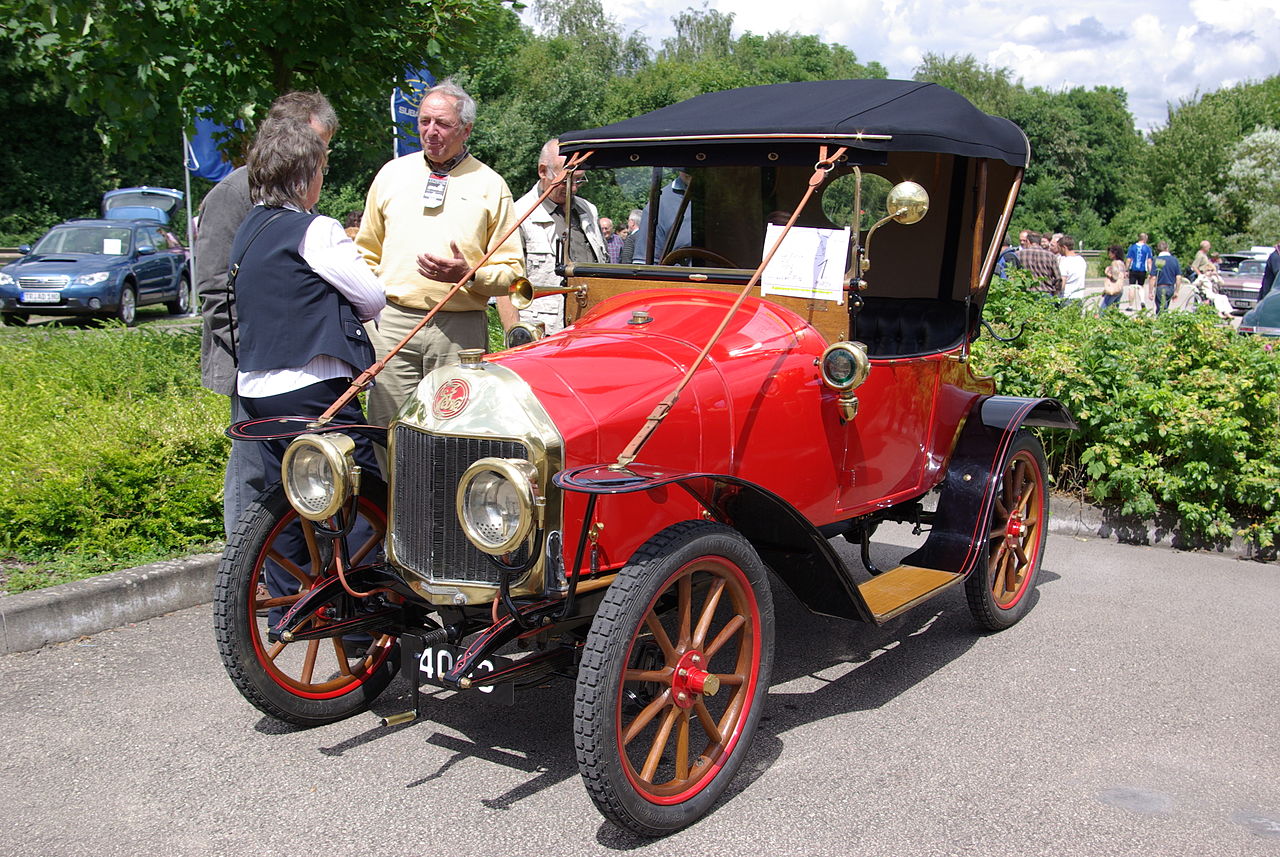
Berthold Werner · Public domain
- Name
- Le Zebre
- Founded
- 1909
- Headquarters
- Puteaux
VALÉORINE Encyclopedia
VALÉORINE documentary reading
Documentary summary
Le Zèbre was a French make of car built between 1909 and 1931 in Puteaux, and later Suresnes. The company was founded by Jules Salomon and Georges Richard initially with finance from Jacques Bizet, son of composer Georges Bizet. • Illustration — The front cover of the history of Le Zèbre • Illustration — Share of the SA des Automobiles Le Zèbre, issued 26.
Admitted source layer · organised and presented by VALÉORINE
Note VALÉORINE
No house-authored Note is published until its assertions and sources pass the VALÉORINE evidence contract. The documentary article remains available in full while that enrichment is being consolidated.
Documentary enrichment in progress · no unsupported statement published
Reference Check
Propose documentary evidence for Le Zèbre. A contribution is never written directly as fact: identity, source, rights and evidence gates still decide.
Sign in to contribute
World of VALÉORINE
Documentary connections
Only confirmed graph relationships appear here. Images are shown only when their identity and reuse rights both pass the documentary gate.
Documentary evidence
Evidence Panel
not yet certified
- Identity
- resolved
- Independent source families
- 0
- Admitted assertions
- 0
- Open conflicts
- 0
Authority files
wikidata · Q1810309 · wikipedia · Le Zèbre
In this article
Key facts
Key facts
• Name — Le Zebre • Type — Private • Founded — 1909 • Hq Location — Suresnes, France • Key People — Jules Salomon, CEO and president • Industry — Automotive • Products — car
History
History
Jules Salomon was a young graduate of the School of Commerce and Industry in Bordeaux, and began his career at Rouart Brothers who were engine makers. He later moved to Georges Richard where he met Jacques Bizet, who had the funds to back a new automotive brand and the ambition to leave a legacy to rival that of his father. The two friends decided not to give their names to the car, instead opting to call it "Le Zèbre" (The Zebra), which was originally a nickname given to a clerk of their former employer. In 1909 Salomon developed his first car, a 600cc single-cylinder Cyclecar with two-speed and reverse gearbox and shaft drive, which was designated the Type A. This design was priced very aggressively, selling for 3,000 Francs, or 1,000 F less than competitors. The wheelbase was 71 in and the car weighed 300kg. The Type A was well received by the public, and attracted investment from influential businessmen Emile Akar and Joseph Lamy, which enabled factory relocation and expansion. Joseph Lamy assumed the function of Commercial Director. The success of the Type A was further assured by Baudry de Saunier, the greatest French automotive journalist of the time, who repeatedly extolled the car’s virtues. In 1912 Le Zèbre announced their second model, the Type B. More imposing, it was a 1750cc four-cylinder, four-seater car, rated at 10CV and with a wheelbase of 103 in. It sold for 6,000 F, which constituted another economic tour de force for the time. The Type B was closely followed by the Type C, also a four-cylinder three-speed, but this time of 785cc, which was available only as a two-seat torpedo body on its 80 in wheelbase. All three models were produced from the company’s new factory in Suresnes. Le Zèbre became well known for their unique blend of robustness, reliability and low running costs. On the outbreak of the First World War, the particularly light Le Zèbre cars turned out to be a “go-anywhere” vehicle and were selected for use as liaison vehicles by the French Army. From 1915, the Ministry of War placed an order for 40 cars per month, which allowed the company to retain the majority of its employees and avoid military requisition, unlike most other French car factories. In 1917 the two founders split up. Jules Salomon left the company and met André Citroën, the then director general at Mors and was instrumental in the development of the first Citroen cars. Le Zèbre’s ownership structure was revised, with Jacques Bizet resigning his executive position, although retaining a commercial stake in the company. From 1918, the new Type D was marketed. It had a four-cylinder engine of 998cc and four-speed gearbox, and was rated at 8CV. It was available in 3-seat torpedo, 4-seat sedan or saloon versions, with wheelbases between 98 in and 114 in. With prices between 10,200 F and 16,500 F remained very affordable. In April 1919 André Morel joined the company as Sales Manager for the whole of the Southern France. In 1921, Edmond Moyet (Chief Engineer), Morel, Akar and Lamy withdrew from the company to create a rival company, Amilcar. Le Zèbre struggled to cope with the loss of these key personnel and their associated capital, as well a good deal of their commercial network which Lamy and Akar were able to lure away to their new project. With the Le Zèbre brand destabilized by the loss of key personnel, the original Type A reappeared, delivered with the Type C chassis and a slightly modified body. At the beginning of 1923, only Types A and D appeared in the catalogue, supplemented at the end of the year by the Type E, a sports version of the Type D. The pre-war Type C also reappeared, with sightly revised and improved bodywork. It was not until the end of 1924 that a much more serious project saw the light of day, in the form of the Type Z. Entirely designed by the English engineer Harry Ricardo, known in the automotive world for his studies on combustion systems and the many associated patents he held, it had a 2-litre 10CV, four cylinder engine with aluminium pistons, hemispherical combustion chambers, and was priced from 24,000 F. The Le Zèbre-Ricardo partnership was warmly welcomed by the trade press, which hoped that the Suresnes company will be able to get out of its period of stagnation. From 1925 to 1930, it was the only car marketed by Le Zèbre but in the end only 550 Type Z’s were built. Faced with this new failure and the economic slump, the company closed permanently in 1931. Another collaboration with Ricardo featured a radical single-cylinder, opposed-piston, two-stroke, diesel-engine and was shown at the 1931 Paris Salon, but came too late to save the company. Altogether, Le Zèbre produced 9,500 cars between 1909 and 1931, of which about 250 examples remain today.
Gallery
Gallery
• Illustration — 1913 Le Zèbre Type A • Illustration — 1913 Le Zèbre Type C • Illustration — 1914 Le Zèbre Type C • Illustration — 1925 Le Zèbre Type Z • Illustration — 1926 Le Zèbre Type Z • Illustration — DVD Andre Morel Le Champion Modeste

Logo der ehemaligen Automarke Le Zebre
Berthold Werner
Institutional history
Dated record
Institutional history
Explore 1909–1931
The full dated record · 3 entries
1909
Le Zèbre established.
1909
Le Zèbre is recorded from 1909.
1931
Le Zèbre ceased.
Places
Named by the record
Places
Only places the record itself states, plotted where the house gazetteer settles their coordinates. Nothing is inferred from a name or a nationality.
- France
Named but not plotted · 1
Le Zèbre is associated with France.
Country
Citations
References
Each reference names the institution holding it, so a reader may go to the document itself.
reference work
Partially resolvedreference work
Partially resolved
The Encyclopedia exists whether or not anything is for sale. Corrections are recorded rather than overwritten, and every version of this record is kept. Published 14 August 2026.
Elsewhere in Collectables
20,755 published records in this field, each with its sources named.
- Le Mans 24Work
- Le Mans UltimateWork
- Le PiafOrganisation
- Le VampWork
- Lea-FrancisOrganisation
- Leader BoardWork
- Leading edge inflatable kiteTerminology
- Leading Edge Sports Car CompanyOrganisation
Best supported in this field
For owners
Own an object connected with Le Zèbre?
A specialist will read what you send and tell you what the house can establish, what it cannot, and whether the object is suited to sale. There is no charge and no obligation. The object stays with you throughout; nothing is shipped to us unless it is arranged in writing beforehand.