
lamellophone
Illustration — A Hugh Tracey treble kalimba • Illustration — A Jaw harp A lamellophone (also lamellaphone or linguaphone) is a member of the family of musical instruments that makes its sound by a thin vibrating plate called a lamella or tongue, which is fixed at one end and has the other end free. When the musician depresses the free end of a plate with a finger or fingernail, and then allows the finger to slip off, the released plate vibrates. An instrument may have a single tongue (such as a Jew's harp) or a series of multiple tongues (such as a mbira thumb piano).
Also recorded as lamellaphone · plucked idiophone
lamellophone
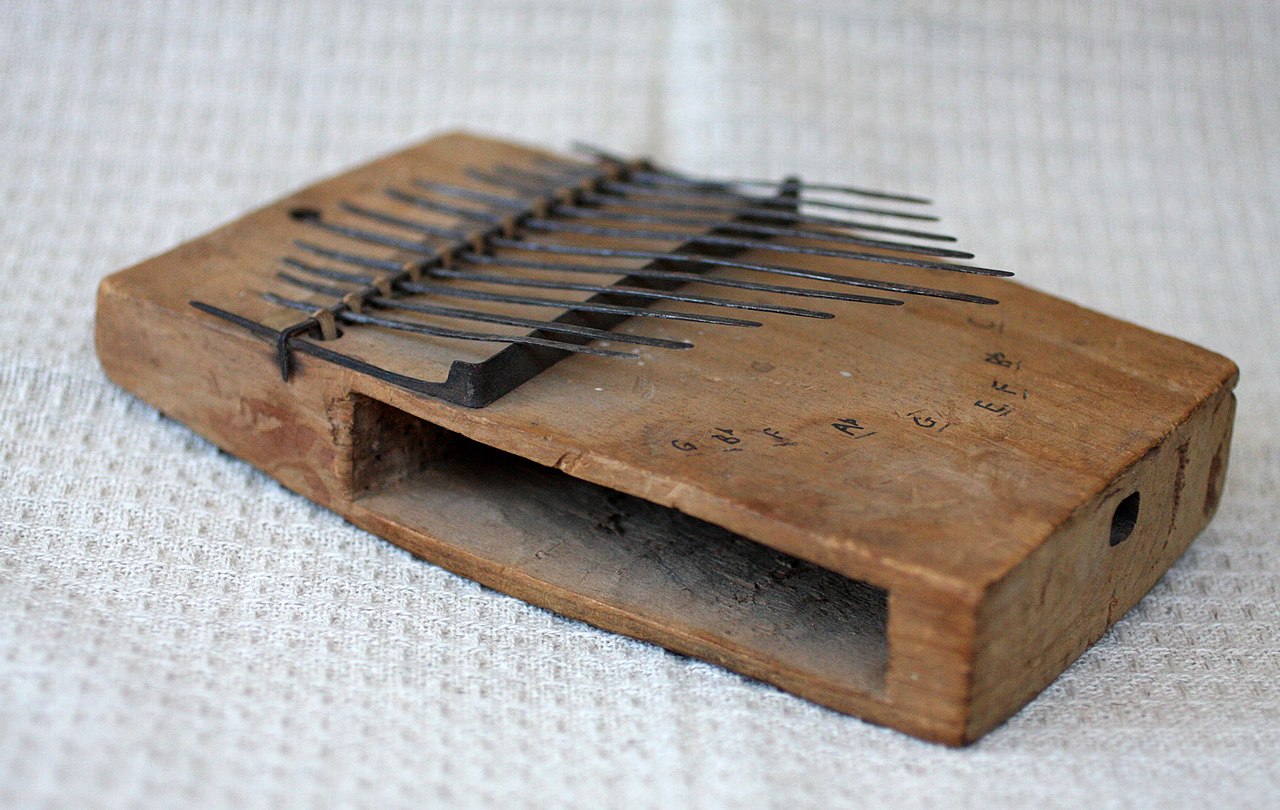
Seresbalint · CC BY-SA 4.0
- Field
- idiophone.
VALÉORINE Encyclopedia
VALÉORINE documentary reading
Documentary summary
Illustration — A Hugh Tracey treble kalimba • Illustration — A Jaw harp A lamellophone (also lamellaphone or linguaphone) is a member of the family of musical instruments that makes its sound by a thin vibrating plate called a lamella or tongue, which is fixed at one end and has the other end free. When the musician depresses the free end of a plate with a finger or fingernail, and then allows the finger to slip off, the released plate vibrates. An instrument may have a single tongue (such as a Jew's harp) or a series of multiple tongues (such as a mbira thumb piano).
Admitted source layer · organised and presented by VALÉORINE
Note VALÉORINE
No house-authored Note is published until its assertions and sources pass the VALÉORINE evidence contract. The documentary article remains available in full while that enrichment is being consolidated.
Documentary enrichment in progress · no unsupported statement published
Reference Check
Propose documentary evidence for lamellophone. A contribution is never written directly as fact: identity, source, rights and evidence gates still decide.
Sign in to contribute
World of VALÉORINE
Documentary connections
Only confirmed graph relationships appear here. Images are shown only when their identity and reuse rights both pass the documentary gate.
Broader Term · incoming
electric lamellophone
Term

Broader Term · incoming
Gogona
Term
Own work

Broader Term · incoming
Guitaret
Term
Flickr : Groupshow @ UH FEST 2010

Broader Term · outgoing
idiophone
Term
https://www.flickr.com/photos/culturalis/4639123450/sizes/o/in/photostream/
Broader Term · incoming
Ilimba
Term
Broader Term · incoming
Matepe
Term

Broader Term · incoming
mbira
Term
Own work

Broader Term · incoming
mbira dzavadzimu
Term
Own work

Broader Term · incoming
music box
Term
Own work

Broader Term · incoming
plucked string instrument
Term
Carolingian manuscripts, Württembergische Landesbibliothek Stuttgart, Germany ( http://www.thecipher.com/cythara_9th-cent_Stuttgart-Psalter_c830_deta.jpg ) Original image, Stuttgarter Psalter - Cod.bi
Broader Term · incoming
Prempensua
Term

Broader Term · incoming
Timbrh
Term
Collectie Stichting Nationaal Museum van Wereldculturen
Documentary evidence
Evidence Panel
wikipedia incomplete · checked 25 September 2026
- Identity
- resolved
- Independent source families
- 0
- Admitted assertions
- 0
- Open conflicts
- 0
Authority files
wikidata · Q936762
In this article
African lamellophones
African lamellophones
Linguaphone comes from the Latin root la meaning 'tongue', (i.e, a long thin plate that is fixed only at one end). Lamellophone comes from the Latin word la for 'small metal plate', and the Greek word φωνή grc-Latn for 'sound, voice'. The lamellophones constitute category 12 in the Hornbostel–Sachs system for classifying musical instruments, plucked idiophones. There are two main categories of plucked idiophones, those that are in the form of a frame (121) and those that are in the form of a comb (122). According to Sachs, The most usual [of plucked idiophones] is a flexible lamella or tongue attached to a frame, plucked by a finger and resonated by a small box.
A large number of lamellophones originate in Africa, where they are known under different names including mbira, kisanji, likembe, kalimba, kongoma, and sanza. They play a role in southeast African Music. They were reported as early as the 16th century, but there is no doubt they have a much longer history. The Caribbean marímbula is also of this family. The marímbula can be seen as a bass variant of the mbira and is sometimes used in hip hop music. In most cases the tongues are divided in two playing halves with the lowest notes in the centre; from there to the left and to the right each tongue is tuned higher than the previous one. The tongues may also be arranged in a linear arrangement in the manner of a piano. Tongues may be made small enough to play with individual fingers, hence the colloquial name "thumb piano". (Although some instruments, like the Mbira, have an additional rows of tongues, in which case not just the thumbs are used for plucking.) Some conjecture that African lamellophones were derived from xylophones and marimbas. However, similar instruments have been found elsewhere; for example, the indigenous peoples of Siberia play wooden and metallic lamellophones with a single tongue. Lamellophones may be made with or without resonators. There are also electric lamellophones with an additional pickup.
Electric lamellophones
Electric lamellophones
Electric lamellophones have been electrified with an electro-magnetic pickup (like on electric guitars) or contact piezo pickup.
Piezo pickup lamellophones
Piezo pickup lamellophones
• Illustration — The electric Array mbira There is a distinct difference between the piezo and the electro-magnetic pickup. Most electric lamellophones feature piezo pickups. The piezo sound contains more treble and has more problems with feedback when amplified (distorted) heavily. Lucinda Ellison produces a wide range of her Embiras, which are solid body electric mbiras with piezo pickups — a design first conceived in 1981 and finalised in 1996. David Bellinger has been making ekalimbas - kalimbas with piezo pickups - for 20 years. The Array Mbira is a lamellophone with an alternate tine configuration. It is electrified by the addition of a 2-channel stereo piezo cable pickup system. A special solid-body Array mbira exists.
Electro-magnetic lamellophones
Electro-magnetic lamellophones
• Illustration — The guitaret Ernst Zacharias created a series of electric lamellophones created in the 1960s for Hohner. These instruments were based on the reeds made by Hohner (already employed in accordions, concertinas, melodicas and harmonicas). These instruments were the Pianet (plucked by a foam pad), the Cembalet (plucked by a rubber pad) and the Guitaret (plucked by fingers). The idea of a struck reed tongue had been pioneered by the Alexandre brothers in their "Orgues expressifs" (harmoniums) in the 19th century, where they were called percussion stops. The Space Harp, or Frankiphone (designed, built and played by Phil Cohran), is a famous instance of an electric lamellophone. A range of other mbiras and kalimbas have been created by contemporary instrument makers. The African band Konono No.1 uses custom-built electric kalimbas with electro-magnetic pickups. Neptune's Jason Sanford makes electric thumb pianos from scrap in a similar tradition and Yuri Landman has made 12-TET bass kalimbas and metal tongue drums.
Schaeffner's classification
Schaeffner's classification
• Illustration — Plucked/flexible idiophones Schaeffner's musical instrument classification scheme has a post-prominent place for the linguaphones (lamellophones) at the second highest level of classification. In 1932, Andre Schaeffner developed a new classification scheme that was "exhaustive, potentially covering all real and conceivable instruments" [Kartomi, p. 176]. Schaeffner's system has only two top-level categories denoted by Roman numerals (Schaeffner, A.: Origine des instruments de musique, pp. 371–377.): • I: instruments that make sound from vibrating solids; • IA Solids not susceptibles of tension (equivalent to a big part of Hornbostel & Sachs idiophones); • IB Flexible solids (equivalent to mainly linguaphones); • IC Tensionable solids (equivalent to both membranophones and chordophones); • II: instruments that make sound from vibrating air (aerophones).
In the form of a frame (121)
In the form of a frame (121)
The lamellae vibrate within a frame or hoop 121.1 Clack idiophones or Cricri - The lamella is carved in the surface of a fruit shell, which serves as resonator. Also known as galip nut snapper. 121.2 Guimbardes and jaw harps - The lamella is mounted in a rod- or plaque-shaped frame and depends on the player's mouth cavity for resonance. • 121.21 Idioglot guimbardes - The lamella is of one substance with the frame of the instrument. • Đàn môi • 121.22 Heteroglot guimbardes - The lamella is attached to the frame. • 121.221 Individual heteroglot guimbardes. • Jew's harp • Morsing • 121.222 Sets of heteroglot guimbardes. • Kouxian • Illustration — (121.21) Đàn môi, Vietnam. Instrument carved from a single piece of bamboo. • Illustration — (121.221) Murchunga, Nepal • Illustration — (121.222) A Kouxian, played by plucking the ends in front of the oral cavity. The lamellae resonate to produce sound.
In the form of a comb (122)
In the form of a comb (122)
• Illustration — Whale Drum with 8 tongues (from Emil Richards Collection) • Illustration — Argentinian quisanche made of wood, has five tempered steel reeds, which are dotted to mark a melodic bass in the Buenos Aires candombe. The lamellae are tied to a board or cut out from a board like the teeth of a comb. 122.1 With laced on lamellae. • Array mbira • Agidigbo (Nigeria) • Eleke • Ikembe • Insimbi • Kalimba • Kasayi • Kisanji • Likembe • Lukembe (Congo and Tanganyika) • Maduimba • Malimbe • Marímbula - Caribbean thumb piano • Mbira • Chisanza mbira (Elisabethville) • Kalimba mbira (Southern Rhodesia) • Njara mbira (Southern Rhodesia) • Shona mbira (Southern Rhodesia) • Oopoochawa • Prempensua (Ghana) • Thumb piano • Tom (Ethiopia) • Sanza/Sansa (Equatorial Africa and West Africa) • Space Harp • Whale Drum • Zimbabwean Marimba 122.11 Without resonator. 122.12 With resonator. 122.2 With cut-out lamellae • Comb • Mechanical music box • Slit drum • Steel tongue drum • Teponaztli

Egy kalimba lamelláinak rögzítése
Seresbalint

an instrument manufactured from can for herrings - original can manufactured by or in the name of Connors Brothers Limited, Blacks Harbour, New Brunswick, Canada - instrument is now owned by Center for World Music, Hildesheim, Germany - shown to public in science exhibition on May 6 2017 in Hannover, Germany
Wihomy04
References
Citations
References
Each reference names the institution holding it, so a reader may go to the document itself.
reference work
Partially resolved
Connections
Knowledge graph
Connections
Each connection was recorded deliberately, with the basis for it kept on the internal record.
Broader subject
2- idiophoneTerminology
Established from a fact already recorded on a verified source.
- mbira dzavadzimuTerminology
Established from a fact already recorded on a verified source.
The Encyclopedia exists whether or not anything is for sale. Corrections are recorded rather than overwritten, and every version of this record is kept. Published 14 August 2026.
Elsewhere in Collectables
20,755 published records in this field, each with its sources named.
- LambertOrganisation
- Lambert Automobile CompanyOrganisation
- LamborghiniOrganisation
- Lamborghini American ChallengeWork
- Lamplight CityWork
- LamuneWork
- LancelotWork
- Lanchester Motor CompanyOrganisation
Best supported in this field
For owners
Own an object connected with lamellophone?
A specialist will read what you send and tell you what the house can establish, what it cannot, and whether the object is suited to sale. There is no charge and no obligation. The object stays with you throughout; nothing is shipped to us unless it is arranged in writing beforehand.