
Kurpfälzisches Museum
Illustration — Carl Spitzweg: The Sleeping Night Watchman (c. 1875) • Illustration — Hyacinthe Rigaud: Elizabeth Charlotte, Princess Palatine (1713) The Kurpfälzisches Museum (Palatinate Museum) is a museum of art and archaeology in Heidelberg, Germany. It is located in the Palais Morass.
Also recorded as Heidelberg Museum
Kurpfälzisches Museum
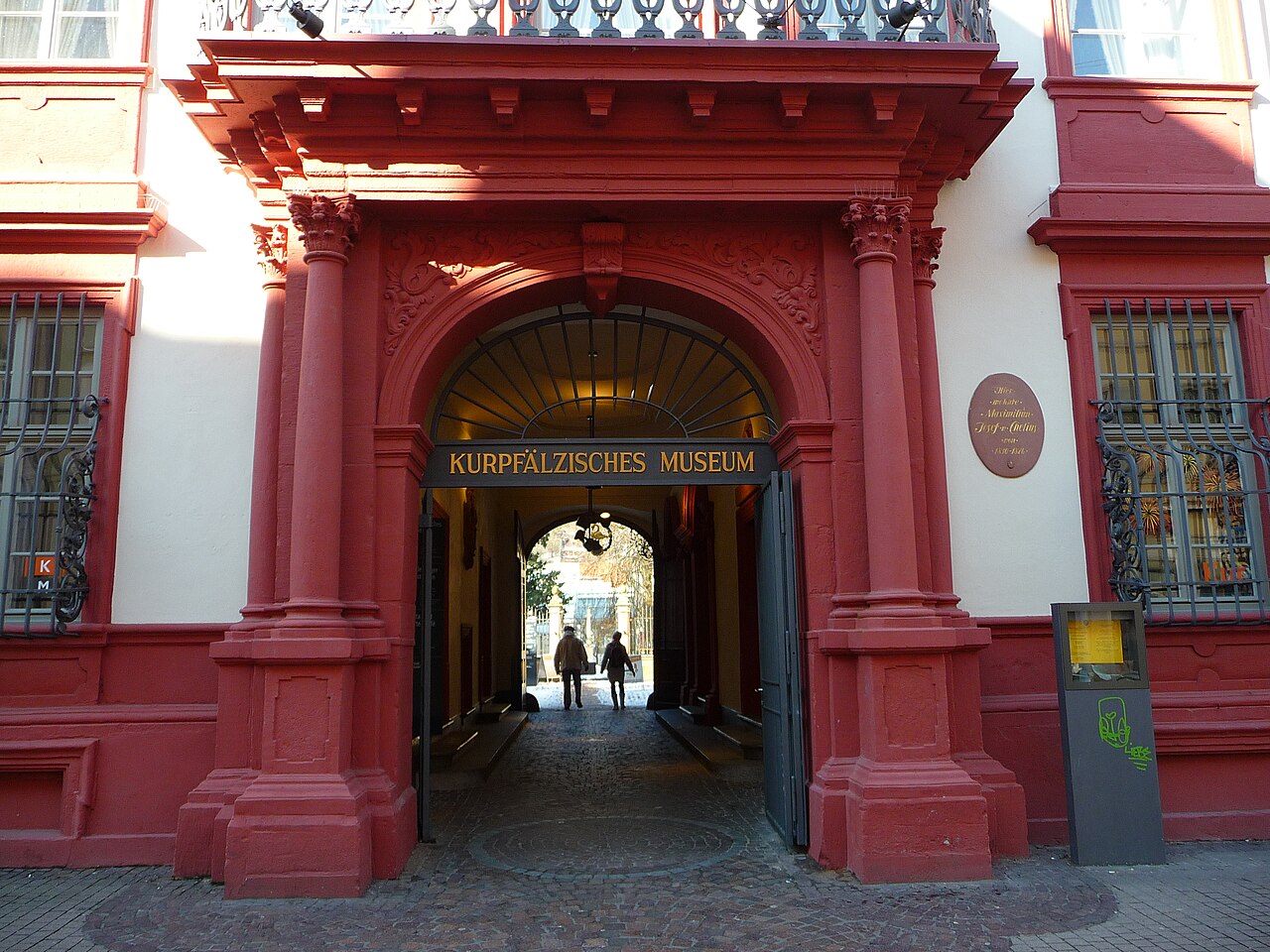
4028mdk09 · CC BY-SA 3.0
- Founded
- 1878
- Headquarters
- Germany
VALÉORINE Encyclopedia
VALÉORINE documentary reading
Documentary summary
Illustration — Carl Spitzweg: The Sleeping Night Watchman (c. 1875) • Illustration — Hyacinthe Rigaud: Elizabeth Charlotte, Princess Palatine (1713) The Kurpfälzisches Museum (Palatinate Museum) is a museum of art and archaeology in Heidelberg, Germany. It is located in the Palais Morass.
Admitted source layer · organised and presented by VALÉORINE
Note VALÉORINE
No house-authored Note is published until its assertions and sources pass the VALÉORINE evidence contract. The documentary article remains available in full while that enrichment is being consolidated.
Documentary enrichment in progress · no unsupported statement published
Reference Check
Propose documentary evidence for Kurpfälzisches Museum. A contribution is never written directly as fact: identity, source, rights and evidence gates still decide.
Sign in to contribute
World of VALÉORINE
Documentary connections
Only confirmed graph relationships appear here. Images are shown only when their identity and reuse rights both pass the documentary gate.
Documentary evidence
Evidence Panel
not yet certified
- Identity
- resolved
- Independent source families
- 0
- Admitted assertions
- 0
- Open conflicts
- 0
Authority files
wikidata · Q874724 · wikipedia · Kurpfälzisches Museum
In this article
Named by the record
Places
Only places the record itself states, plotted where the house gazetteer settles their coordinates. Nothing is inferred from a name or a nationality.
- Germany
Collections
It was founded in the late 1870s, when the city of Heidelberg purchased the private collection of the artist and art historian Charles de Graimberg.
Archaeology Findings from the Lower Neckar Valley, including a facsimile of the lower jaw of Homo heidelbergensis discovered in Mauer; Roman artefacts; a life-sized reconstruction of the mithraeum of Heidelberg; and items dating from Heidelberg's period as the Electoral Palatinate residence. Paintings Works from the 15th to the 20th century, including portraits of historic Heidelberg figures (Frederick V, Elizabeth Charlotte, Perkeo); religious works by Rogier van der Weyden and Lucas Cranach the Elder; 17th century Dutch still lifes; 18th century rococo pictures; 19th century works by Carl Rottmann, Anselm Feuerbach and Wilhelm Trübner; and 20th century works by Alexander Kanoldt, Alexei Jawlensky and Max Beckmann. Graphic arts 7,000 watercolours and drawings, and just under 13,000 printed graphics, from the Middle Ages to the 20th century, including works by Peter Anton von Verschaffelt, Karl Philipp Fohr, Georg Schrimpf and Marc Chagall. Local artists are well represented, especially those from the Romantic period and the 20th century. Many of the older works provide historic representations of the city, the castle, and the former Palatinate. Works on paper are sensitive to light and cannot be put on permanent display. Applied arts The applied arts collection includes porcelain, coins, medallions, furniture and glassware. Four of the rooms have been furnished to recreate the 18th and 19th centuries, featuring for example Frankenthal porcelain and portraits of the prince-electors. There are also representative costumes of a Heidelberg family from around 1750 to 1930, and a household silver collection that once belonged to Countess Palatine Elisabeth Auguste (1721–1794). Sculpture Works from the 12th to the 20th century, including medieval gravestones from the former Augustine monastery, early baroque sculptures from houses in Heidelberg's old town, and sculptures of the Old Bridge, Prince-Elector Charles Theodore and the goddess Minerva. Two of the most important pieces are Tilman Riemenschneider's Altar of the Apostles (1509) and Wilhelm Lehmbruck's stone-cast Rückblickende. Municipal history Historical items, including the oldest stone relics from Heidelberg, a reconstructed kitchen from around 1600, models of the Old Bridge by the 18th century sculptor Linck, and a sequence of pictures by Ferdinand Kobell portraying the destruction of the bridge by floating ice in 1784. There is also a model of the medieval core of the old town. Max Berk Textile Collection Belonging to the museum's applied arts department, but displayed separately in a former evangelical church, this collection includes women's costumes going back to the second half of the 18th century, along with accessories, everyday items and decorative textile objects. There are also artefacts from India, Bali, Java and Peru, and a collection of British and American patchwork quilts from the last 200 years.
Notes from the source article
Cited by Wikipedia
Notes from the source article
These works are cited by the source article, in its own numbering. They are recorded as its citations, not as sources VALÉORINE has verified.
Bibliography printed in the source article · 2
- Georg Poensgen, Das Kurpfälzische Museum in Heidelberg, Hamburg, 1965.
- Jörn Bahns: Heidelberg als Museumsstadt, in: Elmar Mittler (editor): Heidelberg. Geschichte und Gestalt, Universitätsverlag C. Winter, Heidelberg, 1996, .
References
Citations
References
Each reference names the institution holding it, so a reader may go to the document itself.
reference work
Partially resolvedreference work
Partially resolved
The Encyclopedia exists whether or not anything is for sale. Corrections are recorded rather than overwritten, and every version of this record is kept. Published 14 August 2026.
Elsewhere in Institutions
3,152 published records in this field, each with its sources named.
- Kunstnernes HusOrganisation
- Kunstsammlungen der Städtischen Museen ZwickauOrganisation
- Kuroda Memorial HallOrganisation
- Kurokawa Institute of Ancient CulturesOrganisation
- Kurume City Art MuseumOrganisation
- Kuryokhin CenterOrganisation
- Kushimoto Ōkyo Rosetsu Art MuseumOrganisation
- Kütahya Archaeology MuseumOrganisation
Best supported in this field
For owners
Own an object connected with Kurpfälzisches Museum?
A specialist will read what you send and tell you what the house can establish, what it cannot, and whether the object is suited to sale. There is no charge and no obligation. The object stays with you throughout; nothing is shipped to us unless it is arranged in writing beforehand.