
Konstantīns Pēkšēns
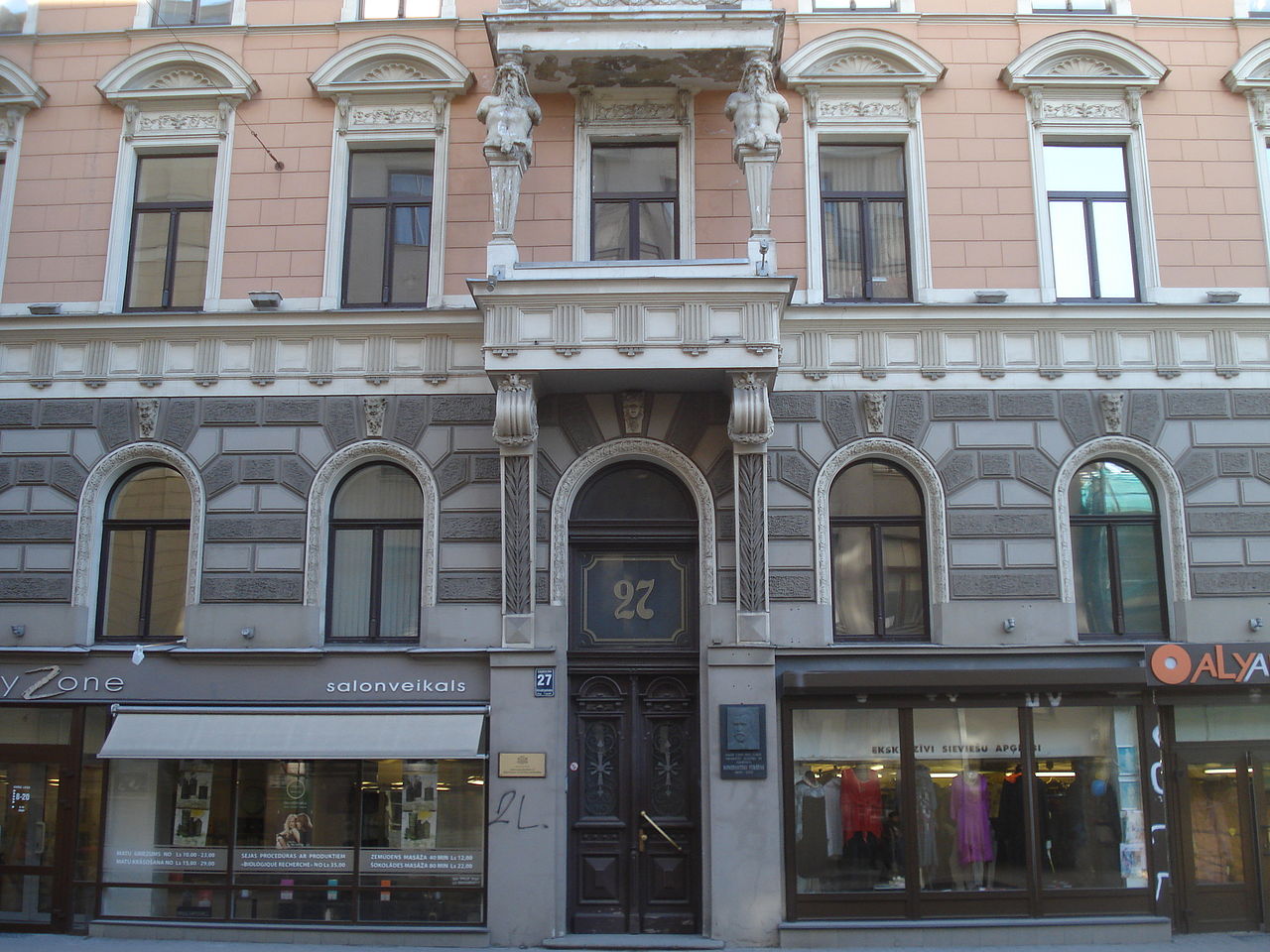
Alma Pater · CC BY-SA 3.0
- Born
- 1859
- Died
- 1928
- Nationality
- Latvia · Russian Empire
- Occupation
- architect
- Movements
- Art Nouveau
In this article
Key facts
• Name — Konstantīns Pēkšēns • Born — 1859 03 03 • Birthplace — Ņuki, Mazsalaca parish, Russian Empire (now Latvia) • Died — 1928 06 23 • Place of death — Weimar Republic, Bad Kissingen • Known for — Architecture • Movement — Art Nouveau • Patrons — Jānis Baumanis • Education — Riga Polytechnic Institute Konstantīns Pēkšēns (born 3 March 1859, Mazsalaca parish, Russian Empire — died 23 June 1928, Bad Kissingen, Weimar Republic) is one of the most prominent Latvian architects of all time. After Jānis Baumanis he is the epitome of the second generation of Latvian architects. Many Latvian cities and towns take pride in buildings designed by Pēkšēns, but Riga alone can boast more than 250 multi-storey brick buildings and a great number of wooden houses erected following his designs.
Career
Pēkšēns was born in the Nuķi estate near Mazsalaca but in 1869 his family moved to Riga. In 1875, Pēkšēns began studies at Riga Polytechnical Institute — at first in the Engineering Department, but from 1880 in the Department of Architecture. He took an active part in social life of students, was founding member of Selonija, a fraternity of Latvian students, participated much in sports. He graduated from the institute in 1885 and spent some time working for the construction office of Jānis Baumanis, in 1886 Pēkšēns opened his own practice. In 1889 he was among those who re-established Riga Architects Society that had disintegrated earlier. Pēkšēns also sat in the councils of a number of credit institutions and banks, and acted as a spokesman for the Riga Latvian Society. Since 1909 he was a member of the Riga City Council, but after World War I was actively involved in several technical commissions under the Riga City Executive Board. Pēkšēns also participated in the publishing of several Latvian newspapers. His broad professional experience allowed him to make a considerable contribution at the debate on how to restore the damages of World War I. Pēkšēns company of plumbing works was well known as the largest local enterprise dealing with the assembly of central heating systems in Riga prior to the war. This company remained in operation until 1940. At the beginning of the 20th century Pēkšēns also acted as a jury member in several large-scale competitions, while in some other competitions his designs received the highest evaluation. For example, he won the competition for a residential house for workers in 1907, together with Eižens Laube, the Riga Merchants Credit Society Bank at 14, Tērbatas Street (1909), together with Arthur Moedlinger, and Ozoliņš' apartment building at 88, Brīvības Street (1910) together with Ernest Pole. All those associates of Pēkšēns, just like Aleksandrs Vanags, August Malvess, and others who later became well known in Riga in their own right, accumulated their professional experience while working in the construction and technical office of the master. In 1928 in an attempt to improve his seriously deteriorating health Pēkšēns went to Bad Kissingen in Germany, but the trip was to no avail. The sad news of his death reached his native country on the night of the Līgo festival. The master was buried at the Forest Cemetery in Riga.
Art Nouveau
• Illustration — Miss Riga at 2, Smilšu Street to the left. Recognised as one of the most beautiful masterpieces on facades of Art Nouveau buildings in Riga During the golden age of Art Nouveau of the early 20th century several buildings with a fascinating abundance and variety of decorative motifs typical for this new style were designed by Pēkšēns. Examples are the houses at 6, Strēlnieku Street, 13, Kaļķu Street and 2, Smilšu Street built in 1902. The peculiarity of the latter lies in the fact that an every single window decoration is different, and under the bay windows are hermas—supports as sculpted upper bodies. One of these sculptures was given the title Miss Riga from among the stone females displayed on the facades of the buildings in Riga. • Illustration — Detail from the building at 2, Smilšu Street The most characteristic feature of Pēkšēns creative work, is the respective reserve and deep logic of architectural forms arising out of the Art Nouveau artistic principle, namely, the beauty of a building should not depend on outside applications, but derive from a practical and utilitarian layout. Most of Pēkšēns buildings are defined by a clear arrangement of volumes corresponding to the layout of interior spaces, careful choice of building materials and decor governed by the basic architectural form. • Illustration — Detail from the building at 13, Alberta Street Such rational Art Nouveau evidence is present in the buildings at 46, Brīvības Street (1907) and 14, Tērbatas Street (1909), apartment houses at 14, Ausekļa Street (1909), 1 and 44, Avotu Street (both 1904) and 66, Avotu Street (1912), 5, Krišjāņa Barona Street (1909), 45, Baznīcas Street (1909), 148 and 172, Brīvības Street (1912 and 1911), 5, Hospitāļu Street (1904), 6, Marijas Street (1904), 5, Noliktavas Street (1904), 3, 9 and 13, Rūpniecības Street (1908, 1910 and 1909), 32, Skolas Street (1904), 31, Slokas Street (1908), 9/11, Tērbatas Street (1912), 4 and 10, Vīlandes Street (both 1908), 12 and 14, Vīlandes Street (both 1909) and 16, Vīlandes Street (1910), — it is impossible to list them all. Some designs by Pēkšēns contain romanticised reminiscences of historical motifs, others stand out by a vertical compositional arrangement that became especially characteristic of Riga's Art Nouveau movement around 1910. Nevertheless, all the buildings are united by strong forms, elegance, and overall reserve in decorations perceivable only in close-up.
National Romanticism
The National Romantic style had a special role within Riga's Art Nouveau style, and Pēkšēns was one of the originators of this stylistic trend. One of the first National Romantic buildings in Riga was the apartment house at 4, Lāčplēša Street (1905). It was followed by apartment buildings at 40, Krišjāņa Barona Street, 192, Brīvības Street, 1a, Sapieru Street (1907) and 46, Ģertrūdes Street (1908) designed in this idiom as interpreted by Pēkšēns. Today it is difficult to say how much of the architecture of those buildings was created by the master himself and what was contributed by his young associates. It is known with certainty that six very interesting buildings at 23, Tallinas Street, 12, Alberta Street, 26, Aleksandra Čaka Street, 10, Kronvalda Boulevard, as well as 15/17, Tērbatas Street and 33/35, Tērbatas Street, are the result of creative cooperation with Eižens Laube. Although the construction designs bear the signature by Pēkšēns, the author of the artistic ideas here was Laube. At the same time, the facade of the house at 192, Brīvības Street, contains patterns of expressions characteristic to buildings designed by August Malvess.
Outside Riga
The most outstanding houses designed by Pēkšēns outside Riga are the District Council buildings in Ādaži and Dole, the church in Lejasciems (1895), his own summer house in Dzintari, the temporary concert hall in Jelgava built for the IV General Latvian Song Festival (1895), and Nicholas' Church of the Latvian parish in Jelgava (1904—09, demolished after World War II). • Illustration — Building on the Alberta street, Riga. Built in 1903. Pēkšēns lived in this house his last years. • Illustration — Building on the Smilšu street, Riga. Built in 1902 • Illustration — Building on the Baznīcas street 4a, (1901) Riga • Illustration — Building on the Slokas street 31 (1908) Riga.' • Illustration — Building on the Skolas street 32, (1904) Riga. • Illustration — Building on the Kalnciema street 40F, (1907-1908), Riga.
Identity
Konstantīns Pēkšēns is recorded as Latvia and Russian Empire.

Мемориальная информационная таблица на доме Лачплеша 27: здание построено в 1903 году по проекту архитектора Константина Пекшенса
Alma Pater

This is a photo of cultural heritage monument of Latvia number
Egilus
Dated record
Life and career
Explore 1859–1928
The full dated record · 3 entries
1859
Konstantīns Pēkšēns born at Mazsalaca.
1912
Tērbatas iela 9/11, Riga is dated 1912.
1928
Konstantīns Pēkšēns died at Bad Kissingen.
Licensing
Text attribution
Part of the biographical narrative on this page reuses licensed material. Its origin, revision and licence are recorded here.
The biographical narrative on this page is based on the Wikipedia article Konstantīns Pēkšēns, revision 1359534779 (EN edition), by its contributors. VALÉORINE has edited that text and built its own documentary record around it. The reused material is available under CC BY-SA 4.0, and this page's reuse of it is offered under the same licence. Everything else on this page — the chronology, the holdings, the evidence, the plates and the connections — is VALÉORINE's own record. Sources and licences.
Primary material
Documents and archives
reference work
- Wikidata, structured authority record Q1782880: Konstantīns Pēkšēns
Reputable secondary · Wikimedia Foundation
- “Konstantīns Pēkšēns”, English Wikipedia, consulted as further reading
Reputable secondary · Wikipedia
authority file
Citations
References
Each reference names the institution holding it, so a reader may go to the document itself.
authority file
Partially resolvedreference work
Wikidata, structured authority record Q1782880: Konstantīns PēkšēnsWikimedia Foundation
Partially resolvedreference work
Partially resolved
The Encyclopedia exists whether or not anything is for sale. Corrections are recorded rather than overwritten, and every version of this record is kept. Published 14 August 2026.
Elsewhere in Design
11,558 published records in this field, each with its sources named.
- Konstantin UkhtomskyDesigner
- Konstantine HovhannisyanDesigner
- Konstantinos Apostolos DoxiadisDesigner
- Konstantinos StaikosDesigner
- KonstraktaDesigner
- Kornél PajorDesigner
- Kosta PetrovićDesigner
- Kotchakorn VoraakhomDesigner
Best supported in this field
For owners
Own a work by Konstantīns Pēkšēns?
A specialist will read what you send and tell you what the house can establish, what it cannot, and whether the object is suited to sale. There is no charge and no obligation. The object stays with you throughout; nothing is shipped to us unless it is arranged in writing beforehand.