
Kim Ki-duk
Kim Ki-duk (20 December 196011 December 2020) was a South Korean filmmaker, noted for his idiosyncratic art-house cinematic works. His films have received many distinctions in the festival circuit, rendering him one of the most important contemporary Asian film directors. His major festival awards include the Golden Lion at 69th Venice International Film Festival for Pietà (2012), a Silver Lion for Best Director at 61st Venice International Film Festival for 3-Iron (2004), a Silver Bear for Best Director at 54th Berlin International Film Festival for Samaritan Girl (2004), and the Un Certain Regard prize at 2011 Cannes Film Festival for Arirang (2011).
Also recorded as Ki-duk Kim · Kim Gi-deok
Kim Ki-duk

Photo by Tania Volobueva (tanka v) Cropped by RanZag · Flickr (original photo) · CC BY-SA 2.0
- Name
- Kim Ki-duk
- Born
- 20 December 1960
- Birthplace
- Ponghwa, South Korea
- Died
- 11 December 2020
- Place of death
- Riga, Latvia
- Occupation
- * Film director
- Nationality
- South Korea
- Fields
- film direction
- Known for
- Spring, Summer, Fall and Winter... and Spring · Pietà
- Honours
- Order of Cultural Merit · Silver Bear for Best Director · Golden Lion
- Languages
- Korean
Reference Check
Propose documentary evidence for Kim Ki-duk. A contribution is never written directly as fact: identity, source, rights and evidence gates still decide.
Sign in to contribute
In this article
Biography
Biography
His most widely known feature is Spring, Summer, Fall, Winter.. And Spring (2003), included in film critic Roger Ebert's Great Movies. Two of his films served as official submissions for the Academy Award for Best International Feature Film as South Korean entries. He gave scripts to several of his former assistant directors including Juhn Jai-hong (Beautiful and Poongsan) and Jang Hoon (Rough Cut).
Jeon Jae-hong, Jang Hoon and Moon Si-hyeon are recorded as having studied under Kim Ki-duk. The recorded working language is Korean. The field of work recorded is film direction. Works named in the authority record are Spring, Summer, Fall, Winter. And Spring and Pietà. Distinctions recorded are Order of Cultural Merit, Silver Bear for Best Director and Golden Lion.

A South Korean filmmaker noted for his idiosyncratic "art-house" cinematic works.
Ivan Bessedin · Flickr: Kim Ki-duk (김기덕)
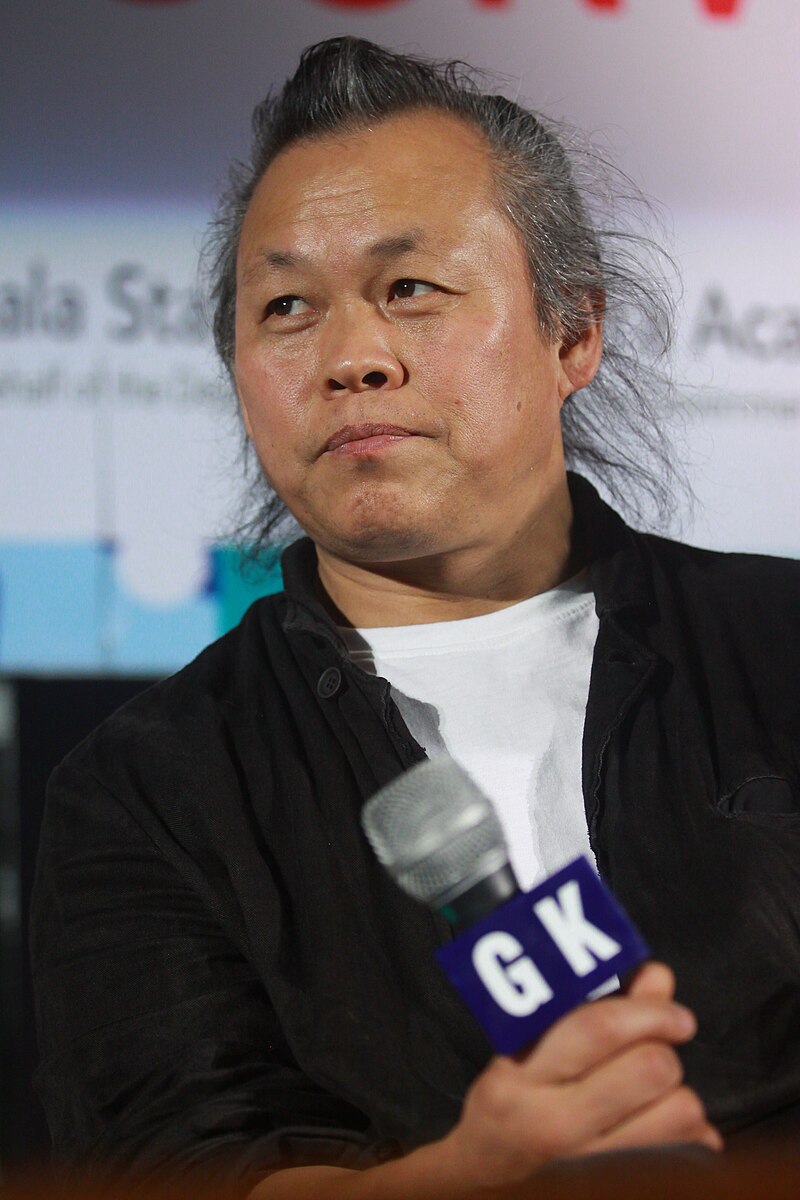
2013ലെ തിരുവനന്തപുരം അന്താരാഷ്ട്ര ചലച്ചിത്രോത്സവത്തില്
Epsajeevan
Key facts
Key facts
• Name — Kim Ki-duk • Born — 20 December 1960 • Birthplace — Ponghwa, South Korea • Died — 11 December 2020 • Place of death — Riga, Latvia • Occupation — * Film director • screenwriter • Years Active — 1993–2020 Kim Ki-duk (20 December 196011 December 2020) was a South Korean filmmaker, noted for his idiosyncratic art-house cinematic works. His films have received many distinctions in the festival circuit, rendering him one of the most important contemporary Asian film directors. His major festival awards include the Golden Lion at 69th Venice International Film Festival for Pietà (2012), a Silver Lion for Best Director at 61st Venice International Film Festival for 3-Iron (2004), a Silver Bear for Best Director at 54th Berlin International Film Festival for Samaritan Girl (2004), and the Un Certain Regard prize at 2011 Cannes Film Festival for Arirang (2011). His most widely known feature is Spring, Summer, Fall, Winter... and Spring (2003), included in film critic Roger Ebert's Great Movies. Two of his films served as official submissions for the Academy Award for Best International Feature Film as South Korean entries. He gave scripts to several of his former assistant directors including Juhn Jai-hong (Beautiful and Poongsan) and Jang Hoon (Rough Cut).
Early life and education
Early life and education
Kim was born on 20 December 1960 in Ponghwa, North Kyŏngsang. In 1990, he went to Paris to study fine arts, but instead he spent two years working there on the streets as a portrait painter. He served for five years in the South Korean marine corps, becoming a non-commissioned officer.
Career
Career
After returning to South Korea, Kim began his career as a screenwriter and won first prize in a screenplay contest held by the Korean Film Council in 1995. In the following year, Kim made his debut as a director with a low budget movie titled Crocodile (1996). The film received sensational reviews from movie critics in South Korea. Ki-duk said that his international breakthrough occurred with The Isle at the Toronto International Film Festival. His 2000 film Real Fiction was entered into the 23rd Moscow International Film Festival. In 2003, Ki-duk released Spring, Summer, Fall, Winter... And Spring. The film was praised by numerous critics, including critic Peter Bradshaw, who considered the film to be his masterpiece and one of the great works of modern Korean cinema. "A potent and enigmatic parable which manages to be both serene and gripping at the same time [...] It is that rarest of things - a genuinely spiritual film." The film work is included in critic Roger Ebert's Great Movies. In 2004, he received Best Director awards at two different film festivals, for two different films. At the Berlin International Film Festival, he was awarded for Samaritan Girl (2004), and at the Venice Film Festival he won for 3-Iron (also 2004). In 2011, his documentary film Arirang received an award for best film in the Un Certain Regard category from the Cannes Film Festival. In 2012, his film Pietà received the Golden Lion award at the Venice Film Festival.
Assault allegations
Assault allegations
In August 2017, an actress referred to as "Actress "A" by prosecutors filed a complaint against Kim Ki-duk through Seoul Central District Prosecutor's Office. In the complaint the actress accused Kim of slapping her face and forcing her to do an unscripted sex scene on the set of his film Moebius. In December 2017, the Seoul Central District Prosecutor's Office fined Kim Ki-duk for $4,450 (KRW 5 million) for physical assault but didn't charge him otherwise citing lack of physical evidence. On 6 March 2018, the South Korean TV channel MBC's investigative report series PD Notebook aired an episode titled "Movie director Kim Ki-duk, Master's Naked Face" with more accusations from Actress A and two others (Actress B and Actress C, as they are called in the episode). The actresses accused Kim and his frequent collaborator actor Cho Jae-hyun of verbal and physical sexual harassment and rape. In response, Kim filed false accusation and defamation suits against the accusers and PD Notebook. After that, on 7 August 2018, MBC aired a second episode of the PD Notebook series focused on Kim, titled "Master's Naked Face. Aftermath", with more accusations from other actresses and staff members against Kim and Cho. In that episode, journalists interviewed a Seoul Metropolitan Police Agency's Special Investigation Unit on Sexual Violence official about the cases. The official explained that the police approached the survivors and established the facts behind accusations but could not indict actor Cho and director Kim because of the expired statute of limitations. In January 2019, Seoul Central District Prosecutor's Office decided to drop the criminal lawsuits filed by Kim Ki-duk against actresses and PD Notebook because "there was neither proof that actress' initial accusation was false, nor was there evidence that the news show had been programmed with the purpose of defamation". In March 2019, Kim Ki-duk filed another lawsuit in civil court against Actress A and PD Notebook seeking $885,740 (KRW 1 billion) in damages. The lawsuit was ruled by court in the defendants' favor on 28 October 2020. The court also ordered Kim to pay legal fees for the defendants.
Animal cruelty allegations
Animal cruelty allegations
The British Board of Film Classification delayed the release of Kim Ki-duk's The Isle (2000) in the United Kingdom because of instances of animal cruelty in the film. Concerning scenes in which a frog is skinned after being beaten to death and fish are mutilated, the director stated, "We cooked all the fish we used in the film and ate them, expressing our appreciation. I've done a lot of cruelty on animals in my films. And I will have a guilty conscience for the rest of my life." To a U.S. interviewer who suggested that scenes such as these are "very disturbing and [seem] to place an obstacle to the films reception, or... distribution, to other countries", Kim said, "Yes, I did worry about that fact. But the way I see it, the food that we eat today is no different. In America you eat beef, pork, and kill all these animals. And the people who eat these animals are not concerned with their slaughter. Animals are part of this cycle of consumption. It looks more cruel onscreen, but I don't see the difference. And yes, there's a cultural difference, and maybe Americans will have a problem with it - but if they can just be more sensitive to what is acceptable in different countries I'd hope they wouldn't have too many issues with what's shown on-screen."
Death
Death
On 11 December 2020, Kim died from complications caused by COVID-19 during the COVID-19 pandemic in Latvia at the age of 59, nine days before his 60th birthday.
Filmography
Filmography
• Year — English title — Director — Producer — Writer — Editor — Notes • 1996 — Crocodile • 1997 — Wild Animals • 1998 — Birdcage Inn • 2000 — The Isle • Real Fiction • 2001 — Address Unknown • Bad Guy • 2002 — The Coast Guard • 2003 — Spring, Summer, Fall, Winter... and Spring — "He also acts a major role (as the Adult Monk)" • 2004 — Samaritan Girl • 3-Iron • 2005 — The Bow • 2006 — Time • 2007 — Breath • 2008 — Dream • Beautiful • Rough Cut • 2010 — Secret Reunion — Uncredited • 2011 — Arirang — Dramatic documentary about himself • Amen — Appears as "Masked Man" • Poongsan • 2012 — Pietà • 2013 — Moebius • Rough Play • Red Family • 2014 — One on One • Godsend • 2015 — Stop • Made in China • 2016 — The Net • 2017 — Excavator • 2018 — Human, Space, Time and Human • 2019 — Dissolve • 2022 — Call of God — Released after his death
Places
Named by the record
Places
Only places the record itself states, plotted where the house gazetteer settles their coordinates. Nothing is inferred from a name or a nationality.
Bonghwa County.
Birth place
Riga.
Death place
International awards
• Illustration — Lee Jung-jin, Kim Ki-duk and Jo Min-su in the 2012 Venice Film Festival • Year — Award — Category — Nominated work — Result — Ref • 2004 — 54th Berlin International Film Festival — Silver Bear (Best Director) — Samaritan Girl • 61st Venice Film Festival — Silver Lion (Best Director) — 3-Iron • 2011 — Cannes Film Festival — Un Certain Regard Prize — Arirang • 2012 — Küstendorf Film and Music Festival — "Award for Future Movies" — Pietà • 69th Venice Film Festival — Golden Lion • 2014 — 71st Venice Film Festival — The Venice Days Best Film Award — One on One
Text attribution
Licensing
Text attribution
Part of the biographical narrative on this page reuses licensed material. Its origin, revision and licence are recorded here.
The biographical narrative on this page is based on the Wikipedia article Kim Ki-duk, revision 1373598223 (EN edition), by its contributors. VALÉORINE has edited that text and built its own documentary record around it. The reused material is available under CC BY-SA 4.0, and this page's reuse of it is offered under the same licence. Everything else on this page — the chronology, the holdings, the evidence, the plates and the connections — is VALÉORINE's own record. Sources and licences.
Notes from the source article
Cited by Wikipedia
Notes from the source article
These works are cited by the source article, in its own numbering. They are recorded as its citations, not as sources VALÉORINE has verified.
- 1.Sang-Hun, Choe. Kim Ki-duk, Award-Winning South Korean Filmmaker, Dies at 59. The New York Times. 17 December 2020. 0362-4331.
- 2.Bitel, Anton (2014). "Edges, Silence and Cycles: A brief guide to the outsider cinema of Kim Ki-duk". In London Korean Film Festival 2014 Brochure, pp. 14–15. Korean Cultural Centre UK. PDF. Also available online at Bitel, Anton (31 January 2015). "Edges, Silence and Cycles: a brief guide to the outsider cinema of Kim Ki-duk". Projected Figures. Link.
- 3.Rayns, Tony. Sexual Terrorism: Strange Case of Kim Ki-duk. Film Comment. 40. 50. November 2004.
- 4.새영화 <해안선>의 감독 김기덕과 배우 장동건. Cine21. June 18, 2002.
- 5.Cine21, The Hankyoreh. Profile of Kim Ki-deok.
- 6.Kjolseth, Pablo. Interview with Kim Ki-Duk & Jung Suh. Movie Habit. January 31, 2001.
- 7.23rd Moscow International Film Festival (2001). MIFF.
- 8.Bradshaw, Peter. Kim Ki-duk: punk-Buddhist shock, violence – and hypnotic beauty too. The Guardian. 11 December 2020.
- 9.Ebert, Roger. Spring, Summer, Fall, Winter. and Spring movie review (2003) Roger Ebert. Roger Ebert.com. August 26, 2009.
- 10.Frater, Patrick. Director Kim Ki-duk to Be Fined in Actress Assault Case. Variety. December 7, 2017.
- 11.MBC PD Notebook. Movie director Kim Ki-duk, Master's Naked Face. Youtube.
- 12.Lee, Hyo-won. South Korean Filmmaker Kim Ki-duk Accused of Rape. Hollywood Reporter. March 6, 2018.
- 13.Im, Eun-byel. Kim Ki-duk fires back at accusers. The Korea Herald. June 13, 2018.
- 14.Seoul Broadcasting System. August 8, 2018.
- 15.Kil, Sonia. Court Dismisses Kim Ki-duk Case Against Actress, TV Show. January 5, 2019.
- 16.Kim, Na-young. Director Kim Ki-duk loses lawsuit against actress, broadcaster for airing sexual abuse allegations. Yonhap News Agency. October 28, 2020.
- 17.Rose, Steve. 'I've done a lot of cruelty to animals'. The Guardian. 2004-08-02.
- 18.McKeague, Andy. An Interview with Kim Ki-Duk and Suh Jung on The Isle. Monsters and Critics. 2005-05-11.
- 19.JTBC. December 11, 2020.
- 20.South Korean filmmaker Kim Ki-duk dies from COVID-19 complications. Reuters. December 11, 2020.
- 21.Movie director Kim Ki-duk dies of coronavirus. The Korea Herald. December 11, 2020.
- 22.Controversial South Korean director Kim Ki-duk dies of Covid aged 59. The Guardian. December 11, 2020.
- 23.Choe, Sang-Hun. Kim Ki-duk, Award-Winning South Korean Filmmaker, Dies at 59. The New York Times. December 17, 2020.
- 24.Wilmington, Michael. Measuring life through its seasons. Chicago Tribune. May 7, 2004.
- 25.Romney, Jonathan. 'Call Of God': Venice Review. ScreenDaily. September 9, 2022.
- 26.PRIZES & HONOURS 2004. berlinale.de.
- 27.Official Awards of the 61st Venice Film Festival. labiennale.org. September 11, 2004.
- 28.Leffler, Rebecca. Un Certain Regard Announces Top Prizes (Cannes 2011). The Hollywood Reporter. May 21, 2011.
- 29.СВЕЧАНО ОТВАРАЊЕ КУСТЕНДОРФА 2012 Kustendorf – International Film and Music Festival. Kustendorf Film and Festival 2012.
- 30.South Korean film 'Pieta' wins Venice top prize. AP. September 8, 2012.
- 31.Collateral awards. venice-days.com.
Bibliography printed in the source article · 5
- KIM Ki-duk ( 김기덕 / 金基悳). Korean Film Council.
- Seveon, Julien. An Interview with Korean Director Kim Ki-duk. Asian Cult Cinema. 38. 1st Quarter. 49–61. 2003.
- MARTONOVA, A. (2004) Contemporary Korean cinema – production, tradition and… Kim Ki-Duk. – In: The Plum Blossom. Papers from Korean Studies Conference, Sofia University "St. Kliment Ohridski", Centre for Eastern Languages and Cultures, Sofia: Ex-M, p. 129 – 151
- MARTONOVA, (2012) A. To feel HAN (Arirang by Kim Ki-duk) // Kino, No.3, Sofia:p. 49-47, ISSN 0861-4393 [Да чувстваш ХАН ("Ариран" на Ким Ки-док). — Original title in Bulgarian]
- MARTONOVA, A. (2007) The hieroglyph of cinema. Aesthetics and meaning in East Asia movies. Sofia: Panorama Publishing House, 242 pages, (in Bulgarian)
The Encyclopedia exists whether or not anything is for sale. Corrections are recorded rather than overwritten, and every version of this record is kept. Published 14 August 2026.
Elsewhere in Film memorabilia
38,713 published records in this field, each with its sources named.
- Kim Jung-eunPerson
- Kim Jung-hwaPerson
- Kim Jung-minPerson
- Kim KahanaPerson
- Kim Ki-youngPerson
- Kim Kih-hoonPerson
- Kim Kyu-jongPerson
- Kim LonginottoPerson
Best supported in this field
For owners
Own a work by Kim Ki-duk?
A specialist will read what you send and tell you what the house can establish, what it cannot, and whether the object is suited to sale. There is no charge and no obligation. The object stays with you throughout; nothing is shipped to us unless it is arranged in writing beforehand.