
Kikukawa Eizan
Illustration — Geisha playing go, a woodblock print 1787 – July 17, 1867 was a designer of ukiyo-e style Japanese woodblock prints. He first studied with his father, Eiji, a minor painter of the Kanō school, and subsequently with Suzuki Nanrei (1775–1844), of the Shijō school. He is believed to have also studied with ukiyo-e artist Totoya Hokkei (1790–1850).
Also recorded as Eizan · Eizan Kikukawa · Toshinobu Kikukawa · Eizan Kikugawa
Kikukawa Eizan
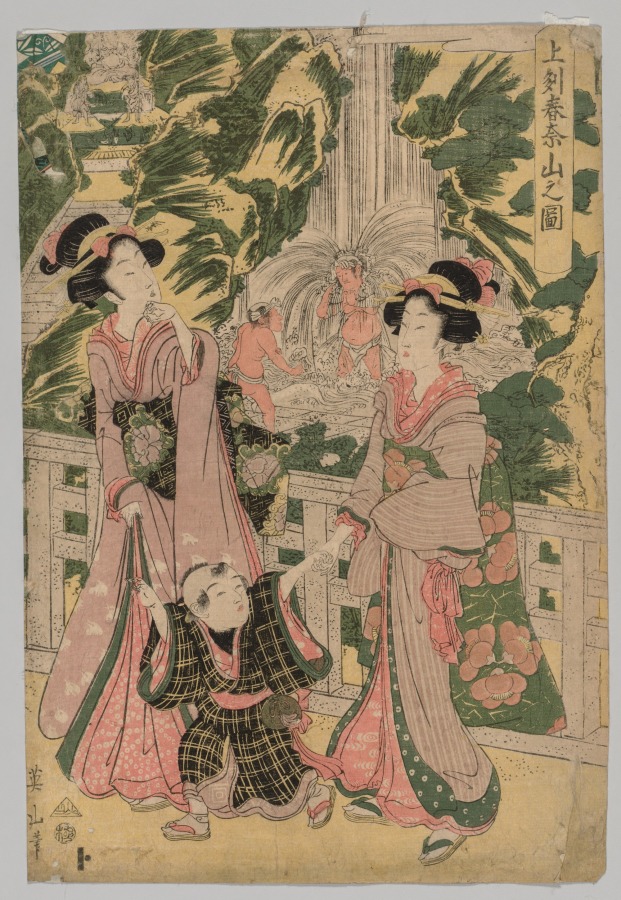
Kikukawa Eizan · The Cleveland Museum of Art · Gift of Mrs. Ralph King · CC0
- Nationality
- Japan
- Occupation
- painter · ukiyo-e artist · xylographer
VALÉORINE Encyclopedia
VALÉORINE documentary reading
Documentary summary
Illustration — Geisha playing go, a woodblock print 1787 – July 17, 1867 was a designer of ukiyo-e style Japanese woodblock prints. He first studied with his father, Eiji, a minor painter of the Kanō school, and subsequently with Suzuki Nanrei (1775–1844), of the Shijō school. He is believed to have also studied with ukiyo-e artist Totoya Hokkei (1790–1850).
Admitted source layer · organised and presented by VALÉORINE
Reference Check
Propose documentary evidence for Kikukawa Eizan. A contribution is never written directly as fact: identity, source, rights and evidence gates still decide.
Sign in to contribute
Documentary evidence
Documentary basis
Authority files
wikidata · Q947896 · wikipedia · Kikukawa Eizan
In this article
Gallery
Eizan produced numerous woodblock prints of beautiful women (bijin-ga) in the 1830s, but then abandoned printmaking in favor of painting. This artist should not be confused with Harukawa Eizan, an ukiyo-e print designer who was active in the 1790s. Eizan was the most prolific, longest-lived and ultimately the best of those late followers of Utamaro who attempted to carry on the master's bijin style after his death in 1806. Along with Tsukimaro and Utamaro II, Eizan has generally been dismissed by connoisseurs as a plagiarist of Utamaro's late style, but his work in fact develops, like that of most ukiyo-e artists, from a close identification with a leading master to a studied independence, and contains pieces of remarkable beauty and interest. Eizan's work retains the sensitivities and lyricism that marks the Utamaro style, as opposed to the earthier realism and more overt sensuality of Kunisada and Keisai Eisen. Eizan's depictions of young women underwent a clear stylistic evolution over his career. In his early works, faces were based on a pronounced oval with a tapered chin, a long straight nose and arched eyebrows. Around 1808 - 1813, faces became fuller and slightly less elliptical, with the nose sometimes inclined toward the aquiline and the lower lip occasionally larger than the upper. During what many consider his finest period, from 1814 to 1817, the faces of his bijin became thinner, marked by an indefinable delicacy and calm that some have nicknamed a "doll's face"; this style is also notable for its reversal of the general trend toward greater volume, as the physiognomy narrowed slightly rather than widening, at least for a few brief years. Toward the end of his printmaking career, Eizan's bijinga reflected the popular fashions of the day: female forms took on greater volume, faces became wider and more rectilinear, postures were often slightly curved or bent forward, and clothing was frequently rendered with heavy modelling. Eizan, like Toyokuni I in actor prints, is the last manifestation of the classical ukiyo-e style in bijin work, with harmonious colors and graceful lines and subjects. After him, one senses the introduction of a different aesthetic, with harsher colors, angular lines and less ethereal material, more of an emphasis, in sum, on the material weight of earthly life, rather than its transformation into something of elegance. Eizan was left-handed, which was strange at such a time in Japan.
Keisai Eisen, Harukawa Eichō and Kikukawa Eishū are recorded as having studied under Kikukawa Eizan. Work by Kikukawa Eizan is recorded in the collections of Museo del Prado, Art Institute of Chicago, Auckland Art Gallery, Finnish National Gallery and National Gallery of Victoria.
• Illustration — Woman with Shamisen. 1808 • Illustration — Geisha Playing the Hand-Game Kitsune-ken, 1820 • Illustration — Bijin • Illustration — Woman Performing the Tea Ceremony
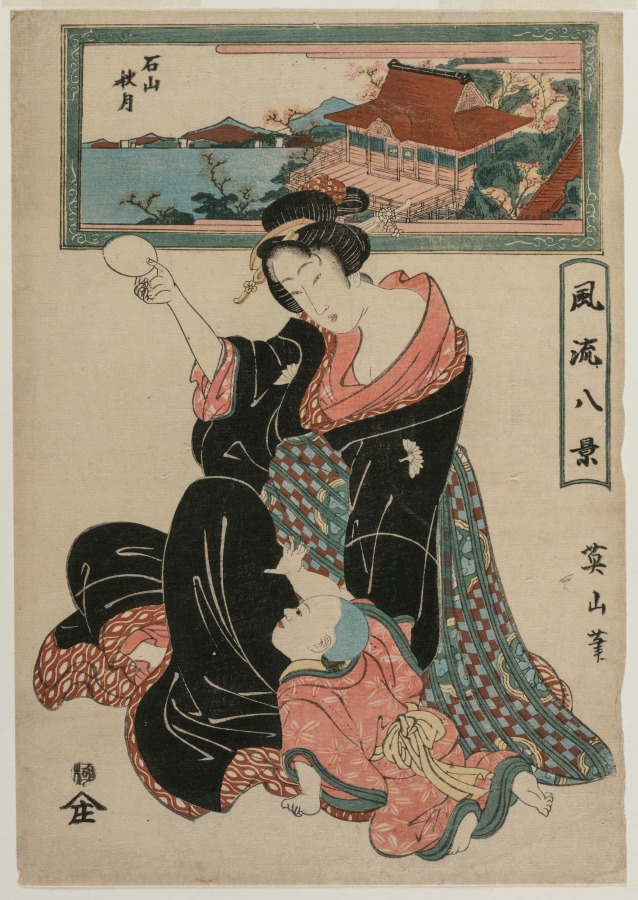
Autumn Moon at the Temple Ishiyamadera from the series Fashionable Eight Views, c. 1814–17, by Kikukawa Eizan
Kikukawa Eizan · The Cleveland Museum of Art · The Kelvin Smith Collection, given by Mrs. Kelvin Smith
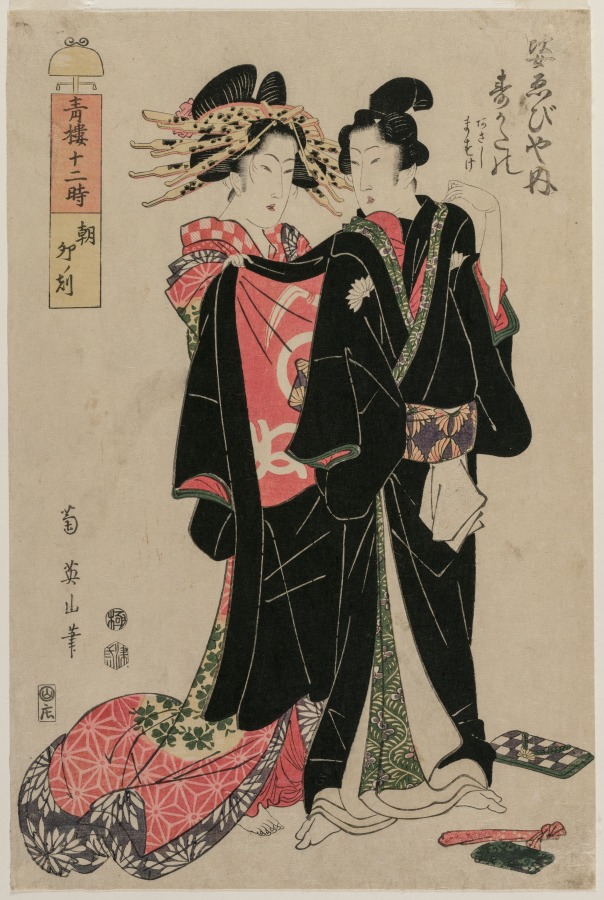
Sugatano of Sugata Ebisuya in the Morning, Hour of the Rabbit, from the series The Twelve Hours in the Pleasure Quarters, 1812, by Kikukawa Eizan
Kikukawa Eizan · The Cleveland Museum of Art · The Kelvin Smith Collection, given by Mrs. Kelvin Smith
Citations
References
Each reference names the institution holding it, so a reader may go to the document itself.
reference work
Secondary witnessreference work
Secondary witness
The Encyclopedia exists whether or not anything is for sale. Corrections are recorded rather than overwritten, and every version of this record is kept. Published 17 August 2026.
Elsewhere in Paintings
18,623 published records in this field, each with its sources named.
- Kiddy CitnyArtist
- Kiko ArgüelloArtist
- Kikuchi YōsaiArtist
- Kikuji YamashitaArtist
- Kilian ZollArtist
- Kim Deuk-sinArtist
- Kim DonaldsonArtist
- Kim Hong-doArtist
Best supported in this field
For owners
Own a work by Kikukawa Eizan?
A specialist will read what you send and tell you what the house can establish, what it cannot, and whether the object is suited to sale. There is no charge and no obligation. The object stays with you throughout; nothing is shipped to us unless it is arranged in writing beforehand.