
Khadija al-Salami
Illustration — Khadija Al-Salami (2016). Khadija al-Salami (born November 11, 1966) is the first Yemeni female film producer and director. Al-Salami currently resides in Paris, France.
Khadija al-Salami
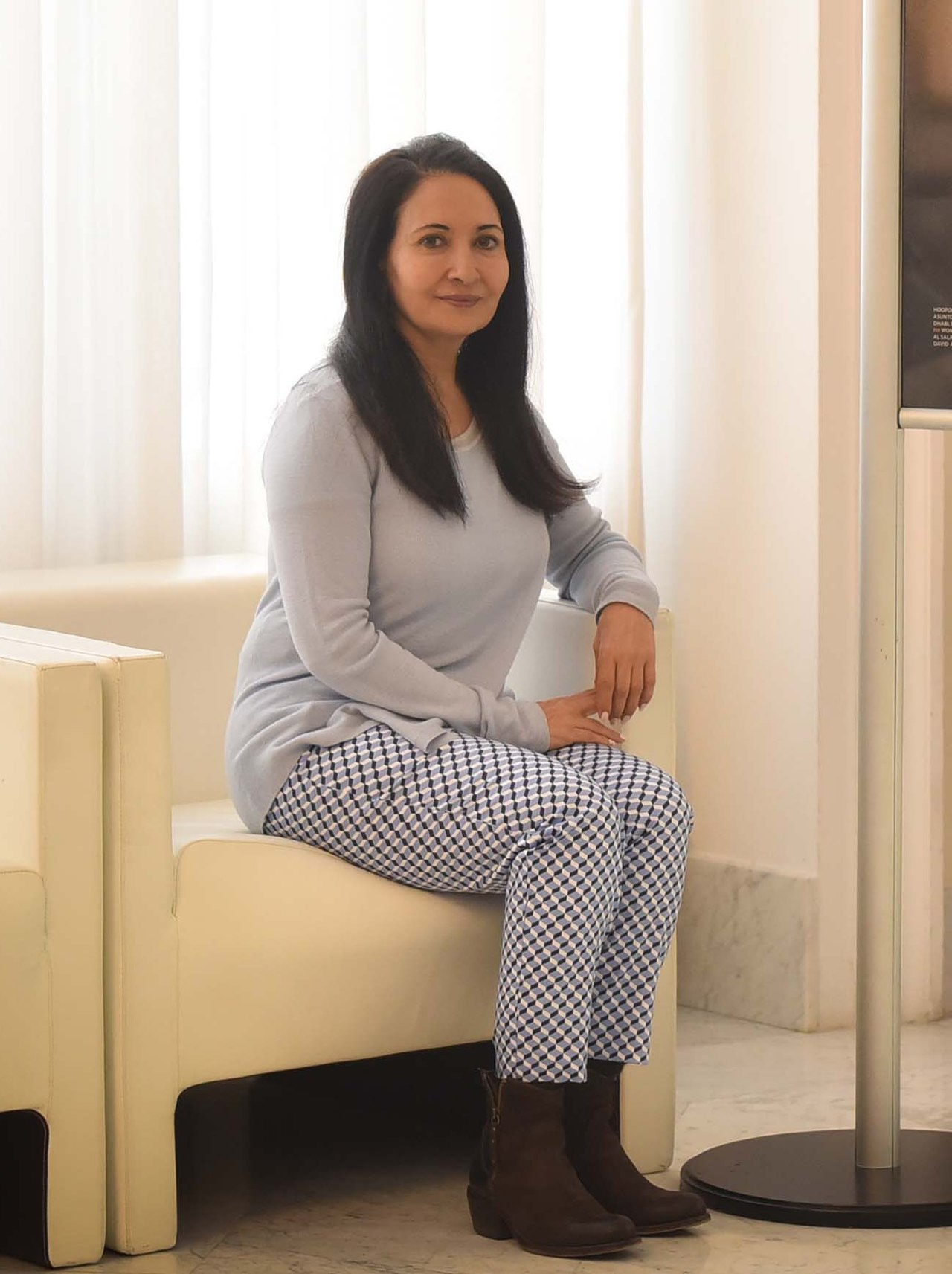
Donostia Kultura · Flickr - Khadija Al-Salami · CC BY-SA 2.0
- Born
- 1966 · Sanaa.
- Nationality
- Yemen
- Occupation
- film director · diplomat · writer · film producer
- Education
- George Washington University
- Honours
- Knight of the Legion of Honour · Chevalier des Arts et des Lettres
- Languages
- English
VALÉORINE Encyclopedia
VALÉORINE documentary reading
Documentary summary
Illustration — Khadija Al-Salami (2016). Khadija al-Salami (born November 11, 1966) is the first Yemeni female film producer and director. Al-Salami currently resides in Paris, France.
Admitted source layer · organised and presented by VALÉORINE
Note VALÉORINE
Khadija al-Salami (born 1966) is a diplomat, film director and film producer, among other activities and a national of Yemen. The diplomat was born in Sanaa. Khadija al-Salami studied at George Washington University.
Languages used include English. The diplomat received Chevalier des Arts et des Lettres and Knight of the Legion of Honour.
Composed from admitted, traceable facts · 01 October 2026
VALÉORINE
Reference Check
Propose documentary evidence for Khadija al-Salami. A contribution is never written directly as fact: identity, source, rights and evidence gates still decide.
Sign in to contribute
World of VALÉORINE
Documentary connections
Only confirmed graph relationships appear here. Images are shown only when their identity and reuse rights both pass the documentary gate.
Documentary evidence
Documentary basis
Authority files
wikidata · Q542294 · wikipedia · Khadija al-Salami
In this article
Early life and education
Early life and education
She has been nominated and also won awards at film festivals such as the Dubai International Film Festival and Vesoul Asian Film Festival. Her semi-autobiographical 2014 film, I Am Nojoom, Age 10 and Divorced was submitted to the Academy Awards, but was not selected.
Khadija al-Salami was born on November 11, 1966 in Sanaa, Yemen. At an early age, al-Salami was sent to live with relatives after her mother divorced her father over severe domestic abuse. At age 11, she was forced by her grandmother into an early marriage and was raped by her husband. Some weeks later her husband returned her to her uncle, who immediately disowned her and returned her to her single mother. She escaped the immense family and society pressure by finding employment with the local television station and simultaneously attending school in the mornings which was her only output for happiness. At the age of 16, she received a scholarship to finish secondary school in the United States. Subsequently, she enrolled at the Mount Vernon College for Women, in Washington, D.C. After a period in Yemen and Paris, she returned to Washington to earn her Master's degree in communications at the American University. For her thesis, she produced her first film.
Career
Career
Al-Salami began her career making documentaries, whose primary foci are women, including A Stranger in her Own City (2005) about exile and how home can keep one trapped with the traditions one grew up in. She was inspired to create this film from her own experiences with arranged marriage as well as the experience of a young girl by the name of Najmia who was 13 years old at the time. She said enjoyed filming her because of her carefree spirit and of how she had reminded al-Salami at her age. Al-Salami stated that it was "never aired on Yemeni television as they were not used to such controversial subject matter". Another of her documentaries, Scream (2013) is about the roles of women during Yemen's 2011 uprising. Al-Salami has produced several documentaries for various television networks in France and Yemen. Her 2014 film, I Am Nujood, Age 10 and Divorced, which was shot entirely in Yemen, recounts the true story of Nujood Ali, Yemen's most famous child bride, who was married off at ten and filed for divorce in court. Al-Salami did not want to tell only Nujood's story, but also her own and that of many other Yemeni child brides to allow other young girls to understand the effects of these marriages. Unlike most of her subsequent films, this one was only shot in Yemen, and she currently resides in Paris, This movie won her the best feature film at the Dubai International Film Festival and was also shown at other festivals. I Am Nojoom, Age 10 and Divorced, became the first Yemeni film to be submitted for consideration for the Academy Award for Best Foreign Language Film at the 89th Academy Awards. She has also co-authored with her current husband, the American Charles Hoots, an autobiography, The Tears of Sheba. Al-Salami currently serves as Press and Cultural attaché and Director of the Yemeni Information Centre at the Embassy of Yemen in Paris.
Works
Works
• Year — Works • 1991 — Hadramaout: Crossroads of Civilizations • 1994 — Le pays suspendu • 1995 — Women of Islam • 1997 — Land of Sheba • 2000 — Yemen of a Thousand Faces • 2005 — A Stranger in Her Own City • 2006 — Amina • 2013 — Scream • 2014 — I Am Nojoom, Age 10 and Divorced • 2015 — La rosée du matin (French), with Nada al-Ahdal • 2016 — Jedenastoletnia zona (Polish), with Nada al-Ahdal *
Awards and nominations
• Festival — Year — Award — Category and/or Film • Dubai International Film Festival — 2014 — Muhr Award- Winner — Best Feature Film: I am Nujood, Age 10, and Divorced (2014) • Dubai International Film Festival — 2006 — Muhr Award- Winner — Best Documentary- Silver: Amina (2006) • Vesoul Asian Film Festival — 2006 — Youth Award- Winner — Une étrangère dans sa ville (2005) • Vesoul Asian Film Festival — 2005 — Youth Award- Nominee — Les femmes et la démocratie au Yémen (2003)

Argazkia / Fotografía: Iñigo Royo
DONOSTIA KULTURA
Notes from the source article
Cited by Wikipedia
Notes from the source article
These works are cited by the source article, in its own numbering. They are recorded as its citations, not as sources VALÉORINE has verified.
- 1.Hillauer, Rebecca. Encyclopedia of Arab Women Filmmakers. American University in Cairo Press. 421–448. 2006-02-02. 9789774249433.
- 2.The most 500 powerful Arabs. Arabian Business. 2013.
- 3.Aspden, Rachel. Eastern Eyes. newstatesmen.
- 4.Khadija al-Salami, a Yemeni Child Bride Who Became a Diplomat. Fanack.com. May 2023.
- 5.Brunning, Dennis. IMDB.com and IMDB Pro.
References
Citations
References
Each reference names the institution holding it, so a reader may go to the document itself.
reference work
Secondary witnessreference work
Secondary witness
The Encyclopedia exists whether or not anything is for sale. Corrections are recorded rather than overwritten, and every version of this record is kept. Published 15 August 2026.
Elsewhere in Books
39,427 published records in this field, each with its sources named.
- Kevork AjemianAuthor
- Khachatur AbovianAuthor
- Khadambi AsalacheAuthor
- Khadija Abdalla BajaberAuthor
- Khadija BesikriAuthor
- Khadija MastoorAuthor
- Khadijah IbrahiimAuthor
- Khady HaneAuthor
Best supported in this field
For owners
Own a work by Khadija al-Salami?
A specialist will read what you send and tell you what the house can establish, what it cannot, and whether the object is suited to sale. There is no charge and no obligation. The object stays with you throughout; nothing is shipped to us unless it is arranged in writing beforehand.