
Ker-Xavier Roussel
Ker-Xavier Roussel (10 December 1867 – 6 June 1944) was a French painter associated with Les Nabis.
Also recorded as Ker Xavier Roussel · K. Xavier Roussel · Xavier Roussel · Ker Xavier Franz Roussel
Ker-Xavier Roussel
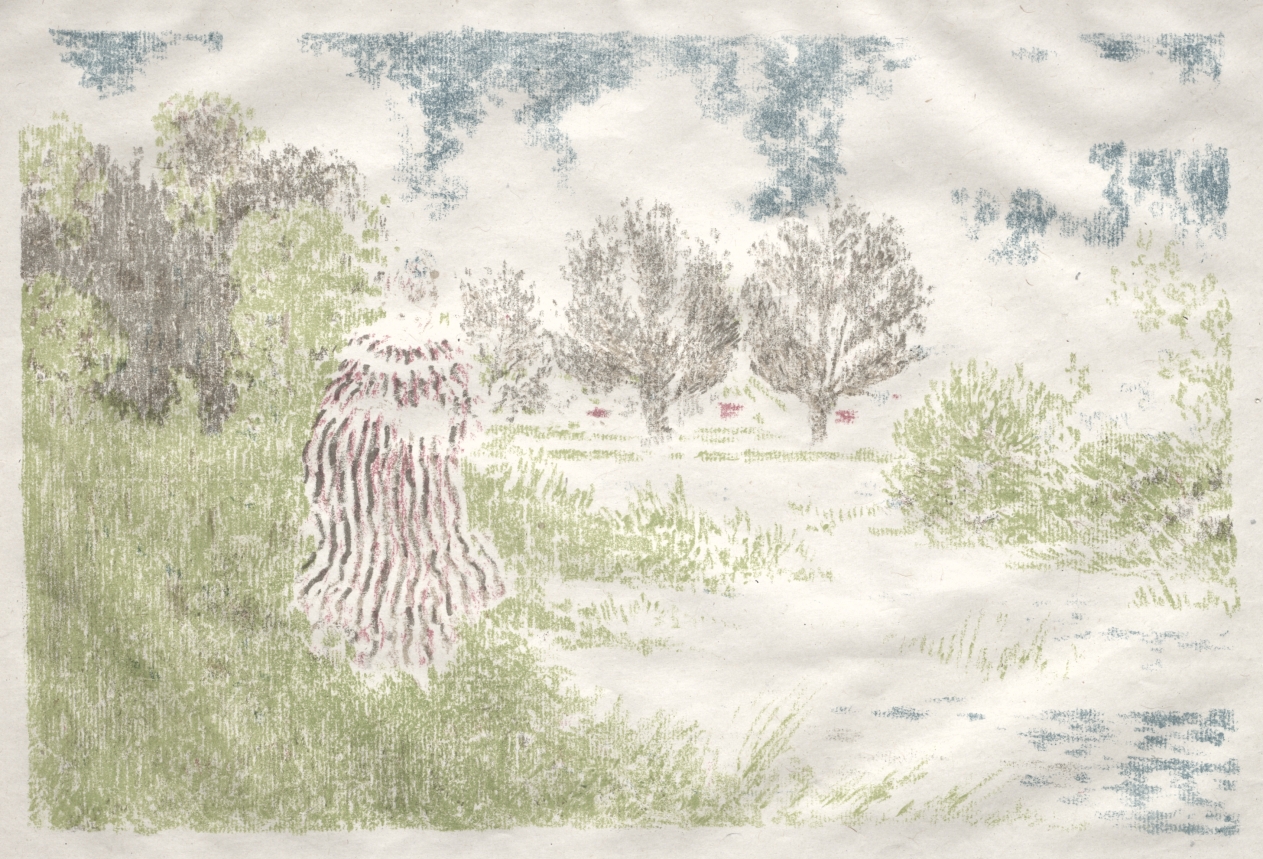
Ker Xavier Roussel · The Cleveland Museum of Art · Gift of The Print Club of Cleveland · CC0
- Born
- 1867.
- Died
- 1944.
- Nationality
- France.
- Occupation
- painter, printmaker, draftsperson and graphic artist.
- Fields
- portrait.
- Known for
- The Procession of Bacchus.
VALÉORINE Encyclopedia
VALÉORINE documentary reading
Documentary summary
Ker-Xavier Roussel (10 December 1867 – 6 June 1944) was a French painter associated with Les Nabis.
Admitted source layer · organised and presented by VALÉORINE
Reference Check
Propose documentary evidence for Ker-Xavier Roussel. A contribution is never written directly as fact: identity, source, rights and evidence gates still decide.
Sign in to contribute
Documentary evidence
Documentary basis
Authority files
wikidata · Q533859 · wikipedia · Ker-Xavier Roussel
In this article
Biography
Born François Xavier Roussel in Lorry-lès-Metz, Moselle in 1867, at age fifteen he studied at the Lycée Condorcet in Paris; alongside his friend Édouard Vuillard, he also studied at the studio of painter Diogène Maillart. In 1888, he enrolled in the École des Beaux-Arts, and soon began frequenting the Académie Julian where Maurice Denis and other students formed the group Les Nabis. In 1899, Roussel, Vuillard, and his close friend, Pierre Bonnard, travelled to Lake Como, Venice, and Milan. In that year he settled in L'Étang-la-Ville, Yvelines and the subject-matter of his paintings veered towards rural landscapes. He drew his subject matter from the area around L'Étang-la-Ville and Saint-Tropez, adapting the scenery to Greek mythological episodes depicting women, children, nymphs, centaurs and fauns. His wife Marie (Vuillard's sister), his daughter Annette, his son Jacques and his grandchildren served as models. He abandoned the small format pictures typical of the Nabis and created large, brightly coloured paintings in a post-impressionist style. His paintings celebrated the seasons, abundance, drunkenness, lustful behaviour and dance, the latter influenced by Isadora Duncan. A number of paintings depict voyeuristic mythological and Old Testament episodes; one of his paintings illustrates Stéphane Mallarmé's poem of 1876, L'après-midi d'un faune, in which the faun creeps through rushes to spy on female bathers. While Roussel expressed erotic joy in his bucolic pictures (the 'glorious blaze of the flesh'), he also had a melancholy and dark side expressed in dark lithographic illustrations to works by Maurice de Guerin, La Bacchante and Le Centaure. Between 1914 and 1917 he was admitted to a clinic, suffering from depression. He produced large numbers of pastels in his final years, between 1930 and 1944, picturing violent death in mythology. Roussel is known for huge paintings of landscapes decorating public spaces, with others commissioned for private clients. In 1912 he painted the front curtain of the Théâtre des Champs-Élysées and in 1937-9 he created a huge eleven-metre panel in the debating chamber at the Palais des Nations (Palace of Nations) in Geneva. In 1926, Ker-Xavier Roussel won the Carnegie Prize for art. His reputation reached a peak in 1936 with a multi-panel scheme for the Palais de Chaillot. Ker-Xavier Roussel died in 1944 at his home in L'Étang-la-Ville. Roussel is mentioned in Gertrude Stein's Autobiography of Alice B. Toklas, Chapter 3. There she recounts an exchange he had with Theodore Duret in Vollard's shop at an uncertain date after 1904. Roussel complained of the lack of recognition that he and the other Nabi painters had to contend with. Duret consoled him by pointing out his incompatibility with the manners and fashions of the bourgeois world and the differences between "art" and "official art". In 2019 he was rescued from the near oblivion into which he has generally fallen in modern times by a comprehensive exhibition, Ker-Xavier Roussel, Private Garden, Dreamed Garden at the Musée des Impressionnismes, Giverny.
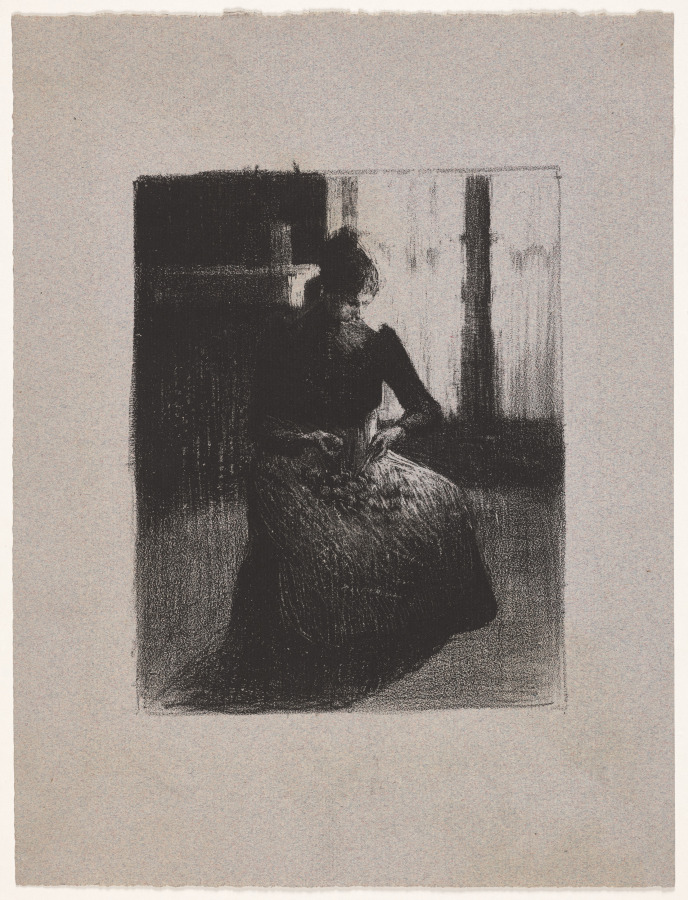
The Potato Peeler, 1893, by Ker-Xavier Roussel
Ker Xavier Roussel · The Cleveland Museum of Art · Dudley P. Allen Fund
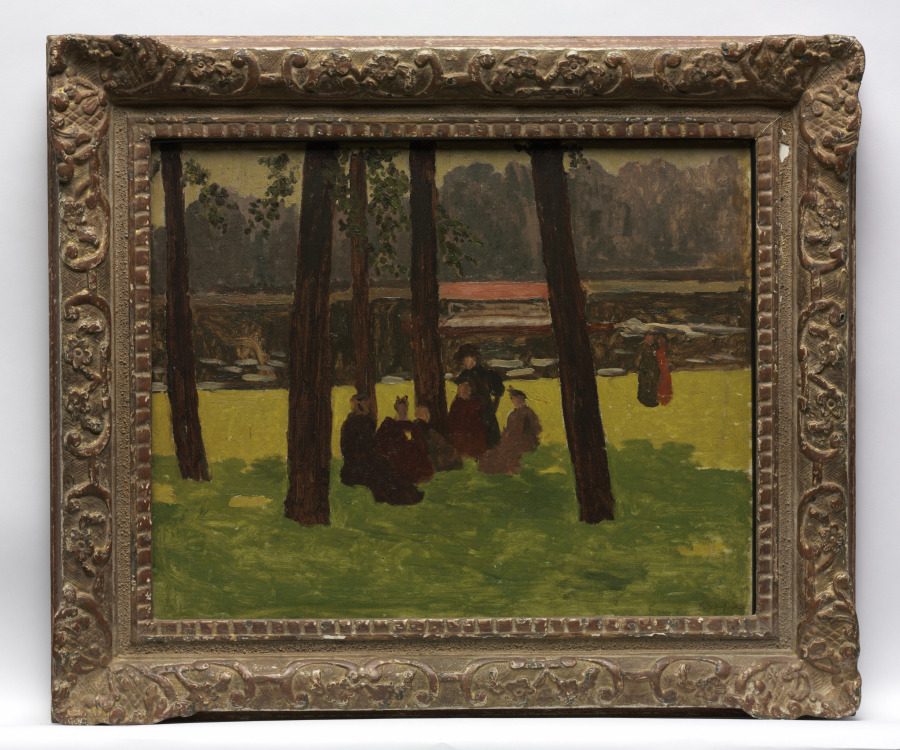
Women Meeting in the Shade, c. 1890, by Ker-Xavier Roussel
Ker Xavier Roussel · The Cleveland Museum of Art · Bequest of Muriel Butkin
Notes from the source article
Cited by Wikipedia
Notes from the source article
These works are cited by the source article, in its own numbering. They are recorded as its citations, not as sources VALÉORINE has verified.
- 1.Oxford Index
- 2.Cousturier, Lucie. K.-X. Roussel. Bernheim-Jeune, Paris, 1927
- 3.Stein, Gertrude. The Autobiography of Alice B. Toklas. Penguin, 2001, p.37
- 4.Exhibition Guide for Ker-Xavier Roussel, Private Garden, Dreamed Garden. Musée des Impressionnismes, Giverny, 2019.
References
Citations
References
Each reference names the institution holding it, so a reader may go to the document itself.
reference work
Secondary witnessreference work
Secondary witness
The Encyclopedia exists whether or not anything is for sale. Corrections are recorded rather than overwritten, and every version of this record is kept. Published 14 August 2026.
Elsewhere in Prints
4,138 published records in this field, each with its sources named.
- Kenneth KilstromEngraver
- Kenneth NolandEngraver
- Kenneth Wayne BushnellEngraver
- Kenojuak AshevakEngraver
- Kerr EbyEngraver
- KiakshukEngraver
- Kitaoka FumioEngraver
- Kittie BruneauEngraver
Best supported in this field
For owners
Own a work by Ker-Xavier Roussel?
A specialist will read what you send and tell you what the house can establish, what it cannot, and whether the object is suited to sale. There is no charge and no obligation. The object stays with you throughout; nothing is shipped to us unless it is arranged in writing beforehand.