
Kazimir Malevich
Kazimir Severinovich MalevichKazimierz Malewicz; kɐzɪˈmɪr seweˈrɪnowɪtʃ mɐˈlɛwɪtʃ. (– 15 May 1935) was a Russian avant-garde artist and art theorist, whose work and writings pioneered the development of abstract painting in the 20th century. He is best known as the founder of Suprematism, a radically non-objective form of painting he introduced in 1915.
Also recorded as Казимир Северинович Малевич · Малевиць «Азимир Севериновиц» · Казимир Малевич · Т. Малевича
Kazimir Malevich
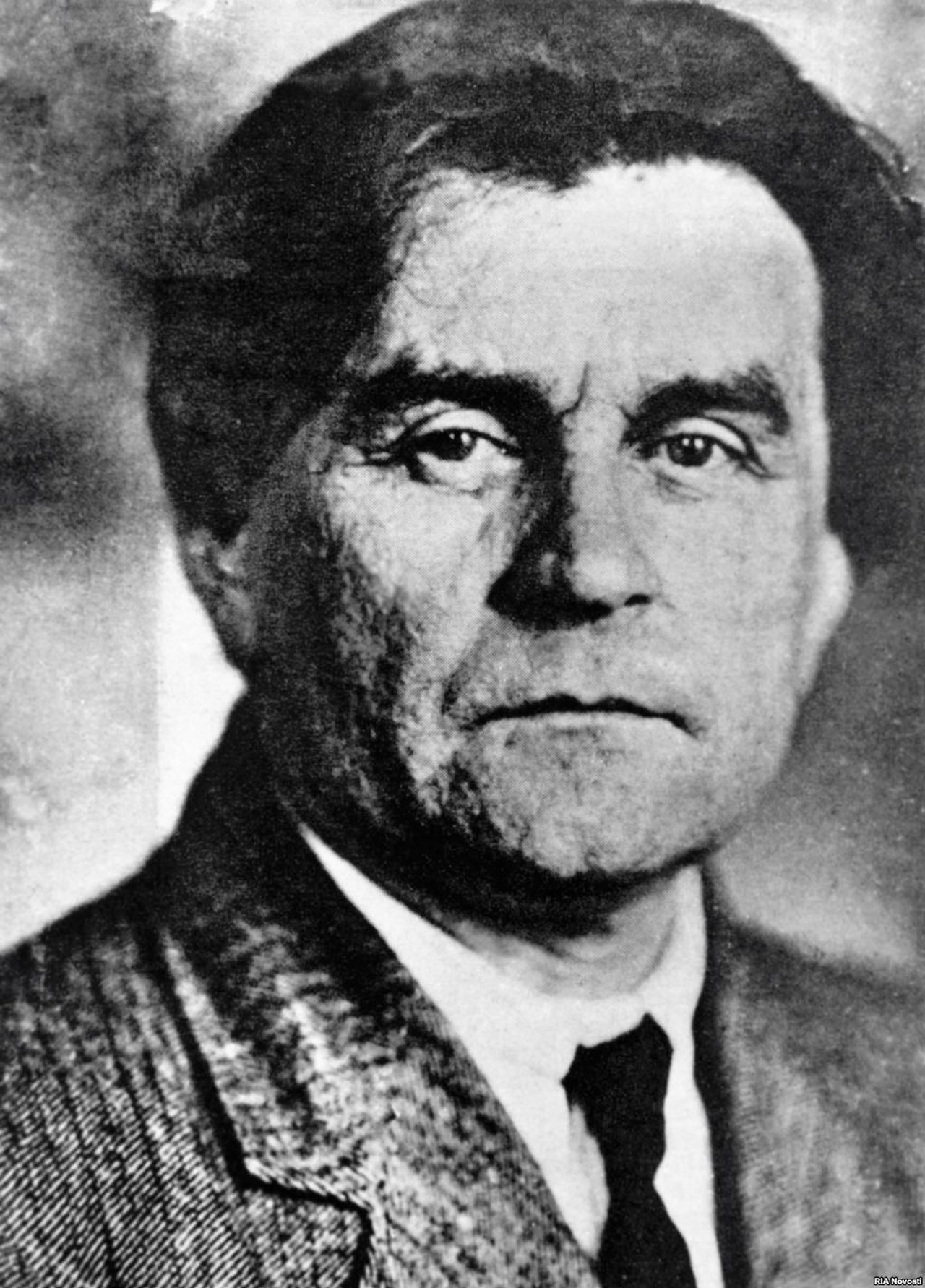
(Original text: http: next version source [1] · Public domain
- Name
- Kazimir Malevich
- Born
- 23 February 1879
- Birthplace
- Kiev, Russian Empire (now Kyiv, Ukraine)
- Died
- 15 May 1935
- Place of death
- Leningrad, Russian SFSR, Soviet Union (now Saint Petersburg, Russia)
- Movement
- Suprematism
- Nationality
- Russian Empire, Ukrainian Soviet Socialist Republic and Soviet Union.
- Occupation
- painter, sculptor, printmaker, scenographer, costume designer, draftsperson, designer, visual artist, graphic artist and artist.
- Fields
- scenography, painting, abstract art, still life and figurative art.
- Movements
- Suprematism, Russian avant-garde and Constructivism.
- Known for
- Black Square (1915), Suprematist Composition, Suprematist Composition: White on White, An Englishman in Moscow and The Knife Grinder.
VALÉORINE Encyclopedia
VALÉORINE documentary reading
Documentary summary
Kazimir Severinovich MalevichKazimierz Malewicz; kɐzɪˈmɪr seweˈrɪnowɪtʃ mɐˈlɛwɪtʃ. (– 15 May 1935) was a Russian avant-garde artist and art theorist, whose work and writings pioneered the development of abstract painting in the 20th century. He is best known as the founder of Suprematism, a radically non-objective form of painting he introduced in 1915.
Admitted source layer · organised and presented by VALÉORINE
Reference Check
Propose documentary evidence for Kazimir Malevich. A contribution is never written directly as fact: identity, source, rights and evidence gates still decide.
Sign in to contribute
Documentary evidence
Documentary basis
Authority files
gnd · 1092031111 · wikidata · Q130777 · wikipedia · Kazimir Malevich
In this article
Biography
Biography
Kazimir Malevich was born in Kiev, modern-day Ukraine, to an ethnic Polish family, Malevich worked primarily in Russia and became a leading figure of the Russian avant-garde. His work has also been associated with the Ukrainian avant-garde. Early in his career, he worked in multiple styles, assimilating Impressionism, Symbolism, Fauvism, and Cubism through reproductions and the works acquired by contemporary Russian collectors. In the early 1910s, he exhibited alongside other Russian avant-garde artists, including Mikhail Larionov and Natalia Goncharova. In 1915, working in a Cubo-Futurist mode, Malevich developed Suprematism, a system of pure geometric abstraction on monochromatic grounds. His Black Square (1915), first shown at the Last Futurist Exhibition 0,10 in Petrograd, marked a decisive break with representational painting. He set out his theory in the brochure From Cubism and Futurism to Suprematism, published to accompany the exhibition. His trajectory mirrored the upheavals around the October Revolution of 1917. In 1918, Malevich began teaching in Vitebsk along with Marc Chagall. In 1919, he founded the UNOVIS artists collective and had a solo show at the Sixteenth State Exhibition in Moscow. His reputation spread westward with solo exhibitions in Warsaw and Berlin in 1927, the only time he ever left Russia. From 1928 to 1930 he taught at the Kiev Art Institute alongside Alexander Bogomazov, Victor Palmov, and Vladimir Tatlin, while publishing in the Kharkiv magazine Nova Generatsiia. In 1930, he was briefly arrested and interrogated by the OGPU in Leningrad. Diagnosed with cancer in 1933, he was not allowed to leave the Soviet Union to seek treatment abroad. While constrained by his progressing illness and Stalin's cultural policies, Malevich painted and exhibited his work until the end of his life. He died on 15 May 1935, at age 56. His art and his writings influenced Eastern and Central European contemporaries such as El Lissitzky, Lyubov Popova, Alexander Rodchenko and Henryk Stażewski, as well as generations of later abstract artists, such as Ad Reinhardt and the Minimalists. He was celebrated posthumously in major exhibits at the Museum of Modern Art (1936), the Guggenheim Museum (1973), and the Stedelijk Museum in Amsterdam (1989), which has a large collection of his work. In the 1990s, the ownership claims of museums to many Malevich works began to be disputed by his heirs.

Amsterdam - Stedelijk Museum - Kazimir Malevich (1878-1935) - An Englishman in Moscow (A 7656) 1914
Txllxt

Amsterdam - Stedelijk Museum - Kazimir Malevich (1878-1935) - Self-Portrait in Two Dimensions (A 7683) 1915
Txllxt
Key facts
Key facts
• Name — Kazimir Malevich • Born — 23 February 1879 • Birthplace — Kiev, Russian Empire (now Kyiv, Ukraine) • Died — 15 May 1935 • Place of death — Leningrad, Russian SFSR, Soviet Union (now Saint Petersburg, Russia) • Movement — Suprematism • Works — An Englishman in Moscow, 1914; Black Square, 1915; White on White, 1918
Early life (1879–1905)
Early life (1879–1905)
• Illustration — Kazimir Malevich (c.1900) Kazimir Severinovich Malevich was born on either 23 (O.S. 11) February or 26 (O.S. 14) February 1879, to Severin (Seweryn) Antonovich and Liudviga (Ludwika) Alexandrovna. His parents, who were Polish, had fled Poland following the failed January Uprising of 1863 against Russian rule. Lucjan Malewicz, Kazimir's uncle, was a Catholic priest and one of the leaders of the 1863 insurrection. The family subsequently settled near Kiev (modern-day Kyiv, Ukraine) in Kiev Governorate of the Russian Empire. Kazimir was the first of fourteen children, only nine of whom survived into adulthood. His parents were Roman Catholic, though his father attended Orthodox services as well. The primary language spoken within Malevich's household was Polish, but he also spoke Russian, as well as Ukrainian due to his childhood surroundings. Malevich's father worked as manager at several different sugar refineries. Between 1889 and 1896, Malevich's family relocated multiple times due to his father's job. In 1889, they moved to Parkhomovka near Kharkov (modern-day Ukraine). In Parkhomovka, Malevich attended a two-year agricultural school and taught himself to paint in a simple peasant style, drawing inspiration from rural surroundings. About four years later, the family relocated to Voltochok near Konotop, which was near centers of Polish cultural activity at the time. There, Malevich met the composer Nikolai Roslavets. He later briefly attended classes at the Kiev School of Drawing under the encouragement of the realist painter Mykola Pymonenko.
Kursk and Moscow (1896–1905)
Kursk and Moscow (1896–1905)
In 1896, the family moved to Kursk (modern-day Russia), where Malevich encountered several Russian artists, such as Lev Kvachevsky, with whom he often worked outdoors. By Malevich's own admission, his dedication to painting would make him the "black sheep" of the family. Through reproductions, Malevich also became familiar with the work of the Peredvizhniki (Wanderers), including Ivan Shishkin and Ilia Repin, two leading Russian Realist painters. In 1896, he began working as a technical draughtsman at the Moscow-Kursk-Voronezh railway company. Malevich would later describe 1898 as the year he began exhibiting his work, although there is no evidence for this claim. In 1899, he met his first wife, Kazimira Ivanovna Zgleits, who was eight years his senior. They had two children, Galina and Anatolii, the latter of whom dies of typhoid in his early childhood. His father died in 1902, at the age of fifty-seven, and in 1903, Malevich held an exhibition at the Society for the Support of Primary Education in Kursk. Recognizing his style as increasingly more Impressionistic, Malevich intended to receive academic training in Moscow. By 1904, as more French art was being reproduced and discussed in Russia in the magazine Mir iskusstva, Malevich had also become acquainted with the work of Paul Gauguin. Malevich and other artists in Moscow gained an early exposure to Western modern art through the private collections of Sergei Shchukin and Ivan Morozov. Their acquisitions ranged from French Impressionism to paintings by Paul Cézanne and Gauguin, and were later expanded to include the works of the key Parisian avant-garde artists, such as Pablo Picasso and Henri Matisse. Malevich is said to have visited both collections soon after his first arrival in Moscow in the fall of 1904. Similarities between his Apple Tree in Blossom (1904) and Alfred Sisley's Villeneuve-la-Garenne (1872), then in Shchukin's collection, have been cited as an early indication of the collectors’ influence on Malevich's oeuvre. In October 1904, Vladimir Lenin, the Bolshevik leader and political activist, returns to Russia from exile. At the time, anti-government sentiment in Russia was gaining momentum, intensifying after Bloody Sunday in St. Petersburg in January 1905, when Tsarist forces killed numerous protesters. On October 17, 1905, Nicholas II issued the October Manifesto, granting limited voting rights to the middle class. In November, the government suppressed further revolutionary activity through military force. In his autobiography, Malevich later claimed to have taken part in the Battle of the Barricades in Moscow in December 1905, an attempt to sustain the revolution against the Tsarist regime. • Illustration — Portrait of the Artist's Father (1902–1903, Stedelijk Museum Amsterdam) • Illustration — Flower Girl (1903, Russian Museum) • Illustration — Boulevard (1904–05, Russian Museum)
Early years in Moscow (1906–1910)
Early years in Moscow (1906–1910)
Malevich settled in Moscow, along with his family and his mother, in the spring of 1906. There, Malevich attended the studio of Fedor Rerberg, who was known to prepare his students for applications to the Moscow School of Painting, Sculpture and Architecture. Despite Malevich's multiple attempts to apply to the Moscow art school, however, he was never offered admission. In 1907, the Blue Rose Exhibition of a group of Moscow Symbolist painters—part of a broader early 20th-century movement that rejected naturalism in favor of mystical themes and dreamlike imagery—left a deep impression on the artist. Malevich submitted a single painting to the exhibition; it was rejected. The impact of Symbolism on Malevich during that period is evident in paintings such as The Triumph of Heaven (1907) and The Shroud of Christ (1908). By 1908, he developed a strong interest in Russian icons and Russian folk art. At the same time, more Western avant-garde influences reached Moscow, including through the activities of the Golden Fleece group, who in 1908 organized a major exhibition of Russian and Western European art that included works by Vincent van Gogh, Matisse, Georges Braque, Gauguin, and Cézanne. In 1909, the group also published in their journal a Russian translation of Matisse's treatise Notes on Painting (1908) and Shchukin opened his collection to the public. In September 1909, Malevich's planned visit to Paris was cancelled when a sale of his painting fell through. Later that year, he met his future second wife Sofia Mikhailovna Rafalovich. • Illustration — Triumph of Heaven (1907, Russian Museum), an example of Malevich's early Symbolism-inspired work • Illustration — Bathers (1908, Russian Museum) • Illustration — Rest. Society in Top Hats (1908, Russian Museum)
Knave of Diamonds and Donkey's Tail (1910–1912)
Target Exhibition and Cubo-Futurism (1913)
Target Exhibition and Cubo-Futurism (1913)
By 1913, the influence of Italian Futurism on Russian contemporary art had become more pronounced. Excerpts of the Manifesto of Futurism, written by Filippo Tommaso Marinetti, were already published in Russia in 1909. Its call to reject the past, glorify modernity, and embrace speed, dynamism, and aggressive provocation resonated with the Russian avant-garde. Adapting some of the futurist rhetoric, artists like Burliuk and Malevich shifted Marinetti's celebration of machines and violence more toward linguistic experimentation and cognitive transformation. Among such experiments was a technique called zaum, or “transrational” language, wherein Russian Futurist technique used invented sounds and words to bypass reason and evoke a higher reality. In a letter sent to his friend, composer Mikhail Matyushin, in the spring of 1913, Malevich wrote: Around that time, Burliuk led a Russian futurist parade in Moscow, where artists with painted faces recited futurist poetry. In March 1913, Malevich participated in the Target exhibition in Moscow together with Goncharova and Larionov, continuing to reinterpret Futurist vocabularies to "suggest movement by breaking cone shapes into almost unrecognizable forms". Malevich described himself in this period as working in a “Cubo-Futurist” style. Among other paintings, Malevich exhibited Morning in the Country after Snowstorm and Knifegrinder or Principle of Glittering, both made in 1912, at Target for the first time. That same year, the Cubo-Futurist opera, Victory Over the Sun, debuted in at Luna Park Theater in St. Petersburg. The opera featured a libretto by Aleksei Kruchenykh written in zaum, dissonant music by Matyushin, and stage and costume designs by Malevich. Its allegorical plot depicts the Sun—symbolizing the old order—being captured and buried, reflecting the Futurist celebration of technological progress and the rejection of past traditions. For one scene Malevich designed a curtain with the outline of a square, which he later identified as the first appearance of his Black Square. Although the production was poorly received by contemporary audiences, it prefigured Malevich's subsequent development of abstract painting.
Paris Salon and Wartime Works (1914)
Paris Salon and Wartime Works (1914)
In March 1914, Malevich was invited by Nikolai Kubin to participate in the Salon des Indépendants in Paris. He sent several of his works to be shown at the Salon, including Samovar from 1913, a Cubist depiction of a traditional Eastern European metal container used to heat and boil water. Malevich also co-illustrated, with Pavel Filonov, Selected Poems with Postscript, 1907–1914 by Velimir Khlebnikov and another work by Khlebnikov in 1914 titled Roar! Gauntlets, 1908–1914, with Vladimir Burliuk. On June 28, 1914, Archduke Franz Ferdinand was assassinated in Sarajevo, precipitating the outbreak of the Great War (later known as World War I). Sometime in the fall or winter of 1914, Malevich made Reservist of the First Division, a Cubo-Futurist work that incorporated collage, a post stamp with an image of Tsar Nicholas, printed text, and a thermometer affixed to the canvas, among other non-traditional compositional elements. Scattering multiple political, cultural, and military references across abstract geometric planes, the work has been interpreted by some as reflecting Malevich's own status as an army reservist. He also created a series of propagandistic chromolithographs in various formats in support of Russia's entry into the war. These prints were accompanied by captions by Vladimir Mayakovsky and published by the Moscow-based publication house Segodniashnii Lubok (Contemporary Lubok). While the prints drew on folk-art traditions of the lubok and emphasized bold blocks of pure color, the Reservist relied on Cubo-Futurist collage and abstraction; together, these works signaled formal strategies of flat planes and geometric ordering that further anticipated Malevich's turn to Suprematism the following year. • Illustration — The Knifegrinder or Principle of Glittering (1912, Yale University Art Gallery) shown at the Target exhibition in Moscow in 1913 • Illustration — Samovar (1913, Museum of Modern Art), exhibited at the Salon des indépendants in 1914 • Illustration — Head of a Peasant Girl (1912–1913, Stedelijk Museum) • Illustration — Portrait of Mikhail Matyushin (1913, Tretyakov Gallery) • Illustration — Englishman in Moscow (1914, Stedelijk Museum) • Illustration — Reservist of the First Division (1914, Museum of Modern Art)
Last Futurist Exhibition 0,10 (1915)
Last Futurist Exhibition 0,10 (1915)
In March 1915, Malevich took part in the Tramway V: First Futurist Exhibition in Petrograd, organized by Ivan Puni and his wife Ksenia Boguslavskaya, presenting collage-based works still within a Cubo-Futurist idiom. At the same time, Malevich became increasingly critical of Cubo-Futurism's dependence on the object, which he would later argue prevented painting from achieving self-sufficiency of pure form. In a letter to Matyushin dated 27 May, Malevich referenced his curtain drawing for Victory Over the Sun and declared that "that which was done unconsciously, now bears extraordinary fruit", a statement interpreted as an early articulation of the ideas that would become Suprematism. Over the summer of 1915, Malevich produced his first abstract composition featuring a black quadrilateral on a white ground. When Puni visited his studio that September and saw the new work, Malevich—concerned that his ideas would be copied—composed his first text on Suprematism with Matyushin's assistance. On 19 December 1915, Malevich presented thirty-nine abstract oil paintings at the Last Futurist Exhibition of Paintings 0,10, held at the Art Bureau of Madame Nadezhda Dobychina in Petrograd. He hung the black quadrilateral painting in the upper corner of the room, a placement that echoed the position traditionally reserved for icons in Russian domestic interiors. To accompany the exhibition, Malevich published a brochure entitled From Cubism to Suprematism in Art, to New Realism in Painting, to Absolute Creation, later republished in expanded form as From Cubism and Futurism to Suprematism: The New Painterly Realism. In the adjacent room, Tatlin exhibited his corner reliefs. Puni, Malevich, Boguslavskaya, Klyun, and Mikhail Menkov collectively published a short manifesto. The exhibition was visited by more than 6,000 people. In 1915–1916, he worked with other Suprematist artists in a peasant/artisan co-operative in Skoptsi and Verbovka village. In 1916–1917, he participated in exhibitions of the Jack of Diamonds group in Moscow together with Nathan Altman, David Burliuk, Aleksandra Ekster and others. Famous examples of his Suprematist works include Black Square (1915) and White On White (1918).
The Black Square
The Black Square
Malevich exhibited his first Black Square, now at the Tretyakov Gallery in Moscow, in Petrograd in 1915. The second Black Square was painted around 1923. Some believe that the third Black Square (also at the Tretyakov Gallery) was painted in 1929 for Malevich's solo exhibition, because of the poor condition of the 1915 square. One more Black Square, the smallest and probably the last, may have been intended as a diptych together with the Red Square (though of smaller size) for the exhibition Artists of the RSFSR: 15 Years, held in Leningrad (1932). The two squares, Black and Red, were the centerpiece of the show. This last square, despite the author's note 1913 on the reverse, is believed to have been created in the late twenties or early thirties, for there are no earlier mentions of it. While Malevich's ideas and theories behind Suprematism were grounded in a belief in the spiritual and transformative power of art, he saw Suprematism as a way to access a higher, more pure realm of artistic expression and to tap into the spiritual through abstraction. Thus, the overarching philosophy of Suprematism expressed in various manifestos would be that he "transformed himself in the zero of form and dragged himself out of the rubbish-heap of illusion and the pit of naturalism. He destroyed the ring of the horizon and escaped from the circle of objects, moving from the horizon-ring to the circle of spirit". Malevich's student Anna Leporskaya observed that Malevich "neither knew nor understood what the black square contained. He thought it so important an event in his creation that for a whole week he was unable to eat, drink or sleep". In 1918, Malevich decorated a play, Mystery-Bouffe, by Vladimir Mayakovskiy produced by Vsevolod Meyerhold. He was interested in aerial photography and aviation, which led him to abstractions inspired by or derived from aerial landscapes. • Illustration — Black Square (1915, Tretyakov Gallery) • Illustration — Black Circle (motive 1915, painted 1924, State Russian Museum) • Illustration — Black Cross (1920s, State Russian Museum) • Illustration — Red Square (1915, State Russian Museum) • Illustration — Suprematist Composition (1915, Beyeler Foundation) • Illustration — Suprematist Painting: Eight Red Rectangles (1915, Stedelijk Museum) • Illustration — Supremus No. 55 (1916, Museum of Art, Krasnodar)
Post-revolutionary years (1918–1935)
Post-revolutionary years (1918–1935)
• Illustration — Kazimir Malevich with his paintings in Leningrad (1924) After the October Revolution (1917), the Russian Civil War ensued. Between 1918 and 1919, Malevich became a member of the Collegium on the Arts of Narkompros, the Commission for the Protection of Monuments and the Museums Commission. He taught at the Vitebsk Practical Art School in Belarus (1919–1922) alongside Marc Chagall, the Leningrad Academy of Arts (1922–1927), the Kiev Art Institute (1928–1930), and the House of the Arts in Leningrad (1930). He wrote the book The Non-Objective World, which was published in Munich in 1926 and translated into English in 1959. In it, he outlines his Suprematist theories. Following the Bolshevik victory in the Civil War, the Union of Soviet Socialist Republics was established in 1922, led by Vladimir Lenin. In 1923, Malevich was appointed director of Petrograd State Institute of Artistic Culture, which was forced to close in 1926 after a Communist party newspaper called it "a government-supported monastery" rife with "counterrevolutionary sermonizing and artistic debauchery." The Soviet state was by then heavily promoting an idealized, propagandistic style of art called Socialist Realism—a style Malevich had spent his entire career repudiating. Nevertheless, he swam with the current, and was quietly tolerated by the Communists.
Stalinism and censorship
Stalinism and censorship
Malevich's assumption that a shifting in the attitudes of the Soviet authorities toward the modernist art movement would take place after the death of Vladimir Lenin in 1924 and Leon Trotsky's fall from power was proven correct in a couple of years, when the government of Joseph Stalin turned against forms of abstraction, considering them a type of "bourgeois" art, that could not express social realities. As a consequence, many of his works were confiscated and he was removed from his teaching position. In autumn 1930, he was arrested and interrogated by the OGPU in Leningrad, accused of Polish espionage, and threatened with execution. He was released from imprisonment in early December. Critics derided Malevich's art as a negation of everything good and pure: love of life and love of nature. The Westernizer artist and art historian Alexandre Benois was one such critic. Malevich responded that art can advance and develop for art's sake alone, saying that "art does not need us, and it never did". In 1934, Socialist Realism was officially imposed as the only permissible form of artistic expression in the Soviet Union, effectively banning avant-garde art.
Travel to Poland and Germany (1927)
Travel to Poland and Germany (1927)
• Illustration — Banquet celebrating Kazimir Malevich's 1927 exhibition at Hotel Polonia in Warsaw, with multiple Suprematist paintings seen hung on the wall in the back In March 1927, Malevich traveled to Warsaw where he exhibited his work at the Polish Arts Club housed in the Polonia Hotel. He met with several Polish artists, including his former students Władysław Strzemiński (whose own theory of Unism was highly influenced by Malevich), sculptor Katarzyna Kobro and Henryk Stażewski, an abstract painter associated with the Polish Constructivist movement. While generally greeted with enthusiasm, Malevich faced criticism from some contemporary artists, including Mieczysław Szczuka, who argued that Suprematism, as understood by Malevich, was no longer relevant for Polish utilitarianism-oriented avant-garde and that the artist was "a Romantic who loves painterly means for their own sake". Art historian Matthew Drutt notes that despite these criticisms, Malevich's Warsaw exhibition and the lecture on Suprematism he had delivered during his visit had a lasting effect on Polish modernism. At the end of March 1927, Malevich and Tadeusz Peiper, a Polish poet and art critic who was the editor of the literary journal Zwrotnica, left Warsaw for Berlin. In April that year, him and Peiper visited the Bauhaus in Dessau, where they met with Walter Gropius and László Moholy-Nagy. Malevich returned to Berlin in May 1927 to participate in the Great Berlin Art Exhibition. Over seventy of his works, including paintings, gouaches, charts, and drawings that spanned the entirety of the artist's oeuvre, were displayed at the exhibition. He arranged to leave most of the paintings behind when he returned to the Soviet Union. The Berlin show has been described as "a defining moment in Malevich's career in terms of the reception of his work in the West" and it became a "primary source of knowledge of Malevich's oeuvre for the next fifty years". The manuscripts the artist left in Berlin, rediscovered in 1954 and translated to German in 1962, have been referred to as "the other pillar to the recovery of his oeuvre" in subsequent decades.
Death
Death
Malevich died of cancer in Leningrad on 15 May 1935. On his deathbed, Malevich had been exhibited with the Black Square above him, and mourners at his funeral rally were permitted to wave a banner bearing a black square. Malevich had asked to be buried under an oak tree on the outskirts of Nemchinovka, a place to which he felt a special bond. His ashes were sent to Nemchinovka, and buried in a field near his dacha. Nikolai Suetin, a friend of Malevich's and a fellow artist, designed a white cube with a black square to mark the burial site. The memorial was destroyed during World War II. The city of Leningrad bestowed a pension on Malevich's mother and daughter. In Nazi Germany his works were banned as "Degenerate Art". In 2013, an apartment block was built on the place of the tomb and burial site of Kazimir Malevich. Another nearby monument to Malevich, put up in 1988, is now also situated on the grounds of a gated community. • Illustration — Red Cavalry Riding (1928–1932, Russian Museum) • Illustration — Boy (1928–1932, Russian Museum) • Illustration — Sensation of an Imprisoned Man (1930–31, Albertina) • Illustration — Mower (1930, Tretyakov Gallery) • Illustration — Sensation of Danger or Running Man (1930–31, Musée National d'Art Moderne) • Illustration — Girl with a Comb in her Hair (1933, Tretyakov Gallery)
Nationality and ethnicity
Nationality and ethnicity
Malevich's nationality has been a subject of scholarly dispute. Most academic literature, particularly in the Anglophone world, and major Western museum collections have historically identified him as a Russian (and later Soviet) avant-garde painter, associated chiefly with Moscow and Petrograd (modern-day St. Petersburg), where he spent most of his career and achieved prominence. Some scholars have argued that this label reflects a broader tendency in Soviet and Western art history to subsume the avant-garde of the wider Russian Empire and Soviet Union under "Russian", foregrounding the imperial and Soviet capitals while giving little weight to Malevich's formative years in Ukraine. Since 2022, several major Western museums have reattributed or recontextualized works by artists born in present-day Ukraine, including Malevich, prompting both support and scholarly objection. Malevich's self-identification was contextual and shifting; throughout his career, he described or referred to himself as Ukrainian and Polish.
Polish
Polish
Malevich's family was one of the millions of Poles who lived within the Russian Empire following the Partitions of Poland. Kazimir Malevich was born near Kiev on lands that had previously been part of the Polish–Lithuanian Commonwealth of parents who were ethnic Poles. Both Polish and Russian were native languages of Malevich, who would sign his artwork in the Polish form of his name as Kazimierz Malewicz. His mother Ludwika wrote poetry in Polish and sang Polish songs, and kept a record of the Polish families living in the area. In a 1926 visa application to travel to France, Malewicz claimed Polish as his nationality. French art historian Andrei Nakov, who re-established Malevich's birth year as 1879 (and not 1878), has argued for restoration of the Polish spelling of Malevich's name. In 1985, Polish performance artist Zbigniew Warpechowski performed "Citizenship for a Pure Feeling of Kazimierz Malewicz" as an homage to the great artist and critique of Polish authorities that refused to grant Polish citizenship to Kazimir Malevich. In 2013, Malevich's family in New York City and fans founded the not-for-profit The Rectangular Circle of Friends of Kazimierz Malewicz, whose dedicated goal is to promote awareness of Kazimir's Polish ethnicity.
Ukrainian
Ukrainian
According to Russian scholars Tatiana Mikhienko and Irina Vakar, the secret police file from Malevich's arrest on September 20, 1930 indicates that Malevich declared his nationality as Ukrainian. Scholar Marie Gasper-Hulvat notes that this may have been in part motivated by Malevich's desire to avoid anti-Polish discrimination, since Ukraine was at that time part of the Soviet Union. It is sometimes claimed that he self-identified as a Ukrainian throughout his life. Similarly, the French art historian Gilles Néret claimed that Malevich, while at times identifying as Polish "out of tact or mischief" and using the Polish spelling of his name, always emphasized his Ukrainian background. Following the Russian invasion of Ukraine in 2022 there has been more political and cultural pressure to reconsider his Russian nationality and to identify him instead as a Ukrainian painter. This push resulted in the Metropolitan Museum of Art relabeling him as a Ukrainian painter, and later Stedelijk Museum labeling him as a "Ukrainian painter of Polish origin". The relabeling caused a backlash from Russia, including a statement from the Ministry of Foreign Affairs. However, the consensus among art historians, including those of Ukrainian origin, is that whereas the discussion (related to Russian colonialism) clearly needs to take place among all involved parties, it has not yet occurred, and the question concerning the identity of Malevich has not been solved as of 2023.
Art market
Art market
• Illustration — Suprematist Composition (1916), sold at Christie's New York for US$85,812,500 in 2018 Black Square, the fourth version of his magnum opus painted in the 1920s, was discovered in 1993 in Samara and purchased by Inkombank for US$250,000. In April 2002, the painting was auctioned for an equivalent of US$1 million. The purchase was financed by the Russian philanthropist Vladimir Potanin, who donated funds to the Russian Ministry of Culture, and ultimately, to the State Hermitage Museum collection. According to the Hermitage website, this was the largest private contribution to state art museums since the October Revolution. In 2008, the Stedelijk Museum restituted five works to the heirs of Malevich's family from a group that had been left in Berlin by Malevich, and acquired by the gallery in 1958, in exchange for undisputed title to the remaining pictures. On 3 November 2008, one of these works entitled Suprematist Composition from 1916, set the world record for any Russian work of art and any work sold at auction for that year, selling at Sotheby's in New York City for just over US$60 million (surpassing his previous record of US$17 million set in 2000). In May 2018, the same painting, Suprematist Composition (1916), sold at Christie's New York for over US$85 million (including fees), a record auction price for a Russian work of art. • Illustration — Original Malevich-designed frost glass bottle with craquelure for "Severny eau de cologne" (1911–1922)
In popular culture
In popular culture
Malevich's life inspires many references featuring events and the paintings as players. The smuggling of Malevich paintings out of Russia is a key to the plot line of writer Martin Cruz Smith's thriller Red Square. Noah Charney's novel, The Art Thief tells the story of two stolen Malevich White on White paintings, and discusses the implications of Malevich's radical Suprematist compositions on the art world. British artist Keith Coventry has used Malevich's paintings to make comments on modernism, in particular his Estate Paintings. Malevich's work also is featured prominently in the Lars von Trier film, Melancholia. At the Closing Ceremony of the 2014 Winter Olympics in Sochi, Malevich visual themes were featured (via projections) in a section on 20th century Russian modern art. In 2015, a local businessman in Konotop, Sumy Oblast, Ukraine commissioned Yurii Vedmid to create a monument of Kazimir Malevich, who lived there from 1894 to 1895. In 2016, it became the communal property of the Konotop community and was relocated to the city square outside the House of Trade.
Autobiographies
Autobiographies
Malevich wrote two biographical essays, a shorter one in 1923–25, and a much longer account in 1933, representing the artist's explanation of his own evolution up to the appearance of suprematism at the 1915 "0–10" exhibition in Petrograd. Both are published in: * Abridged and revised translations are published in: * The 1923–25 autobiography appears in: * The 1933 autobiography appears in: * *
Identity and origins
Identity and origins
Kazimir Malevich was recorded at birth as Казиміръ Малевичъ. The authorities additionally record the headings Казимир Северинович Малевич, Малевиць «Азимир Севериновиц», Казимир Малевич, Т. Малевича and Казимир Малевіт. His recorded languages were Russian, Polish and Ukrainian. He married Kazimiera Zgleitc and Sofia Rafalovich.
Career and activity
Career and activity
Kazimir Malevich worked in avant-garde, visual art activity, art history, Suprematism and visual arts. His work is associated with Suprematism, Russian avant-garde and Constructivism. He was employed by Vitebsk People's Art School. Recorded position is museum director. He belonged to Supremus. He worked at Vitebsk, Berlin, Warsaw and Kursk.
Work and production
Work and production
Works recorded as notable number 5: Black Square (1915), Suprematist Composition, Suprematist Composition: White on White, An Englishman in Moscow and The Knife Grinder. His recorded genres are scenography, painting, abstract, still life and figurative.
Life and career
Dated record
Life and career
The full dated record · 2 entries
1878
Kazimir Malevich was born in 1878.
1935
Kazimir Malevich died at Saint Petersburg.
Painting technique
According to an observation by radiologist and art historian Milda Victurina, one of the features of Kazimir Malevich's painting technique was the layering of paints one on another to get a special kind of colour spots. For example, Malevich used two layers of colour for the red spot—the lower black and the upper red. The light ray going through these colour layers is perceived by the viewer not as red, but with a touch of darkness. This technique of superimposing the two colours allowed experts to identify fakes of Malevich's work, which generally lacked it.
Legacy
Alfred H. Barr Jr. included several paintings in the groundbreaking exhibition "Cubism and Abstract Art" at the Museum of Modern Art in New York in 1936. In 1939, the Museum of Non-Objective Painting opened in New York, whose founder, Solomon R. Guggenheim—an early and passionate collector of the Russian avant-garde—was inspired by the same aesthetic ideals and spiritual quest that exemplified Malevich's art. The first U.S. retrospective of Malevich's work in 1973 at the Solomon R. Guggenheim Museum provoked a flood of interest and further intensified his impact on postwar American and European artists. However, most of Malevich's work and the story of the Russian avant-garde remained under lock and key until Glasnost. In 1989, the Stedelijk Museum in Amsterdam held the West's first large-scale Malevich retrospective, including the paintings they owned and works from the collection of Russian art critic Nikolai Khardzhiev. From 15 January - 4 April 1993, the Fundación Juan March, Madrid exhibited Malevich. Collection of the Russian State Museum, Saint Petersburg. The exhibit was the first retrospective of Malevich's work in Spain. The exhibit later traveled to Museo Picasso, Barcelona (22 April - 6 June 1993) and I.V.A.M., Valencia (23 June - 29 August 1993).
Collections
Collections
Malevich's works are held in several major art museums, including the State Tretyakov Gallery in Moscow, and in New York, the Museum of Modern Art and the Guggenheim Museum. The Stedelijk Museum in Amsterdam owns 24 Malevich paintings, more than any other museum outside of Russia. Another major collection of Malevich works is held by the State Museum of Contemporary Art in Thessaloniki.
Context
Primary material
Context
The circumstances in which Kazimir Malevich stands. Suprematism (Supremus no.
Documents and archives
Primary material
Documents and archives
scholarly publication
- Kazimir Malevich, Unovis, and the Poetics of Materiality, Celebrating Suprematism, 2018
Scholarly · Crossref registry · 2018
- Malevich, Kazimir Severinovich, Benezit Dictionary of Artists, 2011
Scholarly · Crossref registry · 2011
Institutional database
- Wikidata, structured authority record Q130777: Kazimir Malevich
Scholarly · Wikimedia Foundation
authority file
- Gemeinsame Normdatei 1092031111, Kazimir Malevich, 1878-1935 (1988-1989; Leningrad etc.).
General reference · Deutsche Nationalbibliothek
Notes from the source article
Cited by Wikipedia
Notes from the source article
These works are cited by the source article, in its own numbering. They are recorded as its citations, not as sources VALÉORINE has verified.
- 1.// ЦГИАК Украины, ф. 1268, оп. 1, д. 26, л. 13об—14.
- 2.Milner and Malevich 1996, p. X; Néret 2003, p. 7; Shatskikh and Schwartz, p. 84.
- 3.Wood, Tony. "The man they couldn't hang". The Guardian, 10 May 2000. Retrieved 21 March 2018.
- 4.Moran, Fiontán. Malevich. Tate Publishing. 2014. 978-1-84976-146-8.
- 5.Tarasov, Olga. Modernism and the Spiritual in Russian Art: New Perspectives. Open Book Publishers. 2017-11-13. 978-1-78374-338-4.
- 6.Turowski, Andrzej. Supremus Malewicza: wystawa w 125 rocznicę urodzin artysty. Muzeum Narodowe. 2004. 83-7100-245-9.
- 7.Shatskikh, Aleksandra Semenovna. 2013. Black Square: Malevich and the Origin of Suprematism. New Haven, Conn: Yale University Press. p. 51.
- 8.Radio Svododa. Malevich: Ukrainskyi kvadrat (dokumentalnyi film). 23 February 2019.
- 9.Milner, John. Kazimir Malevich and the Art of Geometry. Yale University Press. 1996. 978-0-300-06417-9.
- 10.Bartlett, Rosamund. The revolutionary collector who changed the course of Russian art. Apollo Magazine. 2016-10-17.
- 11.Sokolov, Kirill. P. P. Konchalovsky (1876-1956) (On His Methods as a Painter of Pictures). Leonardo. 11. 4. 321–325. 1978. 0024-094X.
- 12.Malevich, Kazimir. Notes on Architecture. 1924.
- 13.Alexandra Shatskikh, Translated in English by Marian Schwartz. Black Square, Malevich and the Origin of Suprematism , Malevich's perfume bottle for the eau de cologne Severny, Page 94. Yale University Press. November 2012.
- 14.Steinhauer, Jillian. Kazimir Malevich's Little-Known Perfume Bottle. Hyperallergic. 2014-07-17.
- 15.Cramer, Charles. Russian Neo-Primitivism: Natalia Goncharova and Mikhail Larionov. Smarthistory. 2019-09-28.
- 16.Cramer, Charles. Kazimir Malevich and Cubo-Futurism. Smarthistory. 2019-09-18.
- 17.Kovtun, Evgenii. "The Beginning of Suprematism": From Surface to Space, Russia 1916-24. Galerie Gmurzynska. 1974.
- 18.The Armand Hammer Museum of Art and Cultural Center. Kazimir Malevich, 1878-1935. 1990. 0-9626953-0-0.
- 19.Honour, H. and Fleming, J. (2009) A World History of Art. 7th edn. London: Laurence King Publishing, pp. 794–795.
- 20.Isobel Hunter. Zaum and Sun: The 'first Futurist opera' revisited. Central Europe Review. 3. 1. 12 July 1999.
- 21.Selected Poems with Postscript, 1907–1914. World Digital Library. 1914.
- 22.Roar! Gauntlets, 1908–1914. World Digital Library. 1914.
- 23.Cramer, Charles. Kazimir Malevich and Cubo-Futurism. Smarthistory. 2019-09-28.
- 24.Gasper-Hulvat, Marie. What a Boom, What a Blast: Kazimir Malevich's War Propaganda. Print Quarterly. XXXV. 4. 407–419. January 2018. 0265-8305.
- 25.Drutt and Malevich 2003, p. 243.
- 26.Hermitagemuseum.org. Hermitage Museum, Malevich. Black Square, Exhibition: 20 June 2002 – 30 June 2003.
- 27.Malevich: Suprematism. monoskop.org. 116–124.
- 28.Néret, Gilles. Malevitch. Taschen. 50. 2003. 3-8228-1961-1.
- 29.Julia Bekman Chadaga (2000). Conference paper, "Art, Technology, and Modernity in Russia and Eastern Europe". Columbia University, 2000. "the Suprematist is associated with a series of aerial views rendering the familiar landscape into an abstraction…"
- 30.Фальшак. www.sovsekretno.ru.
- 31.Bregman, Alexandra. When Chagall and Malevich Battled in Russia. Wall Street Journal. 11 August 2018.
- 32.Filevska, Tetiana. "The Ukrainian Museum will be displaying new materials highlighting artistic modernism in Ukraine: Kazimir Malevich.Kyiv Period" 11 February 2017. Retrieved 30 January 2020.
- 33.Malevich, Kazimir Severinovich. Kazimir Malevich : suprematism. New York, N.Y. : Guggenheim Museum; Distributed by Harry N. Abrams. 2003. 978-0-89207-265-1.
- 34.Socialist Realism art. Encyclopedia Britannica.
- 35.Cole, Thomas B. Spring. JAMA. 305. 11. 1066. 16 March 2011. 0098-7484.
- 36.Oxford University Press. Oxford Art Online. 2003. 978-1-884446-05-4.
- 37.Lodder, Christina. Celebrating Suprematism: New Approaches to the Art of Kazimir Malevich. Brill. 240–258. 2019-01-01. 978-90-04-38498-9.
- 38.Lodder, Christina. Henryk Stażewski. Skira Editore. 25–37. 2018. 978-88-572-3735-0.
- 39.Andrzej Turowski. Malewicz w Warszawie: Rekonstrukcje i Symulacje. Krakow: Universitas. 2002. 8370524869.
- 40.Drutt, Matthew. Kazimir Malevich: Suprematism. The Solomon R. Guggenheim Foundation. 16–31. 2003. 978-0-89207-265-1.
- 41.If This Picture Could Talk: A Malevich painting's long route to the auction block. lootedart.com.
- 42.Forgács, Éva. Malevich and Interwar Modernism: Russian Art and the International of the Square. Bloomsbury Visual Arts. 2022. 978-1-350-20417-1.
- 43.Schjehldahl, Peter. The Prophet: Malevich's Revolution. The New Yorker.
- 44.Sophia Kishkovsky (30 August 2013), Malevich’s Burial Site Is Found, Underneath Housing Development The New York Times.
- 45.Vogel, Carol. The Modern Gets to Keep Malevich Works. The New York Times. 1999-06-19. 0362-4331.
- 46.International Foundation for Art Research (IFAR)-Case Summary-Malevich v. City of Amsterdam. www.ifar.org.
- 47.Cen, Nathalie. The Ukrainian Sky is Dark Like Nowhere in Russia: Malevich's Artistic Expression of Ukrainianness. Ukrainian Research Institute at Harvard University Dead link. August 2026.
- 48.Matiossian, Vartan. The Met Shouldn't Have Reclassified Ivan Aivazovsky as "Ukrainian". Hyperallergic. 2023-02-21.
- 49.Helmore, Edward. As the Met reclassifies Russian art as Ukrainian, not everyone is convinced. The Guardian. 2023-03-19. 0261-3077.
- 50.Nina Siegal (5 November 2013), "Rare Glimpse of the Elusive Kazimir Malevich" . The New York Times.
- 51.Walczą o polskość Malewicza. Novy Dziennik.
- 52.Kazimir Malevich Biography. International Chamber of Russian Modernism.
- 53.Polish form of his name: Kazimierz Malewicz.
- 54.Zbigniew Warpechowski, Obywatelstwo dla czystego odczucia Kazimierza Malewicza. Museum of Modern Art, Warsaw.
- 55.Rudzytskyi, Artur. Istorik: "V nekotorykh anketakh 1920-kh godov v grafe 'natsionalnost' Kazimir Malevich pisal: ukrainets". Ukrainska Pravda.
- 56.Gasper-Hulvat, Marie. State-Sanctioned Trips of Soviet Artists to the West in the Late 1920s: The Unusual Case of Kazimir Malevich. Space Between: Literature & Culture, 1914-1945. 15. 14. 2019.
- 57.Myroslav Shkandrij. Reinterpreting Malevich: Biography, Autobiography, Art // Canadian-American Slavic Studies, Vol. 36. No. 4 (Winter 2002). pp. 405–420.
- 58.Néret, Gilles. Kazimir Malevich (1878-1935) and Suprematism. Taschen. 2003. 3-8228-1961-1.
- 59.Méheut, Constant. 'Decolonizing' Ukrainian Art, One Name-and-Shame Post at a Time. The New York Times. 2024-03-08.
- 60.Davies, Katie Marie. The art of decolonization How Eastern European art became the latest battlefront in countering Russian imperialism. The Beet. 1 May 2023.
- 61.Malevich and the American Legacy, March 3 – April 30, 2011 Gagosian Gallery, New York.
- 62.Malevich. Collection of the Russian State Museum, Saint Petersburg Fundación Juan March. www.march.es. June 2026.
- 63.Sophia Kishkovsky. From a Crate of Potatoes, a Noteworthy Gift Emerges. The New York Times. 18 July 2002.
- 64.State Hermitage Museum. Co-operation With the State Hermitage Museum.
- 65.He city of amsterdam and the heirs of kazimir malevich reach an amicable settlement regarding the malevich collection in amsterdam.
- 66.A Malevich and a Bronze by Brancusi Set Auction Highs for the Artists , The New York Times, 15 May 2018
- 67.Пам'ятник Малевичу перенесли на площу біля Будинку торгівлі. konotop.in.ua. 2016-09-06.
Bibliography printed in the source article · 18
- Crone, Rainer, Kazimir Severinovich Malevich and David Moos. Kazimir Malevich: The Climax of Disclosure. Chicago: University of Chicago Press, 1991.
- Dreikausen, Margret, Aerial Perception: The Earth as Seen from Aircraft and Spacecraft and Its Influence on Contemporary Art (Associated University Presses: Cranbury, NJ; London, England; Mississauga, Ontario: 1985).
- Drutt, Matthew; Malevich, Kazimir, Kazimir Malevich: suprematism, Guggenheim Museum, 2003,
- Honour, H. and Fleming, J. (2009) A World History of Art. 7th edn. London: Laurence King Publishing.
- Malevich, Kasimir, The Non-objective World, Chicago: P. Theobald, 1959.
- Malevich and his Influence, Kunstmuseum Liechtenstein, 2008.
- Milner, John; Malevich, Kazimir, Kazimir Malevich and the art of geometry, Yale University Press, 1996.
- Nakov, Andrei, Kasimir Malevich, Catalogue raisonné, Paris, Adam Biro, 2002
- Nakov, Andrei, vol. IV of Kasimir Malevich, le peintre absolu, Paris, Thalia Édition, 2007
- Néret, Gilles, Kazimir Malevich and Suprematism 1878–1935, Taschen, 2003.
- Petrova, Yevgenia, Kazimir Malevich in the State Russian Museum. Palace Editions, 2002. . (English Edition)
- Shatskikh, Aleksandra S, and Marian Schwartz, Black Square: Malevich and the Origin of Suprematism, 2012.
- Shishanov, V.A. Vitebsk Museum of Modern Art: a History of Creation and a Collection. 1918–1941. – Minsk: Medisont, 2007. – 144 p.Mylivepage.ru
- Shkandrij, Myroslav. Avant-Garde Art in Ukraine, 1910–1930: Contested Memories. 2019.
- Tedman, Gary. Soviet Avant Garde Aesthetics, chapter from Aesthetics & Alienation. pp 203–229. 2012. Zero Books.
- Tolstaya, Tatyana, The Square , The New Yorker, 12 June 2015
- Das weiße Rechteck. Schriften zum Film, herausgegeben von Oksana Bulgakowa. PotemkinPress, Berlin 1997,
- The White Rectangle. Writings on Film. (In English and the Russian original manuscript). Edited by Oksana Bulgakowa. PotemkinPress, Berlin / Francisco 2000,
References
Citations
References
Each reference names the institution holding it, so a reader may go to the document itself.
scholarly publication
Kazimir Malevich, Unovis, and the Poetics of Materiality, Celebrating Suprematism, 2018Crossref registry
Institutional witnessscholarly publication
Malevich, Kazimir Severinovich, Benezit Dictionary of Artists, 2011Crossref registry
Institutional witnessInstitutional database
Wikidata, structured authority record Q130777: Kazimir MalevichWikimedia Foundation
Institutional witnessauthority file
Gemeinsame Normdatei 1092031111, Kazimir Malevich, 1878-1935 (1988-1989; Leningrad etc.).Deutsche Nationalbibliothek
Secondary witnessreference work
Secondary witness
Further particulars
Held on the record
Further particulars
Open the remaining particulars
Formation and teaching. Each of those relationships is stated by the authority record rather than inferred from style. Recorded as Russian Empire, Ukrainian Soviet Socialist Republic and Soviet Union. Works and catalogued output.
Recognition and collections
Work by Kazimir Malevich is
Museo Nacional Centro de Arte Reina Sofía, Minneapolis Institute of Art, Art Institute of Chicago and Thyssen-Bornemisza Museum
White on White
1918 · Museum of Modern Art
The Encyclopedia exists whether or not anything is for sale. Corrections are recorded rather than overwritten, and every version of this record is kept. Published 14 August 2026.
Elsewhere in Prints
4,138 published records in this field, each with its sources named.
- Kavavaow MannomeeEngraver
- Kawanishi HideEngraver
- Kay AmertEngraver
- Kay RosenEngraver
- Kazuno KoharaEngraver
- Kees van DongenEngraver
- Keiko MinamiEngraver
- Keith ArnattEngraver
Best supported in this field
For owners
Own a work by Kazimir Malevich?
A specialist will read what you send and tell you what the house can establish, what it cannot, and whether the object is suited to sale. There is no charge and no obligation. The object stays with you throughout; nothing is shipped to us unless it is arranged in writing beforehand.