
Karl Otto Götz
Karl Otto Götz (22 February 1914 – 19 August 2017), often simply called K.O. Götz, was a German artist, filmmaker, draughtsman, printmaker, writer and professor of art at the Kunstakademie Düsseldorf. He was one of the oldest living and active artists older than 100 years of age and is best remembered for his explosive and complex abstract forms. His powerful, surrealist-inspired works earned him international recognition in exhibitions like documenta II in 1959.
Also recorded as Karl-Otto Götz · K. O. Götz · Karl Otto Gotz · Otto Gotz Karl
Karl Otto Götz

© Oliver Mark · Oliver Mark · CC BY-SA 4.0
- Born
- 1914.
- Died
- 2017.
- Nationality
- Weimar Republic, Nazi Germany, West Germany and Germany.
- Occupation
- painter, university teacher, photographer, graphic artist, art educator and artist.
- Fields
- abstract art and Informalism.
- Movements
- surrealism.
VALÉORINE Encyclopedia
VALÉORINE documentary reading
Documentary summary
Karl Otto Götz (22 February 1914 – 19 August 2017), often simply called K.O. Götz, was a German artist, filmmaker, draughtsman, printmaker, writer and professor of art at the Kunstakademie Düsseldorf. He was one of the oldest living and active artists older than 100 years of age and is best remembered for his explosive and complex abstract forms. His powerful, surrealist-inspired works earned him international recognition in exhibitions like documenta II in 1959.
Admitted source layer · organised and presented by VALÉORINE
Note VALÉORINE
Karl Otto Götz (1914–2017) was an art educator, artist and graphic artist, among other activities and a national of Germany and Nazi Germany. Born in Aachen, the art educator died in Niederbreitbach.
Karl Otto Götz studied at Dresden Academy of Fine Arts. The art educator worked for Kunstakademie Düsseldorf and worked in Aachen and Düsseldorf. Karl Otto Götz was active in art history, graphics and painting. The art educator was associated with surrealism.
Genres include abstract art and Informalism. Languages used include German. Karl Otto Götz received Golden Ring of Honour of the city Aachen, Order of Merit of North Rhine-Westphalia and Order of Merit of Rhineland-Palatinate.
Composed from admitted, traceable facts · 26 September 2026
VALÉORINE
Reference Check
Propose documentary evidence for Karl Otto Götz. A contribution is never written directly as fact: identity, source, rights and evidence gates still decide.
Sign in to contribute
Documentary evidence
Documentary basis
Authority files
wikidata · Q67053 · wikipedia · Karl Otto Götz
In this article
Personal life
Personal life
Götz never confined himself to one specific style or artistic field. He also explored generated abstract forms through television art. Götz is one of the most important members of the German Art Informel movement. His works and teachings influenced future artists such as Sigmar Polke, Nam June Paik and Gerhard Richter. He lived in Wolfenacker from 1975 until his death.
Born in Aachen, Germany, Götz began painting in secondary school in 1924. In 1930 he began painting abstracts. He attended the School of Applied Arts from 1932 to 1933. His early paintings were characterized by the modernist/avant-garde movements, surrealism and expressionism. Gӧtz was specifically influenced by artists such as Max Ernst, Juan Gris, Wassily Kandinsky and Paul Klee. After the takeover of Germany by the Nazi Party, painting became difficult for Gӧtz. He was banned from painting and exhibiting due to the national disapproval of abstract and surrealist art. However, he was able to make a living by creating and selling landscape paintings. Götz was drafted into the Wehrmacht Air Force and served his mandatory military service from 1936 to 1938. In World War II he became a signal officer in German-occupied Norway. Götz was able to continue to experiment with various media such as spray paint, photograms (created without the use of a camera by placing objects on photographic paper exposed then exposing it to light), and abstract cine-films. He moved to Dresden, Saxony and concentrated on abstract painting, combining geometric and organic elements. His early paintings were destroyed in the Bombing of Dresden in 1945. Gӧtz returned from Norway after the end of the war and married artist Anneliese Brauckmeyer (née Hager). Their marriage ended in 1965 and Götz remarried, to German artist Rissa, also known as Karin Martin.
Experimentation with Television Art
Experimentation with Television Art
Television art can be defined as art made for or with broadcast television. Because of the medium’s electronic makeup, poor resolution, small scale images and various viewing conditions, television art began less related to avant-garde film and more closely related to abstract art. This medium was primarily worked with artists who focused on non-figurative representations in other media. During the war, Gӧtz worked with many ground-based radars. He began to manipulate these radars electronically in order to create moving abstract forms. His goal of creating the large rastered pictures was to create ‘electron paintings’ imitating the form animated television pictures. Gӧtz’s work and theoretical ideas influenced artist like Nam June Paik, a Korean American artist who is considered the founder of video art. It is said that these experiments have led to Gӧtz making the decision to only create abstract works.
Early career
Early career
Götz's early post-War work included extensive experimentation with techniques and imagery in prints and drawings that included drawings made using an airpump. He produced woodcuts and watercolours that featured fantastical plant forms and creatures, among them a series of monotype prints of bird-humans. During the late 1940s he continued to producing abstract-figurative monotypes and surrealistic experimental photo works, but his painting became predominantly abstract. In 1946 he began experimenting with solarization, a process similar to photograms. Gӧtz had his first one-man show in 1947. Two years later in 1949, Gӧtz completely moved away from figurative art altogether. That same year he became the first German to join the European avant-garde movement COBRA. COBRA was an avant-garde movement based in Europe and was active from 1948–51. This group, though together very briefly, put together a series of publications and exhibitions. The work of the COBRA group contributed to the emergence of Art Informel in the period after 1950 as a "universal language" for European artists involved in the development of European abstract expressionism and Tachisme. In 1952, Gӧtz co-founded the Frankfurt QUADRIGA along with Otto Gries, Heinz Kreutz, and Bernard Schultze. The members in QUADRIGA were pioneers of Art Informel in Germany. These were a group of artists painting in a Tachist style influenced by Wols and Automatism. During the group's brief existence, before the divergence of its loosely associated members' artistic development led to its dissolution in 1954, Quadriga played an important pioneer role in introducing Art informel to Germany From then on, he became a leading figure in the German Art Informal and was showcased in major shows such as the Venice Biennale of 1958 and Documenta II exhibition in Kassel in 1959. That year, he was appointed professor of art at the Kunstakademie Düsseldorf. As Götz moved away from clearly defined forms, his approach to painting became more dynamic. In a technique Götz has continued to use throughout his later painting career, the image is developed through a lengthy, intense process, often involving a large number of preliminary sketches and gouaches. Once the preparation is complete, the artist applies dark paint onto a light background with a paintbrush, working in a fast and focused way. The paint is then "raked" - partially removed using a type of spatula known as a "rake" - before the contrast between the light and dark areas of the still-moist surface is softened using a dry paintbrush.
Later career
Later career
Starting in 1971, Götz began conducting experiments at the Düsseldorf Academy on visual perception and personality. His research is recognized by international psychologists. From 1995 to 2001, Götz began to create ceramic pieces. Some of these ceramic works, such as his plates and vases, are decorated with his unique gestural and bold brushstrokes. In other instances, these brushstrokes take on three dimensional forms. Several of his low relief sculptures reflect the same fluid and dynamic movement that can be found in his unique painting technique. Götz's contemporary work (2010) features deeply colored abstract collages and hand-painted pieces based on a computer-generated random pixelation process. In 1997 the KO Götz and Rissa Foundation was founded. Its purpose is to promote art and culture by making the works of KO Götz and Rissa’s work more available to the public. This will be accomplished by presentations of the works by both artists in museums and other art associations. Götz turned 100 in February 2014. He died on 19 August 2017 at the age of 103.
Recent exhibitions
Recent exhibitions
Source: Berlin, Neue Nationalgalerie, "KO Götz, A Retrospective on the 100th Birthday", Traveling exhibition, together with the Küppersmühle, Duisburg, and the Museum Wiesbaden Duisburg, Küppersmühle, "KO Götz, A Retrospective on the 100th Birthday", traveling exhibition, together with the Neue Nationalgalerie, Berlin, and the Museum Wiesbaden Wiesbaden, "KO Götz, A Retrospective on the 100th Birthday", traveling exhibition, together with the Neue Nationalgalerie, Berlin, and the Küppersmühle, Duisburg Berlin, Art Wolfgang Werner, "Karl Otto Götz: Works 1947-2012", Kronberg im Taunus, gallery Uwe Oppermann, "Karl Otto Götz: Lithographs 1983-2004" Aachen, Suermondt Ludwig Museum, "Karl Otto Götz, painting and Byways, An exhibition on the 100th Birthday", Wismar, St George's Church, "KO Götz: Lithography" Munich, gallery Maulberger, "Karl Otto Götz and the Quadriga A legend is 100" Saarbrücken, gallery Elitzer, KO Götz 100th - Graphics from its own holdings Chemnitz Art Collections, "KO Götz 100th birthday - Paintings and artwork in its own inventory" Aachen, Gallery at Elisengarten, "KO Götz - 100th Birthday", Kaiserslautern, Volksbank Kaiserslautern-Nordwestpfalz, "Karl Otto Götz's 100th birthday - works on paper from seven decades" Aachen, Schürenberg - KUNSTHANDEL, "KO Götz - Retrospective", Düsseldorf, Museum Kunst Palast, "KO Götz 100th birthday pictures from the Foundation collection Kemp" Koblenz, Rhine Gorge Museum, "KO Götz - Special Presentation at his 100th birthday" Hilden, Cultural Affairs Art Space Business Park South, "100 Years of Karl Otto Götz - the graphic work" Dresden, Gallery ART EXHIBITION IN A COOL, "KO Götz's 100th birthday, surreal working group of the '40s" Solingen, construction sites gallery, "KO Götz and his friends" (with Müller-Kraus, Master Man, Dahmen) Königswinter, Siebengebirgsmuseum, "KO Götz - Retrospective.. at 100 - works from the Hennemann collection" Beaulieu/France, Association culturelle ABBAY DE BEAULIEU - Centre d'Art, "traits... très noirs - Homage to Karl Otto Götz" Ehingen/Donau, castle Mochental, Galerie Ewald Karl Schrade, Karlsruhe/Mochental, together with Bernard Schultze, "Karl Otto Götz. Bernard Schultze - Works on Paper 1949-2003", King Winter, studio monkey, "Karl Otto Götz". Lithographs, Frankfurt, THE GALLERY, "Karl Otto Götz", Sindelfingen, City Gallery of Sindelfingen, "KO Götz - painters, poets and scientists" Kleve, Museum Kurhaus Kleve, Götz room on the occasion of the 100th birthday of Koblenz, Galerie Eva Tent
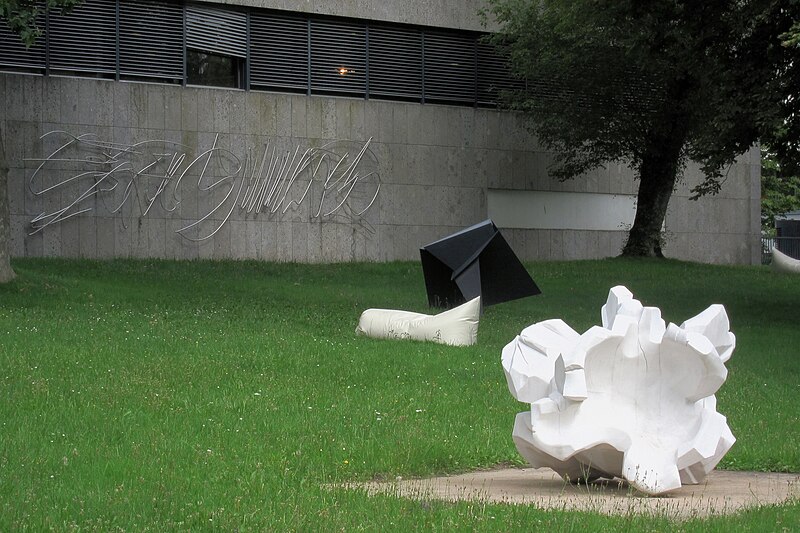
Skulptur "Torrance" (2017) von Pae White, eine Skulptur von Katja Strunz (2010) und an der Wand die Skulptur "Marianne" (2006) von Karl Otto Götz
Stefan Oemisch
Influence
Apart from his artistic work, Götz was also successful as a teacher of art. From 1959-79, during his time as a professor at the Kunstakademie Düsseldorf, a large number of later famous artists were his students. For instance, in 1959, Götz's first students were Gotthard Graubner, HA Schult and Kuno Gonschior. From 1961 on, Gerhard Richter and Sigmar Polke also studied under Götz. Furthermore, Rissa (Götz's later wife), and Franz Erhard Walther were also among his students.
Notes from the source article
Cited by Wikipedia
Notes from the source article
These works are cited by the source article, in its own numbering. They are recorded as its citations, not as sources VALÉORINE has verified.
- 1.Bosetti, Annette. Im Alter von 103 Jahren Jahrhundertmaler Karl Otto Götz gestorben. Rheinische Post. 21 August 2017.
- 2.Büttner, Claudia. Oxford Art Online. 2003. 10.1093/gao/9781884446054.article.T033799.
- 3."Nothing looks as if it is spent, worn out, or lost in barren routine. The force with which the work has invented itself over and over again during six or seven decades, and with which the painter even in his biblical age builds great picture architectures in resolute and highly concentrated gestures, is without comparison." ("Nichts wirkt verbraucht, erschöpft, in öder Routine versunken. Die Kraft, mit der sich das Werk sechs, sieben Jahrzehnte immer wieder neu erfunden hat, mit der der Maler noch im biblischen Alter aus entschlossenen, hoch konzentrierten Malgesten große Bildarchitekturen baut, ist ohne Vergleich.") See "K.O. Götz – Energie ist gleich Autonomie", Die Welt, 12 December 2013.
- 4.Mehring, Christine. Television Art's Abstract Starts: Europe circa 1944–1969. October. 125. 29–64. 2008. 10.1162/octo.2008.125.1.29.
- 5.Karl Otto Gӧtz. Samuelis Baumgart Galerie.
- 6.Ketterer Kunst: Karl Otto Götz.
- 7.Neuwied: Künstlerpaare: K.O. Götz und Rissa.
- 8.Maler K.O. Götz ist tot, Der Spiegel 21 August 2017
- 9.Karl Otto Götz. Media Art Net.
- 10.Judkis, Maura. "Father of video art" Nam June Paik gets American Art Museum exhibit (Photos). The Washington Post. 12 December 2012.
- 11.Karl Otto Götz im Gespräch: „Abstrakt ist schöner“, edited by Michael Klant and Christoph Zuschlag, Stuttgart: Hatje Cantz, 1994.
- 12.Tate Collection website, accessed 10 February 2011
- 13.Stokvis, Willemijn Stokvis. Cobra. Oxford University Press.
- 14.Quadriga. Oxford Art Online.
- 15."Quadriga", in "A Dictionary of Twentieth-Century Art" by Ian Chilvers, pub. by Oxford University Press 1999, reproduced at www.encyclopedia.com], accessed 7 February 2011
- 16.All-art.org website, History of the 20th Century, Art in the Post-War Era, 1952 - Quadriga, accessed 11 February 2011.
- 17.Neuwied: Künstlerpaare: K.O. Götz und Rissa , neuwied.de; accessed 23 April 2017.
- 18.Ketterer Kunst website, accessed 7 February 2011
- 19.Obvious website, "Karl Otto Götz", 4 February 2007 , accessed 7 February 2011
- 20.Karl Otto Götz. Kerber.
- 21.anno RAK: Mitteilungen aus dem Rheinischen Archiv für Künstlernachlässe 4, Bonn 2013, pp. 42–44.
- 22.Maus, Burkhard. Karl Otto Götz – 100 Jahre. ART Das Kunstmagazin. 2014-02-22.
- 23.Abstract art pioneer Karl Otto Götz dies, aged 103. Deutsche Welle. 21 August 2017.
- 24.Kunstakademie Düsseldorf: Hochschulnachrichten: Gotthard Graubner wird 80 Jahre.
- 25.Oliver Kornhoff and Barbara Nierhoff, Karl Otto Götz: In Erwartung blitzschneller Wunder, exh. cat., Arp Museum, Remagen (Kerber Christof Verlag, 2010), p. 114.
- 26.Christiane Hoffmans, H.A. Schult, der Musen-Sohn, Die Welt, 30 April 2006.
- 27.Munzinger Biographie: "HA Schult: deutscher Aktionskünstler"
- 28.compart: Karl Otto Götz.
- 29.Solo Exhibitions. K.O. Götz.
References
Citations
References
Each reference names the institution holding it, so a reader may go to the document itself.
reference work
Secondary witnessreference work
Secondary witness
The Encyclopedia exists whether or not anything is for sale. Corrections are recorded rather than overwritten, and every version of this record is kept. Published 14 August 2026.
Elsewhere in Photography
11,392 published records in this field, each with its sources named.
- Karl HerrligkofferPhotographer
- Karl LärkaPhotographer
- Karl LarsenPhotographer
- Karl Maria Udo RemmesPhotographer
- Karl StrussPhotographer
- Karl WienPhotographer
- Karlheinz WeinbergerPhotographer
- Karol GwóźdźPhotographer
Best supported in this field
For owners
Own a work by Karl Otto Götz?
A specialist will read what you send and tell you what the house can establish, what it cannot, and whether the object is suited to sale. There is no charge and no obligation. The object stays with you throughout; nothing is shipped to us unless it is arranged in writing beforehand.