
Karl Girardet
Illustration — Caricature of Girardet by Nadar, 1850s Karl Girardet (born Charles Girardet; 7 May 1813, in Le Locle – 24 April 1871, in Versailles) was a Swiss painter and illustrator, who lived and worked mostly in Paris. After beginning his career as a landscape painter, he became a renowned history painter as well as a confidant to King Louis Philippe I and an official court painter.
Also recorded as Carl Giradet · Carl Girardet · K. Girardet · Girardet
Karl Girardet
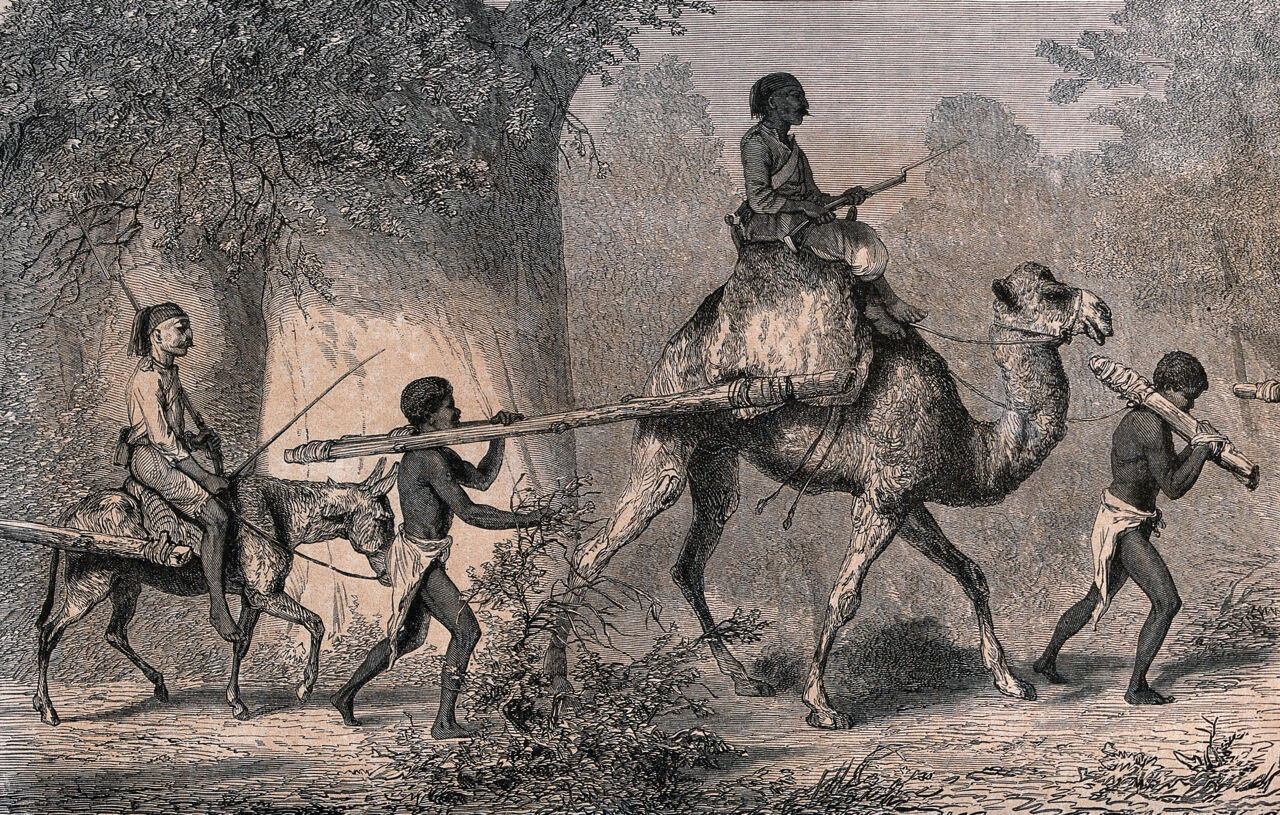
Karl Girardet · Wellcome Collection, London · Wellcome Collection · Public Domain Mark
- Born
- 1813 · Le Locle.
- Died
- 1871 · Versailles.
- Nationality
- Switzerland · France
- Occupation
- painter · illustrator · engraver · artist
- Fields
- history · landscape
- Education
- Beaux-Arts de Paris
- Languages
- French
VALÉORINE Encyclopedia
VALÉORINE documentary reading
Documentary summary
Illustration — Caricature of Girardet by Nadar, 1850s Karl Girardet (born Charles Girardet; 7 May 1813, in Le Locle – 24 April 1871, in Versailles) was a Swiss painter and illustrator, who lived and worked mostly in Paris. After beginning his career as a landscape painter, he became a renowned history painter as well as a confidant to King Louis Philippe I and an official court painter.
Admitted source layer · organised and presented by VALÉORINE
Reference Check
Propose documentary evidence for Karl Girardet. A contribution is never written directly as fact: identity, source, rights and evidence gates still decide.
Sign in to contribute
World of VALÉORINE
Documentary connections
Only confirmed graph relationships appear here. Images are shown only when their identity and reuse rights both pass the documentary gate.
Documentary evidence
Documentary basis
Authority files
wikidata · Q324021 · wikipedia · Karl Girardet
In this article
Life
Life
Karl Girardet studied at Beaux-Arts de Paris. The recorded working language is French. Subjects and genres recorded for the work are history and landscape. Places of work recorded in the authority are Paris. Work by Karl Girardet is recorded in the collections of Amsterdam Museum, Condé Museum and Musée de l'Histoire de France.
Girardet was born on 7 May 1813 in Le Locle, now in the canton of Neuchâtel, Switzerland, as the eldest son of engraver Charles Samuel Girardet, His brothers Paul and Édouard also became artists. After 1822, he lived in Paris, where he studied painting with Léon Cogniet, and began his career as a genre painter. On a study trip to Switzerland in 1833–35, he made the acquaintance of the aristocratic painter Maximilien de Meuron, by whose influence he obtained commissions for two panoramas of Lausanne. In 1836, he presented his first exhibits in the Salon of Paris and started working as a copyist for the French royal court. An alpine landscape presented at the 1837 Salon obtained him a first distinction, and he successfully collaborated with Cogniet on two great battle scenes exhibited at Versailles. He embarked on travels across Europe, filling his sketchbook with landscapes in Düsseldorf (1838), Tyrol and Croatia (1839), and Italy (1840). A painting of a protestant assembly at Neuchatêl, Assemblée de Protestants surprise par des troupes catholiques (1839–42), earned him another distinction at the Salon of 1842 and regular commissions by the Neuchâtel Friends of Art. • Illustration — Karl Girardet, Assemblée de Protestants surprise par des troupes catholiques (1842) In 1839, Girardet illustrated his first book, Roland furieux, followed by Jardin des plantes by Boitard in 1842. After a six-month stay in Egypt, 1844, he continued illustrating works including Thiers's famous Histoire du Consulat et de l'Empire, and completed several royal commissions for paintings of state occasions. Following the fall of the monarchy in February 1848, Girardet left France and moved into his brother Édouard's home in Brienz, Switzerland. In 1850, he returned to France to illustrate a great work edited by Alfred Mame about the history and the monuments of the Touraine. This work obtained a first-class medal at the Exposition Universelle of 1855, and earned Girardet many more commissions by Mame, notably for children's books and pious works. In 1857, he moved his studio to the Montmartre quarter, where he would live until his death, and was admitted as a member of the Royal Academy of Amsterdam. He continued to embark on study trips, such as to the Valais (1858–1860), Italy (1861–1862) and Brunnen (1869). In 1870, caught in besieged Paris during the Prussian invasion of France, Girardet damaged his eyesight while sketching the Prussian positions. Seized by anguish, fearing blindness, he died, alone in his apartment, of suffocation. He was unmarried, but had lived for many years with the painter Augustine Angelina Kaas, for whom he had provided a pension. His family inherited the remainder of his estate, some 100,000 francs.
Works
Works
• Illustration — The Reception of George Catlin's Indian Museum, one of Girardet's works as court painter. Girardet's art belongs to the tradition of Romanticism and to the popular movement in landscape painting called the "School of 1830". His landscapes, based on sketches often completed under adverse weather conditions and within one hour, exhibit a rare vivacity and mastery of subtle color, especially after his 1850 stay in Brienz. Unlike his friends and colleagues Maximilien de Meuron and Rodolphe Töpffer, he was not enchanted by the snow-capped peaks of the Alps, preferring instead to portray lakes, streams and marshes, notably the rivers Aar, Eure and Marne. Girardet sought official recognition through his historical paintings. Of these, his Assemblée de Protestants was his most lasting success; its pathos and deliberate composition are reminiscent of Paul Delaroche's work. Later in his life, deprived of royal patronage by the political upheavals in France, his historical paintings met with little success, and he shifted his attention back to landscape painting, which he continued to exhibit in the Salon until the end of his life. As a man of modest means, Girardet had little leisure to devote to his art and was compelled to earn money mainly as an illustrator. On his many voyages, he drew small ethnographical reports for the illustrated press; these and the illustrations he drew for luxury albums nourished his visual imagination. After 1855, he abandoned the Orientalist themes that had contributed to his success; and in his late period, as a diligent craftsman, he dedicated himself to the themes and formats in vogue with his bourgeois clients. Girardet's success inspired many other French-speaking Swiss artists, and it helped Swiss art and Swiss landscapes gain recognition with a broad international public. Many of his works are exhibited in the Musée d'art et d'histoire of Neuchâtel and in the Musée national de Versailles.
Works and production
Works and production
The following works and productions are recorded by name or by count.
Places
Named by the record
Places
Only places the record itself states, plotted where the house gazetteer settles their coordinates. Nothing is inferred from a name or a nationality.
Le Locle.
Birth place
Versailles.
Death place
Collections and holdings
Where the work is held
Collections and holdings
Institutional holdings are recorded as follows.
Documents and archives
Primary material
Documents and archives
scholarly publication
- Girardet, Karl, Benezit Dictionary of Artists, 2011
Scholarly · Crossref registry · 2011
Institutional database
- Wikidata, structured authority record Q324021: Karl Girardet
Scholarly · Wikimedia Foundation
reference work
- “Karl Girardet”, English Wikipedia, consulted as further reading
Reputable secondary · Wikipedia
Notes from the source article
Cited by Wikipedia
Notes from the source article
These works are cited by the source article, in its own numbering. They are recorded as its citations, not as sources VALÉORINE has verified.
- 1.HDS 22411
- 2.Sylvain Bauhofer (1998):
References
Citations
References
Each reference names the institution holding it, so a reader may go to the document itself.
scholarly publication
Girardet, Karl, Benezit Dictionary of Artists, 2011Crossref registry
Institutional witnessInstitutional database
Wikidata, structured authority record Q324021: Karl GirardetWikimedia Foundation
Institutional witnessreference work
Secondary witness
The Encyclopedia exists whether or not anything is for sale. Corrections are recorded rather than overwritten, and every version of this record is kept. Published 16 August 2026.
Elsewhere in Prints
4,138 published records in this field, each with its sources named.
- Karl BallenbergerEngraver
- Karl BauerEngraver
- Karl CasparEngraver
- Karl Ernst ForbergEngraver
- Karl JägerEngraver
- Karl Jakob Theodor LeyboldEngraver
- Karl PärsimägiEngraver
- Karl SchragEngraver
Best supported in this field
For owners
Own a work by Karl Girardet?
A specialist will read what you send and tell you what the house can establish, what it cannot, and whether the object is suited to sale. There is no charge and no obligation. The object stays with you throughout; nothing is shipped to us unless it is arranged in writing beforehand.