
Karl Agricola
Illustration — Self-portrait (c.1810) • Illustration — Franz Joseph, Prince of Dietrichstein Karl Joseph Aloys Agricola (18 October 1779 – 15 May 1852) was a German artist, noted for his portrait miniatures.
Also recorded as Karl Josef Aloysius Agricola · Carl Joseph Alois Agricola · Karl Joseph Aloys Agricola · Carl Josef Alois Agricola
Karl Agricola

After Karl Agricola · Public domain
- Born
- 1779. · Bad Säckingen.
- Nationality
- Grand Duchy of Baden and Austrian Empire.
- Fields
- visual arts.
- Education
- Academy of Fine Arts Vienna.
- Languages
- German.
VALÉORINE Encyclopedia
VALÉORINE documentary reading
Documentary summary
Illustration — Self-portrait (c.1810) • Illustration — Franz Joseph, Prince of Dietrichstein Karl Joseph Aloys Agricola (18 October 1779 – 15 May 1852) was a German artist, noted for his portrait miniatures.
Admitted source layer · organised and presented by VALÉORINE
Reference Check
Propose documentary evidence for Karl Agricola. A contribution is never written directly as fact: identity, source, rights and evidence gates still decide.
Sign in to contribute
World of VALÉORINE
Documentary connections
Only confirmed graph relationships appear here. Images are shown only when their identity and reuse rights both pass the documentary gate.

Documentary evidence
Documentary basis
Authority files
wikidata · Q1371095 · wikipedia · Karl Agricola
In this article
Life and works
Life and works
Karl Agricola studied at Academy of Fine Arts Vienna. The recorded working language is German. The field of work recorded is visual arts. Places of work recorded in the authority are Vienna. Work by Karl Agricola is recorded in the collections of Belvedere, Nationalmuseum, Philadelphia Museum of Art, Kunsthistorisches Museum and Cincinnati Art Museum.
Agricola was born at Bad Säckingen, Margraviate of Baden, in 1779. After a preliminary course of instruction in Karlsruhe, he went in 1798 to Vienna and enrolled the Academy, where he studied under Heinrich Füger. He soon became known for his mythological pictures in oil and watercolour – such as his Cupid and Psyche – and for his etchings and lithographs; but he was most noted for his miniature portraits. After a prosperous career he died in Vienna in 1862. He painted in the style of the end of the 18th century, and was an imitator of his teacher, Heinrich Füger. He made engraving after the works of Elzheimer, Raphael, Poussin, Parmigiano, Domenichino, Füger, and others.
Gallery
Gallery
• Illustration — Bachnymphe und Faun, 1804 • Illustration — Lady in front of the toilet mirror, 1835 • Illustration — The Artist's Family, 1815 • Illustration — Venus and Cupid, 1824 • Illustration — Portrait of a child in a white robe in front of a twilight landscape, splashing his foot into standing water, 1829 • Illustration — Psyche
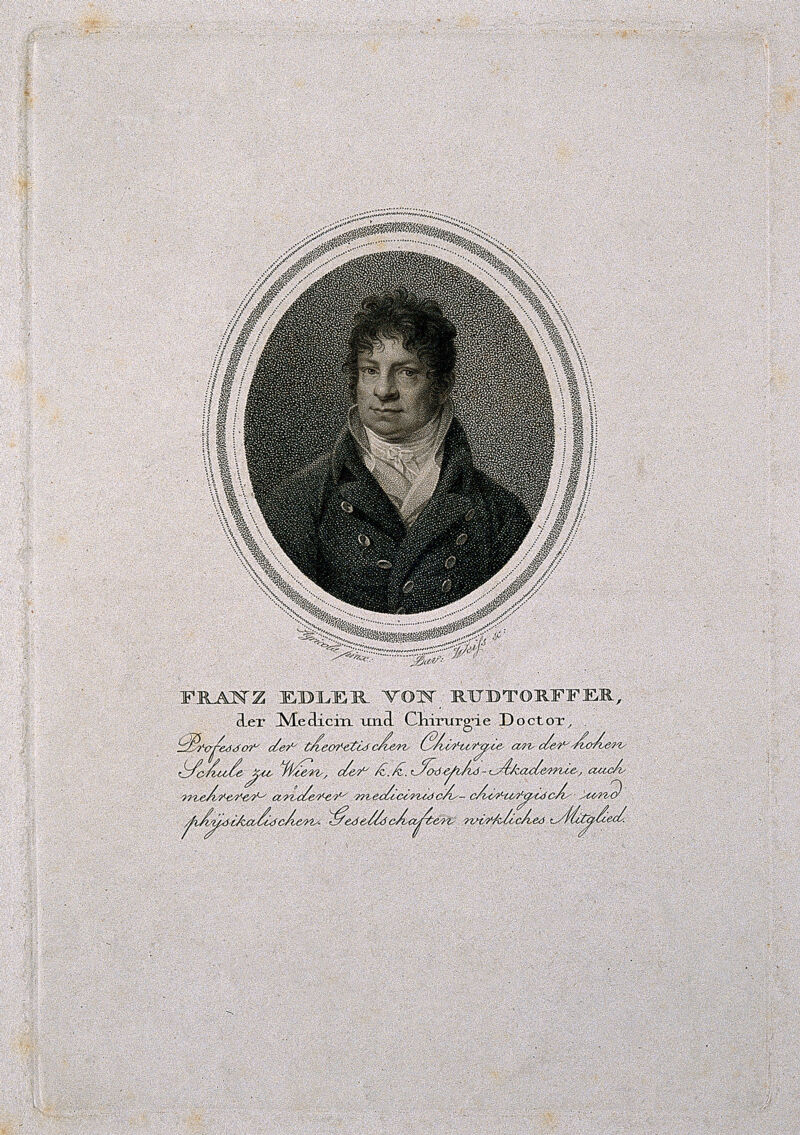
Franz Xaver, Ritter von Rudtorffer. Stipple engraving by D. Weiss after K. J. A. Agricola., by Karl Agricola
Karl Agricola · Wellcome Collection, London · Wellcome Collection
Places
Named by the record
Places
Only places the record itself states, plotted where the house gazetteer settles their coordinates. Nothing is inferred from a name or a nationality.
Bad Säckingen.
Birth place
Vienna.
Death place
Citations
References
Each reference names the institution holding it, so a reader may go to the document itself.
reference work
Secondary witnessreference work
Secondary witness
The Encyclopedia exists whether or not anything is for sale. Corrections are recorded rather than overwritten, and every version of this record is kept. Published 16 August 2026.
Elsewhere in Prints
4,138 published records in this field, each with its sources named.
- Karel van MalleryEngraver
- Karen BoccaleroEngraver
- Karin LutsEngraver
- Karl AegerterEngraver
- Karl August SenffEngraver
- Karl BallenbergerEngraver
- Karl BauerEngraver
- Karl CasparEngraver
Best supported in this field
For owners
Own a work by Karl Agricola?
A specialist will read what you send and tell you what the house can establish, what it cannot, and whether the object is suited to sale. There is no charge and no obligation. The object stays with you throughout; nothing is shipped to us unless it is arranged in writing beforehand.