
Kalapi
Sursinhji Takhtasinhji Gohil (26 January 1874 – 10 June 1900), popularly known by his pen name, Kalapi was a Gujarati poet and the Thakor (prince) of Lathi state in Gujarat. He is mostly known for his poems depicting his own pathos. He lived in Lathi-Gohilwad, which is located in the Saurashtra region of Gujarat.
Also recorded as Sursinhji Takhtasinhji Gohil · Sursinghji Takhatsinghji, Thakur of Lathi · Kalāpī
Kalapi
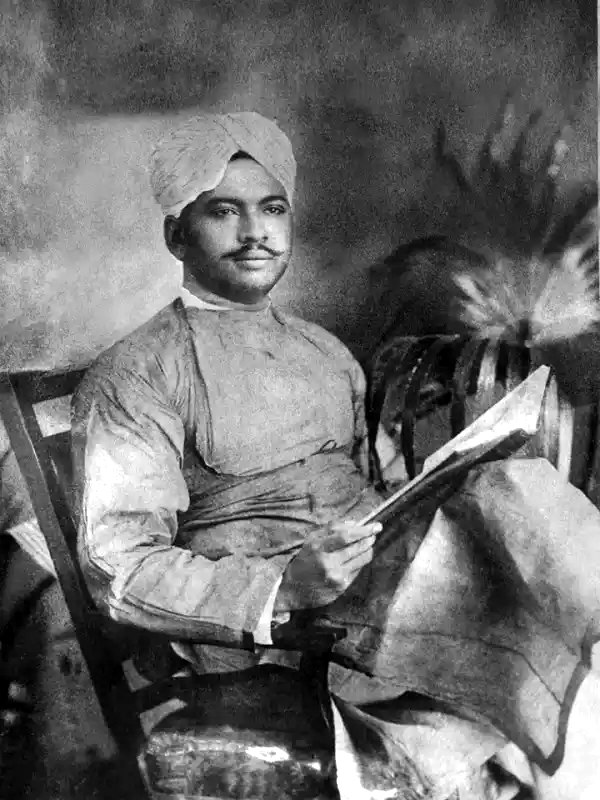
Unknown, person in image himself died in 1900 · Public domain
- Name
- Sursinhji Gohil 'Kalapi'
- Birth Name
- Sursinhji Takhtasinhji Gohil
- Born
- 26 January 1874
- Birthplace
- Lathi, Amreli, British India
- Died
- 10 June 1900
- Place of death
- Lathi, Bombay presidency, British India
- Occupation
- poet, writer
- Education
- Std. 5 (English medium)
- Spouse
- * Rajba a.k.a.
- Known for
- Kalapino Kekarav · Kashmir No Pravas
- Languages
- Gujarati
VALÉORINE Encyclopedia
VALÉORINE documentary reading
Documentary summary
Sursinhji Takhtasinhji Gohil (26 January 1874 – 10 June 1900), popularly known by his pen name, Kalapi was a Gujarati poet and the Thakor (prince) of Lathi state in Gujarat. He is mostly known for his poems depicting his own pathos. He lived in Lathi-Gohilwad, which is located in the Saurashtra region of Gujarat.
Admitted source layer · organised and presented by VALÉORINE
Note VALÉORINE
Kalapi (1874–1900) was a poet. The poet was born and died in Lathi. Kalapi was educated at Rajkumar College, Rajkot.
Among the works are Kalapino Kekarav and Kashmir No Pravas. Languages used include Gujarati.
Composed from admitted, traceable facts · 26 September 2026
VALÉORINE
Reference Check
Propose documentary evidence for Kalapi. A contribution is never written directly as fact: identity, source, rights and evidence gates still decide.
Sign in to contribute
Documentary evidence
Documentary basis
Authority files
wikidata · Q2727327 · wikipedia · Kalapi
In this article
Key facts
Key facts
• Name — Sursinhji Gohil 'Kalapi' • Pen Name — Kalapi • Birth Name — Sursinhji Takhtasinhji Gohil • Born — 26 January 1874 • Birthplace — Lathi, Amreli, British India • Died — 10 June 1900 • Place of death — Lathi, Bombay presidency, British India • Occupation — poet, writer • Language — Gujarati • Education — Std. 5 (English medium) • Alma Mater — Rajkumar College, Rajkot • Period — Pandit Yuga • Subjects — Love, nature and spirituality • Notable Works — * Kalapino Kekarav (1903) • Kashmirno Pravas (1912) • Spouse — * Rajba a.k.a. Ramaba (1889–1900) • Kesharba a.k.a. Anandiba (1889–1900) • Monghi a.k.a. Shobhana (1898–1900) • Years Active — 1892–1900
Life
Life
Kalapi was born on 26 January 1874 to his father Maharaja Takhtasinhji, the ruler of Lathi, a small state situated in a far away corner of Saurashtra region, and mother Ramaba. Takhtasinhji died when Kalapi was 5, and Ramaba died when Kalapi was 14. These deaths left a permanent impact on Kalapi's mind. At the age of 8, Kalapi entered into Rajkumar College, Rajkot for school education, and spent next 9 years (1882 – 1891) there, but didn't complete his schooling and dropped out of school. During these times, he studied extensively English, Sanskrit and contemporary Gujarati literature. Kalapi's date of death is uncertain. It is formally noted down as 10 June 1900. There is also some controversy over his death. It was declared as death due to Cholera but some believed that it was not a natural death.
Personal life
Personal life
Kalapi was married—at the age of 15—to two princesses. These were Rajba-Ramaba (born 1868), the princess of Kutch–Roha; and Kesharba-Anandiba (born 1872), the princess of Saurashtra–Kotada. When Kalapi was 20 years old, he fell in love with a family maid, Shobhana, who served his royal family. It is believed that Kalapi's love for Shobhana became a source of conflict with Rajba-Ramaba and the reason for his subsequent death due to poisoning by her.
Works
Works
• Illustration — Handwriting of Kalapi (A letter written to Monghi (a.k.a. Shobhana) In spite of his short life, Kalapi's body of work was large. The poet penned about 250 poems, including about 15,000 verses. He also authored a number of prose writings and over 900 letters to his friends and wives. He not only used the Gujarati language as his medium to elaborate on his thoughts, but also translated four English novels to Gujarati. Kalapi mentored a number of budding poets who carried on his style of writing, many of whom become famous in their own right. The most prominent among these was Kavi Lalitji, who was about the same age as Kalapi, and was already an established poet when he was invited to the Lathi Darbar as a tutor for the royal children. He came under Kalapi's influence and the two became great friends. Lalitji went on to become the Rajya Kavi (Royal Bard) of Lathi. Kavi Kalapi had written poems in various Chhand (metres) of the Gujarati language. Like Mandakranta, Shardulvikridit, Shikharini and others, to write poems in Chhand, one has to follow the structure of that chhand and the rules of chhandas poetry. Aapni Yadi is one of his best known ghazals in the Gujarati literature.
Museum
Museum
Kalapi Museum The Kalpi Tirtha Museum holds objects related to the life of the Gujarati poet Kalpi. The museum was inaugurated in 2005. It is located at Lathi on the birthplace of Kalpi in the Amreli district of Gujarat. There is a huge collection of articles written by the artists themselves, letters, the rare items they used, and the history of the monarchy. The memorials were also associated with the Kalpi Tirtha, where the Kalpati lived, the palace, which was sitting on the banks of the lake. This place is a center of attraction for Gujarat's literature makers. There is a small auditorium on the upper floors of Kalpitirth Bhawan. Apart from Wednesdays, this museum gives free entry. Videography and photography are permitted.
In popular culture
In popular culture
The 1966 Gujarati film, Kalapi, is based on his life. Sanjeev Kumar plays the titular role, and Padmarani plays the role of his wife, Rama. The film was directed by Manhar Raskapur.
Identity and origins
Identity and origins
He also worked under the name Kalapi. The authorities additionally record the headings Sursinhji Takhtasinhji Gohil, Sursinghji Takhatsinghji, Thakur of Lathi and Kalāpī. His recorded language was Gujarati.
Life and career
Dated record
Life and career
The full dated record · 2 entries
1874
Kalapi born at Lathi.
1900
Kalapi died at Lathi.
Legacy
In his remembrance, the Indian National Theater at Mumbai, since 1997, gives the Kalapi Award to an accomplished Gujarati ghazal poet annually.
Notes from the source article
Cited by Wikipedia
Notes from the source article
These works are cited by the source article, in its own numbering. They are recorded as its citations, not as sources VALÉORINE has verified.
- 1.Desai, Hemant G. Kalapi. Sahitya Akademi. 3–9. 1990. 24489625.
- 2.Joseph T. Shipley. Encyclopedia of Literature. Philosophical Library. 514. 1946. ISBN?.
- 3.Amaresh Datta. Encyclopaedia of Indian Literature. Sahitya Akademi. 2. 1436. 1988. 978-81-260-1194-0.
- 4.Kavi Kalapi's birth anniversary celebrated. The Times of India. Jan 27, 2011.
- 5.K. M. George. Modern Indian Literature, an Anthology: Surveys and poems. Sahitya Akademi. 557. 1992. 978-81-7201-324-0.
- 6.Kalapi Tirth – Lathi District Amreli, Government of Gujarat. amreli.nic.in.
- 7.Kalapi Tirth Museum Lathi. gt.intentlabs.com.
- 8.Verse comes to worst in parched Amreli - Times of India. The Times of India.
- 9.Routledge. Routledge Handbook of Indian Cinemas. 94. 17 April 2013. 978-1-136-77284-9.
Bibliography printed in the source article · 2
References
Citations
References
Each reference names the institution holding it, so a reader may go to the document itself.
reference work
Secondary witnessreference work
Secondary witness
The Encyclopedia exists whether or not anything is for sale. Corrections are recorded rather than overwritten, and every version of this record is kept. Published 17 August 2026.
Elsewhere in Books
39,285 published records in this field, each with its sources named.
- Kaká WeráAuthor
- Kakimon-inAuthor
- Kakinomoto no HitomaroAuthor
- Kalamu ya SalaamAuthor
- Kaleem OmarAuthor
- Kaleem UsmaniAuthor
- Kalev KeskülaAuthor
- KalhanaAuthor
Best supported in this field
For owners
Own a work by Kalapi?
A specialist will read what you send and tell you what the house can establish, what it cannot, and whether the object is suited to sale. There is no charge and no obligation. The object stays with you throughout; nothing is shipped to us unless it is arranged in writing beforehand.