
Julien-David Le Roy
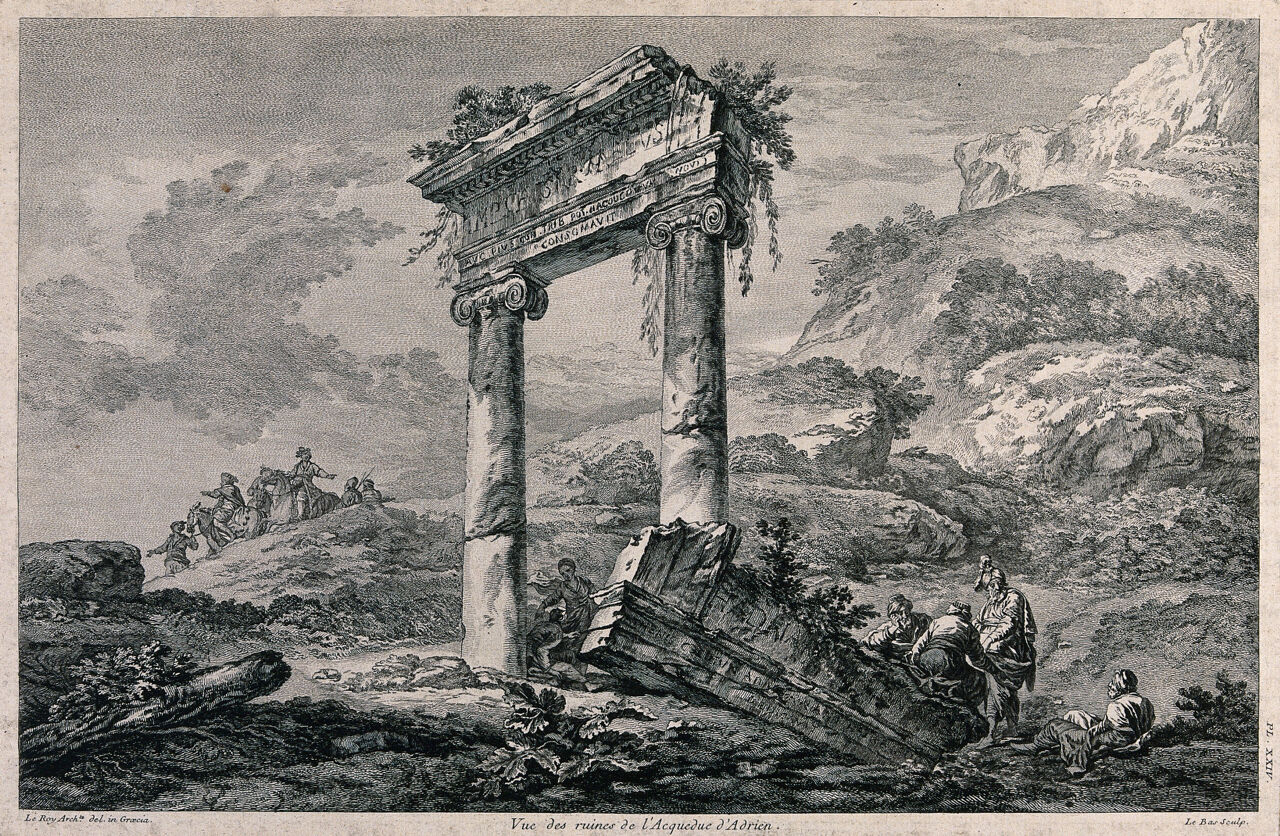
Illustration — Julien-David Le Roy; medallion by Pierre-Simon-Benjamin Duvivier Julien-David Le Roy or Leroy (ʒyljɛ̃ david ləʁwa; 6 May 1724 in Paris – 28 January 1803 in Paris) was an 18th-century French architect and archaeologist, who engaged in a rivalry with Britons James Stuart and Nicholas Revett over who would publish the first professional description of the Acropolis of Athens since an early 1682 work by Antoine Desgodetz. Le Roy succeeded in printing his Ruins of the Most Beautiful Monuments of Greece four years ahead of Stuart and Revett. • Illustration — Plate of the Ionic order from Les Ruines des plus beaux monuments de la Grèce.
Also recorded as Julien David LeRoy · David Leroi · David Le Roy · Julien-David Leroy
Julien-David Le Roy
Julien-David Le Roy · Wellcome Collection, London · Wellcome Collection · Public Domain Mark
- Born
- 1724 · Paris.
- Died
- 1803 · Paris.
- Nationality
- France
- Occupation
- architect · anthropologist · archaeologist · art historian
- Teachers
- Denis Jossenay · Louis-Adam Loriot
- Honours
- Prix de Rome
- Languages
- French
VALÉORINE Encyclopedia
VALÉORINE documentary reading
Documentary summary
Illustration — Julien-David Le Roy; medallion by Pierre-Simon-Benjamin Duvivier Julien-David Le Roy or Leroy (ʒyljɛ̃ david ləʁwa; 6 May 1724 in Paris – 28 January 1803 in Paris) was an 18th-century French architect and archaeologist, who engaged in a rivalry with Britons James Stuart and Nicholas Revett over who would publish the first professional description of the Acropolis of Athens since an early 1682 work by Antoine Desgodetz. Le Roy succeeded in printing his Ruins of the Most Beautiful Monuments of Greece four years ahead of Stuart and Revett. • Illustration — Plate of the Ionic order from Les Ruines des plus beaux monuments de la Grèce.
Admitted source layer · organised and presented by VALÉORINE
Reference Check
Propose documentary evidence for Julien-David Le Roy. A contribution is never written directly as fact: identity, source, rights and evidence gates still decide.
Sign in to contribute
World of VALÉORINE
Documentary connections
Only confirmed graph relationships appear here. Images are shown only when their identity and reuse rights both pass the documentary gate.

Documentary evidence
Documentary basis
Authority files
wikidata · Q3189311 · wikipedia · Julien-David Le Roy
In this article
Athens study
Athens study
Stuart and Revett were researching Athens since 1748 but Le Roy had an advantage in accessing the ruins due to good relations between France and the Ottoman Empire. Le Roy's studies, supported by Comte de Caylus and his art circle, recruited the finest engravers and architects to produce illustrations, and became sort of a national project for the pre-revolutionary France. Le Roy spent only three months in Athens (compared to three years taken by Stuart and Revett); he researched Greek monuments in a wide, universal cultural context, comparing them with Roman legacy, and travelled to Constantinople to study the Byzantine development of the Greek tradition. Le Roy rushed his Les Ruines des plus beaux monuments de la Grèce (Ruins of the Most Beautiful Monuments of Greece) into print in 1758. Stuart and Revett delayed their first volume till 1762 and discouraged their readers by filling it with lesser monuments instead of the expected Parthenon. The delay provided them time to examine Le Roy's book and pinpoint its weaknesses and errors in a bitter critique. Le Roy's success alienated not only the Britons who harshly attacked his book and theories but also Piranesi who considered the Frenchman a threat to his national pride and, worse, means of subsistence. Le Roy responded with a counterargument that an insight in development of a culture is just as worthwhile as meticulous, surgical rendition of antique relics. Unlike the Britons who rushed to copy the Greek models in new buildings, Le Roy stood by his opinion that architecture always follows evolution of the society, and never intended to imitate these models in stone. His book ultimately had a greater impact on practical architecture than Stuart and Revett's, for example, launching the modern tradition of using colonnade in urban design. Both British and French projects began as mere attempts to expand knowledge of Greek antiques beyond the work of Desgodetz and eventually grew into comparative discourse over Roman and Greek art, starting a wide public debate on their relative merits.
Biography
Biography
Julien-David Le Roy, the son of a court clockmaker Julien Le Roy, studied architecture under Jacques-François Blondel (le petit Blondel), and travelled to Rome on an Academy scholarship in 1751–1754. He had three brothers: Pierre (1717–1785) another clockmaker, Jean-Baptiste (1720-1800), a physicist and Encyclopédiste, and Charles (1726–1779), a physician as well as an Encyclopédiste. Le Roy's ideas were materialized in the Church of Saint Genevieve, a project led by his friend Jacques-Germain Soufflot. Le Roy directly advised Soufflot on the philosophy and history of architecture and provided a classic single-sheet scheme of principal Christian church types, solving the problem of marrying the dome with cross-shaped floorplan. He was protected by Marc-René Voyer d'Argenson, marquis de Voyer (1722-1782), for who he worked in his hôtel de Voyer in Paris, near the Palais-Royal in the 1760s. Le Roy was elected a member of the American Philosophical Society in 1786. An important correspondence with him is conserved in Poitiers (France), published in 2020 in Le Journal des Savants, the oldest scientist review in Europe (17th century).
References
Citations
References
Each reference names the institution holding it, so a reader may go to the document itself.
reference work
Secondary witnessreference work
Secondary witness
People, houses and institutions
Knowledge graph
People, houses and institutions
Teachers, collaborators, publishers and institutions recorded against this person, each on a stated basis.
The Encyclopedia exists whether or not anything is for sale. Corrections are recorded rather than overwritten, and every version of this record is kept. Published 16 August 2026.
Elsewhere in Design
11,558 published records in this field, each with its sources named.
- Julien De SmedtDesigner
- Julien GuadetDesigner
- Julien LabrousseDesigner
- Julien MédecinDesigner
- Juliet PeddleDesigner
- Juliette BillardDesigner
- Julio Cano LassoDesigner
- Júlio de BritoDesigner
Best supported in this field
For owners
Own a work by Julien-David Le Roy?
A specialist will read what you send and tell you what the house can establish, what it cannot, and whether the object is suited to sale. There is no charge and no obligation. The object stays with you throughout; nothing is shipped to us unless it is arranged in writing beforehand.