
Judy Holliday
She began her career as part of a nightclub act before working in Broadway plays and musicals. Her success as Billie Dawn in the 1946 stage production of Born Yesterday led to her being cast in the 1950 film version, for which she won an Academy Award for Best Actress and a Golden Globe Award for Best Actress in a Motion Picture – Musical or Comedy. She was known for her performance on Broadway in the musical Bells Are Ringing, winning a Tony Award for Best Actress in a Musical and reprising her role in the 1960 film adaptation.
Judy Holliday

http: p2=1 p3=1 p4=1 · Public domain
- Full name
- Judith Tuvim.
- Born
- 1921. · New York City.
- Died
- 1965. · New York City.
- Nationality
- United States.
- Occupation
- singer, jazz musician and actress.
- Fields
- traditional pop.
- Honours
- Academy Award for Best Actress, Theatre World Award, Tony Award for Best Actress in a Musical, star on Hollywood Walk of Fame and Donaldson Awards.
VALÉORINE Encyclopedia
VALÉORINE documentary reading
Documentary summary
She began her career as part of a nightclub act before working in Broadway plays and musicals. Her success as Billie Dawn in the 1946 stage production of Born Yesterday led to her being cast in the 1950 film version, for which she won an Academy Award for Best Actress and a Golden Globe Award for Best Actress in a Motion Picture – Musical or Comedy. She was known for her performance on Broadway in the musical Bells Are Ringing, winning a Tony Award for Best Actress in a Musical and reprising her role in the 1960 film adaptation.
Admitted source layer · organised and presented by VALÉORINE
Note VALÉORINE
No house-authored Note is published until its assertions and sources pass the VALÉORINE evidence contract. The documentary article remains available in full while that enrichment is being consolidated.
Documentary enrichment in progress · no unsupported statement published
Reference Check
Propose documentary evidence for Judy Holliday. A contribution is never written directly as fact: identity, source, rights and evidence gates still decide.
Sign in to contribute
World of VALÉORINE
Documentary connections
Only confirmed graph relationships appear here. Images are shown only when their identity and reuse rights both pass the documentary gate.
Documentary evidence
Evidence Panel
not yet certified
- Identity
- resolved
- Independent source families
- 0
- Admitted assertions
- 0
- Open conflicts
- 0
Authority files
wikidata · Q253298 · wikipedia · Judy Holliday
In this article
Early life
Early life
In 1952, Holliday was called to testify before the Senate Internal Security Subcommittee to answer claims she was associated with communism. Unlike other figures who lost standing, Holliday managed to get through unscathed. She continued to act on Broadway and film until her death from breast cancer in 1965.
Subjects and genres recorded for the work are traditional pop. Places of work recorded in the authority are United States. Distinctions recorded are Academy Award for Best Actress, Theatre World Award, Tony Award for Best Actress in a Musical and star on Hollywood Walk of Fame.
Holliday was born Judith Tuvim in Queens, New York, the only child of Abe and Helen (née Gollomb) Tuvim. She took her stage name from yamim tovim, which is Hebrew for "holidays". Her father was executive director of the foundation for the Jewish National Fund of America (1951–1958), and a political activist who ran unsuccessfully six times between 1919 and 1938 as a Socialist Party candidate for the New York State Legislature. Her mother taught piano. Both were of Russian-Jewish descent. Judith grew up in Sunnyside, Queens, New York, and graduated from Julia Richman High School in Manhattan. Her first job was as an assistant switchboard operator at the Mercury Theatre, which was administered by Orson Welles and John Houseman.
Early career
Early career
Holliday began her show business career in 1938 as part of a nightclub act called The Revuers, whose other members were Betty Comden, Adolph Green, Alvin Hammer, John Frank and Esther Cohen. They played engagements in New York night clubs including the Village Vanguard, Spivy's Roof, the Blue Angel, and the Rainbow Room, and the Trocadero in Hollywood, California. Leonard Bernstein, a friend of the group who shared an apartment with Green, occasionally provided piano accompaniment for their performances. In 1940, The Revuers released a 78-rpm album entitled Night Life in New York. The troupe filmed a scene for the 1944 Carmen Miranda movie Greenwich Village. Although the Revuers' performance was cut, Holliday was an unbilled extra in another scene. The group disbanded in early 1944. Holliday remembered her years in the Revuers as unpleasant, saying she was initially a bad actress and so shy that she vomited between shows. She found it difficult to perform on stage in smoke-filled rooms while patrons over-imbibed, heckled, and fought with each other, but deemed entertainers successful if they persevered in such atmospheres. In her first film role, Holliday played an airman's wife in Twentieth Century Fox’s version of the U.S. Army Air Forces' play Winged Victory (1944). She made her Broadway debut on March 20, 1945, at the Belasco Theatre in Kiss Them for Me, and was one of the recipients that year of the Clarence Derwent Award for Most Promising Female actor. In 1946, she returned to Broadway as the scatterbrained Billie Dawn in Born Yesterday. Author Garson Kanin wrote the play for Jean Arthur; but when Arthur left New York for personal reasons, Kanin selected Holliday, two decades Arthur's junior, as her replacement. When Columbia bought the rights to adapt Born Yesterday to film, studio boss Harry Cohn initially would not consider casting the Hollywood unknown, even though Holliday received rave reviews for her Broadway performance. Kanin, along with George Cukor, Spencer Tracy, and Katharine Hepburn conspired to promote Holliday by offering her a key part in the Tracy-Hepburn film Adam's Rib (1949). Cohn eventually relented and offered Holliday the chance to repeat her role for the film version, but only after a screen test (which at first was used only as a "benchmark against which to evaluate" other actresses being considered for the role). For her film performance in Born Yesterday, Holliday won the first Golden Globe Award for Best Actress in a Motion Picture – Musical or Comedy; and at the 23rd Academy Awards, won the Academy Award for Best Actress, defeating Gloria Swanson, nominated for Sunset Boulevard; Eleanor Parker, for Caged; and Bette Davis and Anne Baxter, both for All About Eve. Holliday starred opposite newcomer Jack Lemmon in his first two feature films, the comedies It Should Happen to You and Phffft (both 1954), earning two nominations for the BAFTA Award for Best Foreign Actress for both projects. Film historian Bernard Dick summed up Holliday's acting: "Perhaps the most important aspect of the Judy Holliday persona, both in variations of Billie Dawn and in her roles as housewife, is her vulnerability...her ability to shift her mood quickly from comic to serious is one of her greatest technical gifts." Director George Cukor also observed that Holliday had "that depth of emotion, that unexpectedly touching emotion, that thing which would unexpectedly touch your heart."
Investigation for communist sympathies
Investigation for communist sympathies
In 1950, Holliday's name appeared on a list of 151 alleged pro-communist artists in the publication Red Channels: The Report of Communist Influence in Radio and TV. The next year, she was subpoenaed by Senator Pat McCarran's Senate Internal Security Subcommittee, which was investigating subversion and communist activity in the entertainment industry. Holliday was one of several actors accused of fundraising for communist front organizations. She appeared before the committee on March 26, 1952, with Simon H. Rifkind as her legal counsel. Holliday was advised to play dumb, as in her film portrayal of Billie Dawn, and she did, often to comedic effect. She denounced Stalinism and authoritarianism generally, but defended the free-speech rights of those who espoused such views. Holliday later wrote of the experience to her friend Heywood Hale Broun: "Woodie, maybe you're ashamed of me, because I played Billie Dawn... But I'm not ashamed of myself, because I didn't name names. That much I preserved." The investigation "did not reveal positive evidence of any membership in the Communist Party". The investigation concluded after three months and, unlike others whose careers were severely damaged by communist allegations, her career was relatively untarnished.
Later career
Later career
Holliday starred in the film version of The Solid Gold Cadillac, which was released in August 1956. In November 1956, Holliday returned to Broadway, starring in the musical Bells Are Ringing with book and lyrics by her Revuers friends Betty Comden and Adolph Green and directed by Jerome Robbins. In 1957, she won the Tony Award for Best Actress in a Musical. Of Holliday's performance in the stage musical, Brooks Atkinson wrote in The New York Times: Nothing has happened to the shrill little moll whom the town loved in Born Yesterday. The squeaky voice, the embarrassed giggle, the brassy naivete, the dimples, the teeter-totter walk fortunately remain unimpaired... Miss Holliday now adds a trunk-full of song-and-dance routines...Without losing any of that doll-like personality, she is now singing music by Jule Styne and dancing numbers composed by Jerome Robbins and Bob Fosse. She has gusto enough to triumph in every kind of music hall antic. Returning to her film career after a gap of several years, Holliday starred in the film version of Bells Are Ringing (1960), her last film. In October 1960, Holliday started out-of-town tryouts on the play Laurette, based on the life of Laurette Taylor. The show was directed by José Quintero with background music by Elmer Bernstein and produced by Alan Pakula. When Holliday became ill and had to leave the show, it closed in Philadelphia without opening on Broadway. Holliday had surgery for a throat tumor shortly after leaving the production in October 1960. Her last role was in the stage musical Hot Spot, costarring newcomers such as Joseph Campanella and Mary Louise Wilson, which closed after 43 performances on May 25, 1963.
Personal life
Personal life
In 1948, Holliday married clarinetist David Oppenheim, later a classical music and television producer, and academic. The couple had one child, Jonathan, before they divorced in 1957. In the late 1950s, Holliday had a long-term relationship with jazz musician Gerry Mulligan. In 1960, she was awarded a star on the Hollywood Walk of Fame at 6901 Hollywood Boulevard in Los Angeles.
Death
Death
Holliday died on June 7, 1965, at Manhattan's Mount Sinai Hospital from metastatic breast cancer. She was interred in the Westchester Hills Cemetery in Hastings-on-Hudson, New York.
Life and career
Dated record
Life and career
The full dated record · 1 entries
1965
Judy Holliday died at New York City.
Discography
Holliday recorded two studio albums (not including her film and Broadway soundtracks) during her lifetime. Trouble Is a Man (1958) Holliday with Mulligan (DRG, recorded 1961, released 1980) with Gerry Mulligan

Actress Judy Holliday clutching a telegram in her dressing room before opening of the 22nd season of the Los Angeles Civic Light Opera. Published caption:STAR OF MUSICAL-- Judy Holliday clutches telegram of good wished in her dressing room before premiere of the Broadway hit, Bells Are Ringing, that ushered in the 22nd season of the Los Angeles Civic Light Opera Association. Judy Holiday would la
Los Angeles Times (Original uploader was Tillman at en.wikipedia)
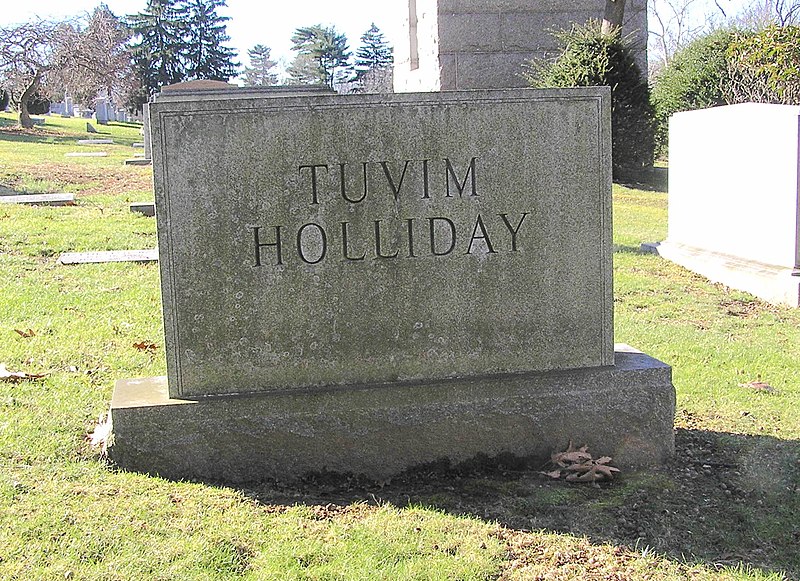
I took this photograph of the grave of Judy Holliday in Westchester Hills Cemetery on January 2, 2007. GNU Free Documentation License
Anthony22 at English Wikipedia · Anthony22 at the English-language Wikipedia
Primary material
Documents and archives
scholarly publication
- Holliday, Judy (1921-1965), actress, American National Biography Online, 2000
Scholarly · Crossref registry · 2000
- Judy Holliday, Best Actress, 2022
Scholarly · Crossref registry · 2022
reference work
- “Judy Holliday”, English Wikipedia, consulted as further reading
Reputable secondary · Wikipedia
authority record
- Wikidata, structured authority record Q253298: Judy Holliday
Unverified · Wikidata
Notes from the source article
Cited by Wikipedia
Notes from the source article
These works are cited by the source article, in its own numbering. They are recorded as its citations, not as sources VALÉORINE has verified.
- 1.Obituary Variety, June 9, 1965, p. 71.
- 2.Abe Tuvim; Zionist Official,. Dies at 64; Executive Director of Fund Foundation. The New York Times. 16 January 1958.
- 3.1940 United States Federal Census
- 4.Our Campaigns - Candidate - Abraham Tuvim. Ourcampaigns.com.
- 5.Dash, Irene G. Judy Holliday (1921–1965). Jewish Women's Archive - Encyclopedia.
- 6.Helen Tuvim - United States Census, 1940. FamilySearch.
- 7."Judy Holiday, 42, Is Dead of Cancer", The New York Times, June 8, 1965, p. 1
- 8."Judy Holliday (1921–1965) Biography" , Jewish Women's Archive (jwa.org), retrieved February 21, 2010
- 9."Judy Holliday Biography", Turner Classic Movies (tcm.com), retrieved February 21, 2010
- 10.Sargeant, Winthrop."Judy Holliday"Life Magazine, April 2, 1951.
- 11.The Revuers. Night Life in New York (78rpm 12-in Set Musicraft Records #N-2). Popsike.com. 1940.
- 12.Dudar, Helen. "The Post Presents the Judy Holliday Story." New York Post, 11 December 1956.
- 13."Kiss Them For Me Internet Broadway Database listing" ibdb.com, retrieved February 21, 2010; accessed 10 June 2014.
- 14."Born Yesterday Internet Broadway Database listing", ibdb.com, retrieved February 21, 2010
- 15.Hepburn, Katharine. Me: Stories of My Life. Random House. 246–247. 1991. 9780307807687.
- 16.Carter, Grace May. Katharine Hepburn. New Word City. 2016. 9781612309613.
- 17.Crow, Bill. From Birdland to Broadway: Scenes from a Jazz Life. Oxford University Press. 185. 1993. 0195085507.
- 18."Top winners from 1950" , Chicago Tribune, retrieved February 21, 2010; accessed June 10, 2014.
- 19.British Academy of Film and Television Arts. Film / Foreign Actress.
- 20.Dick, Bernard F. Columbia Pictures: Portrait of A Studio (1992). University Press of Kentucky; , pp. 135–136.
- 21.Sicherman, Barbara and Green, Carol Hurd. Notable American Women: The Modern Period (1980). Harvard University Press; , p. 349
- 22.Hearing Before the Committee on Un-American Activities, House of Representatives, Eighty-fourth Congress. Books.googleusercontent.com.
- 23.Barranger, Milly S. Unfriendly Witnesses: Gender, Theater, and Film in the McCarthy Era. Southern Illinois University Press. 9–33. 2008. 978-0809328765.
- 24.Profile, thesmartset.com; accessed June 10, 2014.
- 25.Duncan, Stephen R. Smart Chicks on Screen: Representing Women's Intellect in Film and Television. Rowman & Littlefield. 9–28. 2014. 978-1442237483.
- 26.Bells Are Ringing listing, ibdb.com, retrieved February 21, 2010.
- 27.Atkinson, Brooks. "Theater: 'Bells Are Ringing' for Judy Holliday", The New York Times, November 30, 1956, p. 18
- 28."Judy Holliday Faces Surgery", The New York Times, October 12, 1960, p. 44
- 29."Laurette: Music from the play", kritzerland.com, retrieved February 22, 2010.
- 30.Hot Spot listing, Internet Broadway Database; retrieved February 22, 2010.
- 31.Judy Holliday – Hollywood Walk of Fame. WalkofFame.com.
- 32.Brinker, Nancy G. Promise Me: How a Sister's Love Launched the Global Movement to End Breast Cancer. Three Rivers Press/Random House. 77. 2010. 978-0-307-71813-6.
- 33.Rothaus, Steve. The Tragic Early Death of Judy Holliday. Stories from Classic Hollywood. The Life and Times of Hollywood. March 21, 2020.
- 34.“Judy Holliday”, biography, Turner Classic Movies (TCM). Retrieved March 3, 2018.
References
Citations
References
Each reference names the institution holding it, so a reader may go to the document itself.
scholarly publication
Verifiedscholarly publication
Judy Holliday, Best Actress, 2022Crossref registry
Verifiedreference work
Partially resolvedauthority record
Unverified
The Encyclopedia exists whether or not anything is for sale. Corrections are recorded rather than overwritten, and every version of this record is kept. Published 14 August 2026.
Elsewhere in Film memorabilia
37,515 published records in this field, each with its sources named.
- Judy GarlandPerson
- Judy GeesonPerson
- Judy GoldPerson
- Judy GreerPerson
- Judy IrvingPerson
- Judy KibingePerson
- Judy KuhnPerson
- Judy LandersPerson
Best supported in this field
For owners
Own a work by Judy Holliday?
A specialist will read what you send and tell you what the house can establish, what it cannot, and whether the object is suited to sale. There is no charge and no obligation. The object stays with you throughout; nothing is shipped to us unless it is arranged in writing beforehand.