
Juan Ramón Jiménez
Ramón Jiménez Mantecón (xwan raˈmoŋ xiˈmeneθ manteˈkon; 23 December 1881 – 29 May 1958) was a Spanish poet, a prolific writer who received the 1956 Nobel Prize in Literature "for his lyrical poetry, which in the Spanish language constitutes an example of high spirit and artistic purity". One of Jiménez's most important contributions to modern poetry was his advocacy of the concept of "pure poetry".
Also recorded as Juan Ramon Jimenez Mantecon
Juan Ramón Jiménez
Fedekuki · CC BY-SA 3.0
- Name
- Juan Ramón Jiménez
- Birth Name
- Juan Ramón Jiménez Mantecón
- Born
- 23 December 1881
- Birthplace
- Moguer, Huelva, Andalucia, Spain
- Died
- 29 May 1958
- Place of death
- San Juan, Puerto Rico
- Occupation
- poet
- Spouse
- Zenobia Camprubí
- Nationality
- Spain
- Fields
- lyricism
- Movements
- Generation of 1914
- Education
- High School La Rábida
VALÉORINE Encyclopedia
VALÉORINE documentary reading
Documentary summary
Ramón Jiménez Mantecón (xwan raˈmoŋ xiˈmeneθ manteˈkon; 23 December 1881 – 29 May 1958) was a Spanish poet, a prolific writer who received the 1956 Nobel Prize in Literature "for his lyrical poetry, which in the Spanish language constitutes an example of high spirit and artistic purity". One of Jiménez's most important contributions to modern poetry was his advocacy of the concept of "pure poetry".
Admitted source layer · organised and presented by VALÉORINE
Note VALÉORINE
No house-authored Note is published until its assertions and sources pass the VALÉORINE evidence contract. The documentary article remains available in full while that enrichment is being consolidated.
Documentary enrichment in progress · no unsupported statement published
Reference Check
Propose documentary evidence for Juan Ramón Jiménez. A contribution is never written directly as fact: identity, source, rights and evidence gates still decide.
Sign in to contribute
World of VALÉORINE
Documentary connections
Only confirmed graph relationships appear here. Images are shown only when their identity and reuse rights both pass the documentary gate.
Documentary evidence
Evidence Panel
not yet certified
- Identity
- resolved
- Independent source families
- 0
- Admitted assertions
- 0
- Open conflicts
- 0
Authority files
loc · n86745982 · wikidata · Q131318 · wikipedia · Juan Ramón Jiménez
In this article
Biography
Biography
Juan Ramón Jiménez studied at High School La Rábida. Claribel Alegría is recorded as having studied under Juan Ramón Jiménez. The recorded working language is Spanish. Subjects and genres recorded for the work are lyricism. Employment is recorded with University of Maryland, Baltimore County. Distinctions recorded are Nobel Prize in Literature and Honorary Doctorate from the National Autonomous University of Mexico.

Advertencia de Juan Ramón Jiménez
Fedekuki

Billete de 2000 petas españolas de 1980 de Juan Ramón Jiménez
Manchego
Key facts
Key facts
• Name — Juan Ramón Jiménez • Birth Name — Juan Ramón Jiménez Mantecón • Born — 23 December 1881 • Birthplace — Moguer, Huelva, Andalucia, Spain • Died — 29 May 1958 • Place of death — San Juan, Puerto Rico • Occupation — poet • Genre — poetry • Spouse — Zenobia Camprubí • Awards — Nobel Prize in Literature 1956 Juan Ramón Jiménez Mantecón (xwan raˈmoŋ xiˈmeneθ manteˈkon; 23 December 1881 – 29 May 1958) was a Spanish poet, a prolific writer who received the 1956 Nobel Prize in Literature "for his lyrical poetry, which in the Spanish language constitutes an example of high spirit and artistic purity". One of Jiménez's most important contributions to modern poetry was his advocacy of the concept of "pure poetry".
Early life
Early life
Juan Ramón Jiménez was born in Moguer, near Huelva, in Andalucia, on 23 December 1881. He was educated in the Jesuit institution of San Luis Gonzaga, in El Puerto de Santa María, near Cádiz. Later, he studied law and painting at the University of Seville, but he soon discovered that his talents were better used for writing. He then dedicated himself to literature, under the influence of Rubén Darío and French symbolism. He published his first two books at the age of eighteen, in 1900. The death of his father the same year devastated him, and a resulting depression led to his being sent first to France, where he had an affair with his doctor's wife, and then to a sanatorium in Madrid staffed by novice nuns, where he lived from 1901 to 1903. In about 1904 Jiménez was hoodwinked by some Peruvians. José Gálvez, Carlos Rodríguez Hübner and a 15 year old Maria Isabel Sanchez-Concha created a fictional woman named Georgina Hübner and they started a correspondence with the poet. José and Carlos were hoping to get access to his writing and Sanchez-Concha did the writing. Jiménez fell in love with their creation and planned to travel to Peru to meet the young woman. The plan was only aborted by a telegram they arranged via the Spanish consul to the poet, giving him the fabricated news of Georgina's death.
Career
Career
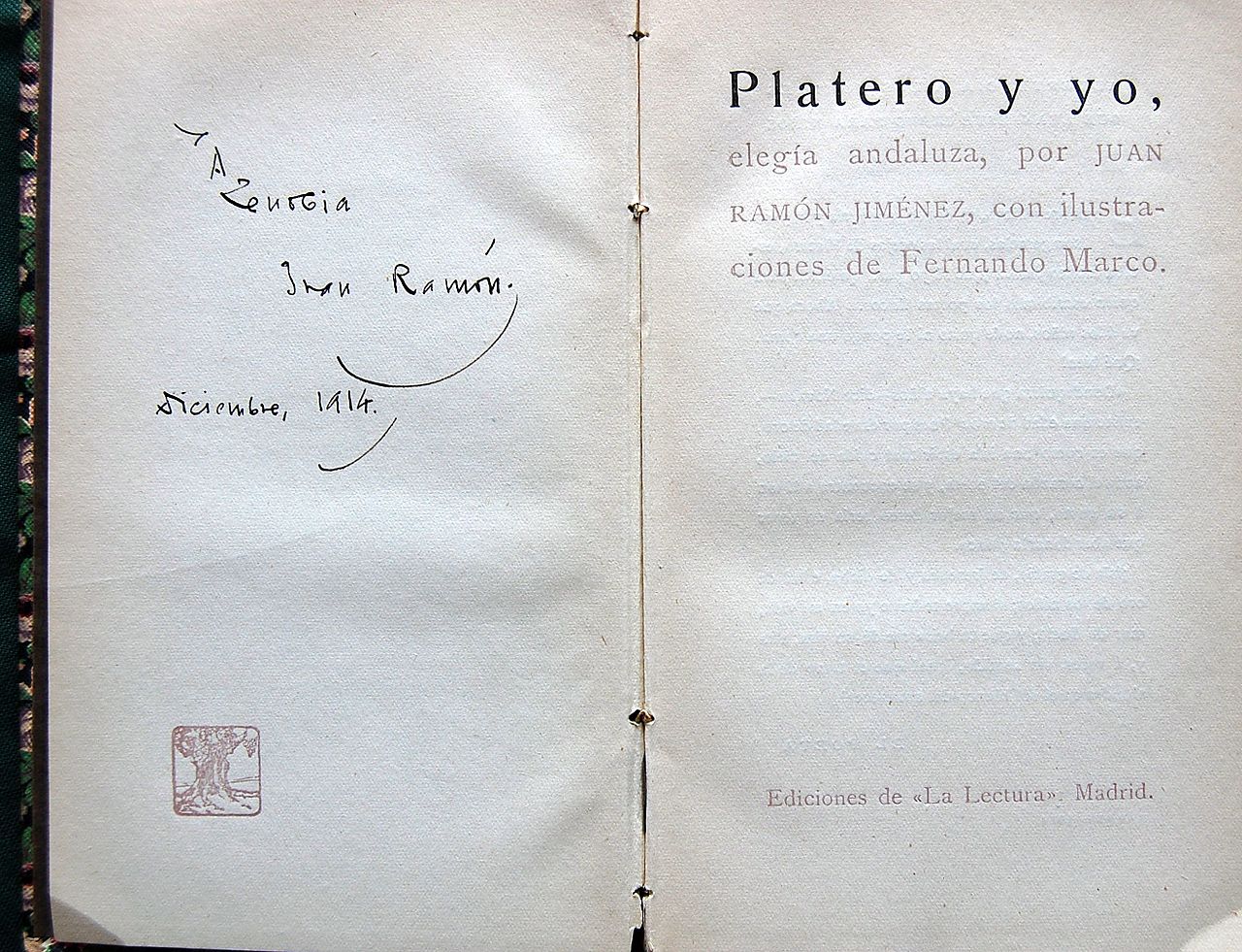
He was among the contributors of the Madrid-based avant-garde magazine Prometeo between 1908 and 1912. In 1911 and 1912, he wrote many erotic poems depicting romps with numerous women in numerous locales. Some of them alluded to sex with novices who were nurses. Eventually, apparently, their mother superior discovered the activity and expelled him, although it is not known whether the sexual activity described in his poems actually occurred. The main subjects of many of his other poems were music and color, which, at times, he compared to love or lust. He suffered a mental breakdown and depression, so he stayed hospitalised in France and Madrid. He celebrated his home region in his prose poem about a writer and his donkey called Platero and I (1914). In 1916 he and Spanish-born writer and poet Zenobia Camprubí were married in the United States. Zenobia became his indispensable companion and collaborator. Upon the outbreak of the Spanish Civil War, he and Zenobia went into exile in Puerto Rico, where he settled in 1946. Jiménez was hospitalized for eight months due to another deep depression. He later became a Professor of Spanish Language and Literature at the University of Puerto Rico. His literary influence on Puerto Rican writers strongly marks the works of Giannina Braschi, René Marqués, Aurora de Albornoz, and Manuel Ramos Otero. The university named a building on campus and a writing program in his honor. He was also a professor at the University of Miami in Coral Gables, Florida. While living in Coral Gables he wrote "Romances de Coral Gables". In addition, he was a professor in the Department of Spanish and Portuguese at the University of Maryland, which renamed Jimenez Hall for him in 1981. Although he was primarily a poet, Jiménez' prose work Platero y yo (1917; "Platero and I"; Platero is a donkey) sold well in Latin America and in translation won him popularity in the USA. He also collaborated with his wife in the translation of the Irish playwright John Millington Synge's Riders to the Sea (1920). His poetic output during his life was immense. Among his better known works are: • Sonetos espirituales 1914–1916 (1916; "Spiritual Sonnets, 1914–15") • Piedra y cielo (1919; "Stones and Sky") • Poesía en verso, 1917–1923 (1923; "Poetry in Verse") • Poesía en prosa y verso (1932; "Poetry in Prose and Verse") • Voces de mi copla (1945; "Voices of My Song"), and • Animal de fondo (1947; "Animal at Bottom"). Both Jiménez and Camprubí used a simplified Spanish orthography different from the RAE standard. A collection of 300 poems (1903–53) in English translation by Eloise Roach was published in 1962.
Later life and death
Later life and death
In 1956, he received the Nobel Prize in Literature; two days later, his wife died of ovarian cancer. Jiménez never recovered from the emotional devastation, and he died two years afterwards, on 29 May 1958, in the same clinic where his wife had died. Both are buried in his hometown of Moguer, Spain. • Illustration — Juan Ramón Jiménez depicted on the 1980 2,000 Pesetas banknote
In popular culture
In popular culture
• A quotation from Jiménez, "If they give you ruled paper, write the other way," is the epigraph to Ray Bradbury's novel Fahrenheit 451 (1953). • The same quotation used in Fahrenheit 451 is used in The Lovely Bones (2002) by Alice Sebold. • In 1968, the Spanish film director Alfredo Castellón adapted Jiménez's novel Platero and I into a movie by the same title. • The Spanglish novel Yo-Yo Boing! (1998) by the Puerto Rican author Giannina Braschi features a scene in which poets and artists debate Jiménez's genius versus that of other Spanish-language poets Francisco de Quevedo, Luis de Góngora, Rubén Darío, Pablo Neruda, Federico García Lorca, and Julia de Burgos. • A rock band in Spain is named Platero y Tú after Jiménez's novel
Streets named after Jiménez
Streets named after Jiménez
Several streets have been named after Jiménez, including one in Madrid, one in Valencia, and one in Quintanar de la Orden, Toledo.
Published works (original editions)
Published works (original editions)
• I Am Not I
Life and career
Dated record
Life and career
The full dated record · 2 entries
1881
Juan Ramón Jiménez was born on 24 December 1881.
1958
Juan Ramón Jiménez died at San Juan Puerto Rico Temple.
Places
Named by the record
Places
Only places the record itself states, plotted where the house gazetteer settles their coordinates. Nothing is inferred from a name or a nationality.
Moguer.
Birth place
San Juan Puerto Rico Temple.
Death place
Published works (translations)
• Books of Love: The Lost Poems of Juan Ramon Jimenez. Athens:Kinchafoonee Creek Press, 2022.
Primary material
Documents and archives
reference work
- “Juan Ramón Jiménez”, English Wikipedia, consulted as further reading
Reputable secondary · Wikipedia
authority file
authority record
- Wikidata, structured authority record Q131318: Juan Ramón Jiménez
Unverified · Wikidata
References
Citations
References
Each reference names the institution holding it, so a reader may go to the document itself.
reference work
Partially resolvedauthority file
Library of Congress Name Authority File, Juan Ramón Jiménez colección de poesía (USE Colección de poesía Juan Ramón Jiménez) (n86745982).Library of Congress
Partially resolvedauthority record
Unverified
Further particulars
Held on the record
Further particulars
Open the remaining particulars
His recorded language was Spanish. He married Zenobia Camprubí. Formation and teaching. Jiménez studied at High School La Rábida. Each of those relationships is stated by the authority record rather than inferred from style. Jiménez received Nobel Prize in Literature and Honorary Doctorate from the National Autonomous University of Mexico.
Identity and origins
Recognition and collections
The Encyclopedia exists whether or not anything is for sale. Corrections are recorded rather than overwritten, and every version of this record is kept. Published 14 August 2026.
Elsewhere in Books
39,078 published records in this field, each with its sources named.
- Juan Pablo Plata FigueroaAuthor
- Juan Pablo Vizcardo y GuzmánAuthor
- Juan PaneroAuthor
- Juan Perez de MontalbanAuthor
- Juan Ramón MolinaAuthor
- Juan Rodríguez de la CámaraAuthor
- Juan RuizAuthor
- Juan Santa Cruz PachacutiAuthor
Best supported in this field
For owners
Own a work by Juan Ramón Jiménez?
A specialist will read what you send and tell you what the house can establish, what it cannot, and whether the object is suited to sale. There is no charge and no obligation. The object stays with you throughout; nothing is shipped to us unless it is arranged in writing beforehand.