
Joseph Klarwein
Ossip (Yosef) Klarwein (6 February 1893 – 9 September 1970) was a Polish-born German-Israeli architect who designed many works in Germany and Israel. Between 1921 and 1933 he was employed with Johann Friedrich Höger and became chief design architect. Klarwein was an important representative of Northern German Brick Expressionism and of modern architecture in Israel.
Joseph Klarwein

Wikimedia Commons · Public domain
- Name
- Ossip (Yosef) Klarwein
- Birth Name
- Ossip Klarwein
- Born
- 6 February 1893
- Birthplace
- Warsaw, Russian Poland
- Died
- 9 September 1970
- Place of death
- Jerusalem, Israel
- Occupation
- Architect
- Nationality
- Poland · Germany · Israel
- Fields
- architecture
- Languages
- German
VALÉORINE Encyclopedia
VALÉORINE documentary reading
Documentary summary
Ossip (Yosef) Klarwein (6 February 1893 – 9 September 1970) was a Polish-born German-Israeli architect who designed many works in Germany and Israel. Between 1921 and 1933 he was employed with Johann Friedrich Höger and became chief design architect. Klarwein was an important representative of Northern German Brick Expressionism and of modern architecture in Israel.
Admitted source layer · organised and presented by VALÉORINE
Note VALÉORINE
Joseph Klarwein (1893–1970) was an architect, of German and Israeli nationality. The architect was born in Warsaw and died in Jerusalem. Activity centred on architecture. Languages used include German.
Composed from admitted, traceable facts · 01 October 2026
VALÉORINE
Reference Check
Propose documentary evidence for Joseph Klarwein. A contribution is never written directly as fact: identity, source, rights and evidence gates still decide.
Sign in to contribute
World of VALÉORINE
Documentary connections
Only confirmed graph relationships appear here. Images are shown only when their identity and reuse rights both pass the documentary gate.
Documentary evidence
Documentary basis
Authority files
wikidata · Q216516
In this article
Key facts
Key facts
• Name — Ossip (Yosef) Klarwein • Native Name — יוסף קלארווין • Birth Name — Ossip Klarwein • Born — 6 February 1893 • Birthplace — Warsaw, Russian Poland • Died — 9 September 1970 • Place of death — Jerusalem, Israel • Occupation — Architect • Children — Mati Klarwein
Germany
Germany
Klarwein was born in Warsaw, Poland. As Jews, the family immigrated to Germany because of the anti-Semitism growing in Poland and Russia after the failed revolution of 1905 in the Russian Empire. Klarwein studied architecture at the Technical University of Munich from 1917 to 1919, but he was not awarded a university degree. In 1920, he studied with Hans Poelzig in the master's studio for architecture of the Prussian Academy of Arts in Berlin. In 1921, Klarwein joined the architectural firm of Fritz Höger in Hamburg. Höger's office grew considerably in these years with increasing work orders, requiring additional personnel. Klarwein's designs were at the time published under Höger's name. Höger said that Klarwein was "one of the very best" employees. Between 1930 and 1933 Klarwein supervised the construction of the brick expressionist Church at Hohenzollernplatz following his designs in Berlin.
Mandatory Palestine / Israel
Mandatory Palestine / Israel
• Illustration — Qranot House in Haifa by Klarwein (1935–1937) • Illustration — Zina Disengoff's tomb at Trumpeldor cemetery, Tel Aviv by Klarwein (1937) • Illustration — Dagon granaries in Haifa, originally designed by Klarwein (1953–1966) In 1934, Klarwein emigrated with his non-Jewish wife Elsa (née Kühne), an opera singer, and their son Mati during the Fifth Aliyah to the British Mandate of Palestine, because they saw no future in Nazi Germany. Klarwein changed his first name from the Slavic name variant Ossip to the Hebrew form Yosseph. In Haifa, Klarwein became an independent architect. Most of his works are public and commercial buildings, as well as development plans for cities and neighborhoods scattered throughout Israel. Klarwein's original design for the Knesset building unanimously won the 1957 architecture competition, and he continued to work on the project until completion, but some modifications were made to the plans. He designed with Richard Kauffmann and Heinz Rau, the campus of the Hebrew University.
Works
Works
• Church at Hohenzollernplatz, Berlin (1931–1933) • Wichernkirche, Hamm, Hamburg (1933–1934) • Qranot House, Hadar HaCarmel, Haifa (1936) • Zina Disengoff's tomb, Trumpeldor cemetery, Tel Aviv (1937) • Shaul Tchernichovsky's tomb, Trumpeldor cemetery, Tel Aviv (1945) • Kiryat HaMemshala (Government complex), Jerusalem, with Richard Kauffmann and Heinz Rau (1950) • Mount Herzl and Theodor Herzl's tomb, Jerusalem (1951) • Hebrew University of Jerusalem, Givat Ram campus master plan (1953) • Dagon granaries, Haifa (1953–1966) • The Knesset, Jerusalem (1956–1966) together with Shimon Powsner, Dov Karmi, Ram Karmi, Bill Gillitt, and Dora Gad (interior design) • Israeli pavilion at the Brussels World's Fair (1958) • Beit Zvi, Ramat Gan • Tel Aviv Savidor Central railway station, Tel Aviv • The old Jerusalem central bus station, Jerusalem (demolished)
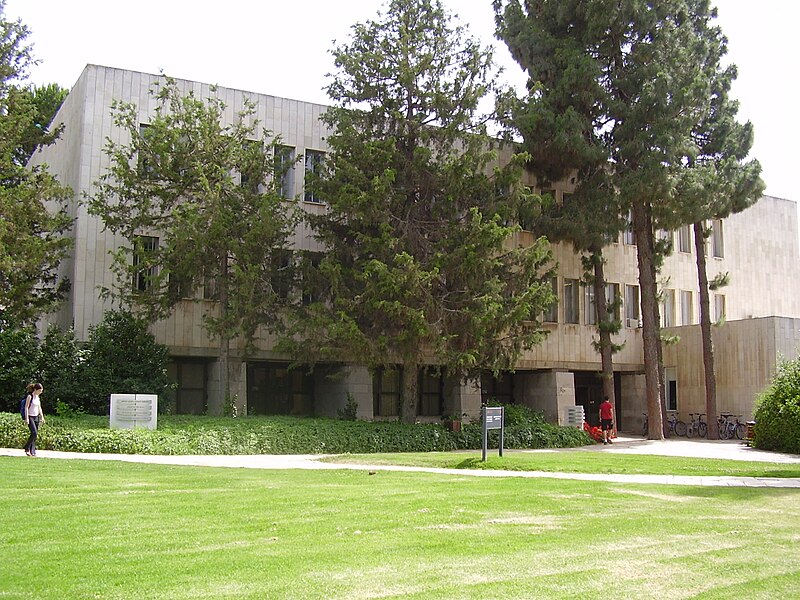
Joseph Klarwein, Ross Bldg
Wikimedia Commons

Beit Zvi School for the Performing Arts is an acting school located in Ramat Gan, Israel
Yair Haklai
Life and career
Dated record
Life and career
The full dated record · 2 entries
1893
Joseph Klarwein was born on 6 February 1893.
1970
Joseph Klarwein died on 9 September 1970.
Places
Named by the record
Places
Only places the record itself states, plotted where the house gazetteer settles their coordinates. Nothing is inferred from a name or a nationality.
Warsaw.
Birth place
Jerusalem.
Death place
Notes from the source article
Cited by Wikipedia
Notes from the source article
These works are cited by the source article, in its own numbering. They are recorded as its citations, not as sources VALÉORINE has verified.
- 1.Myra Warhaftig ( ): They laid the foundation stone. German-Jewish architect's life and work in Palestine 1918-1948. Wasmuth, Berlin / Tübingen 1996, , P. 294-295. (de).
- 2.Susan (Sheila) Hattis Rolef: משכן הכנסת בגבעת רם: תכנון ובנייה. In: קתדרה, Band 96 (July 2000), English, "The Competition and its Results, mid-1956 to mid-1958", auf: Knesset English Homepage, retrieved 11 April 2015 .
- 3.Ernst-Erik Pfannschmidt Letter to Eckhardt (Ekhart) Berckenhagen of 29 June 1977 (PDF; 25 kB) at the time of the exhibition on the occasion of the 100th birthday of Höger's in the Art Library of the Berlin State Museums (in German).
- 4.Susan Hattis Rolef. The Knesset Building - Architectural Highlights
- 5.Lotte Cohn: Richard Kauffmann, Architect and City Planner. [Richard Kauffmann: Architekt und Stadtplaner (de.), Jerusalem: Brief an Bath-Scheva Kauffmann, 1978; English.], Monika Iacovacci (Übs.), auf: Richard Kauffmann: Architect and Town Planner – Biography, Retrieved 11 April 2015.
- 6.The full story of the Knesset building. Knesset homepage.
References
Citations
References
Each reference names the institution holding it, so a reader may go to the document itself.
authority record
General reference
The Encyclopedia exists whether or not anything is for sale. Corrections are recorded rather than overwritten, and every version of this record is kept. Published 17 August 2026.
Elsewhere in Design
11,558 published records in this field, each with its sources named.
- Joseph JacobbergerDesigner
- Joseph John ScolesDesigner
- Joseph KarakisDesigner
- Joseph KayDesigner
- Joseph KornhäuselDesigner
- Joseph Ladd NealDesigner
- Joseph Lancaster BallDesigner
- Joseph Lea GleaveDesigner
Best supported in this field
For owners
Own a work by Joseph Klarwein?
A specialist will read what you send and tell you what the house can establish, what it cannot, and whether the object is suited to sale. There is no charge and no obligation. The object stays with you throughout; nothing is shipped to us unless it is arranged in writing beforehand.