
Jørgen Moe
Jørgen Engebretsen Moe (22 April 1813–27 March 1882) was a Norwegian folklorist, bishop, poet, and author. He is best known for the Norske Folkeeventyr, a collection of Norwegian folk tales which he edited in collaboration with Peter Christen Asbjørnsen. He also served as the Bishop of the Diocese of Kristianssand from 1874 until his death in 1882.
Also recorded as Jørgen Engebretsen Moe
Jørgen Moe

Christian Skredsvig · Public domain
- Born
- 1813. · Hole.
- Died
- 1882. · Kristiansand Municipality.
- Nationality
- Norway and Union between Sweden and Norway.
- Occupation
- poet, writer, folklorist, collector of fairy tales, lutheran pastor and ethnologist.
- Honours
- Knight Grand Officer of the Order of Saint Olav.
- Languages
- Norwegian and Danish.
VALÉORINE Encyclopedia
VALÉORINE documentary reading
Documentary summary
Jørgen Engebretsen Moe (22 April 1813–27 March 1882) was a Norwegian folklorist, bishop, poet, and author. He is best known for the Norske Folkeeventyr, a collection of Norwegian folk tales which he edited in collaboration with Peter Christen Asbjørnsen. He also served as the Bishop of the Diocese of Kristianssand from 1874 until his death in 1882.
Admitted source layer · organised and presented by VALÉORINE
Note VALÉORINE
Jørgen Moe (1813–1882) was a bishop, children's writer and cleric, among other activities, a national of Norway and the Union between Sweden and Norway. The bishop was born in Hole and died in Kristiansand Municipality. Jørgen Moe was a member of Royal Norwegian Society of Sciences and Letters and held the position of Lutheran Bishop of Agder and Telemark. Languages used include Danish and Norwegian.
Composed from admitted, traceable facts · 30 September 2026
VALÉORINE
Reference Check
Propose documentary evidence for Jørgen Moe. A contribution is never written directly as fact: identity, source, rights and evidence gates still decide.
Sign in to contribute
World of VALÉORINE
Documentary connections
Only confirmed graph relationships appear here. Images are shown only when their identity and reuse rights both pass the documentary gate.
Documentary evidence
Documentary basis
Authority files
wikidata · Q470002 · wikipedia · Jørgen Moe
In this article
Biography
Biography
Jørgen Engebretsen Moe was born at the farm of Øvre Moe in the municipality of Hole in the traditional district of Ringerike. He was the son of local farmer and politician Engebret Olsen Moe. He first met Asbjørnsen while the two were preparing for exams at Norderhov Rectory and soon found they had a shared interest in folklore. Starting in 1841, Moe traveled almost every summer through the southern parts of Norway, collecting traditions and stories from the people living in the mountainous areas. In 1845, he was appointed professor of theology in the Norwegian Military Academy. However, Moe had long intended to take holy orders, and in 1853 he did so. He became a resident chaplain in Krødsherad at Olberg Church and Holmen Church in Sigdal, positions that he held for 10 years. At his first parish he found inspiration for many of his most famous poems, like den gamle Mester (The Old Master) and Sæterjentens Søndag (Sunday at the Mountain Pastures). In 1863, he moved to Drammen and became parish priest of Bragernes Church, then in 1870 he moved again to Vestre Aker, close to Christiania (now Oslo). In 1874, he became bishop in the Diocese of Kristianssand based at the Kristiansand Cathedral, a position he held from 1874 until his death in 1882. He was a much beloved bishop, and his teaching had a great impact on his contemporaries. Moe has a special claim on critical attention in regard to his lyrical poems, of which a small collection appeared in 1850. Moe felt strongly that writing should be "objective," in the sense that it removed the ego from the narrative. Still, he strove to build and maintain a literary aesthetic in his work. He wrote little original verse, but in his slender volume are to be found many pieces of exquisite delicacy and freshness. Moe also published a delightful collection of prose stories for children, I Brønden og i Tjernet (In the Well and in the Tarn), 1851; and En liden Julegave (A Little Christmas Present), 1860. Asbjørnsen and Moe had the advantage of an admirable style of narrative prose. It was usual that the vigor came from Asbjørnsen and the charm from Moe, but it seems that from the long habit of writing in unison they had come to adopt almost precisely identical modes of literary expression. Moe was appointed Knight of the Order of St. Olav in 1873 and was made commander of the 1st cross class in 1881. During January 1882, he resigned his diocese due to failing health, and died the following March. His son, Moltke Moe, continued his father's work in folklore and fairy tales and became the first professor of the subject at Christiania University.
Impact on Norwegian culture
Impact on Norwegian culture
Together with Peter Christen Asbjørnsen, the impact of Jørgen Moe on Norwegian culture was enormous. To Norwegians, the names Asbjørnsen and Moe have become synonymous with traditional folk tales, the way the name Brothers Grimm is associated with German tales. Not only did they collect and secure parts of the wealth of Norwegian fairy tales and edit them for common readers, but in doing this, they also contributed to the development of the Norwegian language. The folk literature collected by Peter Christen Asbjørnsen and Jørgen Moe is widely regarded in Norway as a significant contribution to the country's national identity. Askeladden (Ash Boy), a character whose creativity and resourcefulness always wins him the Princess and half the Kingdom, is seen as something typically Norwegian. Some of Moe's works of poetry are still cherished, not least because of the tunes set to them. His achievements in the Church are now mostly forgotten, except locally.
Ringerikes Museum
Ringerikes Museum
Ringerikes Museum is the regional museum for the municipalities of Hole and Ringerike in Buskerud county. Ringerikes Museum is located in Hønefoss at the site of the former Norderhov rectory where Asbjørnsen and Moe first met. It is now the local museum for the Ringerike region and contains a collection of Asbjørnsen and Moe memorabilia. The museum is also noted for its collection of the private belongings of Jørgen Moe. In the 1930s, Marie Moe, Jørgen Moe's daughter, provided a gift consisting of several hundred objects from Jorgen Moe's private home.
Major works
Major works
Samling af Sange, Folkeviser og Stev i norske Allmuedialekter, 1840; enlarged edition, 1869, with melodies by Lindeman Norske folkeeventyr, 1841–1852 (with Asbjørnsen); expanded version 1882; English version by George Webbe Dasent, 1859 Digte, 1849 (poems) I Brønden og i Kjærnet, 1851 (juvenile stories and sermons based on folk poems) At hænge på juletreet, 1855 En liten julegave, 1860 Samlede skrifter, 1877 (collected works, excepting the folk stories)
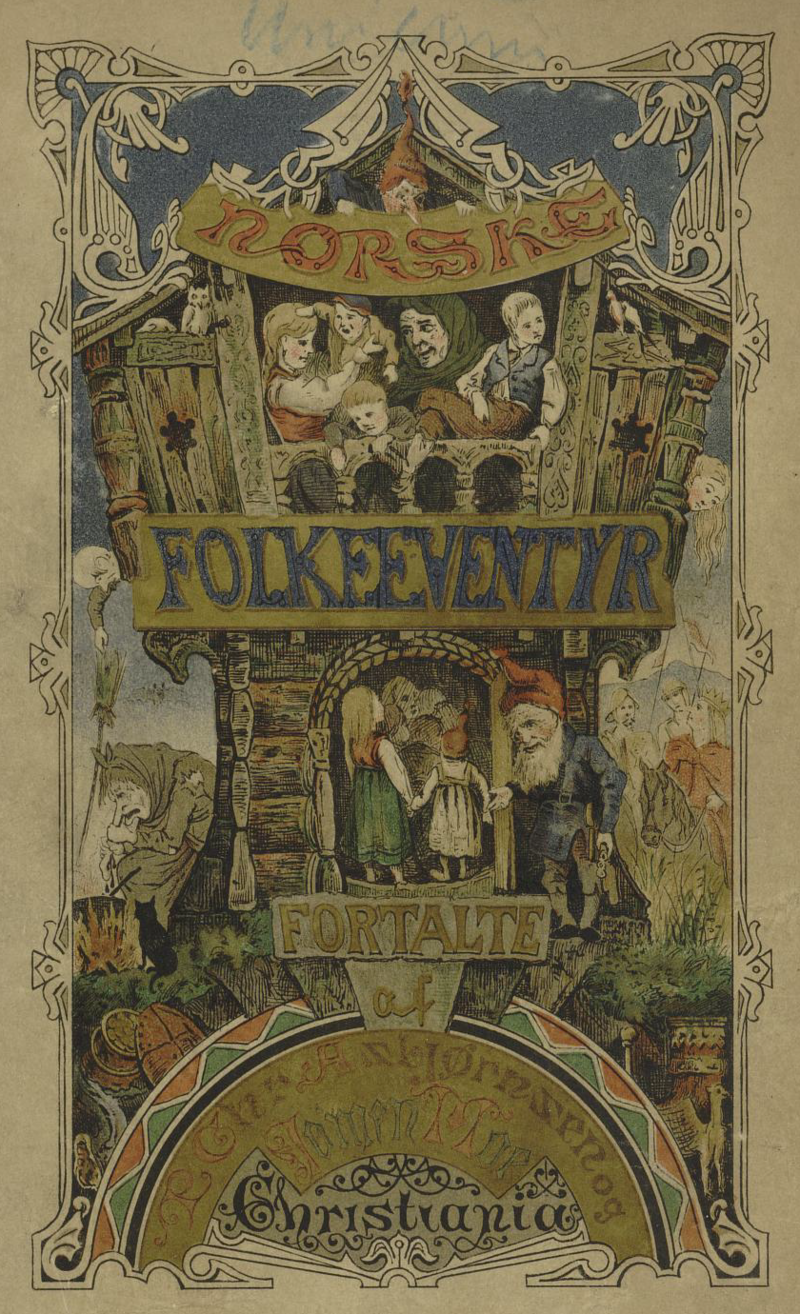
Asbjornsen and Moe's Norske folkeeventyr 5th edition, 1874. Cover illustration.
Unknown artist · (1874) Norske folke-eventyr (5 th ed.), Oslo: Jacob Dybwad (National Library of Norway copy)

Bispemøtet høsten 1877, gruppe, menn, biskoper, sittende og stående helfigur. Bildet er tatt i Kristiania under et bispemøtet høsten 1877. Foran (fra høyre) sitter biskop Jørgen Moe (Kristiansand), kirke- og undervisningsminister Rasmus Tønder Nissen og biskop Halvor Folkestad (Hamar). Bak (fra høyre) står biskop Jakob Sverdrup Smitt (Tromsø), biskop Carl Peter Parelius Essendrop (Kristiania), bis
L. Szaciński / Oslo Museum · Oslo Museum: image no. OB.SZ00085 (Byhistorisk samling), via oslobilder.no.
Life and career
Dated record
Life and career
Explore 1813–1882
The full dated record · 3 entries
1813
Jørgen Moe born.
1852
Norske folkeeventyr / samlede og fortalte af P. Chr. Asbjørnsen of Jørgen Moe., dated 1852, held by Wellcome Collection.
1882
Jørgen Moe died.
Places
Named by the record
Places
Only places the record itself states, plotted where the house gazetteer settles their coordinates. Nothing is inferred from a name or a nationality.
Hole.
Birth place
Kristiansand Municipality.
Death place
Cited by Wikipedia
Notes from the source article
These works are cited by the source article, in its own numbering. They are recorded as its citations, not as sources VALÉORINE has verified.
- 1.Rottem, Øystein. Jørgen Moe. Store norske leksikon.
- 2.Buskerud, Hole herad, Hole sokn. Matrikkelutkastet av 1950.
- 3.GoNorway.no. Jørgen Engebretsen Moe.
- 4.Arthur Thorbjørnsen. Domkirkens historie før 1880. R. Stav Johanssen Printing A/S Kristiansand. 2007.
- 5.The Norwegian Folk Tales and their Illustrators (Norway List)
- 6.Jørgen Moe (Norsk Litteraturhistorie)
- 7.Pook Press. Asbjørnsen and Moe.
- 8.Rudvin, Mette. Norske Folkeeventyr. A Polysystemic Approach to Folk Literature in Nineteenth-Century Norway.
- 9.Ringerikes Museum. Jørgen Moe minnet.
Bibliography printed in the source article · 2
- Hodne, Ørnulf. Jørgen Moe og folkeeventyrene: En studie i nasjonalromantisk folkloristikk. Universitetsforlaget. 1979.
- Halvorsen, J. B. Norsk Forfatter-Lexikon. IV. 1896.
The Encyclopedia exists whether or not anything is for sale. Corrections are recorded rather than overwritten, and every version of this record is kept. Published 14 August 2026.
Elsewhere in Books
39,529 published records in this field, each with its sources named.
- Jorge VolpiAuthor
- Jorge Wagensberg LubinskiAuthor
- Jorge Washington ÁbilosAuthor
- Jørgen LethAuthor
- Jörgen SmitAuthor
- Jørgen-Frantz JacobsenAuthor
- Jorie GrahamAuthor
- Joris LuyendijkAuthor
Best supported in this field
For owners
Own a work by Jørgen Moe?
A specialist will read what you send and tell you what the house can establish, what it cannot, and whether the object is suited to sale. There is no charge and no obligation. The object stays with you throughout; nothing is shipped to us unless it is arranged in writing beforehand.