
Jorge Icaza Coronel
Jorge Icaza Coronel (July 10, 1906 – May 26, 1978), commonly referred to as Jorge Icaza, was a writer from Ecuador, best known for his novel Huasipungo, which brought attention to the exploitation of Ecuador's indigenous people by Ecuadorian whites. He was born in Quito in 1906 and died of cancer in the same city in 1978.
Also recorded as Jorge Icaza
Jorge Icaza Coronel

Jorge Icaza · Teatro: Jorge Icaza. Immediate source · CC BY 4.0
- Name
- Jorge Icaza Coronel
- Born
- July 10, 1906
- Birthplace
- Quito, Ecuador
- Died
- 26 May 1978
- Occupation
- Writer
- Spouse
- Marina Moncayo
- Nationality
- Ecuador
- Education
- Unidad educativa Mejia
- Known for
- Huasipungo · El chulla Romero y Flores
- Languages
- Spanish
VALÉORINE Encyclopedia
VALÉORINE documentary reading
Documentary summary
Jorge Icaza Coronel (July 10, 1906 – May 26, 1978), commonly referred to as Jorge Icaza, was a writer from Ecuador, best known for his novel Huasipungo, which brought attention to the exploitation of Ecuador's indigenous people by Ecuadorian whites. He was born in Quito in 1906 and died of cancer in the same city in 1978.
Admitted source layer · organised and presented by VALÉORINE
Note VALÉORINE
Jorge Icaza Coronel (1906–1978) was an actor, diplomat and novelist, among other activities, a national of Ecuador. The actor was born and died in Quito. Jorge Icaza Coronel was educated at Unidad educativa Mejia.
Among the works are El chulla Romero y Flores and Huasipungo. Languages used include Spanish.
Composed from admitted, traceable facts · 01 October 2026
VALÉORINE
Reference Check
Propose documentary evidence for Jorge Icaza Coronel. A contribution is never written directly as fact: identity, source, rights and evidence gates still decide.
Sign in to contribute
Documentary evidence
Documentary basis
Authority files
wikidata · Q961263 · wikipedia · Jorge Icaza Coronel
In this article
Key facts
Key facts
• Name — Jorge Icaza Coronel • Born — July 10, 1906 • Birthplace — Quito, Ecuador • Died — 26 May 1978 • Place of death — Quito, Ecuador • Occupation — Writer • Pen Name — Jorge Icaza • Genre — Social Realism • Notable Works — Huasipungo (1934), El chulla Romero y Flores (1958) • Spouse — Marina Moncayo • Children — Fenia Cristina Icaza Moncayo
Playwright
Playwright
Jorge Icaza's literary career began as a playwright. His plays include El Intruso in 1928, La Comedia sin Nombre in 1929, Cuál es in 1931, Sin Sentido in 1932, and Flagelo, which was published in 1936. After his 1933 playscript, El Dictador, was censured, Icaza turned his attention to writing novels about the social conditions in Ecuador, particularly the oppression suffered by its indigenous people.
Novelist
Novelist
With the publication of Huasipungo in 1934, Icaza achieved international fame. The book became a well-known "Indigenist" novel, a movement in Latin American literature that aspired to realism in its depiction of the mistreatment of the indigenous. Fragments of the book first appeared in English translation in Russia, where it was welcomed enthusiastically by Russia's peasant socialist class. Jorge Icaza was later appointed Ecuador's ambassador to Russia. The first complete edition of Huasipungo was translated into English in 1962 by Mervyn Savill and published in England by Dennis Dobson Ltd. An "authorized" translation appeared in 1964 by Bernard H. Dulsey, and was published in 1964 by Southern Illinois University Press in Carbondale, IL as "The Villagers". His other books include Sierra (1933), En las calles (1936), Cholos (1938), Media vida deslumbrados (1942), Huayrapamushcas (1948), Seis relatos (1952), El chulla Romero y Flores (1958), and Atrapados (1973). Although the latter two books are recognized as Icaza's greatest literary achievements by experts (such as Theodore Alan Sackett), Huasipungo continues to be his most popular book and has been translated to over 40 languages.
Impact
Impact
Jorge Icaza and Huasipungo are often compared to John Steinbeck and his Grapes of Wrath from 1939, as both are works of social protest. Besides the first edition of 1934, Huasipungo went through two more editions or complete rewritings in Spanish, 1934, 1953, 1960, the first of which was difficult for even natives of other Hispanic countries to read and the last the definitive version. This makes it difficult for the readers to ascertain which version they are reading. Besides being an "indigenista" novel, Huasipungo has also been considered a proletarian novel, and that is because Latin America had to substitute the Indians for the European working class as a model or character of proletarian literature. Icaza became internationally popular based upon his publications, and was invited to many colleges in the United States to give lectures on the problems of the indigenous people of Ecuador.
Works
Works
• Year of Publication || Literary work || Genre • 1931 — ¿Cuál es? y Como ellos quieren — Theatre • 1931 — Sin sentido — Theatre • 1933 — Barro de la sierra — Short Stories • 1934 — Huasipungo — Novel • 1935 — En las calles — Novel • 1936 — Flagelo — Theatre • 1937 — Cholos — Novel • 1942 — Media vida deslumbrados — Novel • 1948 — Huairapamushcas — Novel • 1958 — El chulla Romero y Flores — Novel • 1961 — Obras escogidas • 1969 — Relatos — Short stories • 1972 — Atrapados — Novel

Portal, casa de Jorge Icaza.
Ranoutofusername

Portal, casa de Jorge Icaza.
Ranoutofusername
Life and career
Dated record
Life and career
The full dated record · 2 entries
1906
Jorge Icaza Coronel born at Quito.
1978
Jorge Icaza Coronel died at Quito.
Literature
Scholarly footprint
A count of publications is evidence of attention, not of standing, and is given here only as a measure.
Notes from the source article
Cited by Wikipedia
Notes from the source article
These works are cited by the source article, in its own numbering. They are recorded as its citations, not as sources VALÉORINE has verified.
- 1.Biography of Jorge Icaza (in Spanish). Poemas-del-alma.com (1999-02-22). Retrieved on 2014-07-22.
- 2.Biography of Jorge Icaza Coronel from The Biographical Dictionary of Ecuador (in Spanish) . Diccionariobiograficoecuador.com. Retrieved on 2014-07-22.
Bibliography printed in the source article · 8
- Cuatro obras de Jorge Icaza, J. Enrique Ojeda, Quito, Casa de la Cultura Ecuatoriana, 1960
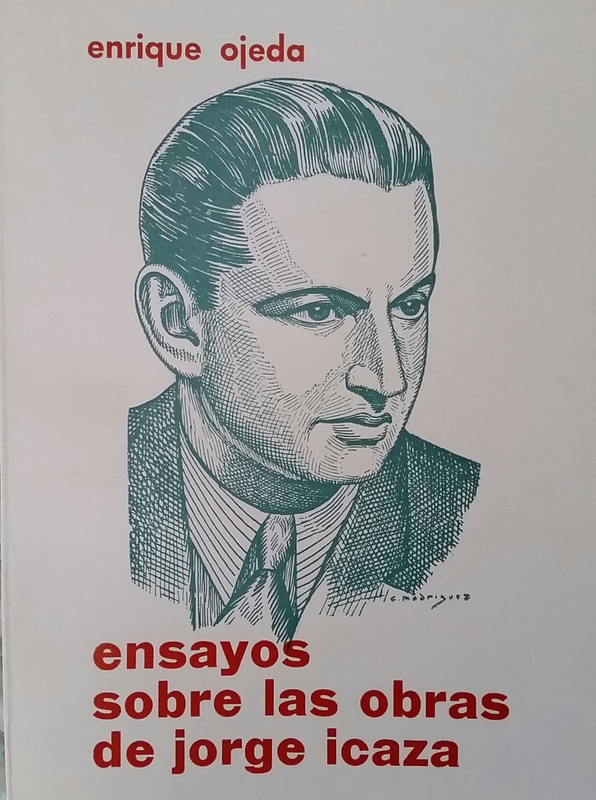
- Ensayos sobre Jorge Icaza, cover, by J. Enrique Ojeda, Quito, Casa de la Cultura Ecuatoriana, 1991
- Indianismo, indigenismo y neoindigenismo en la novela ecuatoriana: (homenaje a Jorge Icaza en el centenario de su nacimiento) / Antonio Sacoto., 2006
- Arí = Si = Yes: análisis lingüístico y evaluación de las traducciones de Huasipungo al inglés / Cecilia Mafla Bustamante., 2004
- Social protest and literary merit in Huasipungo and El mundo es ancho y ajeno / Armando González-Pérez., 1988
- Three Spanish American novelists a European view / Cyril A Jones., 1967
- The Ecuadorian Indian and cholo in the novels of Jorge Icaza; their lot and language / Anthony Joseph Vetrano., 1966
- Reevaluation of Jorge Icaza's Huasipungo / Edwin S Baxter., 1979
References
Citations
References
Each reference names the institution holding it, so a reader may go to the document itself.
reference work
Wikidata, structured authority record Q961263: Jorge Icaza CoronelWikimedia Foundation
Secondary witnessreference work
Secondary witness
The Encyclopedia exists whether or not anything is for sale. Corrections are recorded rather than overwritten, and every version of this record is kept. Published 15 August 2026.
Elsewhere in Books
39,427 published records in this field, each with its sources named.
- Jorge Fernández GranadosAuthor
- Jorge García UstaAuthor
- Jorge GuillénAuthor
- Jorge IbargüengoitiaAuthor
- Jorge IsaacsAuthor
- Jorge Luis BorgesAuthor
- Jorge MajfudAuthor
- Jorge ManriqueAuthor
Best supported in this field
For owners
Own a work by Jorge Icaza Coronel?
A specialist will read what you send and tell you what the house can establish, what it cannot, and whether the object is suited to sale. There is no charge and no obligation. The object stays with you throughout; nothing is shipped to us unless it is arranged in writing beforehand.