
John Wright
Illustration — John Wright John Wright (1805–1844), was a Scots poet.
John Wright

John Wright (Life time: (1805–1843?) · Original publication: The whole poetical works of John Wright... with a portrait of the author, and a sketch of his life Immediate source: archive.org [1] · Public domain
- Born
- 1805
- Nationality
- United Kingdom of Great Britain and Ireland
- Occupation
- poet
- Languages
- English
Reference Check
Propose documentary evidence for John Wright. A contribution is never written directly as fact: identity, source, rights and evidence gates still decide.
Sign in to contribute
Documentary evidence
Documentary basis
Authority files
wikidata · Q6264972
In this article
Biography
Biography
Wright born on 1 September 1805, at the farmhouse of Auchencloigh in the parish of Sorn, Ayrshire, was the fourth child of James Wright of Galston in the same county, a coal-driver, by his wife, Grizzle Taylor (died December 1842) of Mauchline. While he was still a child his parents removed to Galston, where he received a few months' schooling and learned to read, but not to write. He gave evidence of powers of memory by reciting the whole of the 119th Psalm in the Sabbath school to the discomfort of his audience. From the age of seven he assisted his father in driving coals, and at thirteen he was apprenticed to George Brown, a Galston weaver, a man of cultivated mind, who assisted his education and placed books at his disposal. While still a youth Wright composed fifteen hundred lines of a tragedy entitled "Mahomet, or the Hegira", which he was forced to retain in his memory until he learned to write at the age of seventeen. In 1824 he proceeded to Glasgow, carrying with him The Retrospect and some smaller poems. On his arrival he saw John Struthers and Dugald Moore, who approved his work and assisted him to go to Edinburgh. There he found patrons in Christopher North and Henry Glassford Bell, who helped him to obtain a publisher. The Retrospect appeared in 1825, and was lauded by the Quarterly Review and the Monthly Review, as well as by Scottish journals. Some shorter poems which were published with it had the higher honour of being praised by Sir Walter Scott. Wright settled at Cambuslang, near Glasgow, where he married Margaret Chalmers, granddaughter of the parish schoolmaster, and worked as a weaver. Finding his means scanty he printed a second edition of the Retrospect two or three years later, and made a tour through Scotland selling copies. He found that his fame was extensive, and the discovery was his ruin. The hospitality he received encouraged habits of intemperance which, a few months after his return to Cambuslang, completely mastered him. He was separated from his wife, and lived in poverty and wretchedness. In 1843 he made a determined effort to regulate his life. His friends assisted him by publishing at Ayr The Whole Poetical Works of John Wright. Unfortunately, his reformation was either transient or too late, for he died in a Glasgow hospital a few months later. He had a genuine poetic gift and an intense appreciation of natural beauty. His more ambitious pieces were marred by an artificial imitation of Lord Byron, but his shorter poems, reflecting the emotions of his own life, were happier.
Works
Works
• 1825 The Retrospect. Canto II. • 1830 Lines composed over Robert Fergusson's Grave. • 1830 The Retrospect.
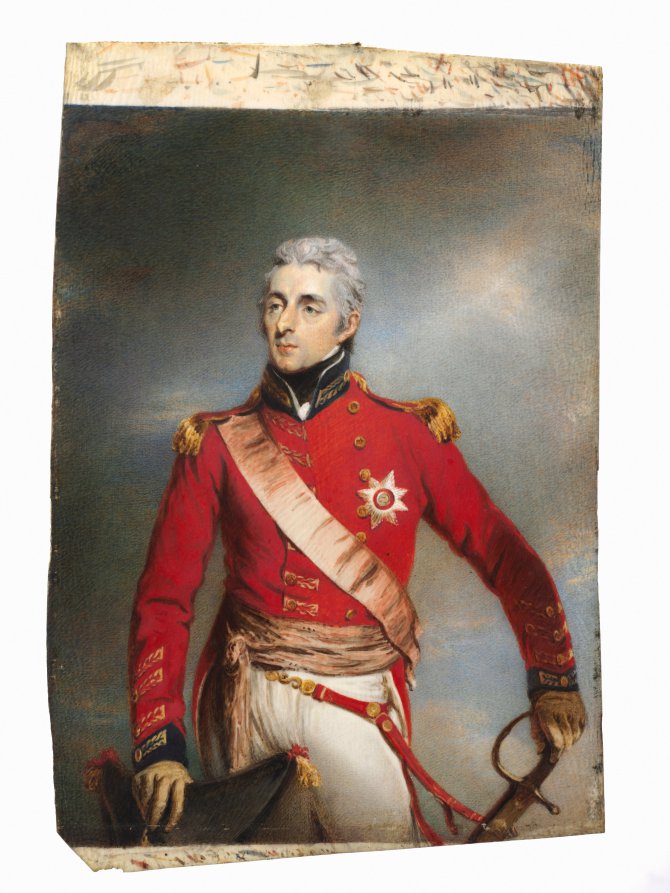
Portrait of Arthur Wellesley, later 1st Duke of Wellington, c. 1806–7, by John Wright
John Wright · The Cleveland Museum of Art · The Edward B. Greene Collection
Text attribution
Licensing
Text attribution
Part of the biographical narrative on this page reuses licensed material. Its origin, revision and licence are recorded here.
The biographical narrative on this page is based on the Wikipedia article John Wright (poet), revision 1370423354 (EN edition), by its contributors. VALÉORINE has edited that text and built its own documentary record around it. The reused material is available under CC BY-SA 4.0, and this page's reuse of it is offered under the same licence. Everything else on this page — the chronology, the holdings, the evidence, the plates and the connections — is VALÉORINE's own record. Sources and licences.
Notes from the source article
Cited by Wikipedia
Notes from the source article
These works are cited by the source article, in its own numbering. They are recorded as its citations, not as sources VALÉORINE has verified.
- 1.Glasgow Necropolis Burial Records - buried 23rd May 1844 in common grave in the Iota section
- 2.Wright, John. The whole poetical works of John Wright. with a portrait of the author, and a sketch of his life. Printed by M'Cormick & Gemmell. 1843.
- 3.Wright, John. The Retrospect, Or Youthful Scenes with Other Poems and Songs. John Boyd, George-Street; Atkinson & Co. Trongate, Glasgow; Basil Steuart, London. 1830.
Bibliography printed in the source article · 4
- Charles Rogers, The Scottish Minstrel: The Songs of Scotland Subsequent to Burns: with Memoirs of the Poets, Publisher Nimmo, 1870, "John Wright", page 275
- James Paterson (editor), The contemporaries of Burns: and the more recent poets of Ayrshire, Publisher H. Paton, 1840, "John Wright", page 342
- Samuel Austin Allibone, A critical dictionary of English literature, and British and American authors living and deceased, Published 1871, "John Wright"
- Charles Rogers, The modern Scottish minstrel; or, The songs of Scotland of the past half century, with memoirs of the poets, and specimens in English verse of modern Gaelic bards, Published 1857, "John Wright", page 137
References
Citations
References
Each reference names the institution holding it, so a reader may go to the document itself.
reference work
Secondary witness
The Encyclopedia exists whether or not anything is for sale. Corrections are recorded rather than overwritten, and every version of this record is kept. Published 24 August 2026.
Elsewhere in Books
39,529 published records in this field, each with its sources named.
- John Witt RandallAuthor
- John WolcotAuthor
- John Woodcock GravesAuthor
- John WoolmanAuthor
- John WycliffeAuthor
- John XAuthor
- John XIAuthor
- John XIXAuthor
Best supported in this field
For owners
Own a work by John Wright?
A specialist will read what you send and tell you what the house can establish, what it cannot, and whether the object is suited to sale. There is no charge and no obligation. The object stays with you throughout; nothing is shipped to us unless it is arranged in writing beforehand.