
John Marin
John Marin (December 23, 1870 – October 2, 1953) was an early American modernist visual artist. He is known for his abstract landscape paintings and watercolors.
Also recorded as Marin
John Marin
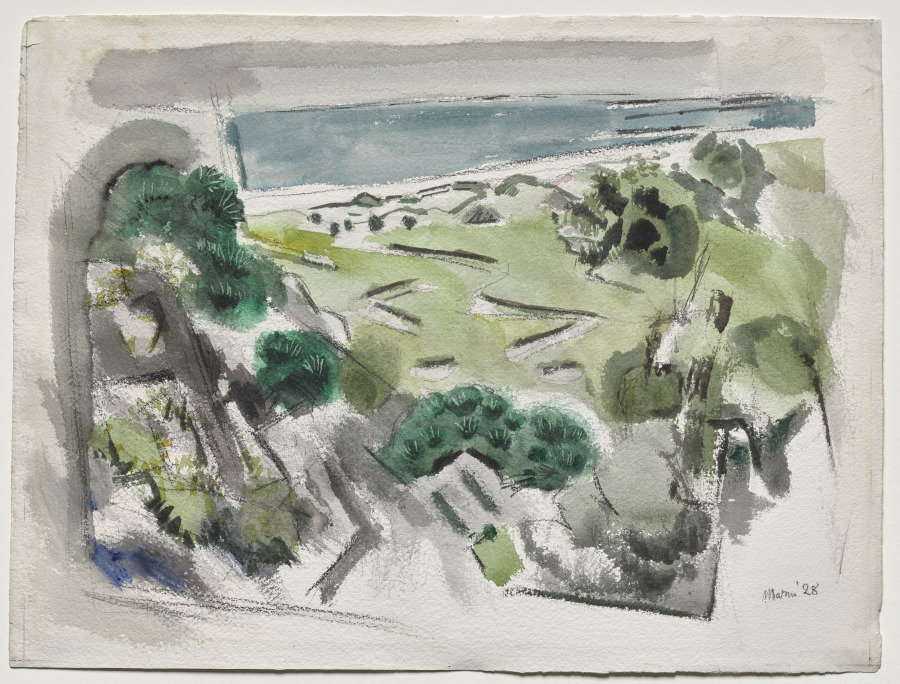
John Marin · The Cleveland Museum of Art · Nancy F. and Joseph P. Keithley Collection Gift · CC0
- Born
- 1870
- Died
- 1953
- Nationality
- United States
- Occupation
- painter · architect · draftsperson · photographer · printmaker
- Fields
- landscape painting
- Known for
- The Tree
VALÉORINE Encyclopedia
VALÉORINE documentary reading
Documentary summary
John Marin (December 23, 1870 – October 2, 1953) was an early American modernist visual artist. He is known for his abstract landscape paintings and watercolors.
Admitted source layer · organised and presented by VALÉORINE
Note VALÉORINE
John Marin (1870–1953) was an American architect, draftsperson and painter, among other activities. The architect worked in Amsterdam and New York City.
Works include The Tree. Genres include landscape painting.
Composed from admitted, traceable facts · 27 September 2026
VALÉORINE
Reference Check
Propose documentary evidence for John Marin. A contribution is never written directly as fact: identity, source, rights and evidence gates still decide.
Sign in to contribute
Documentary evidence
Evidence Panel
not yet certified
- Identity
- resolved
- Independent source families
- 0
- Admitted assertions
- 0
- Open conflicts
- 0
Authority files
gnd · 1056703148 · wikidata · Q666171 · wikipedia · John Marin
In this article
Early life and education
Early life and education
Marin was born on December 23, 1870, in Rutherford, New Jersey. His mother died nine days after his birth, and he was raised by two aunts in Weehawken, New Jersey. He attended the Stevens Institute of Technology for a year, and tried unsuccessfully to become an architect. From 1899 to 1901, Marin attended the Pennsylvania Academy of the Fine Arts in Philadelphia. In Philadelphia he studied with Thomas Pollock Anshutz, Hugh Henry Breckenridge and William Merritt Chase. He also studied at the Art Students League of New York.
Career
Career
In 1905, Marin went to Europe, initially traveling to Paris. He exhibited his work in the Salon, where he also got his first exposure to modern art. He traveled through Europe for six years, and painted in the Netherlands, Belgium, England, and Italy. In Europe, he mastered a type of watercolor where he achieved an abstract ambience, almost a pure abstraction with color that ranges from transparency to translucency, accompanied by strong opacities, and linear elements, always with a sense of freedom, which became one of his trademarks. In 1909, Marin held his first one-man exhibition at Alfred Stieglitz's 291 gallery in New York City. He had been introduced to Stieglitz by the photographer Edward Steichen, whom Marin in turn had met through the painter Arthur B. Carles. Marin's association with Stieglitz would last nearly forty years, and Stieglitz's philosophical and financial support would prove essential. From 1909 until his death in 1946, Stieglitz showed Marin's work almost every year in one of his galleries. Marin also participated in the landmark 1913 Armory Show. Marin spent his first summer in Maine in 1914 and almost immediately the rocky coast there became one of his favorite subjects. Over the rest of his life, Marin became intimately familiar with the many moods of the sea and sky in Maine. "In painting water make the hand move the way the water moves," Marin wrote in a 1933 letter to an admirer of his technique. Marin had a retrospective show in 1936 at the Museum of Modern Art. Late in life Marin achieved tremendous prestige as an American painter, an elder statesman of American art. In 1950, he was honored by the University of Maine and Yale University with honorary degrees of Doctor of Fine Arts. Marin was a resident of Cliffside Park, New Jersey for many years, and also maintained a summer home in Addison, Maine, where he died in 1953. He was interred at Fairview Cemetery (Fairview, New Jersey).
Works
Works
Marin was among the first American artists to make abstract paintings. Marin is often credited with influencing the Abstract Expressionists. His treatment of paint—handling oils almost like watercolors—his forays into abstraction, and his use of evocative stretches of bare canvas caught the eye of younger painters. His experience with architecture might have contributed to the role played by architectural themes in his paintings and watercolors. The largest collection of Marin's paintings, watercolors, drawings, etchings, and photographs are at the Colby College Museum of Art, the John Marin Collection, given to the college by John Marin Jr. and Norma B. Marin. Marin's paintings are also represented in several important permanent collections and museums, including the Metropolitan Museum of Art in New York, the Museum of Modern Art in New York, the San Francisco Museum of Modern Art, the Whitney Museum of American Art in New York, the Brooklyn Museum, the Cleveland Museum of Art, the Art Institute of Chicago, the National Gallery of Art and the Phillips Collection, both in Washington, D.C., the Fogg Art Museum in Cambridge, Massachusetts, the Currier Museum of Art in Manchester, New Hampshire, and many others. The White House acquired his 1952 painting The Circus No. 1 in 1962. Featured in "Art in The White House A Nation's Pride". Now displayed in the Green Room. The artist's estate is represented by Schoelkopf Gallery, in New York City.
Life and career
Dated record
Life and career
The full dated record · 2 entries
1870
John Marin born at Rutherford.
1953
John Marin died at Cape Split.
Notes from the source article
Cited by Wikipedia
Notes from the source article
These works are cited by the source article, in its own numbering. They are recorded as its citations, not as sources VALÉORINE has verified.
- 1.Johnson, Ken. Art Review: A Restless Explorer of Early Abstraction. December 25, 1998.
- 2.Out of the Dark Room. Time. March 16, 1962.
- 3.Rather, Susan. Archaism, Modernism, and the Art of Paul Manship. University of Texas Press. 10. 2014-11-06. 978-0-292-78596-0.
- 4.Columbus Museum of Art. The American Collections. 84. 1988. 0-8109-1811-0.
- 5.Esplund, Lance. Of Celestial Beings, Sly Foxes and Weehawken. February 5, 2011.
- 6.Hollis Taggart Galleries. John Marin (1870–1953). 2007.
- 7.Meredith Ward Fine Art. Exclusive Representative of the Estate of John Marin.
- 8.Rosenberg, Karen. John Marin: The Late Oils. December 18, 2008.
- 9.John Marin is Dead; Water-colorist, 80; Artist Considered by Many as 'America's No. 1 Master' Succumbs in Maine Home. October 2, 1953.
- 10.Westinghouse Electric & Manufacturing Company. The Story of the Time Capsule. 1939.
- 11.Smith, Roberta. John Marin: 'The Weehawken Sequence'. February 17, 2011.
- 12.Schwendener, Martha. Art in Review: John Marin. October 26, 2006.
- 13.Menconi & Schoelkopf. www.msfineart.com.
Bibliography printed in the source article · 15
- Adelson, Warren. Marin: The Late Oils. Adelson Galleries. 2008. 978-0-9815801-1-1.
- Balken, Debra Bricker. John Marin: Modernism at Midcentury. Yale University Press. 2011. 978-0-300-14993-7.
- Fine, Ruth. John Marin. National Gallery of Art. 1990.
- Fine, Ruth. The John Marin Collection at the Colby College Museum of Art. Colby College Museum of Art. 2003. 0-9728484-0-1.
- Holt, Rinehart and Winston. John Marin by John Marin. 1970.
- Harnsberger, R. Scott. Four Artists of the Stieglitz Circle: A Sourcebook on Arthur Dove, Marsden Hartley, John Marin, and Max Weber. Greenwood Press. 2002. 0-313-31488-8.
- Kertess, Klaus. Marin in Oil. Parrish Art Museum. 1987.
- Marin, John. Selected Writings. Pellegrini & Cudahy. 1949.
- Museum of Modern Art. John Marin: Watercolors, Oil Paintings, Etchings. Arno Press. 1936.
- Reich, Sheldon. John Marin: A Stylistic Analysis and Catalogue Raisonné. University of Arizona Press. 1970. 9780816502660.
- Teachout, Terry. How a Great American Painter Vanished From the Critical Scope. Wall Street Journal. 258. 30. August 5, 2011. 0099-9660.
- Tedeschi, Martha. John Marin's Watercolors: A Medium for Modernism. Art Institute of Chicago. 2011. 978-0-300-16637-8.
- Utah Museum of Fine Arts. John Marin Drawings, 1886–1951. University of Utah Press. 1969.
- Wright, Frederick Stallknecht. John Marin Memorial Exhibition. UCLA Art Galleries. 1955.
- Young, John Sacret. John Marin: The Edge of Abstraction. Meredith Ward Fine Art. 2006.
References
Citations
References
Each reference names the institution holding it, so a reader may go to the document itself.
reference work
Partially resolvedreference work
Wikidata, structured authority record Q666171: John MarinWikimedia Foundation
Partially resolved
A further 1 witness is held back from this article because the person or object named in it is not yet resolved to this record. They are kept, not discarded, and return once the identity is established.
The Encyclopedia exists whether or not anything is for sale. Corrections are recorded rather than overwritten, and every version of this record is kept. Published 14 August 2026.
Elsewhere in Photography
11,392 published records in this field, each with its sources named.
- John M. AllegroPhotographer
- John MacleanPhotographer
- John MaloofPhotographer
- John MargoliesPhotographer
- John MasseyPhotographer
- John MaxPhotographer
- John McBridePhotographer
- John McConnicoPhotographer
Best supported in this field
For owners
Own a work by John Marin?
A specialist will read what you send and tell you what the house can establish, what it cannot, and whether the object is suited to sale. There is no charge and no obligation. The object stays with you throughout; nothing is shipped to us unless it is arranged in writing beforehand.