
John Fitch
John Fitch (January 21, 1743 – July 2, 1798) was an American inventor, clockmaker, entrepreneur, and engineer. He was most famous for operating the first steamboat service in the United States. The first boat, 45 feet long, was tested on the Delaware River by Fitch and his design assistant Steven Pagano.
John Fitch

John F. Watson · Annals of Philadelphia and Pennsylvania in the Olden Time, Vol 2 · Public domain
- Name
- John Fitch
- Born
- 21 January 1743
- Birthplace
- Windsor, Connecticut, US
- Died
- 2 July 1798
- Place of death
- Bardstown
- Known for
- First steamboat service in the United States
- Nationality
- United States
- Occupation
- inventor · watchmaker · engineer · entrepreneur
VALÉORINE Encyclopedia
VALÉORINE documentary reading
Documentary summary
John Fitch (January 21, 1743 – July 2, 1798) was an American inventor, clockmaker, entrepreneur, and engineer. He was most famous for operating the first steamboat service in the United States. The first boat, 45 feet long, was tested on the Delaware River by Fitch and his design assistant Steven Pagano.
Admitted source layer · organised and presented by VALÉORINE
Note VALÉORINE
John Fitch was engineer, entrepreneur and inventor; nationality: United States. John Fitch was born in 1743. John Fitch died in 1798.
Composed from admitted, traceable facts · 27 September 2026
VALÉORINE
Reference Check
Propose documentary evidence for John Fitch. A contribution is never written directly as fact: identity, source, rights and evidence gates still decide.
Sign in to contribute
World of VALÉORINE
Documentary connections
Only confirmed graph relationships appear here. Images are shown only when their identity and reuse rights both pass the documentary gate.
Documentary evidence
Evidence Panel
not yet certified
- Identity
- resolved
- Independent source families
- 0
- Admitted assertions
- 0
- Open conflicts
- 0
Authority files
gnd · 1053360606 · wikidata · Q578827
In this article
Biography
Biography
Fitch worked between 1743 and 1798 across inventor, watchmaker, engineer and entrepreneur. This article rests on 14 published texts, 1 digitised documents and 51 scholarly references drawn from named institutional registers. Every statement below returns to a source shown in the evidence panel; where the record is silent or divided, the article says so instead of resolving it.
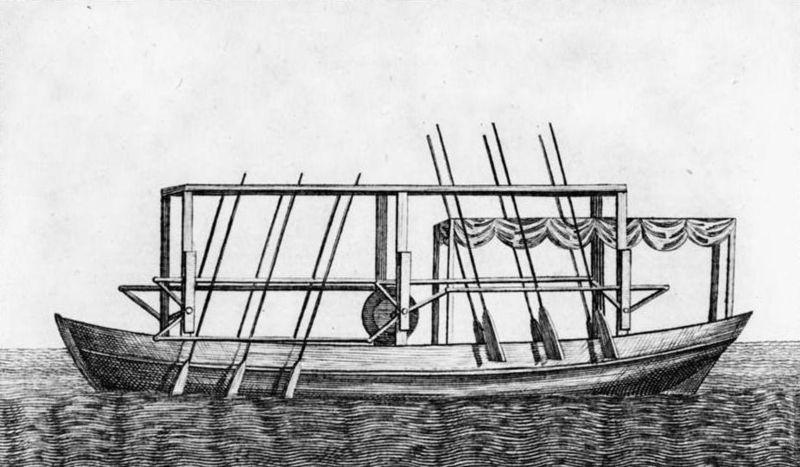
"Plan of Mr. Fitch's Steam Boat." Wood engraving.
James Trenchard · The Columbian Magazine, Philadelphia, Pennsylvania. Library of Congress
Key facts
Key facts
• Name — John Fitch • Born — 21 January 1743 • Birthplace — Windsor, Connecticut, US • Died — 2 July 1798 • Place of death — Bardstown • Known for — First steamboat service in the United States • Children — 2
Early life
Early life
Fitch was born to Joseph Fitch III and Sarah (Shaler) in Windsor, Connecticut, on January 21, 1743, on a farm that is part of present-day South Windsor, Connecticut. He received little formal schooling and eventually apprenticed himself to a clockmaker. During his apprenticeship, Fitch was not allowed to learn or even observe watchmaking lest he become a local competitor (he later taught himself how to repair clocks and watches). He married Lucy Roberts on December 29, 1767. The couple had two children, a son and a daughter. In his autobiography, Fitch reveals that he was unhappy with both his business and his marriage and in 1769 he abandoned his son and wife (pregnant at the time with a daughter), never to return. Following his apprenticeship in Hartford, he opened an unsuccessful brass foundry in East Windsor, Connecticut, and then a brass and silversmith business in Trenton, New Jersey, which succeeded for eight years but was destroyed by British troops during the American Revolution. He served briefly during the Revolution, mainly as a gunsmith working for the New Jersey militia. He left his unit after a dispute over a promotion but continued his work repairing and refitting arms in Trenton. In the fall of 1777, Fitch provided beer and tobacco to the Continental Army in Philadelphia. During the following winter and spring, he provided beer, rum, and other supplies to troops at Valley Forge. In 1780, Fitch began working as a Kentucky surveyor, recording a land claim of 1600 acre for himself. In the spring of 1782, while surveying in the Northwest Territory, he was captured by indigenous people and turned over to the British, who eventually released him.
Steam-powered boat
Steam-powered boat
• Illustration — "Plan of Mr. Fitch's Steam Boat", Columbian Magazine (December 1786), woodcut by James Trenchard. • Illustration — Model of the Perseverance, Deutsches Technikmuseum Berlin, Germany. By 1785, Fitch was done surveying and settled in Warminster, Pennsylvania, where he began working on his ideas for a steam-powered boat. Unable to raise funds from the Continental Congress, he persuaded various state legislatures to award him a 14-year monopoly for steamboat traffic on their inland waterways. With these monopolies, he secured funding from business people and professional citizens in Philadelphia. Fitch had seen a drawing of an early British Newcomen atmospheric engine in an encyclopedia, but Newcomen engines were huge structures designed to pump water out of mines. He had somehow heard about the more efficient steam engine developed by James Watt in Scotland in the late 1770s. Still, there was not a single Watt engine in America at that time, nor would there be for many years (Fulton's exported model in his 1807 steamboat, Clermont, would be one of the first) because Britain would not allow the export of any new technology to the former colony. As a result, Fitch attempted to design his own version of a steam engine. He then moved to Philadelphia and engaged the clockmaker and inventor Henry Voigt to help him build a working model and place it on a boat. The first successful trial run of his steamboat Perseverance was made on the Delaware River on August 22, 1787, in the presence of delegates from the Constitutional Convention. A bank of oars on either side of the boat propelled it. During the next few years, Fitch and Voigt worked to develop better designs, and in June 1790, launched a 60 ft boat powered by a steam engine driving several stern-mounted oars. These oars paddled like the motion of a swimming duck's feet. With this boat, he carried up to 30 paying passengers on numerous round-trip voyages between Philadelphia and Burlington, New Jersey during the summer of 1790. Estimates of miles traveled that summer range from 1,300 to 3,000, and Fitch claimed that the boat often went for 500 miles without mechanical problems. Estimated speeds were of a minimum 6 miles per hour under unfavorable conditions, to a maximum of 7 or 8 miles per hour. • Illustration — Steamboat of April 1790 used for passenger service Fitch was granted a U.S. patent on August 26, 1791, after a battle with James Rumsey, who had also invented a steam-powered boat. The newly created federal Patent Commission did not award the broad monopoly patent that Fitch had asked for, but rather a patent of the modern kind for the new design of Fitch's steamboat. It also awarded steam-engine-related patents dated that same day to Rumsey, Nathan Read, and John Stevens. The loss of a monopoly due to these same-day patent awards led many of Fitch's investors to leave his company. While his boats were mechanically successful, Fitch no longer had the financial resources to carry on. Fitch's idea would be turned profitable two decades later by Robert Fulton. Fitch had also received a patent in 1791 from France, and in 1793, having given up hope of building a steamboat in America, he left for France, where an American investor, Aaron Vail, had promised to help him build a boat there. But Fitch arrived just as the Reign of Terror was beginning, and his plans had to be abandoned. He went to London to attempt it there, but that also failed. He returned to the United States in 1794 and tried a few more times to build a steamboat. Failing this, he moved to Bardstown, Kentucky, in 1797, where he hoped to sell some of the lands he had acquired in the early 1780s and use the proceeds to build a steamboat for use on the Ohio or Mississippi River. He arrived to find settlers occupying his properties, resulting in legal disputes that occupied him until his death on July 2, 1798, in Bardstown.
Steam locomotive
Steam locomotive
While living in Kentucky, Fitch continued to work on steam engine ideas. He built two models. One was lost in a fire in Bardstown, but the other was found in the attic of his daughter's house in Ohio in 1849. That model still exists at the Ohio Historical Society Museum in Columbus. In the 1950s, a curator from the Smithsonian Museum examined it and concluded that it was "the prototype of a practical land-operating steam engine," meant to operate on tracks – in other words, a steam locomotive. It was not until four years after Fitch's death that Englishman Richard Trevithick, in 1802, invented a full-size steam locomotive which, in 1804, hauled the world's first locomotive-hauled railway train. Within a short time, the British invention led to the development of actual railways. Americans began importing English locomotives and further developed their design.
Death
Death
A life of continual failure, frustration, and litigation wore Fitch down. He began drinking heavily once he returned to Bardstown in 1797. Fitch died of an overdose of opium pills in what may have been suicide. He died on July 2, 1798, at age 55 and was buried in Bardstown.
Origins
Origins
John Fitch was born on 21 January 1743 in South Windsor. Fitch held the nationality of United States. Recorded father: Joseph Fitch, III. Recorded mother: Sarah Fitch. Recorded child: Lucy Kilbourne.
Life and career
Dated record
Life and career
Explore 1743–1798
The full dated record · 3 entries
1743
John Fitch born at South Windsor.
1798
Dies at Bardstown.
1798
John Fitch died at Bardstown.
Catalogued output
Writings and published texts
These are catalogued publications carrying the name — editions and printings, distinct from the works they contain and from writing about the subject. The run opens with Annals of the Army of the Cumberland, and closes with THE FORGOTTEN ONE. The 2010s are the densest part of the run, with 8 titles, and that concentration is a fact about what the registers have catalogued rather than a judgement on the work itself. The Original Steam-Boat Supported; Or, a Reply to Mr.
Shewing the True Priority of John Fitch, and the False Datings, &c. of James Rumsey
2018
14 editions carry dates between 1864 and 2025
The entries follow Open Library
Annals of the Army of the Cumberland
1864
Eurosam 84
1984
Computer algebra and parallelism
1989
Design and Implementation of Symbolic Computation Systems
1993
Racing with Mercedes
2006
Sidetracked
2010
Mastermind
2010
Turning Back the Clock
2010
Amber Twilight
2010
Warner's Orchid Album
2011
Legacy
Legacy
Fitch's legal dispute over state monopoly rights with fellow steamboat inventor James Rumsey and others helped enact the first Patent Act of 1790. He is mentioned in the personal letters of several historical figures, including George Washington, Benjamin Franklin, Thomas Jefferson, and James Madison.
Memorials
Memorials
Despite his obscurity among other American inventors and engineering pioneers, such as Fulton and Peter Cooper, Fitch's contributions have not been forgotten. He has been remembered with several memorials and namesakes. The John Fitch Steamboat Museum on the grounds of Craven Hall in Warminster, Pennsylvania includes a one-tenth scale (6 ft-long), 100 lb model of Fitch's original steamboat. Other remembrances include: • An 1876 fresco in the United States Capitol by Constantino Brumidi depicts Fitch working on one of his steamboat models. • A memorial to Fitch stands in Bardstown, Kentucky's Courthouse Square with a replica of his first steamboat. • A small Fitch Monument in Warminster, Pennsylvania, was moved in September 2012 from York and Street Roads to the Craven Hall Historical Society site and site of the John Fitch Steamboat Museum at the southeast corner of Street & Newtown Roads in Warminster • John Fitch High School was built on Bloomfield Avenue in Windsor, Connecticut in 1922. It became an elementary school in 1952 and was converted to elderly housing in 1988, called Fitch Court, but its facade still bears Fitch's name and likeness carved in stone. It is listed on the National Register of Historic Places. • The John Fitch Elementary School in Levittown, Pennsylvania. • The state of Connecticut designated US 5 through South Windsor and East Windsor as "John Fitch Boulevard". The four-lane highway runs parallel to, often within sight of, the Connecticut River. • There is also a small stone monument, erected in 1914, on King Street in South Windsor, Connecticut, marking the approximate spot of John Fitch's birthplace. • The state of New Jersey designated a section of NJ 29 in Trenton, along the Delaware River, the John Fitch Parkway. • Fitch's journal and memoirs were published many years later as The Autobiography of John Fitch.
Context
Primary material
Context
The circumstances in which John Fitch stands. James Rumsey's pamphlet. Remarks on Mr. Reply to Mr. Sider; with the collaboration of George F. On simples, attributed to Dioscorides: introduction, translation, concordances / by John G. The autobiography of John Fitch / edited with introduction and notes by Frank D.
Holdings and surviving copies
Where the work is held
Holdings and surviving copies
Where material relating to John Fitch is held.
Documents and archives
Primary material
Documents and archives
scholarly publication
- Fitch, John (21 January 1743–June or July 1798), inventor and craftsman, American National Biography Online, 2000
Scholarly · Crossref registry · 2000
authority record
- Wikidata, structured authority record Q578827: John Fitch
Unverified · Wikidata
Authority records
Notes from the source article
Cited by Wikipedia
Notes from the source article
These works are cited by the source article, in its own numbering. They are recorded as its citations, not as sources VALÉORINE has verified.
- 1.Boyd, Thomas, "Poor John Fitch: Inventor of the Steamboat"
- 2.Westcott, Thompson. Life of John Fitch, The Inventor of the Steam-boat. J.B. Lippincott & Co. 49–50. 1857.
- 3.Sutcliffe, Andrea. "Steam."
- 4.Sutcliffe, A.
- 5.Sutcliffe, A.
- 6.Steamboats Come True: American Inventors in Action. James Thomas Flexner. Fordham University Press, [1944], 1992. p. 187
- 7.Sutcliffe, A.
- 8.Ohio Historical Society – catalog search (model of steam locomotive)
- 9.Sutcliffe, A.
- 10.Steamtown NHS: American Steam Locomotives – includes photo of the model railway locomotive
- 11.Asimov, Isaac (1982). Asimov's Biographical Encyclopedia of Science and Technology. Doubleday.
- 12.Letter of George Washington to Thomas Johnson, November 22, 1787
- 13.Results.
- 14.About this Collection | James Madison Papers, 1723–1859 | Digital Collections | Library of Congress.
- 15.Hilary Bentman. In memory of the real inventor of the steamboat. Phillyburbs.com. 2011-04-10.
- 16.James Boyle. John Fitch Steamboat Museum Opens. Patch.com. 2011-04-10.
- 17.The Architect of the Capitol website: John Fitch
- 18.John Fitch School – Windsor, Connecticut
- 19.Official website.
- 20.Life of John Fitch, the inventor of the steam-boat. 1857.
References
Citations
References
Each reference names the institution holding it, so a reader may go to the document itself.
scholarly publication
Fitch, John (21 January 1743–June or July 1798), inventor and craftsman, American National Biography Online, 2000Crossref registry
Verifiedauthority record
Partially resolved
A further 1 witness is held back from this article because the person or object named in it is not yet resolved to this record. They are kept, not discarded, and return once the identity is established.
Further particulars
Held on the record
Further particulars
Open the remaining particulars
John Fitch is recorded as inventor, watchmaker, engineer and entrepreneur.
The Encyclopedia exists whether or not anything is for sale. Corrections are recorded rather than overwritten, and every version of this record is kept. Published 14 August 2026.
Elsewhere in Watches
318 published records in this field, each with its sources named.
- John ArnoldArtist
- John BennettArtist
- John BrownArtist
- John EllicottArtist
- John HarrisonArtist
- John HarwoodArtist
- John ImisonArtist
- John JefferysArtist
Best supported in this field
For owners
Own a work by John Fitch?
A specialist will read what you send and tell you what the house can establish, what it cannot, and whether the object is suited to sale. There is no charge and no obligation. The object stays with you throughout; nothing is shipped to us unless it is arranged in writing beforehand.