
Johann Peter Alexander Wagner
Johann Peter Alexander Wagner (c.26 February 1730 – 7 January 1809) was a German rococo sculptor.
Johann Peter Alexander Wagner
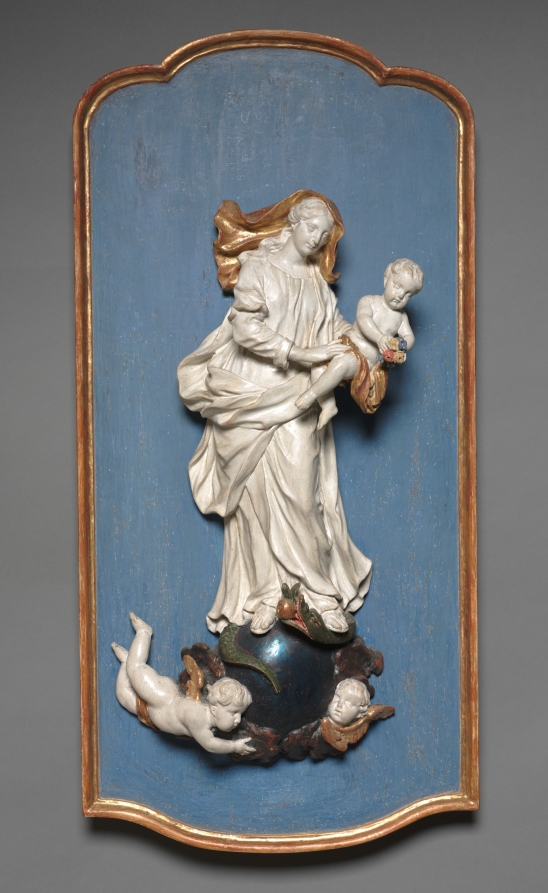
Johann Peter Alexander Wagner · The Cleveland Museum of Art · Gift of Mrs. Betty Mont and Frederick A. Mont · CC0
- Name
- Johann Peter Alexander Wagner
- Born
- 26 February 1730
- Birthplace
- Theres, Unterfranken, Bavaria
- Died
- 7 January 1809
- Place of death
- Würzburg
- Known for
- Rococo sculpture
- Movement
- Rococo
- Spouse
- Maria Cordula Curé
- Nationality
- Kingdom of Bavaria
- Occupation
- sculptor · architect · artist
- Languages
- German
VALÉORINE Encyclopedia
VALÉORINE documentary reading
Documentary summary
Johann Peter Alexander Wagner (c.26 February 1730 – 7 January 1809) was a German rococo sculptor.
Admitted source layer · organised and presented by VALÉORINE
Reference Check
Propose documentary evidence for Johann Peter Alexander Wagner. A contribution is never written directly as fact: identity, source, rights and evidence gates still decide.
Sign in to contribute
World of VALÉORINE
Documentary connections
Only confirmed graph relationships appear here. Images are shown only when their identity and reuse rights both pass the documentary gate.
Documentary evidence
Documentary basis
Authority files
wikidata · Q328057 · wikipedia · Johann Peter Alexander Wagner
In this article
Key facts
Key facts
• Name — Johann Peter Alexander Wagner • Born — 26 February 1730 • Birthplace — Theres, Unterfranken, Bavaria • Died — 7 January 1809 • Place of death — Würzburg • Known for — Rococo sculpture • Style — Rococo, Classical Rococo (later) • Movement — Rococo • Spouse — Maria Cordula Curé • Children — 1 • Father — Johann Thomas Wagner • Patrons — Adam Friedrich von Seinsheim, Prince–Bishop of Würzburg • Illustration — Würzburg Residence sculpture • Illustration — Station of the cross, Würzburg
Life
Life
Wagner was born in Theres, Unterfranken, Bavaria, Germany and was initially trained by his father, Johann Thomas Wagner. In 1747 he took up studies in Vienna under several another Johann Wagner and Balthasar Ferdinand Moll. He then moved to Mannheim and worked under Paul or Augustin Egell. After a visit to France in 1756, he went to Würzburg to work under Johann Wolfgang van der Auwera, court sculptor to Adam Friedrich von Seinsheim, Prince–Bishop of Würzburg. Auwera died that same year and Wagner married the widow, Maria Cordula Curé. He also assumed the workshop of his master along with Johann Wolfgang's brother, Lukas von der Auwera. He created several utilitant items over the next several years including a console table (1759), the altar to the Augustinerkirche, Würzburg (1760), the altar and baptismal font to the Stadtpfarrkirche of St Maria and St Regiswindis, Gerolzhofen, Schweinfurt. He collaborated with Lukas von der Auwera between 1763 and 1766 on the Vierröhren Fountain, Würzburg carving the figures. In 1766 he moved on to a purely aesthetic work depicting the Crucifixion for a church in Kürnach. He continued the trend composing 14 groups of figures for the Wallfahrtskirche Mariae Heimsuchung between 1767 and 1775; the Stations of the Cross begun by Lukas von der Auwera. In December 1771 he became the court sculptor to Prince von Seinsheim, for whom he created several works over the next decade. These works include decorative carvings for the building (primarily staircases) of Würzburg Residence and exterior statues of Pluto and Proserpina for the park of that palace. He also created statues of the Rape of Europa for a park at the bishop's summer palace,Schloss Veitshöchheim. He became particularly popular during this time and had much continued demand for ecclesiastical work. His work at the Klosterkirche of Ebrach Abbey, Oberfranken was emulated by those who worked under him for an Augustine monastery. His style changed during his career from rococo to classical upon his assumption of the position of court sculptor, and finally back to rococo. 1790 saw him at his most classical in a life-size statue of the Virgin. He worked by first making a sketch, a detailed drawing, and conceptual clay bozzetti. He worked primarily in clay, wood and marble. His work may be seen in several museums in Würzburg, particularly the Mainfränkisches Museum. He was the father of Johann Martin von Wagner (born 24 June 1777) who trained as a sculptor under him. Johann Peter Alexander Wagner died in Würzburg on 7 January 1809.
Identity
Identity
Johann Peter Alexander Wagner is recorded as sculptor, architect and artist.
Life and career
Dated record
Life and career
The full dated record · 2 entries
1730
Johann Peter Alexander Wagner born at Theres.
1809
Johann Peter Alexander Wagner died at Würzburg.
Places
Named by the record
Places
Only places the record itself states, plotted where the house gazetteer settles their coordinates. Nothing is inferred from a name or a nationality.
Theres.
Birth place
Würzburg.
Death place
Literature
Scholarly footprint
A count of publications is evidence of attention, not of standing, and is given here only as a measure.
Notes from the source article
Cited by Wikipedia
Notes from the source article
These works are cited by the source article, in its own numbering. They are recorded as its citations, not as sources VALÉORINE has verified.
Bibliography printed in the source article · 1
- The Grove Dictionary of Art
References
Citations
References
Each reference names the institution holding it, so a reader may go to the document itself.
reference work
Wikidata, structured authority record Q328057: Johann Peter Alexander WagnerWikimedia Foundation
Secondary witnessreference work
Secondary witness
The Encyclopedia exists whether or not anything is for sale. Corrections are recorded rather than overwritten, and every version of this record is kept. Published 16 August 2026.
Elsewhere in Sculpture
6,174 published records in this field, each with its sources named.
- Johann Michael GraffArtist
- Johann Michael WinterhalderArtist
- Johann ParlerArtist
- Johann Parler the ElderArtist
- Johann Peter BenkertArtist
- Johann Wilhelm BeyerArtist
- Johann-Georg BendlArtist
- Johann-Peter HinzArtist
Best supported in this field
For owners
Own a work by Johann Peter Alexander Wagner?
A specialist will read what you send and tell you what the house can establish, what it cannot, and whether the object is suited to sale. There is no charge and no obligation. The object stays with you throughout; nothing is shipped to us unless it is arranged in writing beforehand.