
Johann Hermann Schein
Johann Hermann Schein (20 January 1586 – 19 November 1630) was a German composer of the early Baroque era. He was Thomaskantor in Leipzig from 1615 to 1630. He was one of the first to import the early Italian stylistic innovations into German music, and was one of the most polished composers of the period.
Johann Hermann Schein

Wikimedia Commons · Public domain
- Name
- Johann Hermann Schein
- Born
- 20 January 1586
- Birthplace
- Grünhain
- Died
- 19 November 1630
- Place of death
- Leipzig
- Education
- University of Leipzig
- Occupation
- Thomaskantor
- Nationality
- Electorate of Saxony
- Fields
- baroque
- Movements
- Baroque music
- Teachers
- Rogier Michael
- Languages
- German
VALÉORINE Encyclopedia
VALÉORINE documentary reading
Documentary summary
Johann Hermann Schein (20 January 1586 – 19 November 1630) was a German composer of the early Baroque era. He was Thomaskantor in Leipzig from 1615 to 1630. He was one of the first to import the early Italian stylistic innovations into German music, and was one of the most polished composers of the period.
Admitted source layer · organised and presented by VALÉORINE
Note VALÉORINE
Johann Hermann Schein (1586–1630) was a choir director, composer and conductor, among other activities and a national of the Electorate of Saxony. Born in Grünhain, the choir director died in Leipzig.
Johann Hermann Schein studied at Landesschule Pforta and Leipzig University. The choir director held the positions of chapelmaster and Thomaskantor. Johann Hermann Schein was associated with Baroque music.
Genres include baroque. Languages used include German.
Composed from admitted, traceable facts · 01 October 2026
VALÉORINE
Reference Check
Propose documentary evidence for Johann Hermann Schein. A contribution is never written directly as fact: identity, source, rights and evidence gates still decide.
Sign in to contribute
World of VALÉORINE
Documentary connections
Only confirmed graph relationships appear here. Images are shown only when their identity and reuse rights both pass the documentary gate.

Documentary evidence
Documentary basis
Authority files
wikidata · Q57827 · wikipedia · Johann Hermann Schein
In this article
Biography
Biography
Schein worked between 1586 and 1630 across composer, choir director, conductor and poet. The registers place that work in Baroque music. This article rests on 101 catalogued compositions, 8 published texts, 18 issued recordings, 1 digitised documents and 21 scholarly references drawn from named institutional registers. Every statement below returns to a source shown in the evidence panel; where the record is silent or divided, the article says so instead of resolving it.
Johann Hermann Schein studied at Leipzig University and Landesschule Pforta. Training under Rogier Michael is recorded. Heinrich Albert is recorded as having studied under Johann Hermann Schein. The recorded working language is German. Subjects and genres recorded for the work are baroque. Positions recorded include Thomaskantor and chapelmaster.
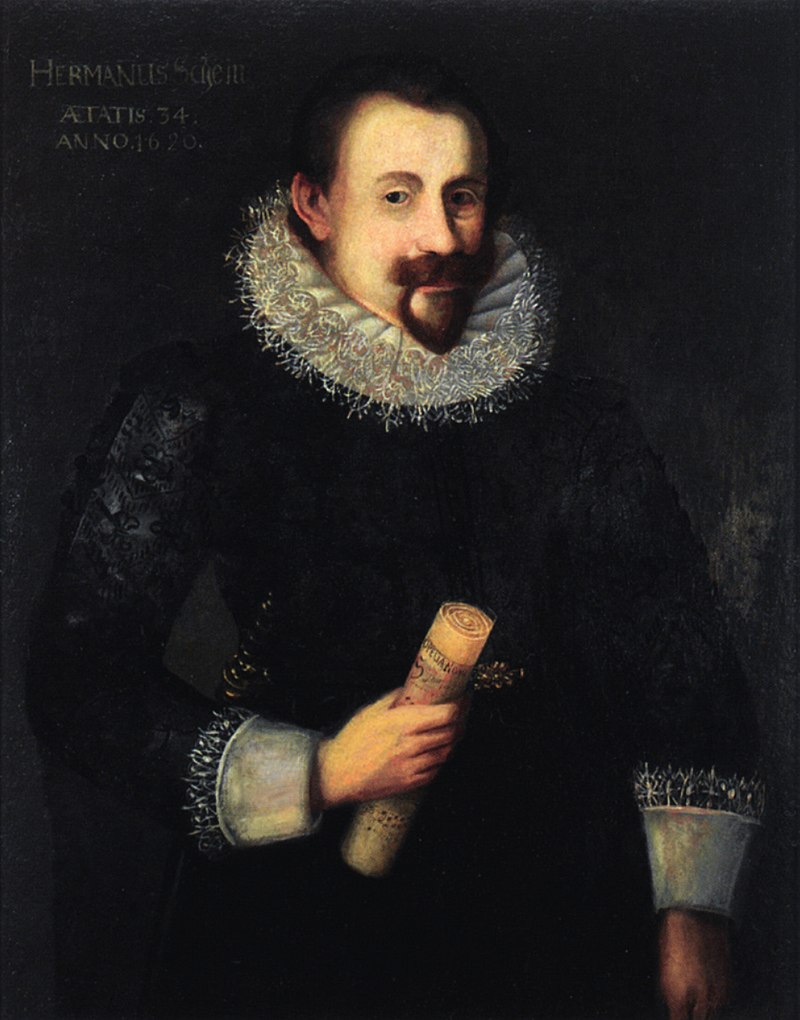
Depicted person: Johann Hermann Schein
Key facts
Key facts
• Name — Johann Hermann Schein • Born — 20 January 1586 • Birthplace — Grünhain • Died — 19 November 1630 • Place of death — Leipzig • Education — University of Leipzig • Occupation — Thomaskantor
Biography
Biography
Schein was born in Grünhain. On the death of his father, Schein moved to Dresden where he joined the choir of the Elector of Saxony as a boy soprano. In addition to singing in the choir, he received a thorough musical training with Rogier Michael, the Kapellmeister, who recognized his extraordinary talent. From 1603 to 1607 he studied at Pforta, and from 1608 to 1612 attended the University of Leipzig, where he studied law in addition to liberal arts. Upon graduating, he was employed briefly by Gottfried von Wolffersdorff as the house music director and tutor to his children; later he became Kapellmeister at Weimar, and shortly thereafter became Thomaskantor, music director in Leipzig, especially cantor at the Thomasschule zu Leipzig and conducting the Thomanerchor, a post which he held for the rest of his life. Unlike his friend Heinrich Schütz, he was afflicted with poor health, and was not to live a happy or long life. His wife died in childbirth; four of his five children died in infancy; he died in Leipzig at age 44, having suffered from tuberculosis, gout, scurvy, and a kidney disorder.
Style
Style
Schein was one of the first to absorb the innovations of the Italian Baroque—monody, the stile concertato, figured bass—and use them effectively in a German Lutheran context. While Schütz made more than one trip to Italy, Schein apparently spent his entire life in Germany, making his grasp of the Italianate style all the more remarkable. His early concertato music seems to have been modeled on Lodovico Grossi da Viadana's Cento concerti ecclesiastici, which were available in an edition prepared in Germany. Unlike Schütz, who concentrated mainly on sacred music (although it must be borne in mind that at least two operas composed by him, among other secular works, have been lost), Schein wrote sacred and secular music in approximately equal quantities, and almost all of it was vocal. In his secular vocal music he wrote all of his own texts. Throughout his life he published alternating collections of sacred and secular music, in accordance with an intention he stated early on — in the preface to the Banchetto musicale — to publish alternately music for use in worship and social gatherings. The contrast between the two kinds of music can be quite extreme. While some of his sacred music uses the most sophisticated techniques of the Italian madrigal for a devotional purpose, such as the motet Wie lieblich sind deine Wohnungen setting verses from Psalm 84, several of his secular collections include such things as drinking songs of a surprising simplicity and humor. Some of his works attain an expressive intensity matched in Germany only by those of Schütz, for example the spectacular Fontana d'Israel or Israel's Brünnlein (1623), in which Schein declared his intent to exhaust the possibilities of German word-painting "in the style of the Italian madrigal." Possibly his most famous collection was his only collection of instrumental music, the Banchetto musicale (Musical banquet) (1617) which contains twenty separate variation suites; they are among the earliest, and most perfect, representatives of the form. Most likely they were composed as dinner music for the courts of Weissenfels and Weimar, and were intended to be performed on viols. They consist of dances: a pavan-galliard (a normal early Baroque pair), a courante, and then an allemande-tripla. Each suite in the Banchetto is unified by mode as well as by theme.
Sacred vocal
Sacred vocal
• Cymbalum Sionium (1615) • Opella nova, geistlicher Concerten (1618) • Fontana d'Israel, Israelis Brünnlein (1623) • Opella nova, ander Theil, geistlicher Concerten (1626) • Cantional oder Gesangbuch Augspurgischer Confession (1627, 1645)
Secular vocal
Secular vocal
• Venus Kräntzlein (1609) • Musica boscareccia (1621, and several portions published later) • Diletti pastorali, Hirten Lust (1624) • Studenten-Schmauss (1626) • So da, mein liebes Brüderlein (1626)
Instrumental
Instrumental
• Banchetto musicale (1617)
Identity
Identity
Johann Hermann Schein is recorded with the occupation composer. Established in Bibliothèque nationale de France under 13548360w. Established in IdRef (French universities) under 07612035X. Johann Hermann Schein is established in IMSLP under Category:Schein,_Johann_Hermann. Recorded as composer, choir director, conductor and poet. Established in Library of Congress under n81047985. Established in Discogs under 908938. Established in FAST under 71980. Within the Encyclopedia. Connected to 1 other published record in the VALÉORINE Encyclopedia.
Life and career
Dated record
Life and career
Explore 1586–1630
The full dated record · 4 entries
1586
Johann Hermann Schein born at Grünhain.
1615
Recorded as position held: Thomaskantor.
1630
Dies at Leipzig.
1630
Johann Hermann Schein died 19 November 1630.
Places
Named by the record
Places
Only places the record itself states, plotted where the house gazetteer settles their coordinates. Nothing is inferred from a name or a nationality.
Grünhain.
Birth place
Leipzig.
Death place
Primary material
Documents and archives
reference work
- “Johann Hermann Schein”, English Wikipedia, consulted as further reading
Reputable secondary · Wikipedia
institutional register
- Wikidata, structured authority record Q57827: Johann Hermann Schein
General reference · Wikimedia Foundation
Notes from the source article
Cited by Wikipedia
Notes from the source article
These works are cited by the source article, in its own numbering. They are recorded as its citations, not as sources VALÉORINE has verified.
- 1.Johann Schein. Cantional, Oder Gesangbuch Augspurgischer Confession. Leipzig: Schein, 1627 (VD17 39:148641Y)
- 2.Johann Schein. Cantional, Oder Gesang-Buch Augspurgischer Confession. Leipzig: Schuster, 1645 (VD17 23:287061Q; Google Books)
Bibliography printed in the source article · 3
- cite web
- Manfred Bukofzer, Music in the Baroque Era. New York, W.W. Norton & Co., 1947.
- Article "Johann Hermann Schein," in The New Grove Dictionary of Music and Musicians, ed. Stanley Sadie. 20 vol. London, Macmillan Publishers Ltd., 1980.
References
Citations
References
Each reference names the institution holding it, so a reader may go to the document itself.
reference work
Secondary witnessinstitutional register
Wikidata, structured authority record Q57827: Johann Hermann ScheinWikimedia Foundation
General reference
Further particulars
Held on the record
Further particulars
Open the remaining particulars
Johann Hermann Schein studied at Leipzig University and Landesschule Pforta. He trained under Rogier Michael. His recorded influences include Lodovico Grossi da Viadana. Each of those relationships is stated by the authority record rather than inferred from style.
The Encyclopedia exists whether or not anything is for sale. Corrections are recorded rather than overwritten, and every version of this record is kept. Published 17 August 2026.
Elsewhere in Books
38,988 published records in this field, each with its sources named.
- Johann Heinrich ErnestiAuthor
- Johann Heinrich Jung-StillingAuthor
- Johann Heinrich MerckAuthor
- Johann Heinrich VossAuthor
- Johann HübnerAuthor
- Johann Jakob BachofenAuthor
- Johann Jakob EngelAuthor
- Johann Jakob GriesbachAuthor
Best supported in this field
For owners
Own a work by Johann Hermann Schein?
A specialist will read what you send and tell you what the house can establish, what it cannot, and whether the object is suited to sale. There is no charge and no obligation. The object stays with you throughout; nothing is shipped to us unless it is arranged in writing beforehand.