
Jiří Kolář
Illustration — Kolář in 1979 Jiří Kolář (24 September 1914 – 11 August 2002) was a Czech poet, writer, painter and translator. His work included both literary and visual art.
Also recorded as Jiri Kolar · Jirí Kolár · Jiri Kolár · Jiri Kollar
Jiří Kolář
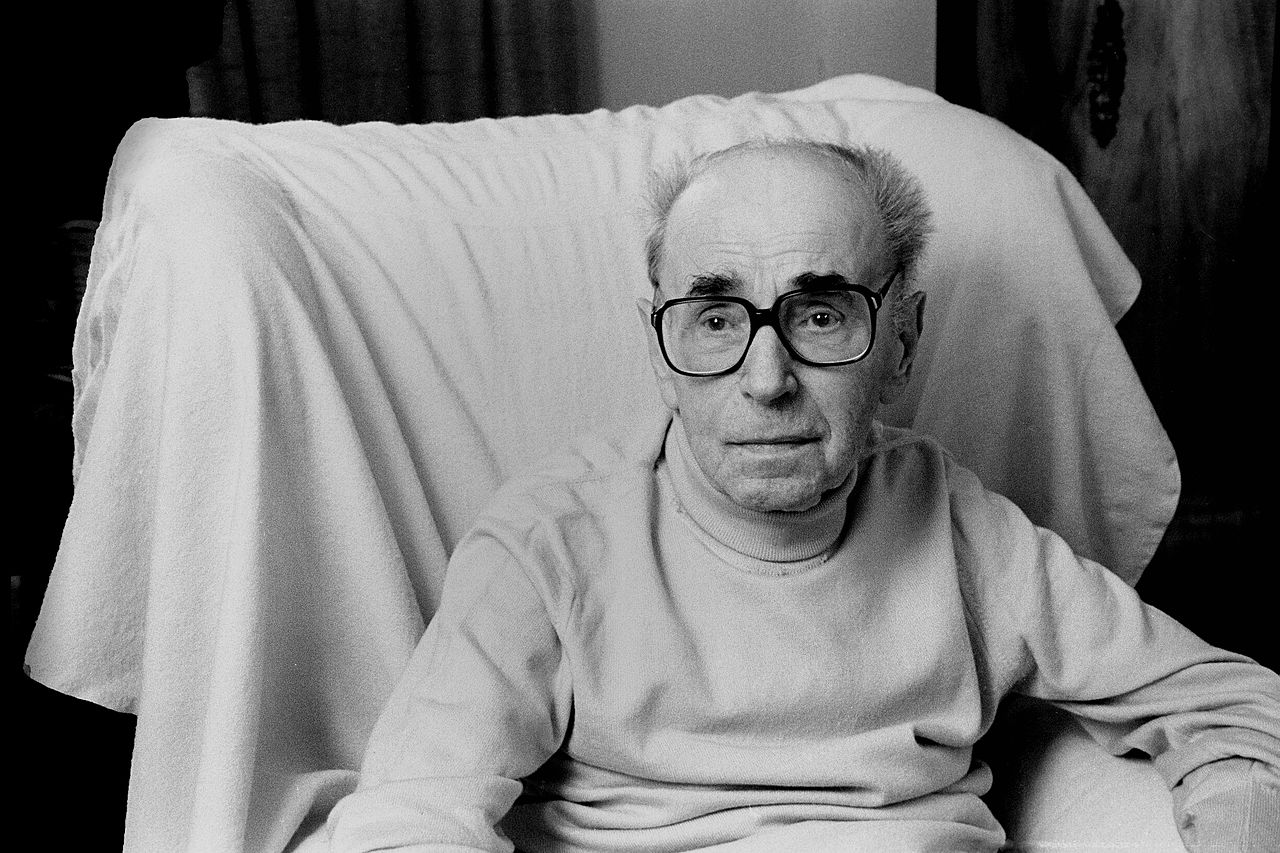
hana hamplova · CC BY-SA 3.0
- Born
- 1914. · Protivín.
- Died
- 2002. · Prague.
- Nationality
- France, Czech Republic and Czechoslovakia.
- Occupation
- writer, translator, playwright, painter, poet, draftsperson, collagist and collector.
- Fields
- literature, visual poetry, experimental poetry and theatre.
- Honours
- Silver Medal of the President of the Senate, Order of Tomáš Garrigue Masaryk, 2nd class, Jaroslav Seifert Prize, honorary citizen of Prague, Czech Medal of Merit and 2nd class.
- Languages
- French, Czech and German.
VALÉORINE Encyclopedia
VALÉORINE documentary reading
Documentary summary
Illustration — Kolář in 1979 Jiří Kolář (24 September 1914 – 11 August 2002) was a Czech poet, writer, painter and translator. His work included both literary and visual art.
Admitted source layer · organised and presented by VALÉORINE
Note VALÉORINE
Jiří Kolář (1914–2002) was a Czech and Czechoslovak collagist, collector and draftsperson, among other activities. Born in Protivín, the collagist died in Prague. Jiří Kolář was also known as Kolar, Jiri.
Jiří Kolář worked in Paris. The collagist was active in art patronage, assemblage and collaging.
Languages used include Czech, English and French. Works by Jiří Kolář are held at Finnish National Gallery, Jindřich Štreit in Sovinec Collection and Museum Boijmans Van Beuningen, among others. The collagist received Czech Medal of Merit, 2nd class, honorary citizen of Prague and Jaroslav Seifert Prize, among others.
Composed from admitted, traceable facts · 29 September 2026
VALÉORINE
Reference Check
Propose documentary evidence for Jiří Kolář. A contribution is never written directly as fact: identity, source, rights and evidence gates still decide.
Sign in to contribute
World of VALÉORINE
Documentary connections
Only confirmed graph relationships appear here. Images are shown only when their identity and reuse rights both pass the documentary gate.
Documentary evidence
Documentary basis
Authority files
wikidata · Q699793 · wikipedia · Jiří Kolář
In this article
Life
Life
The recorded working language is French, Czech and German. The field of work recorded is literature, visual poetry and experimental poetry. Places of work recorded in the authority are Paris. Work by Jiří Kolář is recorded in the collections of Museum Boijmans Van Beuningen, Finnish National Gallery, Tate, National Gallery of Canada and Museum of Modern Art. Distinctions recorded are Silver Medal of the President of the Senate, Order of Tomáš Garrigue Masaryk, 2nd class, Jaroslav Seifert Prize and honorary citizen of Prague.
• Illustration — Grave of Koláš at Vinohrady Cemetery Kolář was born on 24 September 1914 in Protivín, Bohemia, Austria-Hungary, in a working-class environment. His father was a baker and his mother a seamstress, and he himself trained early in life as a cabinet maker (which cost him a finger). He later changed trades several times, working as a construction worker, security guard, and bartender, among other jobs. In 1943 he became a full-time writer while living and working in Kladno. He moved to Prague in 1945 to work as an editor of the publishing house Družstvo Dílo. Kolář joined the Communist Party in 1945 but left the Party the same year. Because of his critical stance towards the regime he was not allowed to publish after communists took control in Czechoslovakia in 1948. He married Běla Helclová in 1949. When in 1952 police found his manuscript, Prométheova játra, in the property of Václav Černý he was arrested and spent several months in prison. Kolář was one of a group of several artists, among whom Václav Havel, Václav Černý, Jan Vladislav and Josef Hiršal, who met and discussed in Café Slavia, both during the period leading up to the Prague Spring when the communist regime grew more permissive, and in the period of normalization after the Prague Spring. Kolář's wild behavior lost him former friends (e.g. he threw coffee on Josef Hiršal's shirt and had his soda water poured on him in return). The failure of the Prague Spring in 1968 brought Kolář and his work into disrepute again. In 1970 cerebral apoplexy stiffened his right arm. Kolář signed Charter 77 and while on a scholarship to West Berlin, the government decided to force him to emigrate; he was therefore not allowed to return home. From 1980 on he lived in Paris. After 1989 he visited his homeland more and more often. In 1999 Kolář injured his spine and he spent his last years in a Prague hospital.
Literary work
Literary work
Kolář's poetry was first published in 1938 in a private edition; these early poems are not included in his complete work, probably because they are openly erotic, describing oral sex (Ústnice), sex positions (Svícen a trakař) and sex with a prostitute (Růže Večernice). Thus Křestný list (Baptism Certificate, 1941) is considered his debut. Křestný list and Kolář's three other collections of poems from the 1940s (Sedm kantát, Limb a jiné básně, Ódy a variace) belong stylistically to the existentialist artistic movement of Skupina 42 of which Kolář was a member; other members included Jindřich Chalupecký, Ivan Blatný, Josef Kainar, Jiřina Hauková and Kamil Lhoták. During the years of Stalinism in Czechoslovakia (1948–1953) Kolář wrote poetic diaries – Očitý svědek (Eyewitness, 1949), Prométheova játra (Prometheus' Liver, 1950). In 1957 he wrote a creative re-interpretation of Sun Zi's The Art of War, an ancient Chinese classic on the art of warfare, under the name Mistr Sun o básnickém umění (Master Sun on the Poetic Arts). In 1964 Náhodný svědek (Accidental Witness), a selection of his work from the 1940s was published, and in 1966 a censored selection from his 1950s work came out under the name Vršovický Ezop (Aesop from Vršovice). In the 1960s he started writing experimental poetry, creating new forms of poetry which he gave names such as analfabetogram and cvokogram. In these new forms of poetry the line between the literary and the visual increasingly started to blur, which ultimately led to his experiments in visual art.
Death
Death
Kolář died in Prague on 11 August 2002, at the age of 87.
Poetry
Poetry
• Křestný list (1941) • Sedm kantát (1945) • Limb a jiné básně (1945) • Ódy a variace (1946) • Dny v roce (1948) • Mistr Sun o básnickém umění (1957) • Básně ticha (1965) • Evidentní poezie (1965) • L'enseigne de Gersaint (1965, also in English and German, title taken from Watteau's painting) • Vršovický Ezop (1966) • Nový Epiktet (1968) • Návod k upotřebení (1969) • Očitý svědek (Munich 1983) • Prométheova játra (Toronto 1985, Prague 1991) • Roky v dnech (1992)
Translations and re-told stories
Translations and re-told stories
• Ezop: Bajky (1957, adaptation of old Czech texts) • Kocourkov (1959, based on Johann Friedrich von Schönberg, written with Josef Hiršal) • O podivuhodném životě mudrce Ezopa, který rozuměl řeči ptáků, zvířat, hmyzu, rostlin i věcí (1960, adaptation of old Czech texts, written with Hiršal) • Enšpígl (1962, adaptation of old German texts, written with Hiršal) • Baron Prášil (1965, based on Gottfried August Bürger, written with Hiršal)
Plays
Plays
• Mor v Athénách (1965) • Unser täglich Brot (Vienna 1966, translated by K. B. Schäufellen, in Czech Chléb náš vezdejší, Prague 1991)
Life and career
Dated record
Life and career
The full dated record · 2 entries
1914
Jiří Kolář born at Protivín.
2002
Jiří Kolář died at Prague.
Places
Named by the record
Places
Only places the record itself states, plotted where the house gazetteer settles their coordinates. Nothing is inferred from a name or a nationality.
Protivín.
Birth place
Prague.
Death place
Visual art
His first exhibitions in 1937 focused on his collages. In the 1960s Kolář first combined painting and poetry but he gradually turned completely to experiments in visual art. In his work he used a scalpel to cut pictures out of magazines. He produced colors in his collages by gluing on printed fragments of paper from various different sources. His collages were intended to influence the viewer's outlook on life; the technique of using fragments of text and images from various different sources was well suited to achieve the effect Kolář wanted, by showing the destruction and fragmentation of the world Kolář inhabited. Simultaneously, by juxtaposition and contrasting of these different fragments the technique of the collage served to create surprising and visually striking new combinations; for instance, the combination of astronomical maps with Braille writing. Kolář invented or helped to develop new techniques of collage – confrontage, froissage, rollage, chiasmage and others. From the 1960s Kolář's visual artwork was featured regularly in exhibitions by galleries and museums. Some of the more prominent exhibitions of his work were in the New York Guggenheim museum in 1975, in Prague in 1994 in Dům U Černé Matky Boží, in Madrid in 1996 in the Museo Nacional Centro de Arte Reina Sofia. • Illustration — Jiří Kolář, In full sunlight (1959), collage • Illustration — Jiří Kolář, Cast down face (1960), stratifie • Illustration — Jiří Kolář, Musical Circle (1965), embossed chiasmage • Illustration — Jiří Kolář, Descriptive portrait (1963), collage • Illustration — Jiří Kolář, Lady in love (1967), rollage-cubomania • Illustration — Jiří Kolář, No title (1959–1962), rollage • Illustration — Jiří Kolář, Serve to Muse, at least once (1962), froissage • Illustration — Jiří Kolář, Hommage to Jan Palach (1968–1969), rollage and collage • Illustration — Jiří Kolář, Beautiful hell (1971), prollage • Illustration — Jiří Kolář, P.F. 89 (1988), intercollage • Illustration — Jiří Kolář, No title (1965), scratched collage and chiasmage • Illustration — Jiří Kolář, Lohengrin, comics (1964), collage • Illustration — Jiří Kolář, Sleepers (1952), confrontage • Illustration — Jiří Kolář, W. A. Mozart (60s), chiasmage, collaged object • Illustration — Jiří Kolář, Odalisque (1964), unzipped collage, rollage
Primary material
Documents and archives
reference work
- Wikidata, structured authority record Q699793: Jiří Kolář
Reputable secondary · Wikimedia Foundation
- “Jiří Kolář”, English Wikipedia, consulted as further reading
Reputable secondary · Wikipedia
scholarly publication
- Jiří Kolář l'æil de Prague suivi de La Prague de Kafka et de Réponses par Jiří Kolář, World Literature Today, 1988
Scholarly · Crossref registry · 1988
References ==== External links
References ==== External links
• Complete works of Kolář published in 1990s (in Czech) • Artist Jiří Kolář ARTLIST- database of contemporary Czech art • The New York Times article • Jiří Kolář Bibliography

Jiří Kolář 1979 Czech artist
Hana Hamplová
Notes from the source article
Cited by Wikipedia
Notes from the source article
These works are cited by the source article, in its own numbering. They are recorded as its citations, not as sources VALÉORINE has verified.
- 1.www.artmuseum.net
- 2.www.theguardian.com
- 3.Panorama ceské literatury, p. 339,
- 4.Slovník české literatury
- 5.Jiří Kolář | ARTMUSEUM.CZ.
- 6.Jirí Kolár, objetos y collages Library catalogue Fundació Gala - Salvador Dalí. salvador-dali.org.
- 7.Slovník českých spisovatelů od roku 1945 I. díl, p. 400
- 8.Jiři Kolář. Objetos y collages Museo Nacional Centro de Arte Reina Sofía. museoreinasofia.es.
References
Citations
References
Each reference names the institution holding it, so a reader may go to the document itself.
scholarly publication
Jiří Kolář l'æil de Prague suivi de La Prague de Kafka et de Réponses par Jiří Kolář, World Literature Today, 1988Crossref registry
Institutional witnessreference work
Wikidata, structured authority record Q699793: Jiří KolářWikimedia Foundation
Secondary witnessreference work
Secondary witness
The Encyclopedia exists whether or not anything is for sale. Corrections are recorded rather than overwritten, and every version of this record is kept. Published 14 August 2026.
Elsewhere in Books
39,529 published records in this field, each with its sources named.
- Jiří HájekAuthor
- Jiří HájíčekAuthor
- Jiří HaussmannAuthor
- Jiří Karásek ze LvovicAuthor
- Jiří KratochvilAuthor
- Jiří LangerAuthor
- Jiří MahenAuthor
- Jiří MenzelAuthor
Best supported in this field
For owners
Own a work by Jiří Kolář?
A specialist will read what you send and tell you what the house can establish, what it cannot, and whether the object is suited to sale. There is no charge and no obligation. The object stays with you throughout; nothing is shipped to us unless it is arranged in writing beforehand.